Learning Outcomes
This article examines consent (volenti non fit injuria) as a defence to negligence, including:
- The nature and function of consent (volenti non fit injuria) as a complete defence and how it operates as a total bar to negligence claims in SQE1 problem questions
- The two strict elements: subjective knowledge of the precise risk that materialises and genuine, voluntary acceptance of the risk of the defendant’s negligence, and how courts test each element on the facts
- The allocation of the burden of proof, the requirement for unequivocal, claimant‑focused evidence, and the reasons why judges interpret the defence narrowly
- The distinction between consent (volenti) and contributory negligence, their different effects on damages, and how to select the correct analysis under exam time pressure
- Patterns of likely failure—employment, rescue, and road traffic scenarios—and patterns of likely success—sports, voluntary hazardous activities, and clearly briefed adventure pursuits
- Statutory and doctrinal limits, notably the Road Traffic Act 1988, s 149, occupiers’ liability principles, and statutory controls on exclusion clauses in consumer and business contexts
- Recurring fact patterns tested in SQE1: car passengers, sports spectators and participants, medical procedures and informed consent, warning signs and waivers, workplace risks, and rescue scenarios
- The underlying public policy considerations and social utility arguments that shape judicial reluctance to exclude liability via volenti and preference for contributory negligence.
SQE1 Syllabus
For SQE1, you are required to understand the consent defence (volenti non fit injuria) in negligence, with a focus on the following syllabus points:
- the meaning and requirements of the consent defence in negligence
- how the courts interpret and apply subjective knowledge of the risk and voluntary acceptance in real scenarios
- the distinction between consent (volenti) and contributory negligence (including practical exam application)
- the practical application of the defence in typical settings—workplaces, sporting activity, medical treatment, road traffic incidents, rescue situations, and visitor liability
- recognition of situations where the defence is limited or excluded by statute or policy
- the subjective nature of the claimant’s knowledge requirement and the rule that knowledge in itself does not amount to consent
- the operation of the defence in occupiers’ liability claims: consent only operates for risks willingly accepted, not for unspecific general dangers
Test Your Knowledge
Attempt these questions before reading this article. If you find some difficult or cannot remember the answers, look more closely at that area during your revision.
- What two elements must a defendant prove to establish the defence of consent (volenti non fit injuria) in negligence?
- True or false? Merely knowing about a risk is enough for the defence of consent to succeed.
- In what types of situations is the defence of consent most likely to fail?
- How does the defence of consent differ from contributory negligence?
- Can a passenger in a car accident ever be prevented from claiming damages on the basis of consent?
Introduction
Consent (volenti non fit injuria) is a complete defence to a claim in negligence. If established, it means the defendant is not liable for the claimant’s loss, regardless of the extent of the damage. The defence embodies a fundamental principle of fairness: a person who, with full understanding and genuine choice, willingly assumes a risk caused by the defendant’s breach of duty cannot later complain if that risk eventuates. However, in practice, the threshold for establishing volenti is very high: it is rarely successful except in the clearest cases, such as where the claimant joins in obviously hazardous conduct with full knowledge and acceptance.
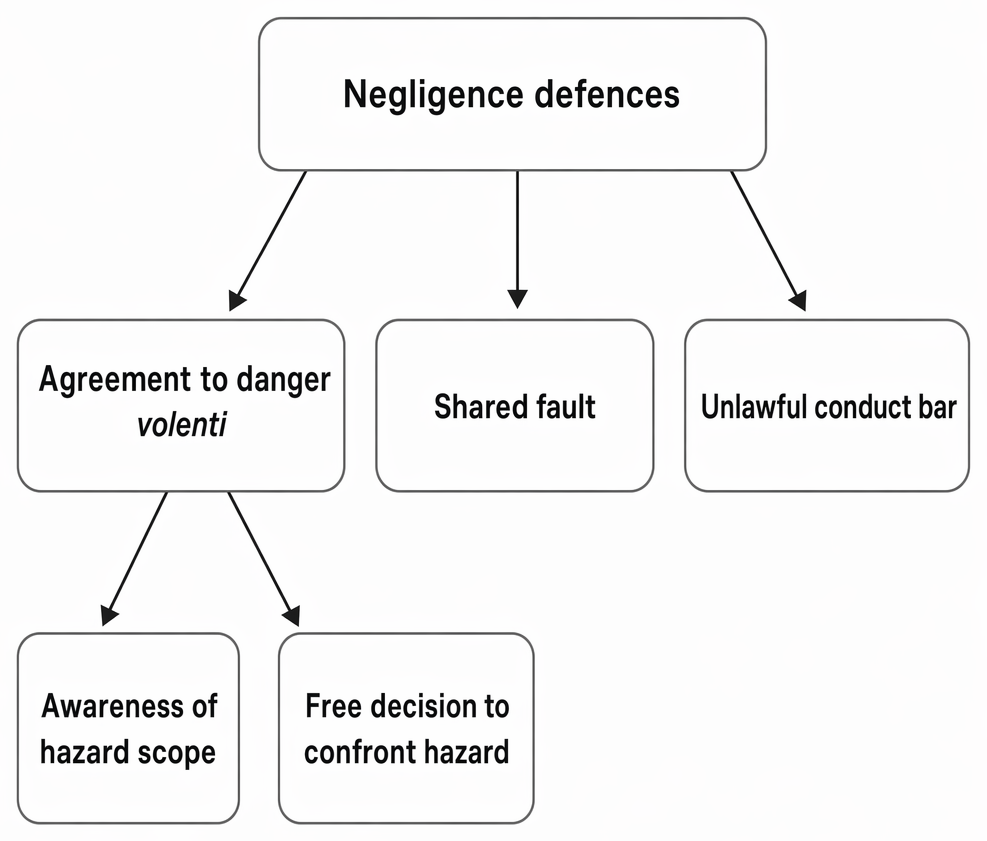
Negligence defences are set out, with volenti non fit injuria divided into knowledge of the risk and free acceptance.
The reasons for the rarity of this defence’s success are threefold. First, both elements—knowledge of the risk and voluntary acceptance—are construed strictly by courts, requiring actual, subjective awareness and free acceptance of the real risk, not just a general sense of danger. Second, courts are generally reluctant to deny a claimant all compensation and will look to apportion blame through contributory negligence wherever possible. Third, public policy and statutory intervention (such as road safety legislation) curtail the defence in certain high-risk contexts.
Key Term: consent (volenti non fit injuria)
A defence to negligence where the claimant, with full understanding and free will, accepts the risk of harm (including the risk arising from the defendant’s negligence), so the defendant will not be liable for injuries or loss resulting from that risk.
Requirements for the Defence of Consent
To successfully rely on consent, the defendant bears the burden of proving both:
- The claimant had full knowledge of the precise nature and extent of the risk;
- The claimant voluntarily accepted the risk, including (in negligence) the risk arising from the defendant’s negligence.
Failure to prove either element will defeat the defence. Both requirements are interpreted narrowly and courts scrutinise the facts rigorously, mindful that mere knowledge is not tantamount to consent, and that consent must be shown to be both genuine and freely given.
Key Term: knowledge of the risk
The claimant must have actual subjective awareness of the specific risk which materialises, not just general awareness of danger or a theoretical risk. The assessment is person-specific—what this claimant understood—not what a reasonable person might have known. Key Term: voluntary acceptance
The claimant must have made a genuine, free, and informed choice to accept both the risk itself and any consequent injury caused by the defendant’s negligence, absent duress, compulsion, or lack of capacity. The choice must reflect a real freedom to refuse.
Knowledge of the Risk
The first element—knowledge—requires that the claimant was fully aware, at the relevant time, of the nature and extent of the risk which subsequently caused the injury. This test is subjective and it is not enough for the claimant to be merely aware that danger exists in general. The claimant must have a clear understanding of the specific risk that eventuates.
Consider, for example, sporting context: a footballer knows that collisions are a routine part of the game, but may not know that a particular tackle will be made with reckless disregard for safety. Only the former is assumed consented to; the latter is not.
This distinction can also be seen in social and recreational contexts. For instance, a person who joins a friend for a ride knowing the driver has had one drink is generally not assumed to have accepted the heightened risk of negligent driving, whereas riding in an obviously incapacitated state (as in a pilot so drunk as to pose a glaring danger) may tip the balance. The threshold for knowledge is high; courts look for clear, compelling evidence that the claimant actually appreciated the specific risk.
The case law demonstrates this strictness. In Dann v Hamilton [1939] 1 KB 509, a passenger who knew the driver had been drinking did not, simply by that knowledge, consent to the risk of the driver’s negligent driving; the court held that agreement to the risks of injury may be express or implied from conduct, but mere knowledge of impairment falls short of consent. In contrast, in Morris v Murray [1991] 2 QB 6, the claimant participated in a manifestly hazardous “drunken escapade” involving a light aircraft, and the Court of Appeal found that he must have had full knowledge of the nature and extent of the risks involved in flying with an obviously incapacitated pilot; his claim failed because his conduct demonstrated voluntary acceptance of those extreme risks. The difference lies in the precision and gravity of the known risk: mere awareness of some danger is insufficient; acceptance requires knowledge of the specific risk that materialises and its extent.
Knowledge must also be of the particular risk posed by negligent conduct, not merely the ordinary risks of the activity. A climber appreciates the risk of a fall if she misplaces a foothold; that does not mean she has knowledge of the different risk of institutional negligence—say, a poorly maintained anchor point hidden from her view. Similarly, a patient agreeing to a routine operation knows surgery carries ordinary risks. For volenti in negligence, the provider must show the patient knew of the specific material risk that occurred and that the omission to warn did not deprive the claimant of that knowledge.
Assessing knowledge is highly fact-sensitive. Courts examine the claimant’s experience, past exposure to the activity, any warnings given (and whether they were understood), and environmental factors that made the risk obvious. However, “obviousness” is never a substitute for actual appreciation: it is circumstantial evidence that may support an inference of knowledge, not a conclusive rule.
Important considerations include:
- Intoxication: Being drunk does not automatically negate knowledge, but extreme intoxication may undermine the inference that the claimant truly appreciated the risk. Conversely, a claimant may be sober enough to know the risk despite alcohol consumption.
- Language and literacy: A warning given in a language the claimant cannot understand rarely supports knowledge unless there is proof the content was otherwise explained.
- Cognitive limitations: Youth or mental impairment may prevent full appreciation of the risk, making the knowledge element hard to establish.
Key Principle: Sciens is not volens (“knowledge is not consent”). The courts are alert to this and will reject the defence where the evidence only demonstrates knowledge and not acceptance.
Voluntary Acceptance
The second element is the claimant’s voluntary acceptance—the claimant must freely and deliberately elect to encounter the risk, accepting both the likelihood and consequences of injury as a result of the defendant’s negligence. Voluntariness requires an absence of duress, compulsion, inequality of bargaining power, or any factor that undermines genuine choice. Acceptance must extend to the risk of negligent conduct, not just the ordinary risks of an activity.
Considerations of voluntariness are especially important in certain relationships, such as:
- Employees: Continuing in dangerous employment does not amount to acceptance, since economic necessity and power imbalance mean the claimant lacks a true choice.
- Rescuers: Societal and moral compulsion to act in emergency situations usually defeats claims that the rescuer consented to risk.
- Capacity: Children and those lacking mental competence cannot provide legally effective consent.
Acceptance may be express (through direct agreement or written waiver), or implied from conduct. However, even where an activity is undertaken voluntarily, consent to the ordinary risks does not extend to unusual or negligent acts outside the normal scope of the activity.
Courts require unequivocal evidence of both elements, and, faced with ambiguity, are more likely to reduce damages for contributory negligence than find for the defendant on volenti.
Practical indicators of voluntary acceptance
Courts will probe for persuasive indicators that the claimant willingly accepted the legal risk of negligence, including:
- Express agreement or clear words acknowledging the risk of negligent acts by the defendant;
- Active participation in creating or escalating the risk (for example, helping prepare a hazardous activity undertaken while the defendant is incapacitated);
- Prior exposure to, and awareness of, the specific risk, coupled with a deliberate decision to proceed despite realistic alternative options to avoid the risk;
- Conduct consistent with acceptance of the legal consequences (e.g., waiving claims in terms compliant with statutory controls), though waivers never substitute for true consent and cannot override controls under the Unfair Contract Terms Act 1977 or the Consumer Rights Act 2015.
In the absence of such indicators, courts tend to conclude that, while the claimant may have been careless, they did not legally accept the risk of injury caused by the defendant’s negligence.
Consent Is Interpreted Strictly
Courts accord the volenti defence a narrow scope and demand substantial evidence of both subjective knowledge and real voluntariness. The burden of proof on the defendant is almost always hard to discharge. Volenti is almost never available in employment, professional rescue, or road traffic cases (subject to statutory exceptions), and is reserved for situations where it would be manifestly unfair to hold the defendant liable because the claimant knowingly and willingly elected to encounter a risk—typically in sports, social adventures, or very clear cases of informed assumption of risk.
The judicial policy is clear: where fairness can be achieved by apportioning responsibility through contributory negligence, courts prefer that route. Volenti, ending recovery entirely, is used sparingly. That preference explains why even robust fact patterns—like knowingly travelling with a driver who has been drinking—often result in a damages reduction rather than a complete bar.
Worked Example 1.1
Question: A passenger accepts a lift from a friend who has been drinking. The passenger knows the driver is over the legal limit. The car crashes and the passenger is injured. Can the driver rely on consent as a defence?
Answer:
No. The passenger’s knowledge that the driver is over the limit is insufficient; there must also be clear evidence that the passenger accepted the risk of negligent driving, and statute (Road Traffic Act 1988, s 149) absolutely bars reliance on consent as a defence by drivers to claims by passengers. While the passenger’s damages may be reduced for contributory negligence (e.g., knowingly travelling with an intoxicated driver), consent will not defeat the claim in full.
Worked Example 1.2
A spectator at a football match is injured by a ball kicked into the stands. Can the club rely on consent as a defence?
Answer:
Possibly. Spectators are generally taken to consent to the ordinary risks of the sport (such as being hit by a ball during the match). However, consent will not extend to risks caused by dangerous conditions, negligent crowd management, or conduct outside what is normal in the sport. If the injury was caused by negligent stadium management or extraordinary hazardous conduct, the defence is unlikely to succeed.
Worked Example 1.3
Question: During an amateur rugby match, a player suffers a broken jaw from a reckless high tackle well outside the rules of the game. Can the defendant rely on consent?
Answer:
Unlikely. While players consent to the ordinary risks of the sport (such as legal tackles and accidental collisions), consent does not extend to acts outside the accepted norms—for instance, reckless or intentionally dangerous conduct that constitutes a breach of the duty of care or is prohibited by the rules of the game.
Worked Example 1.4
Question: A visitor sees a sign at a venue stating “ALL VISITORS ENTER AT THEIR OWN RISK” and later slips on an unmarked wet floor. Does the sign establish consent?
Answer:
Generally no. The common law defence of consent requires actual knowledge and acceptance of the specific risk that materialises. Vague wording such as “enter at your own risk” does not inform visitors of the precise danger and will not, without more, establish either knowledge or true acceptance of the negligent risk.
Worked Example 1.5
Question: A police constable is injured while stopping runaway horses negligently allowed to bolt in a crowded street. Has the constable consented to the risk?
Answer:
No. Rescuers, including professional rescuers such as police, act under a compelling legal, moral, or social duty. The common law recognises that such compulsion negates voluntariness; the defence of consent will not apply where rescue is a natural and foreseeable response to the defendant’s negligence.
Worked Example 1.6
Question: An employee continues to use a machine at work, despite knowing it is not guarded appropriately and that this has been raised with the employer. The employee loses a finger in an accident. Can the employer rely on consent?
Answer:
No. Employees are not treated as having genuinely consented to risks at work, because their economic dependency undermines true voluntariness. The employer owes a continuing duty of care, and awareness of the risk does not defeat liability.
Worked Example 1.7
Question: A rock climber signs a waiver before starting a supervised climb at a leisure centre. During the activity, she is injured due to a frayed harness that should have been replaced by the centre months before. Can the centre rely on consent?
Answer:
Unlikely. Although the climber may have accepted the ordinary risks associated with climbing, that does not extend to negligent conduct well outside the accepted standards, such as failure to maintain safety equipment.
Worked Example 1.8
Question: A friend and the claimant drink heavily. The friend proposes a late-night flight in his light aircraft. The claimant helps ready the plane and joins the flight. It crashes. Does volenti bar the claim?
Answer:
Likely yes. In extreme, glaringly dangerous scenarios—such as flying a light aircraft with an obviously incapacitated pilot—the claimant’s active participation and subjective appreciation of the grave risk can amount to voluntary assumption of the risk of negligence, defeating the claim entirely.
Worked Example 1.9
Question: A patient signs a hospital consent form for routine surgery. The surgeon fails to warn of a material risk of nerve damage that would influence a reasonable patient’s decision. The risk materialises. Can the hospital rely on consent to defeat negligence?
Answer:
No. Consent in trespass may avoid battery, but for volenti in negligence the patient must be informed of material risks to support a genuine, informed choice. Failure to disclose material risks undermines volenti. Liability will turn on breach of the duty to inform and causation.
Contexts Where Consent Defence Is Applied
Employment Situations
Consent almost never succeeds in employment contexts due to the imbalance between employer and employee, and the economic pressures forcing employees to accept dangerous work. In Smith v Charles Baker & Sons, it was confirmed that continuing risky employment does not amount to acceptance of risk sufficient to defeat an employer's duty of care. The courts recognise the social and economic necessity that compels workers to remain in jobs despite hazards, making genuine and voluntary acceptance of risk improbable.
Employers have a non-delegable obligation to maintain safe working systems, adequate training, and appropriate equipment. The mere fact that employees are aware of a risk is insufficient to establish consent; instead, unsafe conduct on the part of employees may support a finding of contributory negligence, reducing (but not eliminating) damages where appropriate. However, consent is not a viable complete defence.
- Employees cannot waive statutory safety protections and are generally protected as a matter of policy, given the need to safeguard employee welfare and prevent exploitation.
Adding further context: the courts sometimes account for workplace realities—noise, concentration demands, repetitive tasks—when assessing a worker’s self-care. That judicial realism makes findings of contributory negligence less likely for industrial workers than for employees in less pressured environments. Reckless disregard of clear safety rules can still attract a deduction, but even then, volenti is rarely entertained.
Consider also the complexity of multi-employer sites and contractor arrangements. Even if an individual worker says, “I know the scaffolding is makeshift but we are on a tight deadline—I’ll proceed,” the law does not infer consent to injury arising from substandard planning or defective equipment. The worker’s statement may be relevant to contributory negligence (if it shows a failure to take reasonable care in the moment), but it does not equate to a voluntary assumption of the employer’s negligent risks. Courts emphasise the employer’s primary responsibility for system safety and supervision where hazards are foreseeable and controllable.
Where a worker genuinely volunteers for a hazardous activity outside the scope of employment (for example, off-duty participation in a non-work social event with obvious dangers organised independently by colleagues), volenti may be argued. Yet even here, the defendant must show that the volunteer truly knew and embraced the precise risk that eventuated, and that the risk was not created or exacerbated by an employer’s negligence in the work context.
Rescuers
The law treats rescuers with particular solicitude, viewing their interventions as compelled by moral, social, or legal duty. Both laypeople and professional rescuers are not seen as acting fully voluntarily when exposing themselves to danger caused by the defendant’s negligence. A rescuer who acts reasonably to save life or property in an emergency is not deemed to have consented to the risk; the defendant remains liable for reasonably foreseeable injury.
Courts will not penalise rescuers by denying them compensation where injury results from the defendant’s initial negligence. However, where the rescuer acts recklessly or takes risks grossly beyond what is reasonable in the circumstances, there may be a reduction in damages for contributory negligence, but volenti will only rarely defeat recovery altogether.
- This approach maintains the social utility of rescue and aligns with public policy, preventing defendants from profiting by encouraging passivity in the face of danger they have created.
A classic example is a police officer injured while stopping runaway horses in a busy street; the officer acted under compulsion and did not accept the negligent risk. Similarly, where a doctor descended a well to rescue trapped workers overcome by fumes, it was held that he had not consented to the risk; his actions, though courageous, were a natural and foreseeable response to the emergency created by the defendant’s negligence. The court treated his decision as reasonable in the circumstances, thereby eliminating volenti and any deduction for contributory negligence.
Key focus points when assessing rescue situations:
- Was the emergency created by the defendant’s negligence?
- Did the claimant act under legal, moral, or social compulsion (not mere bravado)?
- Was the response a natural and proportionate reaction to the danger?
- Did the claimant take reasonable precautions in the circumstances?
If the answer to these questions points to reasonableness, volenti fails. Only where the rescuer’s conduct amounts to taking wholly excessive risks may damages be reduced; even then, a complete bar is almost never justified.
Road Traffic Accidents
Consent as a defence is specifically excluded by statute in most passenger cases. Under section 149 of the Road Traffic Act 1988, a driver cannot avoid liability for injury to a passenger on the basis of the passenger's acceptance of risk, even if the passenger knew the driver was intoxicated, uninsured, or disqualified. The rationale is public protection and the prevention of contractual or implied waivers of liability in hazardous circumstances.
Nevertheless, where a passenger's conduct falls below reasonable standards of self-care (such as by failing to wear a seatbelt, knowingly journeying with an impaired driver, or ignoring manifest dangers), damages may be reduced for contributory negligence. Section 149 does not bar such reductions; it simply prevents use of consent to nullify all liability.
- This statutory policy reflects the focus on public road safety and protection of passengers as vulnerable users.
In practice, courts use established guidelines to calibrate reductions for failing to wear a seatbelt, reflecting whether the non-use prevented injuries or merely worsened them. A passenger who knew of the driver’s intoxication and encouraged risky driving may incur a substantial reduction, but s 149 ensures there is still some recovery. By contrast, a completely blameless passenger (e.g., a child properly restrained) will recover in full.
Two frequently tested nuances:
- Passenger status: s 149 applies to passengers in motor vehicles where compulsory insurance is required. It does not apply to non-road vehicles (e.g., aircraft, boats), so common law volenti may be argued in those contexts, subject to the usual strictness.
- Implied agreements: “I won’t sue” or “We go at our own risk” statements or notices have no effect in road cases due to s 149. They cannot extinguish liability. At most, they support contributory negligence where behaviour demonstrates a failure to take care of one’s own safety.
Sports and Voluntary Activities
Sports participants and spectators may be taken to consent to risks associated with the particular sport or activity. This implied consent extends only to risks normally associated with the activity, such as accidental injury occurring within the rules and usual conduct of the game.
- Participants: Consent covers the risk of lawful contact and the ordinary rigours of competition, but does not extend to conduct outside the rules (e.g., intentional fouling, reckless disregard for safety, or dangerous breaches of duty).
- Spectators: The law recognises that spectators accept the risk of error or accidental mishaps by competitors which are part of the event, but will not impute consent to negligent acts, unsafe premises, or improperly controlled events.
Waivers or disclaimers (often required for adventure activities or spectator events) may support an argument of consent, but do not substitute for clear, subjective knowledge and acceptance of the particular risk, nor can they absolve a defendant from negligent acts beyond the ordinary dangers expected.
- The boundaries of implied consent are flexible: courts analyse the context, the established custom, and what an ordinary participant or spectator could reasonably be taken to accept.
Illustrating the distinction: an amateur rugby player consents to lawful tackles and possible accidental injuries typical of fast contact sports. He does not consent to reckless or dangerous play barred by the rules or to negligent officiating that significantly increases risk. A photographer at a horse race may accept minor errors or lapses of skill from riders during race conditions, but not reckless disregard for spectator safety or negligent course setup.
In motor sports, spectators typically consent to risks arising from vehicles losing control within the anticipated course, provided appropriate barriers and supervision are in place. If the event organiser fails to implement standard safety measures (e.g., correct barrier placement), and a vehicle enters a spectator zone, consent is unlikely to shield the organiser: the harm arises from negligence rather than the ordinary risks of the sport. Participants in such events similarly accept the sport’s ordinary risks but not the organiser’s failure to follow safety protocols or maintain equipment.
For adventure activities, the language of waivers is scrutinised. General clauses (“you participate at your own risk”) are weak support for volenti unless coupled with clear briefings identifying the precise risks. Even then, the defence will not cover latent defects or failures to meet basic safety standards. Furthermore, consumer protection legislation restricts the effectiveness of waivers in business-to-consumer contexts, especially for personal injury.
Medical Treatment
Consent operates as a defence to claims in trespass to the person (battery) and, in negligence, as a bar to claims arising from risks where patients were adequately informed. For medical procedures, a patient who gives valid and informed consent cannot later claim for harm arising from the ordinary risks of the procedure, provided those risks were properly explained, enabling genuine, informed choice.
If, however, the doctor fails to disclose material risks or provides insufficient information, consent will typically fail as a complete defence in negligence, and liability will hinge on whether there was a breach of the duty to inform and on causation. Modern law emphasises patient autonomy and material risk disclosure: a risk is material if a reasonable patient would likely attach significance to it, or the particular patient would likely attach significance to it given their circumstances. Failure to meet that standard undermines any volenti argument, because the patient cannot be said to have freely and knowingly accepted the risk.
- The difference between technical trespass and negligence is significant: consent to the treatment avoids battery; knowledge of risks and reasoned consent is needed for volenti to operate as a barrier to negligence claims concerning risks.
Practical considerations:
- Capacity: Adults are presumed to have capacity in the absence of evidence to the contrary. Where a patient lacks capacity, decisions must be made in their best interests; there is no volenti issue because the justification for treatment is necessity.
- Emergencies: In urgent situations, clinicians may act without consent to prevent serious harm. Volenti is not the operative principle; rather, the law recognises an exception based on necessity and best interests. The provider remains liable if the emergency was caused by negligence and if harm resulted from that negligence beyond what emergency treatment warranted.
- Alternatives: A failure to discuss reasonable alternatives may undermine the defence where the undeclared option would have led the patient to avoid the risk altogether.
Other Relationship Contexts
- Children and those lacking capacity: Consent is ineffective where the claimant cannot fully appreciate and accept the risk due to age, mental capacity, or effect of drugs/illness. Informed consent requires capacity to understand and weigh the material risks.
- Commercial activities and contractual waivers: Absence of genuine bargaining power or unfair terms (subject to the Unfair Contract Terms Act 1977 or the Consumer Rights Act 2015) may vitiate consent and render exclusion clauses or waiver ineffective as a defence.
Capacity and inequality frequently appear together. A waiver signed by a consumer at a leisure activity will be scrutinised and cannot exclude liability for death or personal injury caused by negligence. Even where a waiver is permissible for property damage or pure economic loss, reasonableness tests will apply, and courts will still require clear evidence that the claimant freely accepted the risk.
Express words of acceptance (“I accept the risk of your negligence”) are powerful but not decisive. If a party reasonably relied on the other to manage hidden risks (e.g., certification, maintenance), consent will not be stretched to cover concealed hazards that the claimant could not have appreciated. The defence targets genuine, informed assumption of risk; it does not function as a general escape route for substandard practice or unsafe systems.
Worked Example 1.10
Question: A novice diver attends a scuba course. The operator provides a standard waiver and a short briefing but fails to mention a known issue with a particular regulator model in use. The diver is injured when the regulator malfunctions at depth. Can the operator rely on consent?
Answer:
No. The diver consented to ordinary scuba risks but not to a concealed equipment defect known to the operator. The waiver does not cure the lack of disclosure. Without proof the diver knew and accepted the specific risk of that malfunction, volenti fails.
Worked Example 1.11
Question: A mountaineer with years of experience joins a guided ascent and is expressly warned that the route includes a notorious, unstable rock band. Despite the warning, the mountaineer proceeds and is injured by rockfall within that section. Can the guide rely on consent?
Answer:
Potentially yes. If the evidence shows the claimant actually understood the specific danger, had realistic alternatives (e.g., turning back), and freely chose to continue, the guide may establish both knowledge and acceptance of the precise risk that eventuated. Any negligence in choosing a safe route or in supervision would still defeat the defence.
Worked Example 1.12
Question: A spectator at a motorsport event sits in an area marked as “splash zone—risk of debris.” The organiser failed to install the usual debris fencing. A piece of bodywork injures the spectator. Does volenti apply?
Answer:
Unlikely. The spectator may have accepted the ordinary risk of minor debris, but not the heightened risk created by the organiser’s failure to follow standard safety measures. The harm flows from negligence rather than the ordinary risks of the sport.
Worked Example 1.13
Question: An experienced lab technician agrees to transfer an irritant chemical without mandatory gloves because the supervisor says “it’s only a quick job.” The technician suffers a skin burn. Can the employer rely on consent?
Answer:
No. The technician’s awareness that chemicals can irritate skin does not amount to acceptance of the employer’s negligent instruction to ignore safety protocols. The imbalance of power and the employer’s duty to enforce safe systems negate volenti. A deduction for contributory negligence may still be considered.
Worked Example 1.14
Question: A climber signs a detailed risk acknowledgment listing specific hazards, including “risk of belayer error leading to a leader fall.” The belayer, another participant, makes a minor misjudgment within the range anticipated by the briefing, causing a fall and injury. Can the centre rely on consent?
Answer:
Possibly. If the event fell within the range of ordinary, briefed risks and the centre’s supervision and equipment were otherwise reasonable, the claimant may be taken to have accepted that risk. If, however, the error arose from inadequate training or defective equipment, volenti would not apply.
Worked Example 1.15
Question: A festival patron walks past a sign stating “Enter at your own risk—uneven ground.” He later trips on an unmarked, unbarricaded excavation trench dug that morning. Can the organiser rely on consent?
Answer:
No. The sign is too general. It does not supply knowledge of the precise risk from a fresh trench, nor does it show the patron accepted the legal risk of negligence in failing to barricade it.
Consent vs Contributory Negligence
Consent (volenti) is absolute—a complete defence that, if established, eliminates the defendant’s liability. In contrast, contributory negligence is partial: where the claimant’s own carelessness has contributed to the loss, the court apportions responsibility and reduces damages proportionally.
Key Term: contributory negligence
A partial defence—where the claimant negligently contributed to their own injury or loss, the court reduces damages in line with the degree of fault, but does not eliminate recovery altogether.
In practice, courts prefer the flexibility of contributory negligence. In borderline cases, where the claimant displayed knowledge of the risk and engaged in some unsafe conduct, but did not clearly accept legal responsibility for injury, courts prefer to reduce, rather than extinguish, damages. This approach maximises fairness, avoids unduly penalising inadvertent or pressured claimants, and more accurately reflects shared fault.
For instance:
- A passenger failing to wear a seatbelt, or knowingly travelling with a tired or mildly impaired driver, may see damages reduced, but not denied entirely.
- An employee failing to follow safety training may face a deduction in damages for contributory negligence, but will not be barred from recovery except in the most exceptional circumstances.
For consent to bar recovery entirely, both elements—actual knowledge and free acceptance—must be shown clearly and unambiguously. In their absence, the court will likely apportion liability.
Comparison Table: Consent vs Contributory Negligence
| Feature | Consent (Volenti) | Contributory Negligence |
|---|---|---|
| Effect | Complete defence (no damages) | Partial defence (damages reduced) |
| Requirements | Specific knowledge + voluntary acceptance | Carelessness by claimant |
| Application | Rare; requires clear evidence claimant accepted risk | Common; claimant partly at fault |
| Justification | Assumption of risk removes legal basis for complaint | Fair apportionment of responsibility |
Revision Tip: When both volenti and contributory negligence are pleaded, test them in order. Ask first: did the claimant truly know the specific risk and freely accept the risk of the defendant’s negligence? If not, move to contributory negligence and calibrate a sensible reduction. In road cases with passengers, remember s 149 of the Road Traffic Act 1988: volenti is barred; only contributory negligence is available.
Exam Warning: Do not conflate “risk-taking” with “consent.” Many activities involve risk-taking (e.g., riding as a passenger with a driver who has been drinking). Unless the defendant proves the claimant accepted the legal risk of the defendant’s negligence, the correct analysis is usually contributory negligence, not volenti. In road traffic passenger cases, s 149 of the Road Traffic Act 1988 renders volenti unavailable.
Statutory and Doctrinal Limits on Consent
Statutory Exclusions
- Road Traffic Act 1988, s 149: Statutorily bars volenti from defeating claims by vehicle passengers against drivers. Acceptance of risk is ineffective as a defence; only contributory negligence may apply.
- Unfair Contract Terms Act 1977 and Consumer Rights Act 2015: Statutory controls on contractual and business waivers; terms excluding or restricting liability for personal injury or death due to negligence are void, and any exclusion or limitation for other losses must satisfy statutory tests (such as reasonableness under UCTA or fairness/transparency under CRA).
These controls reflect policy: vulnerable parties should not be deprived of basic protections by contractual devices; and public safety demands accountability for negligent harm.
Doctrinal Preservation
Under the Occupiers’ Liability Act 1957, volenti remains available only for risks the visitor has genuinely and willingly accepted. Section 2(5) preserves the defence where a visitor willingly accepts risks, but the threshold is high. Generic warning signs (“Enter at your own risk”) will not suffice unless the claimant had concrete knowledge and accepted the precise risk involved. The authorities require specificity as to the risk and evidential clarity regarding the visitor’s acceptance.
Occupiers may still reduce their exposure to liability by providing sufficient warnings (where the warning enables the visitor to be reasonably safe), but exclusion of responsibility for negligence is subject to statutory regulation, particularly in business or consumer settings under UCTA and CRA. Distinguish warning notices (which, if adequate, help the occupier satisfy the common duty of care) from exclusion notices (which attempt to remove liability after breach is established). The former is part of duty analysis; the latter is a potential defence subject to statutory constraints.
For non-visitors (trespassers), the Occupiers’ Liability Act 1984 similarly preserves volenti in principle: there is no duty to protect against risks willingly accepted by the trespasser. However, as with the 1957 Act, voluntariness and knowledge are tested strictly. A trespasser who stumbles upon an unexpected hazard has not consented; a trespasser who knowingly engages with a clearly marked danger after suitable warnings may be found to have accepted the risk, depending on the facts and the trespasser’s capacity.
Revision Tip
When analysing occupiers’ liability, keep separate boxes in your mind:
- Adequate warning = assists the occupier to discharge the duty of care (no breach).
- Consent (s 2(5) or s 1(6)) = complete defence where the visitor/trespasser knew and willingly accepted the specific risk.
- Exclusion = post-breach defence, tightly controlled by UCTA/CRA.
Application to Typical Fact Patterns
Passengers and Intoxicated Drivers
- Statute rules out consent as a defence.
- Contributory negligence remains possible, with courts applying apportionment principles.
Typical reductions come from factors like failure to wear a seatbelt, knowingly accepting a lift from a visibly impaired driver, or contributing to distraction. Nevertheless, total defeat of the claim is prohibited by statute; volenti cannot be relied upon by drivers to avoid passenger claims.
A careful application:
- If the passenger is themselves intoxicated, the analysis does not change for volenti (s 149 still applies), but intoxication may affect contributory negligence if it impaired the passenger’s judgment (e.g., choosing to ride with a plainly unsafe driver).
- If the passenger is a child or otherwise lacks capacity, s 149 still precludes volenti, and contributory negligence will be assessed in light of the child’s age and understanding.
Spectators/Participants in Sport
- Consent will cover ordinary risks associated with the sport, both for participants and spectators.
- Will not cover risks arising from dangerous facilities, negligent crowd control, or actions outside the ordinary conduct/rules of the sport.
In practical application, consider the sport’s ordinary risks and the event’s safety management. For instance, a cricket spectator struck by a ball during play likely faces volenti; a spectator injured by unsafe seating or negligent crowd control does not. A participant fouled in a manner contrary to the rules will not be taken to have consented to that injury.
Event organisers should ensure readily understandable pre-event briefings that specify key hazards. If briefings are generic or ambiguous, it is difficult to show that spectators or participants subjectively knew the specific risk that materialised. Conversely, if a participant is experienced and has encountered the particular risk many times (e.g., off-piste skiing with avalanche control briefings), the court may find the knowledge element more readily satisfied.
Medical Treatment – Typical Fact Patterns
- Valid, informed consent bars battery claims.
- For negligence, the defendant must show that the patient was apprised of all material risks; absence of proper disclosure brings liability back within the scope of breach of duty.
Typical pitfalls for defendants include failing to disclose material risks, not discussing reasonable alternatives, and proceeding without ensuring the patient’s understanding and capacity. Where disclosure duties are met and the risk is typical and accepted, volenti can succeed; otherwise, it fails.
Causation is key: even if there was a failure to inform, the defendant may still argue that the patient would have proceeded with the treatment had they been properly advised. If that is made out, the failure to warn does not defeat volenti because the patient would have accepted the risk anyway. However, this is a factual question, and the evidential burden rests with the defendant seeking to rely on consent.
Warning Signs and Notices
- Only effective if the wording is clear, specific, and the claimant has both knowledge and practical acceptance of the risk.
“Enter at your own risk” is too vague. A sign stating “Danger: uneven floor during lobby refurbishment—use marked safe routes” may, with proper layout and visibility, help the occupier discharge the duty to make visitors reasonably safe. Attempts to exclude liability for personal injury in consumer contexts will be void.
Key practicalities:
- Prominence and placement matter. Notices hidden behind doorways or placed at exits cannot establish knowledge before exposure to risk.
- The language must be tailored to the likely visitor base. Technical jargon undermines comprehension for lay visitors; simple language aids understanding.
- Multilingual or pictogram warnings may be necessary in settings serving international visitors.
Work Activities
- Only in rare, clear cases (such as genuine volunteers engaging in risk for reasons unconnected to employment, with full appreciation and free choice) would consent succeed. In most cases, courts will treat employee risk-taking or inattention as contributory negligence.
Assess work-specific pressures, training, safety culture, and equipment maintenance. Where the employer’s structural failures contribute to injury, the defence of volenti is not appropriate; liability remains, with contributory negligence applied only where the employee’s conduct fell below reasonable self-care.
Where independent contractors are involved, an employer or principal cannot usually rely on volenti simply because the contractor is experienced. The same strict tests apply. Unless the contractor actually knew of, and willingly accepted, the precise negligent risk (e.g., a known structural instability in a platform which he deliberately chose to use), the defence fails. Competence does not displace the principal’s duty to coordinate and manage intertwined safety hazards.
Rescue Scenarios
- Volenti does not operate where there is legal, social, or moral compulsion.
- Exceptional, highly reckless rescue attempts beyond what is natural or proportionate might attract a deduction for contributory negligence, never full exclusion by volenti.
The test is the “reasonable rescuer.” If the claimant’s conduct in the emergency was a natural and probable response to the defendant’s negligence, volenti fails. Courts are reluctant to discourage rescue by removing protection.
An important point arises where the rescuer is an employee of the negligent defendant (e.g., a factory worker responding to a fire caused by the employer’s negligence). The combination of employment policy and the rescue principle makes volenti doubly unattractive; the employer’s reliance will almost certainly fail, with any deductions confined to contributory negligence if the rescuer acted beyond what the circumstances reasonably demanded.
Worked Example 1.16
Question: A kayaker rents equipment from a riverside centre. The centre’s waiver states “You assume all risks, including our negligence.” The centre fails to check river conditions, which are unusually hazardous due to recent dam releases. The kayaker capsizes and is injured. Can the centre rely on consent?
Answer:
No. A business cannot exclude liability for death/personal injury caused by negligence. Even aside from statutory invalidity, there is no proof the kayaker knew and accepted the specific risk created by the centre’s failure to assess river conditions. Volenti fails; contributory negligence may be argued depending on the kayaker’s own conduct.
Worked Example 1.17
Question: A teenager trespasses onto a construction site, climbs a scaffold with a sign “Danger—Keep Off,” and falls. Can the site owner rely on consent?
Answer:
Possibly, but only if the teenager had capacity to appreciate the specific risk and the warning was adequate in the circumstances. Courts examine age, understanding, and whether the danger was obvious. With a young trespasser, volenti will rarely succeed; other defences or duty limitations under the 1984 Act will be more relevant.
Worked Example 1.18
Question: Two friends agree to race their bikes down a steep hill at night without lights. One crashes due to the other swerving unpredictably. Can the defendant rely on consent?
Answer:
Potentially, but only in clear cases. The claimant may have accepted the risk involved in night racing, but not necessarily negligent swerving beyond the agreed “rules.” Courts are cautious: if both created the dangerous situation together with knowledge of the obvious risk, volenti may apply. Otherwise, contributory negligence and shared liability are more likely.
Worked Example 1.19
Question: A volunteer ropes technician assists in a community event rigging. The organiser explains the exact hazards, offers alternative tasks, and the volunteer chooses to proceed. A known, briefed hazard materialises and causes injury, despite reasonable precautions. Does volenti apply?
Answer:
Likely yes. With informed, voluntary assumption of a specific hazard that materialised, and no negligence in management, consent may bar recovery.
Worked Example 1.20
A professional boxer is injured due to the opponent’s head-butt in breach of the rules. Can the opponent rely on consent?
Answer:
No. The claimant consents to lawful strikes under the rules of the sport; consent does not extend to fouls outside those rules. Liability turns on whether the conduct fell outside accepted norms.
Practical Guidance for SQE1 Application
When faced with a problem involving potential consent:
- Identify the precise risk that materialised and whether the claimant subjectively knew of that risk.
- Ask whether the claimant truly had a free choice to accept that risk, considering compulsion, inequality, and capacity.
- In borderline cases, consider contributory negligence rather than volenti.
- Apply statutory bars: Road Traffic Act 1988, s 149, and UCTA/CRA.
- Distinguish ordinary, typical risks from negligent risks beyond the norm.
- Treat rescue scenarios with caution: compulsion normally negates voluntariness.
In drafting advice or answering multiple-choice questions:
- Look for express words evidencing acceptance of negligent risk. Even then, check statutory controls.
- Weigh context-specific policies: workplace protection, road safety, and support for rescue and sport.
- Avoid equating warnings with consent. Warnings assist occupiers to discharge their duty; they do not, without more, prove volenti.
Summary
Consent in negligence is a demanding, rarely successful defence. It requires the defendant to prove the claimant’s subjective knowledge of the specific risk and a genuine, voluntary acceptance of that risk, including the risk of negligent conduct. Courts apply the defence strictly, preferring the more flexible partial defence of contributory negligence to apportion responsibility. Public policy and statutes (notably the Road Traffic Act 1988) further restrict volenti, especially in road traffic and consumer contexts. The defence finds its strongest footing in clear cases of voluntary hazardous activity where the claimant unmistakably embraced the risk—such as extreme sports or manifestly dangerous escapades—and is least likely to apply in employment and rescue scenarios. Under occupiers’ liability, volenti remains only for risks specifically and willingly accepted; vague notices are ineffective. In medical cases, informed consent prevents battery, but negligence claims depend on proper risk disclosure and genuine, informed choice.
Key Point Checklist
This article has covered the following key knowledge points:
- Consent (volenti non fit injuria) is a complete defence to negligence, operating as a total bar to recovery, but is rarely successful except in cases of clear, informed, and voluntary assumption of risk.
- The defendant must prove, on balance, that the claimant had actual subjective knowledge of the specific risk and voluntarily accepted it; mere knowledge is never enough.
- Courts strictly interpret both elements—subjectivity of knowledge and genuineness of acceptance require evidence of true freedom, capacity, and understanding.
- Consent is generally unavailable in employment, rescue, and most road traffic claims due to public policy and, in certain contexts, statutory exclusion (notably Road Traffic Act 1988, s 149).
- In sports and voluntary hazardous activities, only ordinary, typical risks are covered; negligent departures from accepted practice or rules fall outside the defence.
- In medical treatment, valid informed consent negates battery; volenti requires proper disclosure for exclusion of negligence claims.
- Courts prefer to apply contributory negligence (partial reduction in damages to reflect the claimant's fault) to apportion blame, rather than bar claims entirely through consent.
- Statutory controls may exclude the defence or set criteria for valid exclusion clauses, especially in road traffic, medical, business, and consumer settings; generic warnings are rarely sufficient.
- Under occupiers’ liability, volenti survives but only shields defendants where the claimant genuinely accepted the specific risk, not on vague notice alone.
- Rescue scenarios are protected: legal, moral, or social compulsion negates voluntariness; only unreasonable, excessive risk-taking may lead to contributory negligence.
Key Terms and Concepts
- consent (volenti non fit injuria)
- knowledge of the risk
- voluntary acceptance
- contributory negligence