Learning Outcomes
This article outlines anti-avoidance in income tax, including:
- how to distinguish clearly between legitimate tax avoidance, abusive avoidance, and criminal tax evasion, with reference to SQE1-style fact patterns
- the statutory purpose, structure and scope of the General Anti-Abuse Rule (GAAR) across income tax and related taxes
- the operation of the double reasonableness test and how examiners expect you to apply it to problem questions
- typical hallmarks of abusive arrangements, such as circular steps, artificial losses and disproportionate tax outcomes, and how to spot them quickly
- the composition, function and practical influence of the GAAR Advisory Panel when HMRC challenges contentious arrangements
- HMRC’s power to make “just and reasonable” counteracting adjustments and the different ways these may neutralise a tax advantage
- procedural steps from HMRC enquiry through GAAR referral, counteraction notices, and taxpayers’ rights of challenge and appeal to the tribunals and courts
- the interaction between GAAR, specific anti-avoidance provisions and the purposive Ramsay approach, and how this hierarchy operates in exam scenarios
- practical considerations for advising clients on compliant tax planning that uses reliefs as intended while avoiding arrangements likely to be classed as abusive under GAAR
SQE1 Syllabus
For SQE1, you are required to understand anti-avoidance provisions in the context of income tax, with a focus on the following syllabus points:
- the distinction between tax avoidance and tax evasion and their legal consequences
- the statutory basis, scope, and application of the General Anti-Abuse Rule (GAAR)
- the meaning of "abusive" arrangements and the double reasonableness test
- how HMRC may counteract abusive arrangements and the process for challenging GAAR decisions
- the practical impact of anti-avoidance rules on tax planning and legal advice
- the relationship between GAAR and other tax legislation, including its priority over conflicting provisions
- the role of the GAAR Advisory Panel, its opinions, and their persuasive effect
- the modern purposive approach to interpreting tax legislation (Ramsay principles) and its interaction with GAAR
Test Your Knowledge
Attempt these questions before reading this article. If you find some difficult or cannot remember the answers, look more closely at that area during your revision.
- What is the difference between tax avoidance and tax evasion?
- What is the General Anti-Abuse Rule (GAAR) and what types of arrangements does it target?
- How does the double reasonableness test operate under GAAR?
- What steps can HMRC take if it considers a tax arrangement to be abusive under GAAR?
Introduction
Anti-avoidance provisions are a key part of the UK income tax system, designed to prevent taxpayers from exploiting the law to obtain tax advantages not intended by Parliament. The General Anti-Abuse Rule (GAAR) is the main statutory tool for tackling abusive tax arrangements. It applies across several taxes, including income tax and capital gains tax, and gives HMRC a mechanism to counteract abusive arrangements by making “just and reasonable” adjustments to remove tax advantages. GAAR sits alongside specific anti-avoidance provisions and a modern purposive approach to statutory interpretation in tax cases (often referred to as the Ramsay principles). For SQE1, you must be able to distinguish between lawful tax planning and arrangements that cross the line into abuse, understand how GAAR operates, and apply the relevant tests to practical scenarios. GAAR is targeted at abusive schemes rather than normal, sensible tax planning, and does not apply to VAT, which follows a separate anti-abuse doctrine.
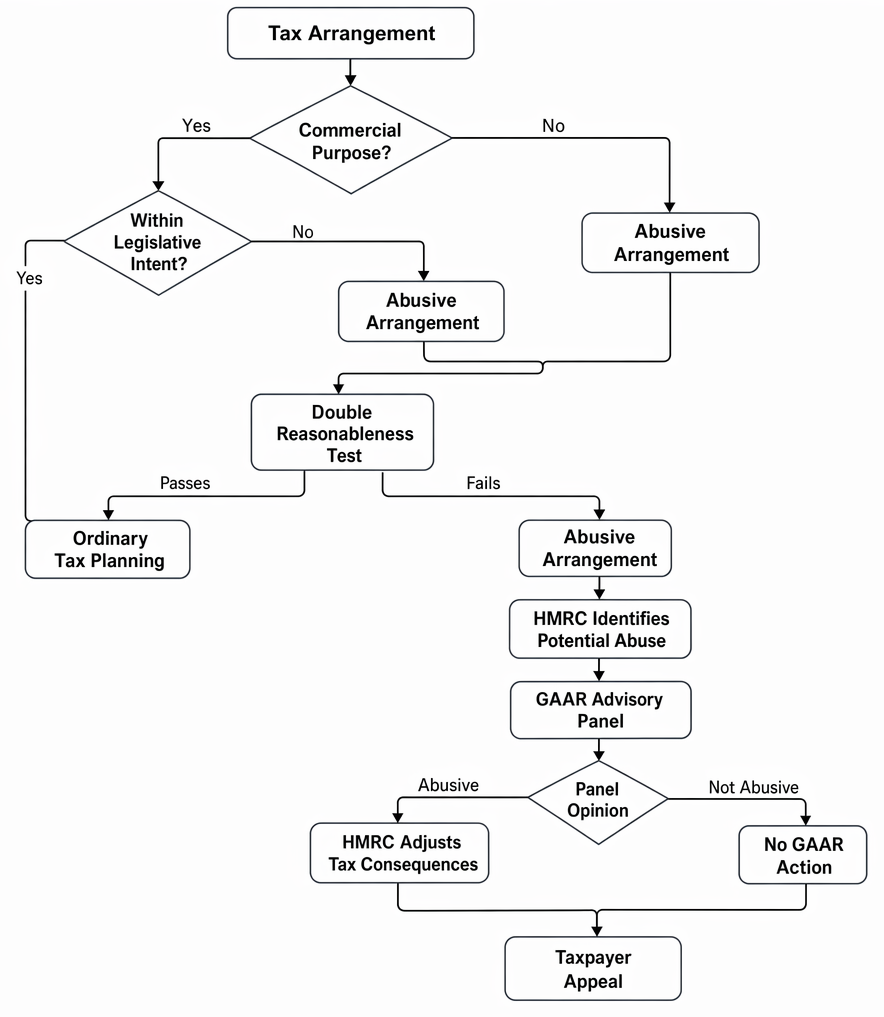
GAAR analysis of income tax arrangements proceeds from commercial purpose and legislative intent through Advisory Panel opinion, HMRC adjustment and appeal.
Key Term: tax advantage
Any reduction, avoidance or deferral of tax, an increase in a tax repayment or relief, or the creation/increase of a tax loss carried forward or set against income or gains.
Tax Avoidance vs Tax Evasion
It is essential to distinguish between tax avoidance and tax evasion. Tax avoidance involves arranging affairs to reduce tax liability within the law, such as claiming reliefs or allowances. Tax evasion is illegal and involves deliberately concealing income or providing false information to HMRC.
Key Term: tax avoidance
Arranging affairs to minimise tax liability using legal means, such as reliefs or allowances, but sometimes in ways not intended by Parliament. Key Term: tax evasion
Illegally reducing tax liability by concealing income, falsifying records, or failing to declare taxable income.
In practice, ordinary planning—such as making pension contributions, claiming personal allowances, utilising the spouse’s basic rate band by transferring assets, or investing in relief-based schemes as intended—constitutes lawful tax avoidance. Evasion, by contrast, includes deliberate underreporting, falsifying invoices, hiding cash receipts, or creating sham transactions to mask income. Evasion may attract civil penalties and criminal prosecution. Advisers who enable abusive schemes may also face sanctions where legislation provides for penalties on enablers of defeated tax avoidance. Being clear about motive and substance is central: arrangements that misuse legislation to secure outcomes Parliament did not intend risk being classed as abusive avoidance and challenged under GAAR.
The General Anti-Abuse Rule (GAAR)
The GAAR is a statutory rule introduced by the Finance Act 2013 to counteract abusive tax arrangements. It applies to income tax, capital gains tax, corporation tax, inheritance tax, and stamp duty land tax, and was subsequently extended to National Insurance contributions by the National Insurance Contributions Act 2014. Further refinements, including the penalty regime for enablers of defeated avoidance, were made by the Finance (No. 2) Act 2017. GAAR provides HMRC with a structured process and power to remove tax advantages arising from arrangements that fall within its scope.
The headline provisions are worth noting for SQE1 purposes. Section 207 of the Finance Act 2013 supplies the statutory definitions of "tax arrangement" and "abusive", and section 209 is the operative power by which HMRC makes counteracting adjustments. The burden of establishing that an arrangement is abusive sits with HMRC, not the taxpayer; this matters in exam scenarios where the facts are finely balanced and no clear hallmark of abuse is present.
Key Term: tax arrangement
An arrangement where, having regard to all the circumstances, it would be reasonable to conclude that obtaining a tax advantage was the main purpose, or one of the main purposes, of entering into it (Finance Act 2013, s 207). Key Term: General Anti-Abuse Rule (GAAR)
A statutory rule allowing HMRC to counteract tax advantages arising from arrangements considered "abusive" under the Finance Act 2013. Key Term: GAAR Advisory Panel
An independent panel that provides opinions to HMRC on whether arrangements are a reasonable course of action under the GAAR. Its views are persuasive though not binding. Key Term: counteracting adjustment
A “just and reasonable” tax adjustment by HMRC to negate a tax advantage arising from an abusive arrangement.
Scope and Purpose
GAAR is intended to prevent taxpayers from obtaining tax advantages through arrangements that, while technically within the law, are considered abusive because they defeat the purpose of tax legislation. It applies to avoidance that crosses the boundary of acceptable planning into contrived or artificial steps inconsistent with the purpose of the relevant provisions. GAAR deters promotion of abusive schemes by enabling HMRC to remove their benefits. There are no direct penalties under GAAR itself; however, if a taxpayer does not pay the adjusted amount, penalties under other legislation may apply. GAAR takes priority over other tax legislation to the extent necessary to counteract the abusive advantage. The practical effect is that, even if a taxpayer complies with the literal wording of a relief, GAAR may override the outcome where the overall arrangement cannot reasonably be regarded as a reasonable course of action in relation to that relief’s purpose.
What is an "Abusive" Arrangement?
An arrangement is "abusive" if it cannot reasonably be regarded as a reasonable course of action in relation to the relevant tax provisions, having regard to all the circumstances (Finance Act 2013, s 207(2)). The statute directs the decision-maker to consider, in particular, whether the effect of the arrangement is consistent with the policy objectives of the tax legislation; whether the means of achieving the result involves one or more contrived or abnormal steps; and whether the arrangement is intended to exploit shortcomings or loopholes in the tax legislation. If the arrangement accords with established practice and HMRC had publicly indicated its acceptance of that practice before the arrangement was entered into, that is an indicator that the arrangement is not abusive — a limited safe harbour that reinforces the importance of published HMRC guidance when planning is undertaken.
This assessment is objective, focuses on the policy of the legislation, and considers the arrangement’s commercial substance and main purpose. Indicators (hallmarks) of abuse often include:
- complex, contrived steps with no commercial rationale beyond tax
- circular transactions or inserted steps designed solely to generate losses or relief
- exploitation of legislative gaps to secure outcomes contrary to Parliament’s intent
- arrangements producing results that are anomalous compared to normal commercial practice
- a disproportionate tax outcome compared to any genuine economic risk or return
Key Term: abusive arrangement
A tax arrangement that cannot reasonably be regarded as a reasonable course of action, considering the purpose of the relevant tax law.
The test for abuse is known as the double reasonableness test.
Key Term: double reasonableness test
The test asks whether it would be reasonable to conclude that the arrangement is not a reasonable course of action in relation to the relevant tax provisions.
The Double Reasonableness Test
The double reasonableness test is central to GAAR. It requires HMRC (and, if challenged, the courts) to consider whether it would be reasonable to conclude that the arrangement is not a reasonable course of action, given the purpose of the tax law. It is not enough that the arrangement is aggressive; the question is whether, looking at all circumstances, it would be reasonable to say that the course of action itself is unreasonable when measured against legislative intent. Relevant factors commonly include:
- the economic and commercial substance of the transactions, viewed as a whole, not step-by-step
- whether the steps reflect genuine business activity or are predominantly tax-driven insertions
- consistency with the known policy aims of the tax provisions (as derived from statute and guidance)
- whether a typical, reasonable taxpayer would undertake the same steps absent the tax advantage
- whether the arrangement manufactures a tax loss or relief without corresponding economic loss or investment
The test does not condemn legitimate planning that uses reliefs as intended. Pension contribution relief, ISAs, and spousal transfers to utilise allowances are ordinary examples that would not ordinarily be abusive. The focus is on misuse or distortion of the relief or provision to produce unintended results.
How GAAR Operates
If HMRC believes a taxpayer has entered into an abusive arrangement, it may:
- Identify the arrangement and consider whether it is abusive under the double reasonableness test.
- Refer the case to the GAAR Advisory Panel for an independent opinion.
- If the arrangement is found to be abusive, HMRC may make "just and reasonable" adjustments to counteract the tax advantage.
- The taxpayer may appeal HMRC's decision to the tax tribunal and courts.
In practice, HMRC will issue a notice setting out its view of the arrangement, the tax advantage obtained, and the proposed counteracting adjustment. The taxpayer is permitted to make written representations before the matter is referred to the GAAR Advisory Panel, which reviews the arrangement and provides a reasoned opinion on whether entering into it can reasonably be regarded as a reasonable course of action. The Panel’s opinion is issued by way of a notice to both taxpayer and HMRC. While the Panel’s opinion is not binding, it is influential and often determines whether HMRC proceeds; if HMRC decides to press on having considered the opinion, it issues a final written notice specifying the adjustments required and the steps the taxpayer must take to give effect to them. If HMRC decides to counteract, it will adjust the tax position to neutralise the advantage—this may include disallowing a loss, treating a step as ineffective for tax, or recharacterising the arrangement consistent with the legislation’s purpose. Taxpayers can challenge the adjustments before the First-tier Tribunal and, if necessary, the Upper Tribunal and higher courts.
Penalties for Enablers of Defeated Avoidance
The Finance (No. 2) Act 2017 introduced a penalty regime targeting persons who, in the course of their business, enable abusive tax arrangements that are later defeated. "Enablers" can include designers, marketers, managers and facilitators of a scheme, whether individuals, companies or partnerships. A significant carve-out applies to individual employees: an employee acting in the course of their employer’s business is not personally an enabler, and any penalty exposure instead falls on the firm or company that employs them. The penalty is measured by reference to the financial or other benefit the enabler received in return for enabling the arrangement, and enablers have a right of appeal to the tax tribunal. This regime sits alongside, rather than replaces, the direct counteraction of the taxpayer’s position under section 209 and creates a separate compliance risk for professional advisers recommending aggressive structures.
Arrangements Caught by GAAR
GAAR applies to arrangements that are:
- contrived or artificial
- lack genuine commercial purpose beyond obtaining a tax advantage
- exploit loopholes or inconsistencies in tax law
It does not apply to straightforward use of reliefs or allowances as intended by Parliament. Examples commonly scrutinised include:
- circular share or loan transactions engineered to create artificial losses for income tax or capital gains tax
- schemes converting employment income into capital to seek lower rates or reliefs without true risk transfer
- inserted partnerships or trusts to access reliefs not meant for the taxpayer’s activity (e.g., routing income to generate losses)
- arrangements producing a repayment or relief out of proportion to any real investment or economic loss
Worked Example 1.1
A taxpayer enters into a series of circular transactions with no commercial purpose except to create an artificial loss, which is then used to reduce their income tax liability.
Answer:
HMRC may apply GAAR, as the arrangement is artificial and abusive. The loss would be disallowed, and the taxpayer's liability adjusted.
Worked Example 1.2
An individual claims a relief for pension contributions made in the normal course of saving for retirement.
Answer:
GAAR would not apply, as this is a reasonable use of relief as intended by Parliament.
Worked Example 1.3
A consultant incorporates and takes a modest salary with dividends, relying on the dividend regime. No artificial steps are inserted; income reflects genuine profits of a trading company.
Answer:
GAAR would not apply. Incorporation and use of dividends is normal planning where a genuine company carries on the trade. There is commercial substance and no contrived steps to obtain unintended reliefs.
Worked Example 1.4
An employee’s bonus is routed through a trust which grants gold-plated “loans” to the employee that are never intended to be repaid, aiming to avoid employment taxes.
Answer:
HMRC could challenge this under specific legislation on disguised remuneration and, if necessary, GAAR. The inserted steps lack commercial purpose and produce a tax outcome contrary to the intent of employment income rules. GAAR counteraction would remove the tax advantage.
Worked Example 1.5
An investor acquires qualifying shares for an approved relief, holds them for the statutory period, and exits with the relief claimed. The investment is genuine and bears real risk.
Answer:
GAAR would not apply. Relief is used as intended, with genuine investment and economic risk. This is reasonable planning aligned with Parliament’s purpose.
HMRC's Powers and the GAAR Advisory Panel
If HMRC decides to apply GAAR, it must refer the case to the independent GAAR Advisory Panel. The Panel issues an opinion on whether the arrangement is a reasonable course of action. While not binding, the Panel's opinion is highly persuasive and informs whether HMRC proceeds to counteraction. HMRC can then make counteracting adjustments “that are just and reasonable in all the circumstances” to remove the tax advantage. Adjustments may include disallowing losses, reversing steps, or recharacterising transactions to reflect their substance and the policy of the law.
Taxpayers have procedural protections. HMRC notifies the taxpayer of its intention to counteract, invites representations, and the taxpayer may respond with evidence of commercial purpose and legislative alignment. After HMRC issues a counteraction notice, the taxpayer may appeal to the First-tier Tribunal and through the appellate courts. There are no standalone GAAR penalties, but failure to pay the resulting adjusted tax can lead to interest and penalties under general rules. Additionally, where legislation applies, persons who enable defeated avoidance schemes in the course of their business may be liable to penalties. HMRC’s GAAR guidance and the Panel’s published opinions provide useful indications of the boundary between acceptable planning and abuse.
Where a taxpayer accepts HMRC’s GAAR finding and does not wish to contest it, the consequence is not a fine, a written warning, or an automatic tribunal referral. Instead, the taxpayer will be required to make just and reasonable adjustments to the amount of tax paid so as to neutralise the advantage. Recognising that the counteraction is a tax adjustment rather than a penalty is an important analytical point for SQE1 problem questions, because candidates often assume a GAAR finding must trigger fine-based sanctions.
Exam Warning: GAAR is not intended to catch ordinary tax planning or use of reliefs. It is aimed at arrangements that are clearly abusive, not merely aggressive.
Practical Implications for Legal Advice
Legal practitioners must ensure that tax planning advice does not cross the line into abuse. When advising clients:
- Consider the commercial purpose and economic substance of the arrangement. Transactions should have a real business rationale beyond tax savings.
- Assess whether the arrangement is reasonable in light of the purpose of the relevant tax law. Review statutory objectives and HMRC guidance to gauge legislative intent.
- Identify hallmarks of abuse, such as inserted circular steps, disproportionate tax outcomes, or unreal economic risk.
- Document commercial drivers and the decision-making process. Evidence of genuine purpose can be critical if HMRC reviews the arrangement.
- Warn clients of the risk of GAAR counteraction if arrangements are artificial or contrived. Explain the GAAR Advisory Panel process and potential for adjustments and appeals.
- Consider whether specific anti-avoidance rules already address the scenario. GAAR can take priority, but ordinary reliefs used as intended should remain outside its scope.
Revision Tip: When answering SQE1 questions, focus on whether the arrangement has genuine commercial substance and whether it aligns with the purpose of the tax provision.
Key Point Checklist
This article has covered the following key knowledge points:
- The distinction between tax avoidance (legal) and tax evasion (illegal).
- The statutory basis, scope, and purpose of the General Anti-Abuse Rule (GAAR).
- The meaning of "abusive" arrangements and the double reasonableness test.
- How HMRC applies GAAR and the role of the GAAR Advisory Panel.
- The importance of commercial substance and legislative intent in tax planning.
- GAAR’s priority over other tax legislation where counteraction is needed.
- The nature of counteracting adjustments—“just and reasonable” measures to remove the tax advantage.
Key Terms and Concepts
- tax avoidance
- tax evasion
- General Anti-Abuse Rule (GAAR)
- GAAR Advisory Panel
- tax arrangement
- abusive arrangement
- double reasonableness test
- tax advantage
- counteracting adjustment