Learning Outcomes
This article outlines the core knowledge and exam skills required to choose between litigation, mediation and arbitration in civil dispute resolution. It explains the defining characteristics of each mechanism, including procedure, confidentiality, cost, control over outcome, enforceability and potential for precedent. It compares their main advantages and disadvantages, highlighting when litigation is necessary for urgent remedies or wide court powers, when mediation is preferable to preserve relationships and achieve flexible settlements, and when arbitration is suitable for technical or cross‑border disputes requiring a private, binding and internationally enforceable award. It examines the CPR framework governing dispute resolution, focusing on the overriding objective, pre‑action protocols, the court’s powers to stay proceedings for ADR, and the costs consequences of unreasonable refusal to mediate. It sets out the basic structure of the Arbitration Act 1996, grounds for challenging or appealing an award, and how the New York Convention supports international enforcement. It develops exam technique for single best answer questions by training you to identify key facts, match them to the appropriate process, justify your choice, and recognise when courts will expect parties to attempt ADR.
SQE1 Syllabus
For SQE1, you are required to understand the characteristics and appropriate use of litigation, mediation, and arbitration in civil dispute resolution, with a focus on the following syllabus points:
- the distinguishing characteristics of litigation, mediation, and arbitration;
- the advantages and disadvantages of each mechanism;
- the circumstances in which each process is most suitable;
- the court’s approach to encouraging ADR and the possible costs consequences of unreasonable refusal.
- the role of pre-action protocols and the Practice Direction on Pre-Action Conduct and Protocols in steering parties towards ADR;
- case management powers (including stays for ADR) and the overriding objective;
- the basic structure of the Arbitration Act 1996 and the limited grounds to challenge awards.
Test Your Knowledge
Attempt these questions before reading this article. If you find some difficult or cannot remember the answers, look more closely at that area during your revision.
- Which dispute resolution process results in a binding decision made by a neutral third party chosen by the parties?
- What is a key feature of mediation compared to litigation?
- If a party unreasonably refuses to mediate, what costs consequence might the court impose even if they win at trial?
- In what situation is arbitration generally more appropriate than litigation or mediation?
Introduction
When advising clients involved in a civil dispute, you must be able to explain the main options for resolving the matter. The three principal mechanisms are litigation, mediation, and arbitration. Mediation and arbitration are often referred to as Alternative Dispute Resolution (ADR), as they are alternatives to the formal court process. Understanding the features, benefits, and drawbacks of each is essential for SQE1 and for effective client advice.
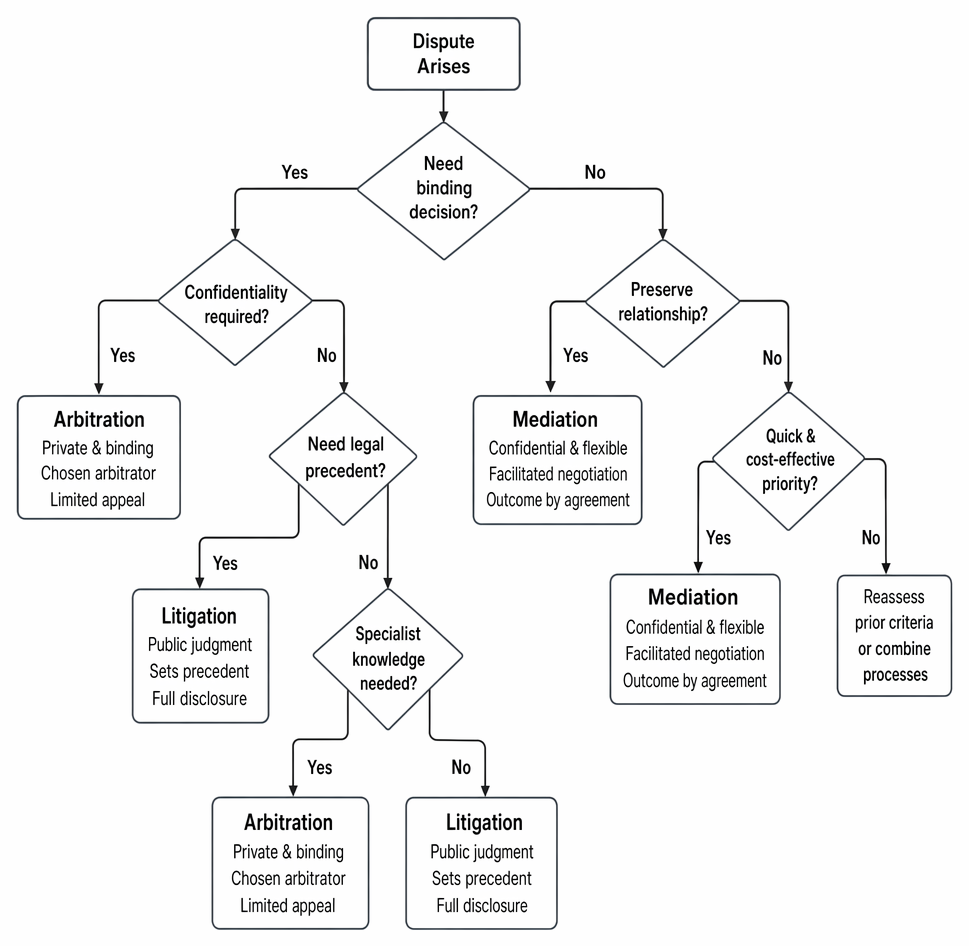
The diagram presents criteria for selecting arbitration, mediation, or litigation, including binding effect, confidentiality, precedent, expertise, relationship preservation, and cost.
ADR sits within a broader “dispute resolution continuum”. Parties start with negotiation, are expected to consider ADR, and use litigation as a last resort where adjudication or court powers are needed. The Civil Procedure Rules (CPR) and pre-action protocols are designed to achieve proportionate, timely resolution, actively promoting ADR before and during proceedings.
Many disputes settle through direct negotiation alone. Negotiation is usually the cheapest and least formal step on the continuum, and it can run alongside pre-action correspondence, mediation, arbitration, or even issued proceedings. Other ADR mechanisms also appear in practice. ENE gives the parties a non-binding merits assessment; expert determination or expert appraisal is often used for a narrow valuation or technical issue; conciliation resembles mediation but with a more interventionist neutral; and med-arb begins as mediation but can convert into a binding arbitral decision if settlement is not reached. These routes help explain why parties are expected to consider ADR broadly rather than treating mediation as the only alternative to court.
Key Term: Alternative Dispute Resolution (ADR)
Methods of resolving disputes outside the formal court process, including mediation and arbitration. Key Term: Overriding Objective
The CPR’s overarching aim to enable the court to deal with cases justly and at proportionate cost, including encouraging ADR where appropriate. Key Term: Early Neutral Evaluation (ENE)
A confidential, non-binding assessment of the dispute by an independent evaluator (often a judge or specialist), used to inform settlement discussions.Test Tip: In SQE-style questions on Characteristics of arbitration, mediation, and litigation as appropriate mechanisms, identify the legal test, the triggering fact, and the consequence before choosing between similar answer options.
Exam Warning: Do not rely on a familiar phrase from Characteristics of arbitration, mediation, and litigation as appropriate mechanisms alone; check whether the facts satisfy every condition, exception, and timing requirement.
Litigation
Litigation is the formal process of resolving disputes through the courts. It is governed by strict procedural rules and results in a binding judgment.
Key Term: Litigation
The process of resolving disputes through the civil courts, resulting in a binding and enforceable judgment.
Features
- Formal, structured, and public process.
- Governed by the Civil Procedure Rules (CPR).
- Adversarial: parties present opposing cases to a judge.
- Binding decision (judgment) enforceable by the state.
- Judgments may set legal precedent.
- Right of appeal (with permission).
- Costs are usually awarded to the successful party, but the court has discretion.
- Active case management: directions, timetables, sanctions, and encouragement of ADR.
Key Term: Civil Procedure Rules (CPR)
The procedural code governing civil litigation in the County Court, High Court, and Court of Appeal. Key Term: Judgment
The binding decision of a court at the conclusion of litigation. Key Term: Overriding Objective
The court’s duty to deal with cases justly and at proportionate cost, including encouraging ADR.
Advantages
- Provides a binding, enforceable outcome.
- Clarifies legal rights and may set precedent.
- Compels disclosure of evidence.
- Suitable for urgent remedies (e.g., injunctions).
- Court powers to join third parties, compel witnesses, and grant a wide range of remedies (damages, declarations, injunctions, specific performance).
Disadvantages
- Expensive and time-consuming.
- Public process—lack of confidentiality.
- Can damage relationships.
- Parties have little control over the process or outcome.
- Appeals can prolong finality, and the adversarial nature can entrench positions.
Key Term: Civil Procedure Rules (CPR)
The procedural code governing civil litigation in the County Court, High Court, and Court of Appeal. Key Term: Judgment
The binding decision of a court at the conclusion of litigation.
Practical context
- Track allocation (small, fast, multi-track) tailors procedure and costs control.
- Pre-action protocols require a letter of claim, early exchange of information, and consideration of ADR.
- Case management may include a stay for ADR, limits on expert evidence, and sanctions for procedural breaches.
- Settlements can be recorded in a consent order or Tomlin order to manage confidentiality and enforceability.
Key Term: Tomlin Order
A court order staying proceedings on agreed terms set out in a confidential schedule; enables enforcement of settlement terms without a public judgment.
Mediation
Mediation is a voluntary, confidential process where a neutral third party (the mediator) helps parties negotiate a settlement.
Key Term: Mediation
A non-binding ADR process where a neutral mediator facilitates negotiation between parties to help them reach a mutually acceptable agreement. Key Term: Without Prejudice
Communications made in a genuine attempt to settle a dispute that cannot be used as evidence in court if settlement is not reached.
Mediation Features
- Voluntary—parties can withdraw at any time.
- Mediator facilitates but does not decide the outcome.
- Confidential and “without prejudice”—discussions cannot be used in court if mediation fails.
- Flexible process—can be tailored to the parties’ needs.
- Focuses on interests and practical solutions, not just legal rights.
- Can involve joint sessions and private caucuses; often preceded by position papers.
Mediation Advantages
- Preserves or improves relationships.
- Faster and less expensive than litigation or arbitration.
- Parties retain control over the outcome.
- Creative, flexible settlements possible (e.g., future work, apologies, changes in process).
- Confidential—protects sensitive information.
- High settlement rates; even when no settlement on the day, it often narrows issues and catalyses later agreement.
Mediation Disadvantages
- No guaranteed resolution—settlement requires agreement.
- Non-binding unless a written agreement is reached.
- May not be suitable if there is a significant power imbalance or unwillingness to compromise.
- Limited disclosure—parties may settle without full information.
- Does not generate precedent and may be inappropriate where immediate injunctive relief is needed.
Enforceability tip: a mediated settlement is enforceable as a contract. If proceedings are on foot, parties often convert terms into a Tomlin order to retain confidentiality and streamline enforcement. Internationally, enforcement of mediated settlements depends on local law; in states that have adopted the Singapore Convention on Mediation, there is a framework to invoke and enforce qualifying mediated agreements.
Worked Example 1.1
Two business partners have a dispute over profit sharing. They wish to continue working together if possible. What is the most appropriate dispute resolution method to try first?
Answer:
Mediation is the most appropriate initial step, as it is collaborative, preserves relationships, and allows the parties to reach a mutually acceptable solution.
Arbitration
Arbitration is a private process where parties agree to submit their dispute to one or more arbitrators for a binding decision (an award).
Key Term: Arbitration
A formal ADR process where parties agree to submit a dispute to a neutral arbitrator (or panel) whose decision (the award) is final and binding. Key Term: Arbitration Act 1996
The main statute governing arbitration in England and Wales, setting out the framework for fair and efficient arbitral proceedings. Key Term: Award
The final, binding decision of an arbitrator or arbitral tribunal resolving the dispute.
Arbitration Features
- Based on agreement—usually an arbitration clause in a contract; agreements must be in writing.
- Governed by the Arbitration Act 1996 in England and Wales.
- Parties choose the arbitrator(s), often with relevant specialist knowledge.
- Proceedings and award are usually confidential.
- The arbitrator’s award is binding and enforceable, with limited rights of appeal.
- Flexible procedure—parties can agree on rules, seat, and language.
- Courts support arbitration (e.g., stay court proceedings where there is a valid arbitration agreement).
Key Term: Seat of Arbitration
The legal jurisdiction whose arbitration law governs procedural aspects of the arbitration; distinct from the physical venue. Key Term: Challenge to Award
Statutory applications to the court under the Arbitration Act 1996 to challenge an award for lack of jurisdiction (s.67) or serious irregularity causing substantial injustice (s.68). Key Term: Appeal on a Point of Law
A non-mandatory right under s.69 Arbitration Act 1996 to appeal an award to the court on a point of English law, often excluded by agreement. Key Term: New York Convention
The international treaty enabling recognition and enforcement of foreign arbitral awards in signatory states.
Arbitration Advantages
- Confidentiality—protects commercial or sensitive information.
- Parties can select arbitrators with specialist knowledge.
- Binding, final decision with limited grounds for challenge.
- Awards are enforceable internationally under the New York Convention.
- Flexible procedure—can be tailored to the dispute (e.g., documents-only arbitration for lower value technical issues).
- Neutral forum for cross-border disputes; choice of seat and rules adds predictability.
Arbitration Disadvantages
- Can be as expensive as litigation, as parties pay for the arbitrator(s) and venue.
- Limited powers to compel evidence from third parties (compared with court powers).
- Limited rights of appeal—even if the arbitrator makes a mistake of law where s.69 is excluded.
- May be slow if the dispute is complex or arbitrators are unavailable.
- Joinder of additional parties may be difficult without consent or institutional rules permitting it.
Procedural highlights (England and Wales):
- Arbitrators owe a duty to act fairly and impartially; parties owe duties to co-operate (s.33 AA 1996).
- Courts can grant supportive measures (e.g., interim injunctions, evidence orders) under s.44 AA 1996 where the tribunal cannot act effectively.
- Enforcement of awards in England and Wales can be obtained by leave of the court (s.66 AA 1996).
- Challenges must be brought promptly (typically within 28 days of the award under s.70 AA 1996).
Worked Example 1.2
A UK company and a US company have a contract with an arbitration clause specifying London as the seat. A dispute arises over delivery terms. The UK company wants a confidential, binding decision enforceable in the US. What is the best process?
Answer:
Arbitration is appropriate. The parties are bound by the arbitration clause, and the award will be confidential, binding, and enforceable in both the UK and US.
The Court’s Approach to ADR and Costs Consequences
The CPR require parties to consider ADR before and during litigation. Courts may stay proceedings to allow ADR and can impose costs sanctions for unreasonable refusal to engage in ADR.
Key Term: Costs Sanction
A court order requiring a party to pay some or all of the other party’s legal costs as a penalty for unreasonable conduct, such as refusing ADR. Key Term: Stay
A temporary suspension of proceedings (e.g., to allow mediation) ordered by the court.
Encouragement and powers
- The overriding objective requires proportionate, efficient resolution, including encouraging ADR where appropriate.
- Under CPR 1.4, courts actively manage cases and encourage ADR.
- CPR 26.4 allows the court to stay proceedings for ADR to take place.
- PD to Part 29 permits directions regarding ADR on the court’s own initiative.
- Pre-action protocols and the Practice Direction on Pre-Action Conduct expect parties to exchange information and consider ADR; non-compliance may attract sanctions.
Costs risks of refusing ADR
Courts assess reasonableness of a refusal to mediate by considering:
- the nature of the dispute and whether ADR is suitable;
- the merits (a very strong case may justify refusal, but not lightly);
- timing and prior settlement attempts;
- costs of ADR versus likely benefits;
- delay and whether mediation might compromise urgent relief;
- conduct such as ignoring invitations to mediate (a silent refusal is frequently treated as unreasonable).
Even a successful litigant can be penalised in costs for an unreasonable refusal to mediate. Outstanding or urgent issues (e.g., pressing injunctions) can be pursued, and ADR considered once urgent relief is obtained.
Key Term: Overriding Objective
The CPR’s overarching duty to further justice at proportionate cost, including promoting ADR.
Worked Example 1.3
A defendant with a strong defence ignores three written invitations to mediate. The defendant then wins at trial. How might the court deal with costs?
Answer:
The court may find the refusal (especially silence) unreasonable and order the defendant to pay a proportion of the claimant’s costs despite winning, or disallow some of the defendant’s costs. The court will weigh the merits, timing, costs, and conduct.
Choosing the Appropriate Mechanism
The best dispute resolution method depends on the dispute’s nature, the parties’ relationship, the need for confidentiality, cost, speed, and whether a binding decision is required.
- Litigation is suitable for urgent remedies, precedent, or where court powers are needed, including joinder and wide-ranging compulsory powers.
- Mediation is ideal for preserving relationships and flexible settlements; useful where parties want control, creativity, and confidentiality.
- Arbitration is appropriate for commercial disputes needing confidentiality, technical knowledge, or international enforceability; often preferred where there is a pre-existing arbitration clause.
Additional decision points:
- Multi-party disputes: courts may more readily consolidate and join parties; arbitration depends on consent and rules.
- International enforcement: arbitral awards are more readily enforceable abroad than court judgments in some jurisdictions.
- Urgency: for immediate injunctions (e.g., nuisance, IP infringement), litigation is often the first step; ADR can follow once interim relief stabilises the situation.
- Evidence and discovery needs: litigation compels broader disclosure; arbitration can tailor narrower, proportionate disclosure.
- Narrow technical or valuation issues: ENE, expert determination, or expert appraisal may resolve the real issue more proportionately than full litigation or arbitration.
Worked Example 1.4
A supplier and retailer have a long-standing relationship but disagree over a delivery schedule. Both want to resolve the issue quickly and continue working together. What is the best initial step?
Answer:
Mediation should be attempted first, as it is collaborative, quick, and helps preserve the business relationship.
Worked Example 1.5
A property owner faces continuing odour from a neighbouring farm affecting hotel guests. The owner wants the nuisance to stop urgently and may consider ADR later. What process should be used first?
Answer:
Litigation to seek a prompt injunction is appropriate. After urgent relief stabilises the situation, mediation can help agree practical long-term solutions.
Summary
Table 1.1: Comparison of Litigation, Mediation, and Arbitration
| Feature | Litigation | Mediation | Arbitration |
|---|---|---|---|
| Process | Formal, public, court-based | Informal, private, voluntary | Formal or informal, private, agreed rules |
| Decision-maker | Judge | Parties (with mediator’s help) | Arbitrator(s) chosen by parties |
| Outcome | Binding judgment | Non-binding (unless agreed in writing) | Binding award |
| Confidentiality | Public | Confidential | Confidential |
| Control | Low (court controls process) | High (parties control process/outcome) | Moderate (parties control procedure) |
| Cost | High | Lower | Variable (can be high) |
| Speed | Often slow | Usually quick | Variable (can be quicker than litigation) |
| Relationships | Often damaged | Can be preserved | Less adversarial than litigation |
| Enforceability | Judgment enforceable by state | Settlement enforceable as contract | Award enforceable internationally |
Key Point Checklist
This article has covered the following key knowledge points:
- Litigation is the formal court process, resulting in a binding and enforceable judgment; it offers urgent relief and broad remedial powers but is public and adversarial.
- Mediation is a voluntary, confidential process where a neutral mediator helps parties reach a settlement; it preserves relationships and enables creative outcomes.
- Arbitration is a private, binding process where parties agree to submit their dispute to an arbitrator; awards are enforceable internationally with limited grounds of challenge.
- ADR operates on a continuum: disputes often begin with negotiation and may also be narrowed by ENE, expert determination/appraisal, conciliation, or med-arb where a full adjudicative process would be disproportionate.
- The CPR require parties to consider ADR and allow costs sanctions for unreasonable refusal; courts can stay proceedings for ADR.
- Choice of mechanism depends on urgency, confidentiality, enforceability needs, relationship, and whether adjudication or court powers are required.
- Arbitral challenges are tightly limited (jurisdiction, serious irregularity, point of law where permitted), with short time limits; awards are enforceable under s.66 AA 1996 and internationally via the New York Convention.
- Settlements reached during litigation can be recorded in a consent order or Tomlin order to manage confidentiality and enforcement.
Key Terms and Concepts
- Alternative Dispute Resolution (ADR)
- Litigation
- Civil Procedure Rules (CPR)
- Judgment
- Mediation
- Without Prejudice
- Arbitration
- Arbitration Act 1996
- Award
- Costs Sanction
- Overriding Objective
- Stay
- Early Neutral Evaluation (ENE)
- Expert Determination
- Conciliation
- Med-Arb
- Seat of Arbitration
- Challenge to Award
- Appeal on a Point of Law
- Tomlin Order
- New York Convention