Learning Outcomes
This article outlines money laundering and anti-money laundering under the Proceeds of Crime Act 2002 (POCA 2002) for SQE1 purposes, including:
- The structure and key elements of the main money laundering offences under POCA 2002 (ss 327–329)
- The distinction between direct involvement offences and non-direct involvement offences, and how they are assessed in exam scenarios
- Reporting obligations in the regulated sector, including the role of solicitors, MLROs, internal reports and external SAR procedures
- Statutory defences such as authorised disclosure (DAML), adequate consideration, reasonable excuse, overseas conduct, and the training defence, with a focus on when they are realistically examinable
- How to identify and respond to common factual red flags and SQE1-style problem questions involving suspicion, "reasonable grounds", and client confidentiality
- The mechanics and timelines of DAML consent, moratorium periods, and deemed consent, and how these affect transactional decision-making
- Ancillary and non-direct involvement offences, including failure to disclose, tipping off (s 333A), and prejudicing an investigation (s 342)
- Escalation requirements within a firm, including when to consult the Money Laundering Reporting Officer (MLRO) and how to document decisions
SQE1 Syllabus
For SQE1, you are required to understand the legal and practical framework for money laundering and anti-money laundering compliance, with a focus on the following syllabus points:
- The definition and stages of money laundering.
- The main direct involvement offences under POCA 2002 (ss 327, 328, 329).
- Non-direct involvement offences, including failure to disclose and tipping off.
- The regulated sector and the reporting obligations for solicitors.
- The main statutory defences to money laundering offences.
- The role of the Money Laundering Reporting Officer (MLRO) and the National Crime Agency (NCA).
- Practical application of anti-money laundering regulations in legal practice.
- The prejudicing an investigation offence (s 342) and how it differs from tipping off.
- Authorised disclosure (DAML) timelines: refusal, moratorium and deemed consent.
Test Your Knowledge
Attempt these questions before reading this article. If you find some difficult or cannot remember the answers, look more closely at that area during your revision.
- Which section of POCA 2002 makes it an offence to conceal, disguise, convert, transfer, or remove criminal property?
- What is the difference between a direct involvement offence and a non-direct involvement offence under POCA 2002?
- What must a solicitor do if they suspect a client is involved in money laundering?
- Name one statutory defence to a money laundering offence under POCA 2002.
- What is the role of the MLRO in a law firm?
Introduction
Money laundering is the process by which criminals attempt to make the proceeds of crime appear legitimate. The Proceeds of Crime Act 2002 (POCA 2002) sets out a comprehensive legal framework to combat money laundering in England and Wales. Solicitors and law firms are subject to strict anti-money laundering (AML) obligations, including reporting duties and compliance with the Money Laundering Regulations 2017. For SQE1, it is essential to distinguish between direct and non-direct involvement offences under POCA 2002, understand the reporting regime, and know the available defences.
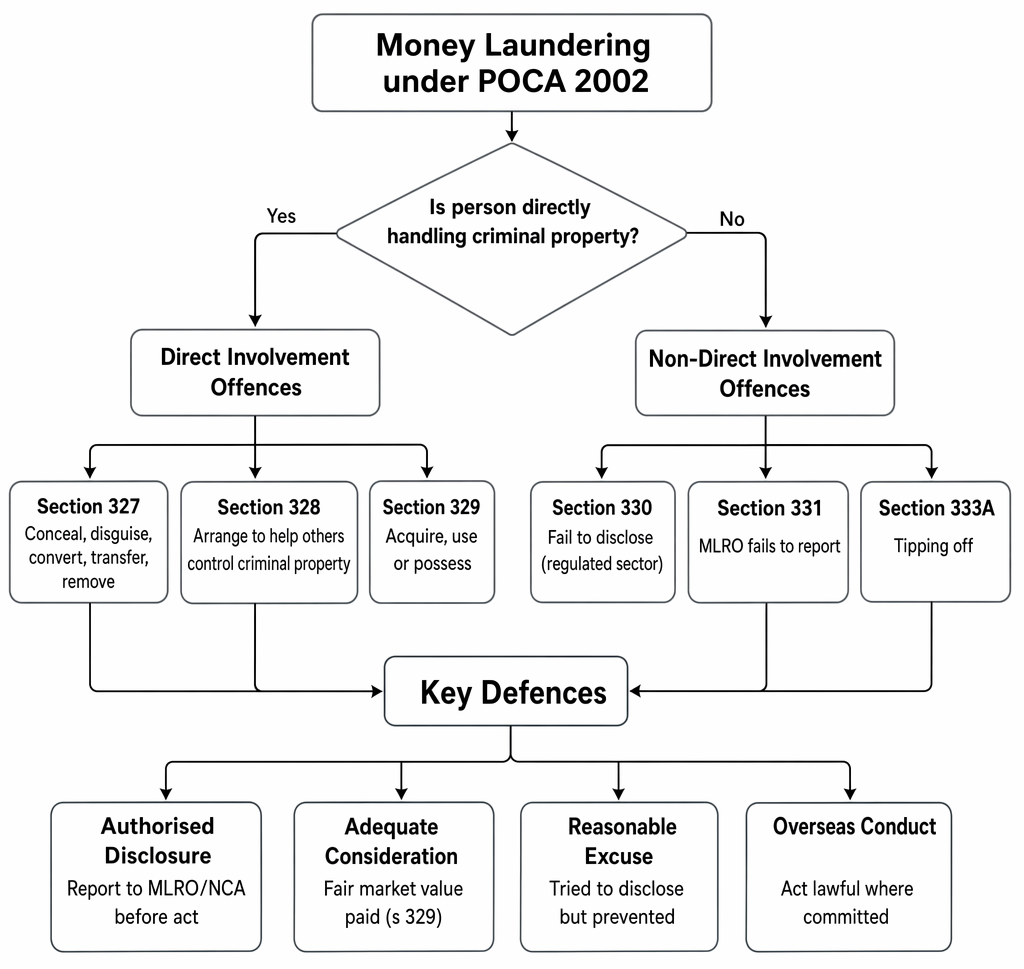
POCA 2002 money laundering offences under ss 327–331 and s 333A are classified by involvement, with key defences indicated.
Test Tip: In SQE-style questions on Direct involvement and non-direct involvement offences under the Proceeds of Crime Act 2002, identify the legal test, the triggering fact, and the consequence before choosing between similar answer options.
Exam Warning: Do not rely on a familiar phrase from Direct involvement and non-direct involvement offences under the Proceeds of Crime Act 2002 alone; check whether the facts satisfy every condition, exception, and timing requirement.
The Stages of Money Laundering
Money laundering typically involves three stages:
- Placement – Introducing criminal funds into the financial system.
- Layering – Moving funds through complex transactions to obscure their origin.
- Reintroduction – Reintroducing the funds into the legitimate economy.
Key Term: money laundering
Money laundering is the process of concealing, disguising, or legitimising the proceeds of crime to make them appear lawful.
Under POCA, “criminal property” includes any benefit from criminal conduct, wherever carried out, provided it would constitute an offence if committed in any part of the UK. The mental element for many offences is a low threshold: “knows or suspects.” The Court of Appeal has confirmed that suspicion is a subjective state falling short of proof or even clear probability; it encompasses a possibility that is more than fanciful, based on the information available.
Key Term: criminal property
Criminal property is any property that constitutes or represents a benefit from criminal conduct, and the person knows or suspects this.
Direct Involvement Offences under POCA 2002
POCA 2002 creates several offences for those directly handling or assisting criminal property. These are often referred to as "primary" or "direct involvement" offences.
Section 327: Concealing, Disguising, Converting, Transferring, or Removing Criminal Property
Section 327 makes it an offence to conceal, disguise, convert, transfer, or remove criminal property from the UK. The offence applies where a person knows or suspects that the property is the proceeds of crime. It captures a wide range of handling behaviour, including undertaking transactions that change the form of property (e.g., cash into an asset).
Key Term: direct involvement offence
A direct involvement offence is one where a person is actively engaged in handling, moving, or assisting criminal property, knowing or suspecting its criminal origin.
Section 328: Arrangements
Section 328 criminalises entering into or becoming concerned in an arrangement which the person knows or suspects facilitates the acquisition, retention, use, or control of criminal property by or on behalf of another person. This is a broad offence and can catch a wide range of professional activities, particularly those that structure or route funds to help others benefit from criminal property.
Section 329: Acquisition, Use, or Possession
Section 329 makes it an offence to acquire, use, or have possession of criminal property, knowing or suspecting its criminal origin. The offence focuses on obtaining or holding the benefit, even where no further transaction occurs.
Mental element and “suspicion”
For ss 327–329, “knows or suspects” is sufficient. Suspicion does not require proof of specific predicate offences or certainty as to the criminal origin. Clear audit trails, provenance queries, and source-of-funds checks often determine whether a reasonable practitioner would be put on inquiry; however, the test itself remains subjective.
Worked Example 1.1
A solicitor is instructed to transfer £200,000 for a client to purchase a property. The client insists on paying in cash and cannot provide a satisfactory explanation for the source of funds. The solicitor suspects the money may be proceeds of crime but proceeds with the transaction.
Answer:
The solicitor risks committing a direct involvement offence under s 327 (concealing or transferring criminal property) and s 329 (acquisition/use/possession), as they have handled funds they suspect are criminal property.
Worked Example 1.2
A boutique corporate firm is asked to create a UK holding company and two offshore subsidiaries to “optimise cash flows” for an overseas client whose income sources are opaque. The structure channels third‑party funds through intercompany loans and service fees with little commercial rationale.
Answer:
Even if the firm does not physically handle the funds, designing or becoming concerned in an arrangement that facilitates the acquisition, retention, use or control of criminal property by another risks liability under s 328. If suspicion exists, an authorised disclosure (DAML request) should be considered and work paused pending consent.
Non-Direct Involvement Offences under POCA 2002
POCA 2002 also creates offences for failures to act when there is knowledge or suspicion of money laundering. These are known as "non-direct involvement" or "secondary" offences.
Section 330: Failure to Disclose (Regulated Sector)
Section 330 makes it an offence for a person working in the regulated sector (including most solicitors) to fail to disclose to the MLRO or NCA if they know, suspect, or have reasonable grounds to know or suspect that another person is engaged in money laundering, and the information came to them in the course of their business. The offence is complete on failure to disclose “as soon as is practicable.” It is not necessary to identify a particular predicate offence or to prove that money laundering has in fact occurred.
Key features of s 330:
- It applies only to those in the regulated sector.
- There is liability where there are reasonable grounds to suspect, even if the individual did not actually suspect.
- Defences include a reasonable excuse for not disclosing, information obtained in privileged circumstances, and the “no training” defence where adequate AML training was not provided by the employer.
Key Term: non-direct involvement offence
A non-direct involvement offence is one where a person fails to report knowledge or suspicion of money laundering, or otherwise enables money laundering by omission.
Section 331: Failure to Disclose by Nominated Officers
Section 331 applies to nominated officers (such as the MLRO) who fail to make a disclosure to the NCA after receiving a report from within the firm and having actual knowledge or suspicion, or reasonable grounds for suspicion, of money laundering. The MLRO must consider internal reports promptly and decide whether to make an external SAR.
Section 333A: Tipping Off
Section 333A makes it an offence to disclose to any person that a suspicious activity report (SAR) has been made, or that an investigation is underway, if that disclosure is likely to prejudice the investigation. The offence typically arises in the regulated sector and includes telling a client that a SAR has gone in or that consent has not yet been received.
Key Term: tipping off
Tipping off is the offence of informing a person that they are under investigation for money laundering, or that a report has been made, where this could prejudice the investigation.
Section 342: Prejudicing an Investigation
Section 342 criminalises making a disclosure that is likely to prejudice a money laundering investigation or falsifying, concealing, or destroying documents relevant to such an investigation, where the person knows or suspects that an investigation is being, or is about to be, conducted. Unlike s 333A, s 342 is not restricted to the regulated sector and applies more broadly.
Worked Example 1.3
A junior solicitor receives information suggesting a client is laundering money. The solicitor does not report this to the MLRO or NCA, believing there is not enough evidence.
Answer:
The solicitor may be liable under s 330 for failure to disclose, as the test is whether there were reasonable grounds for suspicion, not just actual knowledge.
Worked Example 1.4
A fee‑earner emails a client: “We filed a report to the NCA, so we cannot proceed until they approve. We expect to hear within a week.”
Answer:
This risks a tipping‑off offence under s 333A because the communication reveals a SAR and could prejudice an investigation. The correct approach is to avoid any reference to the SAR or NCA process, using neutral reasons for delay that do not mislead the client.
The Regulated Sector and Reporting Duties
Solicitors and most law firms are part of the "regulated sector" for anti-money laundering purposes. This brings additional duties, including:
- Conducting customer due diligence (CDD) on clients.
- Appointing a Money Laundering Reporting Officer (MLRO).
- Training staff to recognise and report suspicious activity.
- Making internal reports to the MLRO and, where appropriate, external reports to the NCA.
- Ongoing monitoring of the business relationship consistent with the firm’s risk assessment.
Key Term: regulated sector
The regulated sector includes businesses and professionals (such as solicitors) subject to anti-money laundering laws and reporting obligations.
Reporting Suspicious Activity
If a solicitor knows or suspects that a client is engaged in money laundering, they must make a disclosure (SAR) to the MLRO or directly to the NCA as soon as practicable. The MLRO will then decide whether to report to the NCA. Where a SAR is made seeking consent to proceed (known as a DAML request), the transaction must not continue unless and until consent is granted, deemed or the moratorium expires.
Key Term: MLRO (Money Laundering Reporting Officer)
The MLRO is the nominated officer in a firm responsible for receiving internal reports of suspicious activity and making external reports to the NCA.
Worked Example 1.5
A solicitor is acting for a client in a business purchase. The client asks for funds to be routed through several offshore accounts for "tax reasons." The solicitor becomes suspicious and makes a report to the MLRO, who then files a SAR with the NCA.
Answer:
The solicitor has complied with their reporting duty. They must not proceed with the transaction until consent is received from the NCA, or the statutory time period has elapsed.
Worked Example 1.6
A litigation boutique is instructed on a debt claim that quickly settles for a large sum with minimal resistance; settlement monies are then to be sent to a non‑party abroad at the client’s instruction. The factual matrix appears contrived.
Answer:
Sham litigation can be a laundering typology. The firm should raise internal suspicion reports to the MLRO, pause payment, consider seeking a DAML, and assess red flags (e.g., third‑party payees, lack of commercial rationale). Client confidentiality is preserved, but the statutory reporting gateway permits disclosure to the MLRO/NCA.
Defences to Money Laundering Offences
POCA 2002 provides several statutory defences to money laundering offences.
Authorised Disclosure Defence
A person is not guilty of a money laundering offence if, before carrying out the prohibited act, they make an authorised disclosure to the MLRO or NCA and obtain consent (sometimes called "appropriate consent" or “defence against money laundering” (DAML)). If consent is refused, the person must not proceed.
Key Term: authorised disclosure
An authorised disclosure is a report made to the MLRO or NCA before (or, in limited cases, after) a prohibited act, seeking consent to proceed.
Consent process in outline:
- Once a DAML SAR is submitted, the NCA has seven working days to respond. If consent is refused within that period, a statutory moratorium (31 calendar days) commences during which the proposed act must not be done.
- The moratorium can be extended by a court in certain circumstances, and the total moratorium period can be extended significantly (the regime permits multiple extensions up to an overall cap measured in months).
- If no response is received within the initial seven‑day period, consent is deemed given and the act may proceed.
Worked Example 1.7
A conveyancing team files a DAML SAR on a proposed completion set for Friday. By the following Thursday (seven working days), the NCA has not responded.
Answer:
Consent is deemed granted at the end of the seven‑working‑day notice period if no refusal is received, so completion may proceed unless independent risk factors justify disengagement. If consent had been refused within the notice period, the 31‑day moratorium would bar completion unless and until lifted or expired.
Reasonable Excuse Defence
A person may have a defence if they intended to make an authorised disclosure but had a reasonable excuse for not doing so. This is interpreted narrowly; fear for personal safety or clear legal impediments may suffice, but commercial inconvenience will not.
Adequate Consideration Defence (Section 329)
For s 329 offences (acquisition, use, or possession), there is a defence if the person acquired, used, or possessed the property for "adequate consideration" (i.e., paid fair market value and did not know or suspect the property was criminal property). “Adequate consideration” does not assist a person who provides services that facilitate criminal conduct.
Key Term: adequate consideration
Adequate consideration means paying fair value for property, without knowledge or suspicion that it is criminal property.
Worked Example 1.8
A car dealer buys a vehicle at market value in the ordinary course of business. Months later, press reports suggest the seller was involved in fraud and the proceeds may have funded the car.
Answer:
If, at the time of the purchase, the dealer neither knew nor suspected the criminal provenance and paid market value, the adequate consideration defence under s 329 is available. If suspicion subsequently arises, the dealer must avoid further handling (e.g., resale) without considering authorised disclosure. Key Term: MLRO (Money Laundering Reporting Officer)
The MLRO is the nominated officer in a firm responsible for receiving internal reports of suspicious activity and making external reports to the NCA.
Overseas Conduct Defence
There is a defence if the criminal conduct occurred abroad and was lawful in the country where it took place, and would not be an offence punishable by 12 months or more in the UK. Care is needed: some conduct, such as bribery of foreign public officials or certain tax evasion facilitation, can still engage UK offences irrespective of local law.
The Money Laundering Regulations 2017
The Money Laundering, Terrorist Financing and Transfer of Funds (Information on the Payer) Regulations 2017 (MLR 2017) impose further obligations on law firms, including:
- Firm-wide risk assessments.
- Written AML policies and procedures.
- Appointment of a nominated officer (MLRO) and, where required, a Money Laundering Compliance Officer (MLCO).
- Ongoing staff training.
- Customer due diligence (CDD) and enhanced due diligence (EDD) for high-risk clients.
- Ongoing monitoring and scrutiny of transactions.
- Record keeping for at least five years.
CDD involves identifying the client, verifying their identity on reliable independent sources, understanding beneficial ownership, and the purpose and intended nature of the business relationship. Ongoing monitoring ensures transactions remain consistent with the firm’s knowledge of the client, their business and risk profile.
Enhanced Due Diligence (EDD)
EDD is required where higher risks are present, such as:
- Clients or counterparties from high‑risk third countries.
- Politically exposed persons (PEPs), or their family members or close associates.
- Complex or unusually large transactions or patterns without apparent legal or economic purpose.
- Non‑face‑to‑face relationships without robust electronic verification.
- Situations flagged in the firm’s risk assessment or sectoral guidance.
Measures include obtaining additional identity information, establishing source of funds and source of wealth, senior management approval to proceed, and enhanced ongoing monitoring.
Worked Example 1.9
A law firm is instructed to act in a property purchase. The client is a politically exposed person (PEP) from a high-risk jurisdiction. The firm applies enhanced due diligence, obtains extra information, and monitors the transaction closely.
Answer:
The firm has complied with its obligations under MLR 2017 by applying EDD to a high-risk client.
Simplified Due Diligence (SDD)
Where lower risk is established (for example, UK-listed companies or domestic public authorities), SDD may be applied proportionately, but firms must evidence the risk assessment justifying SDD and still conduct ongoing monitoring.
Training and the “training defence”
MLR 2017 require regular AML training. Lack of training can provide a defence for employees under s 330 where they did not know or suspect and their employer failed to provide required training. This does not assist MLROs or where there was actual knowledge or suspicion.
Sanctions and red flags
Firms must check sanctions lists and consider the UK financial sanctions regime when onboarding and carrying out transactions. Sanctions screening and red flag indicators (e.g., pressure for speed, unusual third‑party payees, opaque company structures, unexplained cash deposits) inform risk grading and reporting decisions.
Summary
| Offence Type | Section(s) | Description | Who is Liable? | Defence(s) |
|---|---|---|---|---|
| Direct involvement | 327, 328, 329 | Handling, moving, or assisting criminal property | Anyone | Authorised disclosure, adequate consideration, overseas conduct, reasonable excuse |
| Non-direct involvement | 330, 331, 333A | Failure to disclose, tipping off, prejudicing investigation | Regulated sector (solicitors, MLROs) | Authorised disclosure, reasonable excuse, legal privilege, training defence (for s 330) |
| Ancillary offence | 342 | Prejudicing an investigation (e.g., destruction of documents) | Anyone | Reasonable excuse; not disclosing privileged information |
Key Point Checklist
This article has covered the following key knowledge points:
- The main money laundering offences under POCA 2002 are ss 327 (concealing etc), 328 (arrangements), and 329 (acquisition/use/possession).
- Direct involvement offences require active handling or assisting criminal property with knowledge or suspicion.
- Non-direct involvement offences include failure to disclose and tipping off, and apply mainly to those in the regulated sector; s 342 prejudicing an investigation applies more broadly.
- Suspicion is a low, subjective threshold; “reasonable grounds to suspect” can trigger s 330 liability even if the individual did not actually suspect.
- Solicitors must report suspicions of money laundering to the MLRO or NCA as soon as practicable; avoid tipping off.
- Authorised disclosure (DAML) provides a defence; consent is deemed if no refusal is received within seven working days. If refused, a 31‑day moratorium applies (extendable by court).
- Statutory defences include authorised disclosure, reasonable excuse, adequate consideration (for s 329), overseas conduct, and the training defence for s 330.
- The MLRO is responsible for receiving internal reports and making SARs to the NCA; firms must maintain risk‑based AML systems under MLR 2017.
- EDD is mandatory for PEPs, high‑risk third countries and unusual or complex transactions; ongoing monitoring applies in all cases.
Key Terms and Concepts
- money laundering
- criminal property
- direct involvement offence
- non-direct involvement offence
- tipping off
- regulated sector
- authorised disclosure
- adequate consideration
- MLRO (Money Laundering Reporting Officer)
Worked Example 1.10
A solicitor is instructed to transfer £200,000 for a client to purchase a property. The client insists on paying in cash and cannot provide a satisfactory explanation for the source of funds. The solicitor suspects the money may be proceeds of crime but proceeds with the transaction.
Answer:
The solicitor risks committing a direct involvement offence under s 327 (concealing or transferring criminal property) and s 329 (acquisition/use/possession), as they have handled funds they suspect are criminal property.
Worked Example 1.11
A junior solicitor receives information suggesting a client is laundering money. The solicitor does not report this to the MLRO or NCA, believing there is not enough evidence.
Answer:
The solicitor may be liable under s 330 for failure to disclose, as the test is whether there were reasonable grounds for suspicion, not just actual knowledge.
Worked Example 1.12
A solicitor is acting for a client in a business purchase. The client asks for funds to be routed through several offshore accounts for "tax reasons." The solicitor becomes suspicious and makes a report to the MLRO, who then files a SAR with the NCA.
Answer:
The solicitor has complied with their reporting duty. They must not proceed with the transaction until consent is received from the NCA, or the statutory time period has elapsed.
Worked Example 1.13
A law firm is instructed to act in a property purchase. The client is a politically exposed person (PEP) from a high-risk jurisdiction. The firm applies enhanced due diligence, obtains extra information, and monitors the transaction closely.
Answer:
The firm has complied with its obligations under MLR 2017 by applying EDD to a high-risk client.
Worked Example 1.14
A boutique corporate firm is asked to create a UK holding company and two offshore subsidiaries to “optimise cash flows” for an overseas client whose income sources are opaque. The structure channels third‑party funds through intercompany loans and service fees with little commercial rationale.
Answer:
Even if the firm does not physically handle the funds, designing or becoming concerned in an arrangement that facilitates the acquisition, retention, use or control of criminal property by another risks liability under s 328. If suspicion exists, an authorised disclosure (DAML request) should be considered and work paused pending consent.
Worked Example 1.15
A fee‑earner emails a client: “We filed a report to the NCA, so we cannot proceed until they approve. We expect to hear within a week.”
Answer:
This risks a tipping‑off offence under s 333A because the communication reveals a SAR and could prejudice an investigation. The correct approach is to avoid any reference to the SAR or NCA process, using neutral reasons for delay that do not mislead the client.
Worked Example 1.16
A conveyancing team files a DAML SAR on a proposed completion set for Friday. By the following Thursday (seven working days), the NCA has not responded.
Answer:
Consent is deemed granted at the end of the seven‑working‑day notice period if no refusal is received, so completion may proceed unless independent risk factors justify disengagement. If consent had been refused within the notice period, the 31‑day moratorium would bar completion unless and until lifted or expired.
Worked Example 1.17
A car dealer buys a vehicle at market value in the ordinary course of business. Months later, press reports suggest the seller was involved in fraud and the proceeds may have funded the car.
Answer:
If, at the time of the purchase, the dealer neither knew nor suspected the criminal provenance and paid market value, the adequate consideration defence under s 329 is available. If suspicion subsequently arises, the dealer must avoid further handling (e.g., resale) without considering authorised disclosure.
Worked Example 1.18
A litigation boutique is instructed on a debt claim that quickly settles for a large sum with minimal resistance; settlement monies are then to be sent to a non‑party abroad at the client’s instruction. The factual matrix appears contrived.
Answer:
Sham litigation can be a laundering typology. The firm should raise internal suspicion reports to the MLRO, pause payment, consider seeking a DAML, and assess red flags (e.g., third‑party payees, lack of commercial rationale). Client confidentiality is preserved, but the statutory reporting gateway permits disclosure to the MLRO/NCA.