Learning Outcomes
This article outlines the key pre-action consideration of determining which country's laws apply to potential cross-border claims in contract or tort. After reading this article, you should be able to identify the key principles governing choice of law, including party autonomy in contracts and the default rules derived from retained EU law (Rome I and Rome II Regulations). You will understand the distinction between applicable law and jurisdiction and be able to apply these concepts to SQE1-style problem questions, advising on the governing law in given scenarios. You should also be able to recognise and apply special choice-of-law rules for consumer and employment contracts under Rome I, and for particular torts (including product liability and environmental damage) under Rome II. In addition, you will appreciate the scope of the law chosen or determined (what issues it governs), how overriding mandatory provisions and public policy may limit that law, and when foreign limitation periods are applied by English courts.
SQE1 Syllabus
For SQE1, you are required to understand the mechanisms for determining which country's laws apply to contractual or tortious claims, particularly where there is a cross-border element. This involves applying principles from retained EU law and common law. Your ability to distinguish applicable law from jurisdiction is also assessed, with a focus on the following syllabus points:
- The principle of party autonomy in choosing the law applicable to a contract.
- The rules for determining the applicable law for contractual obligations when no choice is made (Rome I Regulation principles as retained EU law).
- Special Rome I protections for consumer and employment contracts and their impact on party choice.
- The rules for determining the applicable law for non-contractual obligations/torts (Rome II Regulation principles as retained EU law) including specific regimes for product liability, environmental damage, and intellectual property.
- The fundamental difference between applicable law (governing law) and jurisdiction (the court's authority to hear a case).
- The scope of the applicable law, including performance, breach, damages, and limitation periods; and application of foreign limitation periods under the Foreign Limitation Periods Act 1984.
- How to apply these rules to advise a client in a cross-border dispute scenario.
Test Your Knowledge
Attempt these questions before reading this article. If you find some difficult or cannot remember the answers, look more closely at that area during your revision.
-
In contractual disputes with a cross-border element, what is the primary principle determining the applicable law?
- a) The law of the country where the contract was performed.
- b) The law chosen by the parties (party autonomy).
- c) The law of the country where the damage occurred.
- d) The law of the court hearing the dispute (lex fori).
-
A UK company contracts with a German company for the supply of goods. The contract does not specify a governing law. Under the rules derived from the Rome I Regulation (as retained in UK law), which country's law is most likely to apply?
- a) UK law (buyer's habitual residence).
- b) German law (seller's habitual residence).
- c) The law of the country where the goods are delivered.
- d) The law of the country where the contract was signed.
-
In a tort claim involving parties from different countries, what is the general rule under the Rome II Regulation principles (as retained in UK law) for determining the applicable law?
- a) The law of the country where the wrongful act was committed.
- b) The law of the country where the parties are both habitually resident.
- c) The law of the country where the damage occurred (lex loci damni).
- d) The law chosen by the claimant.
-
True or false? Jurisdiction refers to the specific laws that will be used to decide the substance of a legal dispute.
Introduction
When advising a client on a potential dispute involving parties, events, or subject matter connected to more than one country, a critical preliminary step is to determine the applicable law, also known as the governing law. This refers to the system of substantive law (e.g., English law, French law) that the court will use to decide the rights and obligations of the parties involved in the dispute. This is distinct from jurisdiction, which concerns the authority of a particular court (e.g., the High Court of England and Wales) to hear the case in the first place. Understanding which country's laws will apply is essential for assessing the merits of a potential claim or defence and advising the client appropriately before commencing proceedings.
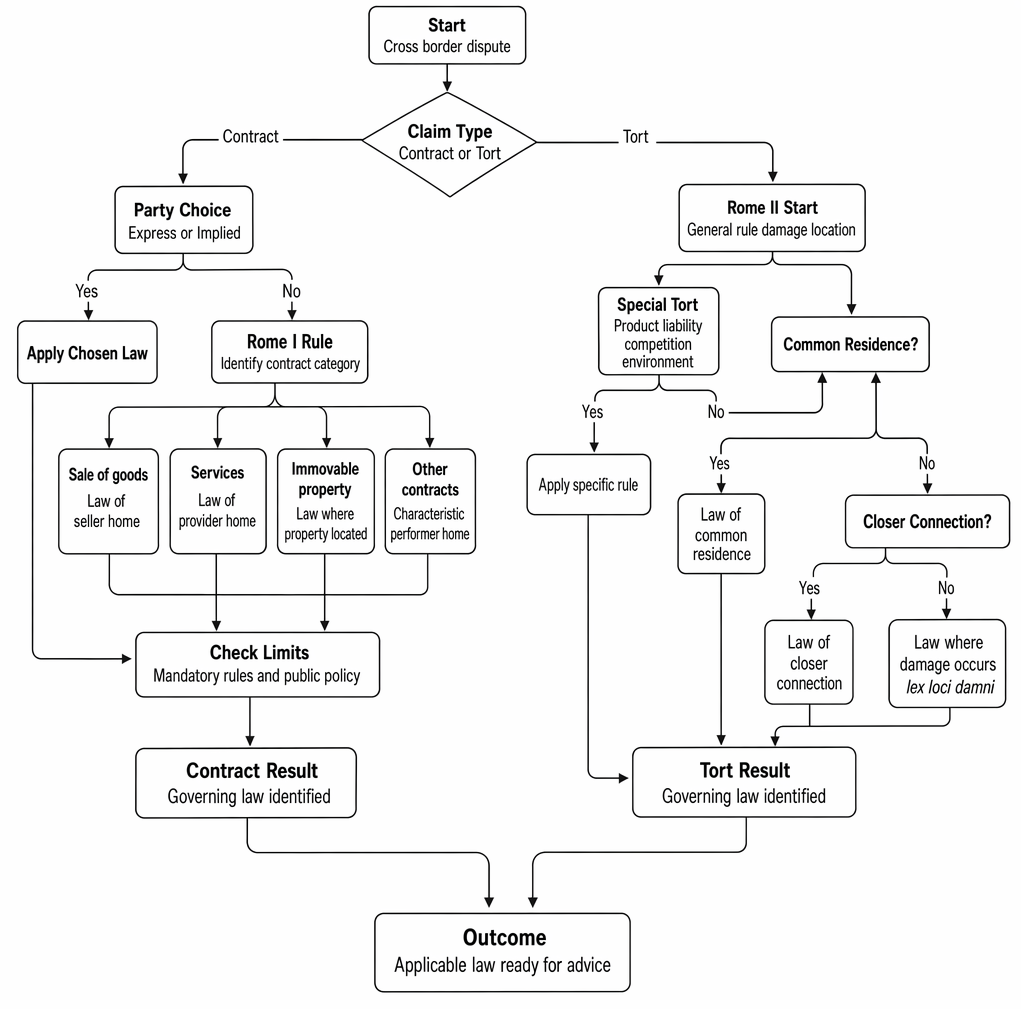
Summary of the choice-of-law analysis for cross-border contractual and tortious claims under Rome I and Rome II.
Identifying the governing law at the outset also informs key pre-action decisions: drafting letters of claim/protocol-compliant correspondence, selecting appropriate expert evidence, anticipating the measure of damages, and assessing limitation periods (bearing in mind that English courts will apply foreign limitation rules where the foreign law governs the claim). The Rome I and Rome II Regulations continue to apply in England and Wales as retained EU law and are of universal application: they aim to determine the governing law irrespective of whether that law is of an EU Member State or a non-EU country.
Key Term: Jurisdiction
The power or authority of a specific court or court system (e.g., the courts of England and Wales) to hear and determine a legal case.Test Tip: In SQE-style questions on Applicable law: determining which country's laws apply to contractual or tortious claims, identify the legal test, the triggering fact, and the consequence before choosing between similar answer options.
Determining Applicable Law in Contractual Disputes
The rules for determining the applicable law for contractual obligations largely stem from the principle of party autonomy and rules derived from EU law, now retained in UK domestic law.
The Principle of Party Autonomy
The foundational principle for contractual applicable law is party autonomy. This means that the parties to a contract are generally free to choose the law that will govern their agreement.
Key Term: Party Autonomy
The freedom of parties to a contract to choose the law that governs their contractual obligations.
This choice is typically made explicit through a specific clause in the contract.
Key Term: Governing Law Clause
A contractual term explicitly stating which country's law will apply to interpret the contract and resolve disputes arising under it.
The choice of law can be express or, less commonly, implied with sufficient certainty from the terms of the contract or the circumstances of the case. UK courts will generally respect the parties' choice of law.
Key Term: Implied Choice
A choice of law that is not stated expressly but is demonstrated with reasonable certainty by the contract terms or circumstances (e.g., a jurisdiction clause pointing strongly to a particular legal system).
Rome I recognises party autonomy but contains important protective rules for certain categories of contracts and limits on the effect of a choice that would deprive weaker parties (consumers and employees) of mandatory protections.
Absence of Choice: Rome I Regulation (Retained EU Law)
If the parties have not made a valid choice of law, the applicable law is determined by rules derived from Regulation (EC) No 593/2008, commonly known as the Rome I Regulation. These rules have been incorporated into UK domestic law following Brexit.
Key Term: Rome I Regulation
Originally an EU regulation, its principles regarding the law applicable to contractual obligations (in the absence of party choice) are now retained in UK law.
Rome I sets presumptive rules based on the nature of the contract, designed to identify the law with the closest connection to the characteristic performance of the contract.
Key Term: Habitual Residence
For natural persons acting in business, their principal place of business; for companies or other bodies, the place of central administration. Habitual residence is the anchor connecting a party to a legal system under Rome I/II. Key Term: Characteristic Performance
The performance that is most characteristic of the contract (e.g., selling or supplying services), used in Rome I to locate the applicable law by reference to the performing party’s habitual residence.
The Rome I rules provide default provisions based on the type of contract. Key examples include:
- Contracts for the sale of goods: Governed by the law of the country where the seller has their habitual residence.
- Contracts for the provision of services: Governed by the law of the country where the service provider has their habitual residence.
- Contracts relating to immovable property (e.g., tenancy agreements): Governed by the law of the country where the property is situated.
- Franchise and distribution contracts: Typically governed by the law of the franchisee/distributor’s habitual residence (the characteristic performer).
If none of these apply, the contract is governed by the law of the country with which it is most closely connected, assessed in light of all circumstances.
Rome I also includes protective regimes for certain relationships:
Key Term: Consumer Contract
Under Rome I, a contract between a trader and a consumer (acting for purposes outside their trade/profession). A choice of law cannot deprive the consumer of the protection provided by mandatory rules of the consumer’s habitual residence if the trader directs activities to that country.
In consumer contracts, even if the parties choose a different law, the consumer retains the mandatory protections of the law of their habitual residence where the trader directs activities to that country (e.g., targeted marketing or online sales).
Key Term: Employment Contract
Under Rome I, the law chosen by the parties cannot deprive the employee of protection afforded by mandatory rules of the law of the country where the employee habitually works. Failing that, the place of business through which the employee was engaged or the country most closely connected may apply.
For employment contracts, the default law is where the employee habitually carries out work. A choice of law cannot reduce the employee’s mandatory protections under that law.
Key Term: Renvoi
A private international law concept where the forum’s conflict rules refer to another state’s conflict rules. Renvoi is excluded under Rome I and Rome II; the reference is to the substantive law of the chosen/determined country only.
Rome I also clarifies formal validity (e.g., whether formal requirements are satisfied) and the scope of the applicable law (interpretation, performance, consequences of breach, damages, and limitation/prescription periods). In English law, foreign limitation periods determined by applicable law are applied via statute.
Key Term: Foreign Limitation Periods Act 1984
English statute requiring the court to apply foreign limitation periods where foreign law governs the claim, subject to a narrow public policy exception to avoid undue hardship.
Limitations on Choice
Party autonomy is not absolute. Certain rules, known as overriding mandatory provisions (e.g., specific consumer protection laws or employment regulations of a particular country), may apply regardless of the parties' chosen law if they are deemed necessary for safeguarding public interests. Furthermore, a court may refuse to apply a provision of the chosen foreign law if doing so would be manifestly incompatible with the public policy (ordre public) of the forum (the country where the court is located).
Key Term: Overriding Mandatory Provisions
Statutory rules considered essential to protect public interests of a country (e.g., worker protection, consumer safety) that apply irrespective of the law otherwise applicable to the contract. Key Term: Public Policy (Ordre Public)
A forum’s fundamental principles allowing a court to refuse application of foreign law where its result would be manifestly incompatible with those principles.
Worked Example 1.1
A tech company based in England enters into a software development contract with a company based in India. The contract includes a clause stating, "This agreement shall be governed by and construed in accordance with the laws of England and Wales." A dispute arises regarding the quality of the software delivered. Which country's law will apply to resolve the dispute?
Answer:
The law of England and Wales will apply. The parties have made an express choice of law in their contract through the governing law clause. This choice will be respected by the court hearing the dispute, based on the principle of party autonomy.
Worked Example 1.2
A Spanish online retailer targets UK consumers through English‑language ads and accepts orders for household goods from UK addresses. A UK consumer buys a vacuum cleaner; the T&Cs choose Spanish law. The product fails, and the consumer claims statutory remedies.
Answer:
Spanish law applies by party choice, but the consumer retains the protection of the mandatory UK consumer rules (as the trader directed activities to the UK). Under Rome I, the choice cannot deprive the consumer of mandatory protections of their habitual residence. The court applies Spanish law supplemented by UK mandatory consumer protections.
Worked Example 1.3
A French employer engages a UK-based salesperson who habitually works in England but travels occasionally to France. The employment contract chooses French law. The employee is dismissed and claims under UK mandatory employment protections.
Answer:
The applicable law is the law of the country where the employee habitually works—England. A choice of French law cannot deprive the employee of mandatory protections of English employment law. English law will apply in substance to the employment relationship under Rome I’s employment rules.
Determining Applicable Law in Tortious Disputes
The rules for determining the applicable law for non-contractual obligations (including torts) are derived from Regulation (EC) No 864/2007, known as the Rome II Regulation, which has also been retained in UK domestic law post-Brexit.
Key Term: Rome II Regulation
Originally an EU regulation, its principles regarding the law applicable to non-contractual obligations (torts) are now retained in UK law.
The General Rule: Rome II Regulation (Retained EU Law)
The general rule under the Rome II principles is that the law applicable to a tortious claim is the law of the country in which the damage occurs, irrespective of the country in which the event giving rise to the damage occurred or the indirect consequences occurred. This is often referred to as lex loci damni.
Key Term: Lex Loci Damni
A legal principle meaning "the law of the place where the damage occurred". This is the general rule for determining the applicable law in tort claims under the Rome II Regulation principles. Key Term: Common Habitual Residence
An exception under Rome II where both parties (the person claimed to be liable and the person sustaining damage) share the same habitual residence at the time the damage occurs; that law governs. Key Term: Closest Connection Escape Clause
If the tort is manifestly more closely connected with another country than that indicated by the general rule or common habitual residence, the law of that other country applies.
Rome II also allows limited party autonomy for non-contractual obligations:
- Parties may agree the applicable law after the event giving rise to the damage; or
- Where they have a pre-existing relationship (e.g., a contract) closely connected with the non-contractual obligation, they may choose the applicable law for that obligation.
Exceptions and Specific Rules
Rome II provides specific regimes for certain non-contractual obligations that displace the general rule where appropriate:
Key Term: Product Liability
Under Rome II, claims for damage caused by a product are generally governed by the law of the country where the injured person had their habitual residence when the damage occurred, if the product was marketed in that country; failing that, lex loci damni or the law of a manifestly closer connection applies. Key Term: Environmental Damage
Rome II allows the claimant to choose the law of the country in which the event giving rise to the damage occurred (instead of lex loci damni), to facilitate effective redress. Key Term: Unfair Competition
Claims concerning unfair competition and acts restricting free competition are governed by the law of the country where competitive relations or the collective interests of consumers are or are likely to be affected. Key Term: Intellectual Property
Infringement of intellectual property rights is governed by the law of the country for which protection is claimed (lex loci protectionis). Key Term: Culpa in Contrahendo
Pre‑contractual liability (e.g., misrepresentation in negotiations) is governed by Rome II, generally by the law that would have governed the contract had it been concluded, or the law of the country in which the negotiations took place if different and more closely connected.
Importantly, Rome II excludes certain matters (e.g., non-contractual obligations arising out of violations of privacy and rights relating to personality, including defamation, by media publications). Those are governed by domestic conflict rules and case law.
As with Rome I, overriding mandatory provisions of the forum and manifest public policy (ordre public) can limit the application of a foreign law determined by Rome II.
Rome II clarifies the scope of the applicable law for torts: it governs, among other things, the basis and extent of liability, apportionment of liability, the existence and assessment of damages (including non-pecuniary loss), defences, and whether and to what extent limitations or prescriptive periods apply. English courts will apply foreign limitation periods when applying foreign law to tort claims, subject to the Foreign Limitation Periods Act 1984.
Worked Example 1.4
A tourist from the UK is injured in Spain due to the alleged negligence of a hotel owned and operated by a Spanish company. The tourist returns to the UK and considers bringing a claim. Which country's law will likely govern the substance of the negligence claim?
Answer:
Spanish law is likely to govern the claim. Applying the general rule derived from the Rome II Regulation (lex loci damni), the applicable law is that of the country where the damage occurred, which in this case is Spain. The exceptions (common habitual residence or manifestly closer connection) do not appear to apply on these facts.
Worked Example 1.5
A UK resident suffers burns from a kitchen appliance bought in France while holidaying there, manufactured by a German company and marketed in the UK and France. The damage occurs in France; the product is also marketed in the UK where the claimant is habitually resident.
Answer:
Product liability rules under Rome II point to the law of the claimant’s habitual residence (UK) if the product was marketed there. As the product was marketed in the UK, UK law applies to the product liability claim, notwithstanding that the damage occurred in France.
Worked Example 1.6
A chemical spill in Country A causes river pollution downstream in Country B, where fish stocks and businesses suffer losses. Affected claimants in Country B consider suing. Which law applies?
Answer:
The general rule is lex loci damni (Country B), but claimants have a Rome II option for environmental damage to choose the law of Country A (where the event giving rise to the damage occurred). Depending on strategy and remedies, claimants may elect Country A’s law under the environmental damage rule.
Worked Example 1.7
Two companies, both habitually resident in England, are involved in a negligent misstatement about a joint venture in Italy causing loss in Italy. What law applies?
Answer:
Where both parties are habitually resident in the same country at the time damage occurs, Rome II applies the law of that country—here, English law—despite the damage occurring in Italy.
Worked Example 1.8
A UK manufacturer and a US distributor negotiate a supply agreement in London; the contract is never concluded. The distributor alleges it relied on the UK manufacturer’s misrepresentations during negotiations and seeks damages. Which law applies?
Answer:
Culpa in contrahendo under Rome II points to the law that would have governed the contract had it been concluded (likely English law if negotiations and performance were centred in the UK). Alternatively, if another country is manifestly more closely connected, that law could apply.
Scope of the Applicable Law and Practical Points
Beyond identifying the governing law, advisers must understand the issues the law governs, and how English courts implement foreign law:
- Scope under Rome I/II: The applicable law governs interpretation, performance, consequences of breach, damages, and limitation/prescription. It also governs set-off, assignment/subrogation, and defences.
- Evidence and procedure: These remain governed by the lex fori (the law of the court seised). For example, disclosure and evidence rules are English procedural matters if the claim is in England and Wales, even if the applicable substantive law is foreign.
- Foreign limitation periods: English courts apply foreign limitation periods where foreign law is applicable (Foreign Limitation Periods Act 1984). A narrow public policy escape exists where applying the foreign limitation would cause undue hardship or be otherwise contrary to justice.
- Renvoi exclusion: Under both Rome I and Rome II, references are to the substantive law of the determined country, not its conflict-of-laws rules (renvoi is excluded).
- Overriding mandatory rules/public policy: Forum mandatory rules (e.g., consumer and employment protections, safety regulations) can apply regardless of the determined law; and English courts can refuse to apply foreign law where its application would be manifestly incompatible with English public policy.
Key Term: Scope (Rome I/II)
The issues governed by the determined law, including interpretation, performance, breach, damages, and limitation/prescription; procedure and evidence remain governed by the forum’s law.
Worked Example 1.9
A French law governs a sales contract by default under Rome I (no choice). The French limitation period for breach of contract is shorter than England’s. Proceedings are brought in the High Court in London after that French limitation period has expired but within the English six-year period. What happens?
Answer:
The English court applies French limitation rules under the Foreign Limitation Periods Act 1984 because French law governs the contract. The claim is likely time-barred if the French limitation has expired, unless applying the foreign limitation would be contrary to public policy (a narrow exception).
Distinguishing Applicable Law and Jurisdiction
It is essential not to confuse applicable law with jurisdiction.
Applicable law determines which country's legal rules decide the case's outcome, whereas jurisdiction determines which country's courts have the power to hear the case. A court in England and Wales might have jurisdiction to hear a dispute but may need to apply French law (if that is the applicable law determined by the rules above) to resolve the substantive issues. Determining both jurisdiction and applicable law are distinct but equally important pre-action steps in cross-border disputes.
A contract may include both a governing law clause and a forum selection (jurisdiction) clause; they perform different functions. An arbitration clause likewise differs from a governing law clause: the seat of arbitration and procedural rules are distinct from the substantive governing law of the contract unless expressly aligned.
Exam Warning: A common pitfall is confusing the rules for determining jurisdiction with the rules for determining applicable law. Ensure you can distinguish between these concepts. For example, the fact that an English court has jurisdiction does not automatically mean that English law will be the applicable law governing the substance of the dispute. Always apply the distinct rules for choice of law (party autonomy, Rome I/II principles) separately from jurisdictional rules.
Key Point Checklist
This article has covered the following key knowledge points:
- Determining the applicable (governing) law is a critical pre-action step in cross-border disputes.
- Applicable law (which country's law governs the substance of the dispute) must be distinguished from jurisdiction (which country's courts can hear the case).
- In contractual disputes, the primary principle is party autonomy – the parties' choice of law, usually in a governing law clause, is of utmost importance.
- If no choice of law is made in a contract, rules derived from the Rome I Regulation (retained EU law) apply, often pointing to the law of the habitual residence of the party performing the characteristic obligation (e.g., the seller in a sales contract, the service provider).
- Consumer and employment contracts receive special protection under Rome I: party choice cannot deprive consumers or employees of mandatory protections of their habitual residence or habitual workplace.
- In tortious disputes, the general rule derived from the Rome II Regulation (retained EU law) is lex loci damni – the law of the country where the damage occurred applies.
- Rome II provides specific regimes for product liability, environmental damage (including claimant choice), unfair competition, and intellectual property infringement.
- Party autonomy in tort is limited but permitted in certain circumstances (e.g., post‑event agreement or pre‑existing relationships).
- Overriding mandatory provisions and public policy can limit the application of a chosen or determined foreign law.
- Scope matters: the applicable law governs interpretation, performance, damages, and limitation/prescription; procedure and evidence are governed by the forum.
- English courts apply foreign limitation periods where foreign law governs the claim (Foreign Limitation Periods Act 1984), subject to a narrow public policy escape.
- Renvoi is excluded under Rome I and Rome II; the reference is to substantive law.
Key Terms and Concepts
- Jurisdiction
- Party Autonomy
- Governing Law Clause
- Implied Choice
- Rome I Regulation
- Habitual Residence
- Characteristic Performance
- Consumer Contract
- Employment Contract
- Renvoi
- Foreign Limitation Periods Act 1984
- Overriding Mandatory Provisions
- Public Policy (Ordre Public)
- Rome II Regulation
- Lex Loci Damni
- Common Habitual Residence
- Closest Connection Escape Clause
- Product Liability
- Environmental Damage
- Unfair Competition
- Intellectual Property
- Culpa in Contrahendo
- Scope (Rome I/II)