Learning Outcomes
This article outlines how to amend statements of case under CPR Part 17 and related provisions, including:
- scope and purpose of CPR Part 17, forms of amendment (before service, by consent, with permission), and strategic reasons for amending pleadings in civil litigation and SQE1 problem questions
- criteria applied by the court when exercising its discretion, including timing, explanation for delay, prejudice to other parties, proportionality, compliance with directions, and the overriding objective
- operation of limitation when adding or expanding claims and parties, the "same or substantially the same facts" test, relation back, and genuine misnomer scenarios
- step-by-step procedure for preparing, drafting, marking up, and verifying amendments, filing and serving amended statements of case, and framing an effective application notice and supporting evidence
- consequences of amendments for directions, disclosure and witness statements, trial dates, and costs, including costs thrown away, wasted preparation, and possible conditions attached to late amendments
- interaction between amendments, requests for further information under Part 18, clarificatory orders, and consequential changes needed elsewhere in the pleadings, ensuring internal consistency across the case
SQE1 Syllabus
For SQE1, you are required to understand the rules and procedures governing amendments to statements of case under CPR Part 17 and related provisions, with a focus on the following syllabus points:
- CPR Part 17 and Practice Direction 17 requirements for amending statements of case
- amendments before service; amendments after service by consent or with permission
- court’s approach to late and complex amendments, and conditions (costs, timetables)
- limitation and “relation back” for new claims; adding or substituting parties after limitation
- practical procedure: application notices, marked-up drafts, statements of truth, service, and directions
Test Your Knowledge
Attempt these questions before reading this article. If you find some difficult or cannot remember the answers, look more closely at that area during your revision.
- When can a party amend a statement of case without the court’s permission?
- What factors will the court consider when deciding whether to allow an amendment to a statement of case?
- How does the limitation period affect the ability to add a new claim or party by amendment?
- What must a party do when seeking to amend a statement of case after it has been served?
Introduction
Amendments to statements of case are a routine but important part of progressing a civil claim. As litigation develops, parties may need to correct errors, clarify issues, or add new facts or claims. The Civil Procedure Rules (CPR) Part 17 sets out the framework for making amendments, balancing flexibility with fairness to all parties. Understanding the rules and the court’s approach is essential for effective case management and for SQE1 success.
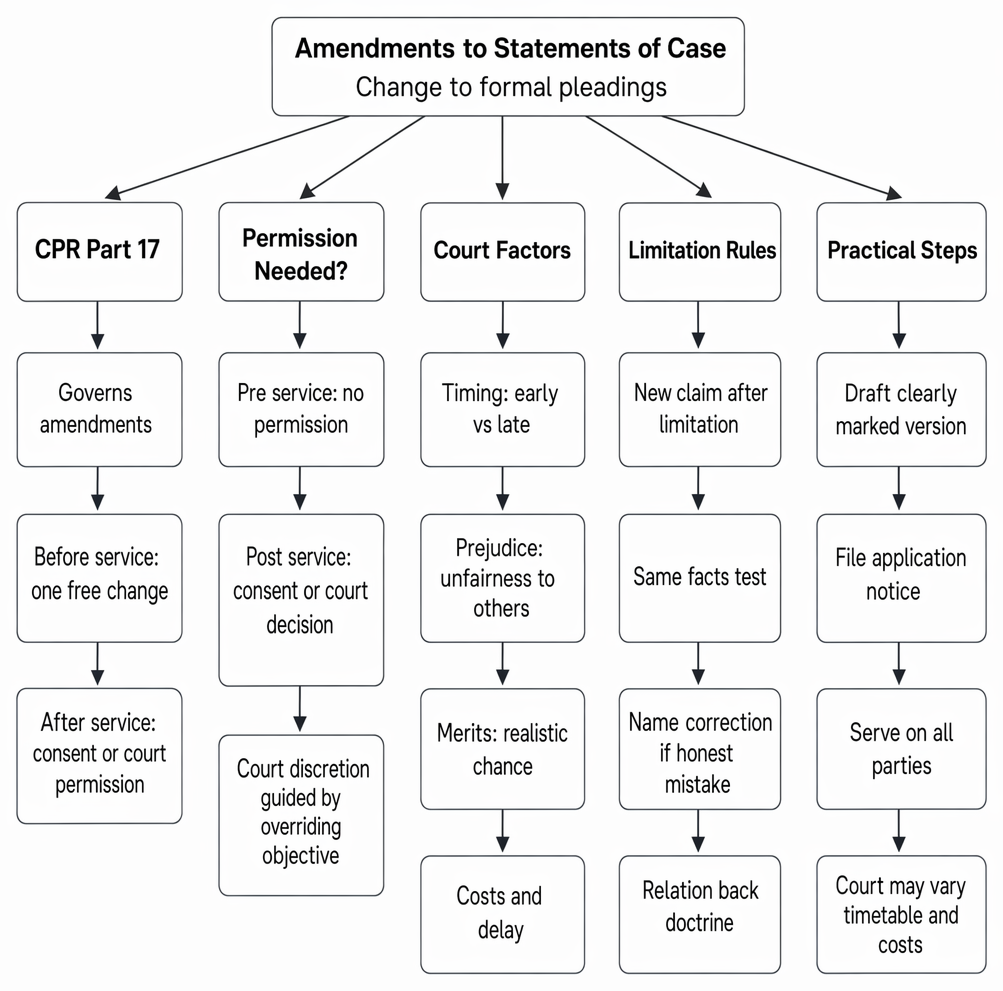
Amendments to statements of case under CPR Part 17, including permission, discretionary factors, limitation issues, and procedural requirements.
Key Term: statement of case
A formal document setting out a party’s case in civil proceedings, such as a claim form, particulars of claim, defence, or reply. Key Term: amendment
A change or addition made to a statement of case, correcting, clarifying, or expanding the issues in dispute. Key Term: court’s discretion
The power of the court to decide whether to allow or refuse an application, considering all relevant circumstances and the overriding objective. Key Term: limitation period
The maximum period allowed by law to bring a claim, after which the claim is barred. Key Term: new claim
A claim involving new facts, causes of action, or parties not included in the original statement of case. Key Term: misnomer
A genuine mistake as to the name of a party (rather than a deliberate change of the legal entity being sued). Key Term: relation back
The principle that an allowed amendment takes effect as if made at the date of the original statement of case for limitation purposes, within the limits set by CPR 17 and the Limitation Act 1980.
Amending Statements of Case: The Rules
When Can Amendments Be Made Without Permission?
A party may amend its statement of case at any time before it has been served on any other party, without needing the court’s permission. This is a practical safety valve at the drafting stage: if a claim form or particulars of claim are not yet served, errors can be corrected or allegations refined without an application.
If the statement of case has already been served, further amendments generally require either the written consent of all other parties (CPR 17.1(2)(a)) or the court’s permission (CPR 17.1(2)(b)). Even amendments made by consent must comply with the procedural requirements for marking changes and re‑verification.
Practical point: where an amendment to a claim form would add a new claim after the expiry of limitation, permission is required. Certain party changes have separate rules under CPR Part 19; these cannot be done without permission after service.
When Is Court Permission Required?
Once a statement of case has been served, a party must seek the court’s permission to amend unless all other parties agree in writing. The court has wide discretion to allow or refuse amendments at any stage of proceedings. The court can also give directions for consequential steps (for example, extended time for a new defence, or revised disclosure).
Where amendments risk disrupting the timetable or causing prejudice, the court will consider conditions, such as costs orders (“costs thrown away”), filing clean and marked-up copies, and adjusted directions to keep the case on track.
The Court’s Approach to Amendments
When deciding whether to allow an amendment, the court will consider:
- the stage of proceedings and timing (early clarifications are favoured; very late amendments face strict scrutiny)
- the reason for the amendment (e.g. correcting an obvious error, responding to new evidence, or adding a plainly arguable claim)
- whether the amendment is necessary to resolve the real dispute and assist the court in dealing with the case justly and at proportionate cost
- prejudice to other parties, including delay, additional cost, and loss of a trial date
- compliance with the overriding objective, including proportionality and efficient conduct
- the arguability of the proposed pleading (futile or unarguable amendments will be refused)
The court is more likely to allow early amendments that clarify issues or correct errors. Late amendments, especially those close to trial or introducing new claims, will be scrutinised carefully and may be refused if they cause unfairness or disrupt the timetable. If allowed, the court may impose conditions (for example, paying costs thrown away or preserving the trial date).
Worked Example 1.1
A claimant realises after serving the particulars of claim that they have misstated the date of the contract. The defendant has not yet filed a defence. Can the claimant amend the particulars of claim without court permission?
Answer:
No. Once the particulars of claim have been served, the claimant must obtain either the written consent of the defendant or the court’s permission to amend.
Showing Amendments and Verification
Practice Direction 17 requires that:
- the amended statement of case must show all changes clearly (for example, underlining additions and striking through deletions, or using track changes)
- a clean copy must also be filed and served
- any amended statement of case must be verified by a statement of truth covering the amendments (CPR 22), even if the original was verified
Failure to mark changes or re‑verify can result in rejection by the court office, delay, or adverse costs orders.
Limitation and Amendments
Amendments may be affected by limitation periods. If an amendment seeks to add a new claim or party after the limitation period has expired, the court will only allow it in limited circumstances governed by CPR 17.4 and the Limitation Act 1980.
Broadly:
- new claims may be added after limitation only if they arise out of the same or substantially the same facts as those already in issue in the existing statement of case
- relation back means that, if allowed, the amended claim is treated as made on the date of the original pleading, but only to the extent permitted by the rules
- adding or substituting a party after limitation is strictly controlled by CPR 19.5 and section 35 Limitation Act 1980; generally the court may allow substitution after limitation where the party originally named was named in mistake (genuine misnomer), or where it is necessary to add or substitute to ensure the claim can be properly determined
Correcting a genuine misnomer (for example, confusing a trading name with the incorporated company behind it) can be permitted after limitation, provided the mistake was not misleading and the intended defendant was identifiable from the original pleadings. By contrast, replacing the defendant with a different legal entity (where there was no mistake as to name) is unlikely to be allowed after limitation.
Limitation and relation back do not rescue amendments introducing claims based on substantially different facts or parties unless the specific tests are met. The court will look at the pleaded factual matrix: the more the new claim rests on facts already in issue, the more likely the amendment will be permitted.
Worked Example 1.2
A claimant wishes to add a claim for negligent misstatement after the limitation period has expired. The facts supporting the new claim are the same as those already pleaded for misrepresentation. Will the court allow the amendment?
Answer:
Yes, if the new claim arises out of the same or substantially the same facts as the existing claim, the court may allow the amendment despite the expiry of the limitation period.
Adding or Substituting Parties after Limitation
Adding or substituting parties by amendment after limitation engages CPR 19.5. The court may permit:
- substitution where the party named in the original claim was named by mistake (misnomer) and the correct party is to be substituted
- addition or substitution where it is necessary to enable the court to resolve the claim (for example, where an interest or liability has passed due to death or bankruptcy)
The court will examine whether the original naming was a genuine mistake as to name (not a tactical choice or a change of identity) and whether the intended defendant could reasonably be identified. If so, substitution can be allowed after limitation with relation back.
Worked Example 1.3
A claimant sues “Dotheboys Farm” within the limitation period. After expiry, they discover the correct legal entity is “Dotheboys Farm Ltd”. Can the claimant substitute the company?
Answer:
Potentially, yes. If “Dotheboys Farm” was a genuine misdescription of “Dotheboys Farm Ltd” and the company was the intended defendant identifiable from the original pleadings, the court may allow substitution under CPR 19.5 despite limitation, treating it as a misnomer correction.
Practical Steps for Amending Statements of Case
When seeking to amend a statement of case after service, a party should:
- prepare a marked-up draft showing proposed changes, and a clean copy
- file an application notice (Part 23) with a draft order, attaching the draft amended pleading and a witness statement explaining the need for the amendment, timing, effect on the timetable, and any limitation issues
- serve the application and draft amendment on all other parties
- propose appropriate consequential directions (for example, extended defence timetables or revised disclosure) and address costs
- if permission is granted, file and serve the amended statement of case and ensure it is verified by a statement of truth
If all parties consent in writing to the amendment, court permission is not needed. However, you must still:
- file the amended document with clear markings and a clean copy
- re‑verify by statement of truth
- serve on all parties, and comply with any consequential directions
Worked Example 1.4
A defendant discovers new evidence supporting a counterclaim after serving the defence. The claimant agrees in writing to the amendment. What should the defendant do?
Answer:
The defendant can amend the defence and counterclaim with the claimant’s written consent, then file and serve both a marked-up and clean amended version, verified by a statement of truth, on the court and all parties, and comply with any consequential directions.
Consequential Directions and Timetables
Amendments often require adjustments:
- the court may reset deadlines for disclosure, witness statements, or expert reports to reflect the new issues
- a defendant may be given time to plead to an amended particulars of claim; 14 days from service is a common starting point, subject to directions
- costs thrown away by amendments are frequently ordered against the amending party on the standard basis
- the court will resist vacating trial dates unless unavoidable; parties should propose targeted timetable changes that preserve the trial window
Drafting and Format
- use clear, orthodox pleading style; do not introduce evidential detail beyond what is necessary for material facts
- mark changes plainly; use underlining/strikethrough or tracked changes as required by PD 17
- include any new heads of loss with sufficient particulars and, if applicable, update interest calculations and bases
- maintain internal consistency across pleadings (for example, update the case summary and schedule of loss where appropriate)
Case Management and Amendments
The court may give directions to manage the impact of an amendment, such as:
- adjusting deadlines for disclosure or witness statements
- allowing further amendments or responses specifically tied to the new issues
- listing a short case management conference if needed
- making costs orders to compensate parties for additional work caused by the amendment, often “costs thrown away”
The court will enforce compliance. If an amendment is late or causes disruption, expect conditions or limited relief. Where an amendment is refused, the court may still direct that certain clarifications be provided by a request for further information (Part 18), if proportionate.
Exam Warning: If an amendment is sought very late, especially close to trial, the court may refuse permission or impose conditions (such as costs or non‑adjournment). Always act promptly if an amendment is needed, explain the delay, and propose directions that preserve proportionality and the trial date.
Revision Tip: Seek to identify possible amendments early in proceedings. Prompt applications are more likely to be granted and reduce the risk of prejudice or wasted costs. If the change is modest and agreed, use written consent to avoid unnecessary hearings, but ensure the formal marking and re‑verification steps are followed.
Additional Worked Examples
Worked Example 1.5
A claimant seeks, two weeks before trial, to add a new negligence duty and factual allegations not previously pleaded. The amendment would require new expert evidence and vacating the trial date. Is permission likely?
Answer:
Unlikely. The court will weigh timing, prejudice, and disruption. Introducing new facts and expert issues close to trial is generally refused unless necessity is compelling and disruption can be avoided. If allowed, it would be subject to strict conditions, including costs and preserving the trial date where possible.
Worked Example 1.6
After limitation expires, a claimant applies to add a new contractual claim for a different breach based on facts not set out in the original particulars of claim. Will relation back assist?
Answer:
No, unless the new claim arises out of the same or substantially the same facts already pleaded. If the new breach depends on facts outside the existing pleading, the test is not met and the court will refuse the amendment.
Worked Example 1.7
A defendant’s name in the pleadings is “John Smith trading as JS Repairs”. It later emerges the correct defendant is “JS Repairs Ltd”. Limitation has expired. What is the best course?
Answer:
Apply under CPR 19.5 to substitute “JS Repairs Ltd”, explaining that “John Smith trading as JS Repairs” was a genuine misnomer and the intended defendant was the company. If the company was identifiable from the claim and there was a mistake as to name, the court may permit substitution notwithstanding limitation.
Key Point Checklist
This article has covered the following key knowledge points:
- amendments to statements of case are governed by CPR Part 17 and PD 17
- a party may amend a statement of case at any time before service without permission
- after service, amendments require either written consent of all parties or court permission
- the court considers timing, necessity, prejudice, arguability, and the overriding objective when deciding on amendments
- amendments adding new claims after limitation are only allowed if they arise out of the same or substantially the same facts; relation back then applies
- adding or substituting parties after limitation is tightly controlled; genuine misnomer and necessary substitution are the main gateways
- draft amendments must show changes clearly, include a clean copy, and be verified by a statement of truth
- the court may give consequential directions and make costs orders (often costs thrown away) when granting amendments
Key Terms and Concepts
- statement of case
- amendment
- court’s discretion
- limitation period
- new claim
- misnomer
- relation back