Learning Outcomes
This article explores the regulation of public assemblies, processions, and trespassory gatherings under the Public Order Act 1986 and related constitutional principles, including:
- the key police powers to impose conditions or prohibitions on processions, public assemblies, and trespassory assemblies, with attention to notice requirements, decision thresholds, and evidentiary basis
- distinctions among public processions, public assemblies, and trespassory assemblies, including variations in regulatory regime, minimum numbers required, and legal implications for organisers and participants
- the procedural steps and legal standards for valid police and local authority intervention, including the hierarchy of authorisation, written notification, and reasons requirements
- the compatibility of statutory and common law public order powers with the Human Rights Act 1998 and Articles 10 and 11 ECHR, applying proportionality and necessity tests as developed by UK and European courts
- doctrines of statutory interpretation (legality, rationality, proportionality) and the role of judicial review in challenges against restrictions on assemblies
- the appellate and supervisory structure for challenging the exercise of public order powers, including the distinction between appeals and claims for judicial review, the available grounds, and relevant remedies
- the practical and constitutional implications of recent legislative reforms, including the expansion of police powers over protest noise, and the continuing relevance of the rule of law and constitutional conventions on the exercise of state power
SQE1 Syllabus
For SQE1, you are required to understand the conditions and prohibitions on assemblies within public order law, with a focus on the following syllabus points:
- the statutory requirements for advance notice and restrictions on public processions and assemblies
- police powers under the POA 1986 to impose conditions or prohibitions on processions, assemblies, and trespassory assemblies
- grounds and procedure for prohibiting processions or assemblies, including distinctions between general and trespassory assemblies
- application of the Human Rights Act 1998 and Articles 10 and 11 ECHR, focusing on freedom of expression and assembly, and the requirement for lawfulness, necessity, and proportionality
- the scope and continuing relevance of common law powers to prevent breach of the peace, and the circumstances for lawful police action outside of statute
- the relationship between public order legislation and delegated authority, statutory interpretation of restrictions on rights, and the mechanisms of review and challenge
Test Your Knowledge
Attempt these questions before reading this article. If you find some difficult or cannot remember the answers, look more closely at that area during your revision.
- Under what circumstances can the police impose conditions on a public assembly, and what factors must guide their decision-making?
- What are the statutory notice requirements for those organising a public procession, and what exemptions apply?
- Who is empowered to prohibit processions, on what grounds, and what procedural steps are mandated for validity?
- How do Articles 10 and 11 ECHR limit police and local authority intervention under the POA 1986, and how have UK courts applied the proportionality test?
- In what ways do common law powers supplement statutory powers for the prevention of public disorder, and how does this interact with statutory and constitutional safeguards?
Introduction
Key Term: public order law
Public order law refers to the body of statutes and principles in England and Wales that regulate the collective behaviour of individuals in public spaces, balancing the rights to protest and assemble with the need to maintain order, protect property, and prevent harm.
Public order law in England and Wales provides the framework through which authorities maintain the balance between upholding freedom of expression and assembly—central pillars of democratic society—and the practical imperative of ensuring peace, safety, and public confidence. The legal regime is primarily statutory, rooted in the Public Order Act 1986 (POA 1986), which establishes the procedures and criteria for both routine and exceptional intervention by the police in public gatherings, marches, and processions. This is complemented by common law principles, particularly the doctrine of breach of the peace, and sits within the overarching requirements of the Human Rights Act 1998, ensuring compliance with the European Convention on Human Rights (ECHR), notably Articles 10 and 11.
The principles and powers outlined herein form a critical part of the functioning legal knowledge tested in the SQE1, and candidates must demonstrate a thorough understanding of the statutory requirements, the nature and scope of police powers, constitutional safeguards, and the ability to critically evaluate the exercise and limits of such powers.
Test Tip: In SQE-style questions on Conditions and prohibitions on assemblies, identify the legal test, the triggering fact, and the consequence before choosing between similar answer options.
Police Powers: Assemblies and Processions
Statutory Definitions and Advance Notice for Public Processions
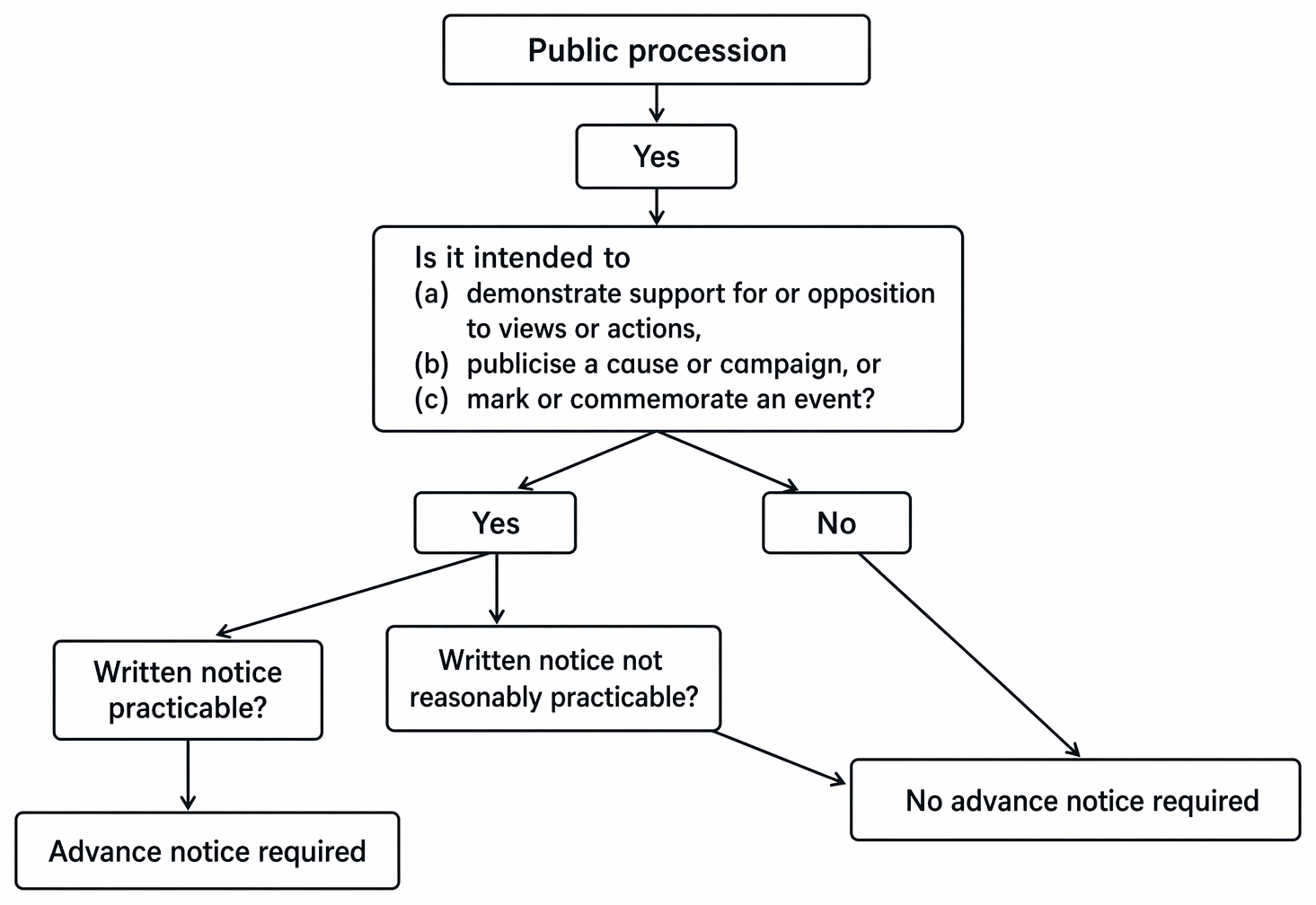
Police powers under the Public Order Act 1986 concerning notice, conditions, prohibitions, and proportionality for processions, assemblies, and trespassory assemblies.
Key Term: public procession
A gathering of any number of people moving together along a route in a public place with a common purpose (such as protest, demonstration, commemoration). There is no statutory minimum number. The event must be accessible to the public or pass through public areas.
Under sections 11–13 of the POA 1986, the organiser of most public processions intended to convey support for, or opposition to, views or actions of persons or bodies, publicise a cause, or commemorate an event must provide advance notice to the police. The written notice must state:
- date and time when it is to start
- proposed route or its starting point and the intended destination
- name and address of at least one organiser
This notice must be delivered to a police station in the locality where the procession is to start, at least six clear days before the event.
Exemptions from the notice requirement include processions that:
- are customarily held (such as annual events or processions for religious observance)
- are funerals
- could not reasonably be notified in advance due to late organisation or spontaneous response to recent events (in which case notice must be given as soon as practicable)
Failure to comply with this requirement is not grounds to render the procession itself unlawful, but may result in an offence by the organiser or participant if the omission was deliberate and unjustified, and can attract penalties if linked to other non-compliance.
Key Term: statutory notice requirement
The legal obligation for organisers to notify the police in writing of the details of a proposed procession within the prescribed time frame, specifying key facts to allow police preparation for, and potential regulation of, the event.
The rationale for notification is not to require permission for the event, but to enable the police to assess any public order risks and, where appropriate, impose conditions or seek a prohibition. If the notification is not possible, organisers are not criminally liable unless they acted deliberately without reasonable excuse.
Imposing Conditions: Section 12 (Processions) and Section 14 (Assemblies)
Section 12 – Conditions on Processions
Section 12 empowers a senior police officer, usually an inspector or above, to impose such conditions on a public procession as are necessary to prevent the occurrence of:
- serious public disorder
- serious damage to property
- serious disruption to the life of the community
- intimidation intended to compel or deter others from exercising legal rights
Conditions can include directions relating to the route, alteration of the start or end points, limiting the number of participants, restricting the type of vehicles, regulating banners and signs, and prescribing the duration and conduct of the procession.
For any condition to be lawfully imposed, the officer must reasonably believe that one or more of the statutory criteria exists. This entails an evidence-based and proportionate assessment, as vague or speculative concerns will not satisfy the legal threshold.
Section 14 – Conditions on Public Assemblies
Key Term: public assembly
A non-moving gathering of two or more persons (as amended from the original 20 by subsequent legislation), assembled in a public place open wholly or partly to the air, often for protest, demonstration, or commemoration. Assemblies are static and distinct from processions.
No advance notice is statutorily required for public assemblies. Police powers under s.14 allow a senior officer to impose conditions on an assembly (location, maximum duration, or number of persons attending), if there is a reasonable belief the gathering may result in:
- serious public disorder
- serious damage to property
- serious disruption to the life of the community
- intimidation
Recent legislative amendments (notably the Police, Crime, Sentencing and Courts Act 2022) explicitly permit conditions to be imposed regarding the level of noise generated by the event, if the noise may result in a significant impact on those or organisations in the vicinity or cause serious disruption to nearby activities.
Conditions must be necessary, evidence-based, and proportionate. Organisers must be notified of the conditions, either in writing before the event or orally at the scene, and participants can only be liable for breaching a condition where they knew or ought reasonably to have known of its existence.
Key Term: condition (public order law)
A rule or restriction imposed by a police officer on the organisation, route, location, conduct, duration, numbers, or characteristics of a public procession or assembly, in accordance with statutory criteria, to avert specific risks to public order, property, or community life.
The existence of these powers enables a graduated response to public order risks and reflects the principle of minimum necessary intervention that is central to the UK legal tradition.
The Proportionality Test and Rights Considerations
Police decision-making under sections 12 and 14 must satisfy not only the tests of reasonableness and necessity but also of proportionality. The principle of proportionality, rooted in common law and the jurisprudence of the ECHR, requires that the least intrusive measure capable of averting the identified risk should be chosen, ensuring that fundamental rights are not impaired more than is strictly required by the situation.
Courts have held (see R (Laporte) v Chief Constable of Gloucestershire [2006] UKHL 55; R (Jones) v Commissioner of Police of the Metropolis [2019] EWHC 2957 (Admin)) that general, formulaic, or precautionary conditions, without a concrete evidential basis, will rarely withstand scrutiny. Restrictions must be tailored to the nature and gravity of the anticipated threat.
The requirement that conditions are appropriately communicated is also essential to the fairness and lawfulness of their imposition.
If conditions are not specific or are excessive in scope, they may be challenged by way of criminal defence on prosecution or by judicial review on public law grounds.
Failure to comply with a valid and known condition constitutes an offence for the organiser and participants, with penalties ranging up to custodial sentences for organisers and fines for attendees or inciters.
Worked Example 1.1
A student collective organises a demonstration after an unexpected government announcement. They give police two days’ notice, explaining that six days’ notice is not viable due to the circumstances.
Answer:
If it was genuinely impractical for notice to be given six days in advance, and the organisers acted as soon as possible, they have complied with the statutory requirement. Police are not empowered to prohibit or criminalise the event for lack of notice, though they may still impose statutory conditions if justified and proportionate.
Changes to Police Powers: Assemblies and the Noise Criterion
Amendments introduced under the Police, Crime, Sentencing and Courts Act 2022 grant police express authority to take account not only of disorder or disruption but specifically of noise from processions and assemblies. Where police believe the level of noise generated may risk causing significant impact or serious disruption, they may impose conditions directed at reducing the noise or its effects.
Despite this increase, the guiding principle remains that conditions must rest on sufficient evidence and restrict rights only so far as is necessary. The Public Order Act 2023 further supplements this framework, both by creating new protest-specific offences (locking on, tunnelling, obstructing major transport works, and interference with key national infrastructure) and by introducing Serious Disruption Prevention Orders; it does not, however, displace the s 12 and s 14 conditions regime, which continues to govern the day-to-day policing of processions and assemblies.
Worked Example 1.2
A street theatre group holds a rally in a central shopping area, using amplified sound throughout. Police receive complaints from local businesses and shoppers that the noise seriously disrupts nearby trade.
Answer:
The police can impose conditions regarding the use and level of amplification, the location, and duration of the assembly, to mitigate disruption. These conditions must be reasoned, limited to what is necessary, and clearly communicated to the organisers and participants.
Prohibiting Processions: Section 13
Key Term: prohibition order
An order, authorised by a local authority (with the Home Secretary’s consent or, in London, by the Metropolitan or City Police Commissioner), banning all or a defined class of processions in a specified area for up to three months, in response to an application by the chief officer of police when there is a real risk that conditions under s.12 will be insufficient to prevent serious disorder.
Section 13 of the POA 1986 allows, in truly exceptional circumstances where s.12 powers to impose conditions are inadequate, the chief officer of police to request a prohibition order, which may ban some or all public processions in a locality for up to three months. The ban must be proportionate in extent and duration, targeted at the risk, and precisely defined as to area and subject.
The Home Secretary’s consent is required outside London. In London, the Commissioner of Police of the Metropolis or City of London may make the order directly, but still requires Home Office consent.
Prohibition orders must specify the type, locality, and period covered, and be communicated (preferably published) so as to allow affected persons to know the terms of the ban. Failure to comply with the required process can render the ban invalid.
Offences are committed by organisers or participants who know, or ought to know, that a prohibited procession is being organised or attended.
Sanctions for violation include fines and, for organisers or inciters, custodial sentences. Challenge to a prohibition order may be by judicial review, but the courts grant a considerable margin of appreciation to operational policing decisions unless the decision was irrational, ultra vires, or otherwise unlawful.
Worked Example 1.3
A series of far-right and counter-demonstrations are planned in a city after a controversial event. Police intelligence indicates a strong likelihood of serious disorder, past processions have led to injuries, and lesser conditions have proved ineffective.
Answer:
The chief constable can apply to the local authority for a prohibition order banning processions in the affected area for a defined period, with the consent of the Home Secretary. The ban must be the minimum necessary and time-limited, and any application will be subject to possible judicial review if challenged.
Trespassory Assemblies: Section 14A POA 1986
Key Term: trespassory assembly
A static assembly of 20 or more people on land in the open air where the public has no (or only limited) right of access, and the police reasonably believe it may cause serious disruption to the life of the community or significant damage to land, property, or a site of historical, archaeological, architectural, or scientific importance.
Section 14A (as inserted by the Criminal Justice and Public Order Act 1994) allows police to apply to the local authority for an order prohibiting for up to four days, in a maximum area of five miles' radius, all trespassory assemblies. The Home Secretary’s consent is again required except in London, where the power rests with the relevant Commissioner with Home Office approval.
Significantly, a trespassory assembly order does not bar all use of the land for otherwise lawful purposes—individuals exercising, for example, a right of way are not generally to be treated as trespassers, following principles set out in DPP v Jones [1999] 2 AC 240. The prohibition solely targets gatherings that are genuinely unlawful by virtue of trespass in excess of any permission or right, and where there is a substantial risk of harm.
Organising or attending a prohibited trespassory assembly is an offence; so too is inciting others to such conduct. The order must be proportionate, location- and time-specific, and directed only at unlawful activity.
Police have further powers, under s.14C, to stop individuals in the vicinity whom they reasonably believe to be en route to a prohibited assembly and to direct them away. Prosecuting those who fail to comply is subject to the usual evidential and public law requirements.
Worked Example 1.4
A festival is proposed by a large group intending to gather (without the owner's consent) on land surrounding a protected monument. The police believe the gathering would cause significant environmental damage and disrupt the local community.
Answer:
The police may apply for a prohibition order under s.14A, covering the area and for a period not exceeding four days, subject to Home Secretary approval. The ban must be targeted and necessary. Organisers or participants who ignore the order can be prosecuted, provided they know (or ought to know) of it.
The Preventive Powers: Common Law Breach of the Peace
Key Term: breach of the peace
The threat or occurrence of actual or imminent violence, harm, or fear of harm to people or property in a public or private context, including actions that provoke or escalate violence, justifying preventive intervention at common law by the police (or, in some situations, by members of the public).
Breach of the peace, as developed by the common law, empowers the police (and citizens, in specific situations) to take reasonable action to prevent, or immediately abate, actual or imminent violence or disorder. This includes dispersing groups, confiscating provocative material, entering premises, or arresting individuals without a formal criminal charge.
For such preventive action to be lawful, the police must honestly and reasonably believe that a breach is imminent and that the measures taken are necessary and proportionate to the threat. The doctrine of proportionality, fleshed out through ECHR jurisprudence and domestic case law, is especially significant in this context, ensuring that preventive measures (including forced dispersal, arrest, or restriction on movement) go no further than required for public safety.
Post-Human Rights Act, courts have scrutinised police use of breach of the peace powers in cases such as R (Laporte) v Chief Constable of Gloucestershire, emphasising that measures must respond to specific, near-term risks and that peaceful assemblies or protests must not be unduly curtailed except in the face of real, evidenced threats.
Unofficial or arbitrary uses of preventive powers may be challenged by way of judicial review, and unlawful exercise may result in legal liability.
Worked Example 1.5
A peaceful demonstration attracts a crowd, some of whom threaten violence toward the protesters. The police determine the risk is imminent and direct those at risk to disperse.
Answer:
Provided the police have a genuine and reasonable belief that violence is imminent, their action in dispersing the group is justified under the common law breach of the peace doctrine—subject to the requirement that the restriction is proportionate and compatible with Articles 10 and 11 ECHR.
Statutory Offences, Enforcement, and Judicial Review
The POA 1986 and associated legislation provide that it is an offence to:
- organise or incite a prohibited procession or trespassory assembly with knowledge (or ought-to-have-known) of the prohibition
- participate in an event in knowing breach of a prohibition order or a condition imposed
- fail to comply with a condition lawfully imposed by the police on a public procession or assembly, where the existence of the condition was (or should have been) known
Penalties range from fines for participants to custodial sentences or higher-level fines for organisers and inciters. The scale of sanction is commensurate with the organisational culpability and the risk presented by the event.
Those facing enforcement may contest the lawfulness or validity of a condition or prohibition as a defence in criminal proceedings. Alternatively, judicial review is available in the High Court (Administrative Court) to challenge:
- the making, scope, or manner of a prohibition order
- the lawfulness or proportionality of any condition imposed
- police or local authority action claimed to be irrational, ultra vires, procedurally defective, or incompatible with the HRA 1998
Applications for judicial review must establish public law error, such as acting beyond statutory powers (illegality), irrationality (Wednesbury unreasonableness), or procedural impropriety.
Courts have underscored the need for authorities to provide clear reasons when exercising such intrusive powers and to show that less restrictive alternatives were considered.
Where challenge is successful, the court may quash the decision and issue appropriate remedies, including mandatory, prohibitory, or quashing orders. Where urgent, they may grant interim relief to prevent irreversible consequences while a challenge is pending.
There is no statutory right of ordinary appeal against the imposition of conditions or prohibitions (unless otherwise specified), so judicial review remains the principal avenue for substantive scrutiny.
Human Rights Limits
The Human Rights Act 1998 incorporates the rights in Articles 10 and 11 ECHR into UK domestic law, so all public authorities (including police and local authorities) must act compatibly with these rights unless a restriction is prescribed by law, serves a legitimate aim, and is necessary and proportionate in a democratic society.
-
Article 10 (Freedom of expression):
- Everyone has a right to hold opinions and to receive and impart information and ideas.
- Interference is permitted only if prescribed by law, directed at a legitimate aim (such as the prevention of disorder), and necessary and proportionate in a democratic society.
-
Article 11 (Freedom of assembly and association):
- Everyone has the right to peaceful assembly and association.
- Restrictions are permissible if prescribed by law, necessary for the prevention of disorder or crime, in the interests of national security, public safety, health, or the rights and freedoms of others.
Key principles relevant to police and administrative intervention include:
- Lawfulness: Any restriction must rest squarely on statutory or common law authority, with clear procedures followed.
- Legitimate aim: The restriction must genuinely serve a pressing public interest, such as public safety or protecting others’ rights.
- Necessity and proportionality: The measure used must be the minimum necessary to achieve the aim, and must not be arbitrary, discriminatory, or excessive.
Domestic courts apply these principles robustly, as shown in R (Laporte) v Chief Constable of Gloucestershire and Austin v Metropolitan Police Commissioner [2009] UKHL 5, examining whether measures such as bans, dispersal, or crowd control (including ‘kettling’) were subject to effective evidence, necessity, and proportionality.
Blanket bans imposed without reference to imminent risk or without considering alternative, less restrictive means are likely to be quashed as unlawful.
Authorities must also ensure procedures for public order measures are fair, accessible, and open to timely legal challenge.
Worked Example 1.6
An environmental protest closes a main road, obstructing traffic and emergency vehicles. Police direct the protestors to move to a designated area nearby.
Answer:
The move is likely lawful if the police have evidence of serious disruption to public safety or the rights of others, the new location is suitable, and the direction is proportionate and clearly communicated to those affected. Additionally, the ECHR’s positive obligations require authorities to take steps to facilitate peaceful assembly rather than frustrate it, unless public order or safety genuinely demands restrictions.
Exam Warning: The strict tests of lawfulness, necessity, and proportionality under the Human Rights Act 1998 and Articles 10 and 11 ECHR apply to all exercises of public order power. Actions going beyond these limits risk invalidation by judicial review or a declaration of incompatibility. No exceptions exist for expediency or administrative convenience; the preservation of rights is essential unless strictly justified.
Summary
| Power/Requirement | Applies to | Key Points |
|---|---|---|
| Advance notice (s.11 POA) | Processions | Six days' notice required unless impracticable; failure is not fatal if justified; certain exemptions |
| Conditions (s.12/s.14 POA) | Processions/Assemblies | May be imposed if reasonable belief of serious disorder, damage, disruption, or intimidation |
| Conditions: noise criterion (as amended) | Processions/Assemblies | Police may impose conditions where protest noise may cause significant impact or disruption |
| Prohibition (s.13/s.14A POA) | Processions/Trespassory assemblies | Used only when conditions insufficient; requires authorisation and strict procedural compliance |
| Breach of the peace (common law) | Any gathering | Preventive police powers to address imminent threats of violence or harm |
| Human rights limits | All | Restrictions must be lawful, necessary, and proportionate; blanket bans are subject to challenge |
| Judicial review | All statutory/public order powers | Courts can scrutinise lawfulness, necessity, and proportionality of police/local authority decisions |
Key Point Checklist
This article has covered the following key knowledge points:
- The Public Order Act 1986 is the primary statute governing conditions and prohibitions on assemblies and processions.
- Police may impose conditions (relating to location, numbers, duration, conduct) on processions or assemblies where justified by a reasonable belief in risk of serious disorder, damage, disruption, or intimidation.
- Advance notice is required for processions except in limited, defined circumstances. Assemblies require no notice, but may still be subject to lawful conditions.
- Statutory prohibitions are available for processions and trespassory assemblies when conditions are insufficient, but are tightly regulated and require high-level authorisation.
- Trespassory assemblies are defined by size (20+), land type, and risk posed; police prohibitions are time- and area-limited.
- Common law breach of the peace powers allow for preventive action but must be exercised cautiously, consistent with necessity and proportionality.
- Human rights law, especially Articles 10 and 11 ECHR, constrains all exercise of police and local authority power regarding assemblies; the proportionality of any restriction is critical to legal compliance.
- Judicial review is available to challenge unlawful or disproportionate public order measures, and courts will strike down measures incompatible with Convention rights.
- Police must always give sufficient notice of conditions or prohibitions where possible, and criminal penalties are only available where defendants have, or ought reasonably to have had, knowledge of the relevant restriction.
Key Terms and Concepts
- public order law
- public procession
- statutory notice requirement
- public assembly
- condition (public order law)
- prohibition order
- trespassory assembly
- breach of the peace