Learning Outcomes
This article explains the concept and assessment of general damages in personal injury claims, specifically focusing on damages for pain, suffering, and loss of amenity (PSLA). After studying this material, you should understand the purpose of these damages, the factors considered in their assessment, the key principles applied (such as objectivity and subjectivity), and the role of judicial guidelines. This knowledge will assist you in analysing scenarios and identifying relevant legal principles concerning non-pecuniary loss in SQE1 assessments. It also clarifies the different evidential and legal tests applied to “pain and suffering” (subjective, dependent on conscious awareness) and “loss of amenity” (objective, independent of awareness), how courts treat multiple injuries as a whole to avoid double counting, and how PSLA operates in fatal cases for the period prior to death. You will see how case law and the Judicial College Guidelines (JCG) are used together to reach consistent awards, and how specific statutory rules (such as the Administration of Justice Act 1982 s 1(1)(b)) affect the scope of recoverable non‑pecuniary loss.
SQE1 Syllabus
For SQE1, you are required to understand the principles governing the award of damages in tort claims, including the assessment of general damages for personal injury and how the courts compensate for non-financial losses resulting from injury, with a focus on the following syllabus points:
- the definition and purpose of general damages for personal injury.
- the specific heads of general damage: pain, suffering, and loss of amenity (PSLA).
- the factors influencing the assessment of PSLA damages.
- the principles applied when quantifying these types of non-pecuniary loss.
- the role and significance of the Judicial College Guidelines.
- how courts distinguish between pain and suffering (subjective) and loss of amenity (objective), including the requirement of conscious awareness for pain and suffering.
- the approach to multiple injuries (a single, overall PSLA award avoiding double counting).
- PSLA in fatal cases (recoverable by the estate for pre-death conscious suffering under LR(MP)A 1934) and the effect of instantaneous death.
- the limited circumstances in which anxiety about future disease is compensable and the contrast with provisional damages.
- tariff-based PSLA for qualifying whiplash injuries under the Civil Liability Act 2018 and associated regulations.
Test Your Knowledge
Attempt these questions before reading this article. If you find some difficult or cannot remember the answers, look more closely at that area during your revision.
-
Which of the following BEST describes general damages in a personal injury claim?
- a) Compensation for quantifiable financial losses incurred up to the date of trial.
- b) Compensation for non-financial losses such as pain and impact on lifestyle.
- c) Compensation specifically for future medical expenses and loss of earnings.
- d) A fixed sum awarded regardless of the severity of the injury.
-
True or False: Damages for 'loss of amenity' are primarily assessed based on the claimant's subjective awareness of their loss.
-
Which publication provides guideline figures for assessing general damages in England and Wales?
- a) The Civil Procedure Rules
- b) The Law Reform (Personal Injuries) Act 1948
- c) The Judicial College Guidelines
- d) The Damages Act 1996
Introduction
When a claimant succeeds in a personal injury claim, the court awards damages designed to compensate them for the loss and harm suffered due to the defendant's tort. Damages are typically divided into special damages (covering quantifiable financial losses up to trial) and general damages (covering non-quantifiable losses and future financial losses). This article focuses specifically on the non-pecuniary aspects of general damages: compensation for pain, suffering, and loss of amenity (often abbreviated as PSLA). Understanding how these intangible losses are valued is a fundamental aspect of personal injury litigation.
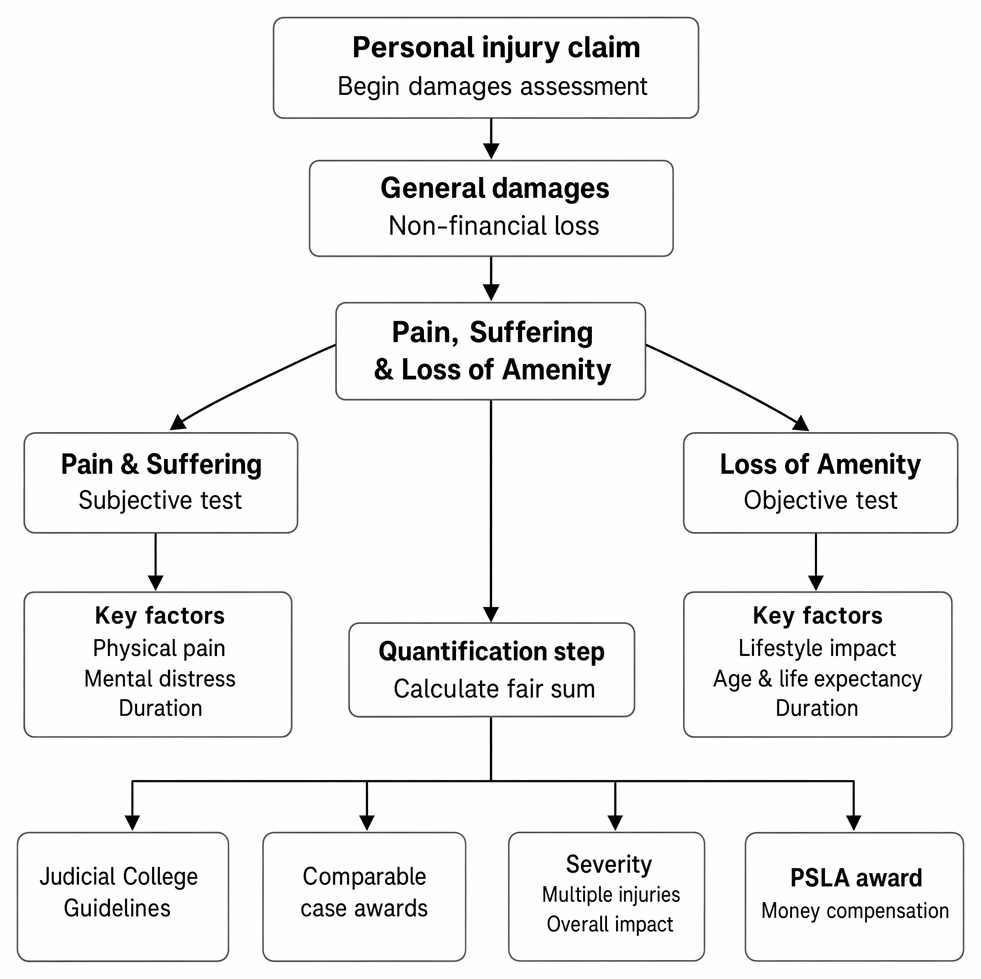
Assessment of PSLA general damages in personal injury claims proceeds by reference to subjective and objective tests, relevant factors, and quantification.
The courts are clear that PSLA reflects the injured person’s physical and psychological experience and the impact on their enjoyment of life. Because these matters cannot be measured in precise monetary terms, the judicial approach uses a mix of principle, case comparison, and guideline brackets to achieve fair and consistent awards. Within PSLA, two distinct but related concepts operate: “pain and suffering” (which requires conscious awareness) and “loss of amenity” (which does not). Their proper separation prevents under- or over-compensation and avoids double counting where injuries overlap.
Key Term: Pain and Suffering
Compensation awarded for the physical hurt and mental distress experienced by a claimant as a direct result of their personal injury. Key Term: Subjective Test
An assessment based on the individual's personal experience, feelings, or viewpoint, rather than external standards. Key Term: Loss of Amenity
Compensation awarded for the reduction in a claimant's ability to enjoy life, pursue activities, and participate in aspects of their pre-injury lifestyle due to their injury. Key Term: Objective Test
An assessment based on external, measurable standards or what a reasonable person would perceive, rather than the individual's personal feelings. Key Term: Judicial College Guidelines
Officially published guidelines providing recommended compensation brackets for various types of personal injuries, used by courts in England and Wales to ensure consistency in assessing general damages. Key Term: Eggshell Skull Principle
The rule that a defendant must take the claimant as found; if an injury is foreseeable, the defendant is liable for its full extent even if the severity is increased by the claimant’s pre-existing vulnerability.Test Tip: In SQE-style questions on General damages: pain, suffering, and loss of amenity, identify the legal test, the triggering fact, and the consequence before choosing between similar answer options.
COMPONENTS OF GENERAL DAMAGES: PSLA
General damages for non-pecuniary loss aim to compensate the claimant for the intangible effects of their injury. This is inherently difficult, as money cannot truly restore what has been lost in terms of physical comfort or enjoyment of life. However, the law attempts to provide a fair monetary sum. The main components are pain and suffering, and loss of amenity.
Pain and Suffering
This head of damage covers the physical pain resulting directly from the injury, any necessary medical treatment, and the psychological suffering endured by the claimant. This includes mental anguish, distress, fear, anxiety, embarrassment, and depression caused by the injury or its consequences.
The assessment of pain and suffering is largely subjective, taking into account the individual claimant's experience. Conscious awareness is central: where a claimant is unconscious, damages for pain and suffering are not awarded for that period. The leading authority supporting this distinction confirms that pain and suffering requires an ability to experience it.
Courts take into account features such as the intensity and duration of pain, whether pain is likely to be ongoing, the nature and invasiveness of treatment (including surgery), and any associated mental distress. Where life expectancy is reduced by the injury, mental suffering caused by the knowledge of that reduction can be compensated as part of pain and suffering.
Factors considered include:
- The severity and nature of the initial injury.
- The duration of pain, both past and expected future suffering.
- The invasiveness, risks, and after-effects of medical treatment.
- The extent of any mental anguish or psychological harm directly linked to the physical injury.
- The claimant's awareness of their condition (an unconscious claimant cannot experience pain and suffering for the period of unconsciousness).
- Mental suffering arising from a shortened life expectancy where supported by evidence.
The eggshell skull principle is directly relevant: if some injury was foreseeable, the defendant remains liable for the full extent of pain and suffering even if the claimant’s vulnerabilities significantly increased its severity. A predisposition to psychiatric symptoms, or greater susceptibility to pain, does not reduce the award if the injury is compensable.
Loss of Amenity
Loss of amenity refers to the reduction in the claimant's ability to enjoy life, engage in activities, and pursue hobbies or interests due to their injury. It focuses on the loss of lifestyle. It includes diminished capacity to participate in family life, socialising, sports or leisure activities, as well as loss of senses (taste, smell, sight, hearing), impaired sexual function, fertility consequences, scarring and disfigurement’s impact on confidence, and loss of marriage prospects or personal relationships.
Unlike pain and suffering, loss of amenity is assessed objectively. The court considers the extent to which the claimant's life has been affected, regardless of whether the claimant is fully aware of the loss (e.g., an unconscious claimant still suffers a loss of amenity). The award reflects what a reasonable person would say has been lost by virtue of the disability or restriction, taking account of the claimant’s age, lifestyle, and pre-injury activities.
Factors considered include:
- The claimant's age and pre-injury lifestyle, hobbies, and activities.
- The impact of the injury on work, social life, family life, and leisure pursuits.
- The duration of the loss of amenity, including any future limitations.
- Loss of senses (e.g., sight, hearing, smell, taste) and their practical and social effects.
- Impact on sexual function, fertility, body confidence, scarring and disfigurement.
- Impact on marriage prospects or personal relationships.
- The claimant’s overall independence and need for assistance in daily tasks.
As with pain and suffering, the eggshell skull principle applies: provided the injury itself was foreseeable, the defendant is liable for the full objective loss of amenity even if it is greater because of the claimant’s characteristics. Objectivity ensures awards for loss of amenity are available even where the claimant remains unaware (e.g., due to a vegetative state), although awareness will still be relevant to pain and suffering.
Worked Example 1.1
Aisha, a 25-year-old professional dancer, suffers a severe leg fracture in a road traffic accident caused by David's negligence. The injury requires multiple surgeries, causes significant ongoing pain, and prevents her from ever dancing professionally again. She also develops clinical depression as a result. What elements of PSLA might Aisha claim for?
Answer:
Aisha can claim for:
- Pain and Suffering: Covering the pain from the fracture, surgeries, ongoing discomfort, and her diagnosed depression (mental suffering). This is assessed subjectively based on her experience.
- Loss of Amenity: Covering her inability to pursue her dancing career, loss of enjoyment from this activity, impact on her social life, and potentially other activities she can no longer enjoy. This is assessed objectively based on the impact on her lifestyle, considering her age and profession.
Worked Example 1.2
Ben, aged 60, suffers a moderate whiplash injury in a car accident, causing pain for 12 months and restricting his ability to play golf, his main hobby. Chen, aged 30, suffers an identical whiplash injury, also causing pain for 12 months, but it prevents her from participating in her main hobby, competitive rock climbing. Are their PSLA awards likely to be the same?
Answer:
Likely not identical. While their pain and suffering might be assessed similarly based on the 12-month duration, their loss of amenity awards could differ. Chen's inability to pursue competitive rock climbing might be viewed as a greater loss of amenity given her age and the nature of the activity compared to Ben's restriction from golf, potentially leading to a higher overall PSLA award for Chen, even if their physical injury descriptions are similar. The objective assessment of LoA considers the specific impact on their individual lifestyles.
Worked Example 1.3
Harvey suffers a head injury and is unconscious for 10 days, then regains consciousness with moderate headaches for another six weeks. He cannot enjoy his usual activities during a three‑month recovery. How would PSLA be assessed for the unconscious period and thereafter?
Answer:
Harvey cannot claim pain and suffering for the 10 days of unconsciousness, as that head requires conscious awareness. He can claim pain and suffering for the six weeks of headaches and associated treatment, assessed subjectively. He can also claim loss of amenity for the whole three‑month period, including the unconscious period, assessed objectively to reflect his inability to enjoy normal life.
ASSESSMENT AND QUANTIFICATION
Quantifying damages for PSLA is challenging. Courts aim for consistency and fairness, relying on established principles and guidelines. The overall award for PSLA is usually presented as a single, combined figure encompassing pain and suffering and loss of amenity. Separating the conceptual components helps focus the assessment, but the court ultimately avoids artificial precision.
Judicial College Guidelines
To aid consistency, the judiciary refers to the Judicial College Guidelines for the Assessment of General Damages in Personal Injury Cases. These guidelines provide brackets (ranges of suggested awards) for different types of injuries based on severity and impact. They include categories for head injury, psychiatric injury, neck and back injuries, limb injuries, sensory loss, scarring, and more. Practitioners and courts also consult reported cases (and practitioner texts) to cross-check where an injury sits within a bracket in light of particular features.
While not binding, these guidelines are highly influential and provide a starting point for valuing PSLA claims. The specific award within a bracket depends on the individual circumstances, considering factors like the claimant's age, the severity and duration of pain, the extent of disability, prognosis, scarring, disfigurement, loss or impairment of senses, and the impact on lifestyle. The JCG brackets are periodically revised to reflect judicial trends and general changes in the valuation of injuries.
In certain road traffic whiplash claims arising after 31 May 2021, PSLA may be subject to fixed statutory tariffs under the Civil Liability Act 2018 and the Whiplash Injury Regulations 2021, rather than JCG brackets. The tariff regime now needs to be read with care: one tariff table applies to qualifying accidents from 31 May 2021 up to 30 May 2025, and a later amended table applies to qualifying accidents on or after 31 May 2025. In each case, the tariffs reflect injury duration and whether minor psychological injury is present. Outside tariff claims, JCG brackets remain the primary reference.
Case Precedent
Courts also consider awards made in previously decided cases involving similar injuries. This helps maintain consistency and ensures that awards reflect current judicial thinking on the value of different types of injury and their consequences. Precedents assist in calibrating placement within or between JCG brackets, especially where particular features (e.g., unique lifestyle impact, unusual treatment pathways, complex scarring, psychiatric comorbidity) justify moving up or down within a range.
Pain and Suffering: Conscious Awareness and Subjective Assessment
Pain and suffering depends on the claimant’s conscious experience. Awards cover physical pain, unpleasant symptoms, distress associated with treatment (including fear of surgery or medical procedures), mental anguish linked to the injury (for example, embarrassment due to a stoma), and—where supported by evidence—the mental suffering arising from the knowledge of reduced life expectancy. If a claimant is unconscious for a period, they cannot recover pain and suffering for that time, though they may recover for the period before and after.
The overall subjective assessment considers:
- extent of physical and mental suffering over time, including flare-ups and residual symptoms.
- intensity and frequency of pain episodes.
- treatment burden and complications (e.g., infections, second surgeries).
- side effects of medication or rehabilitation.
- fear and anxiety related to medical procedures and prognosis.
Loss of Amenity: Objective Assessment
Loss of amenity is an objective assessment of diminished enjoyment of life. It may be significant even in injuries with limited pain if they severely restrict independence or core activities (e.g., permanent loss of smell altering enjoyment of food and social experiences, or hand injuries preventing a pianist from playing). By its nature, loss of amenity can be awarded even while the claimant is unaware of the loss (e.g., in a coma), because the focus is on the reduction in the capacity to enjoy life, not on subjective experience.
In assessing loss of amenity, courts weigh:
- the claimant’s age and expected remaining years of active life.
- the centrality of particular activities to the claimant’s identity or career (e.g., elite athlete versus casual hobbyist).
- the permanence of restrictions (lifelong versus temporary).
- losses of independence (needing assistance with personal care, mobility, household tasks).
- social consequences (withdrawal from communal life, reduced interactions).
- sensory deprivation and disfigurement’s practical and social implications.
Factors Influencing the Award
The final amount awarded for PSLA is determined by considering:
- Severity: More severe injuries attract higher awards, particularly where they cause substantial disability or disfigurement, or where sensations or functions are permanently lost.
- Duration: Longer periods of suffering or permanent disability result in higher awards. Temporary injuries with full recovery will attract less than permanent conditions.
- Impact: The greater the impact on the claimant's life, work, and enjoyment (including hobbies, relationships, and independence), the higher the award.
- Age: A younger claimant suffering permanent disability may receive a higher award for loss of amenity due to the longer period of loss; conversely, particular losses may be more keenly felt at certain ages (e.g., fertility at childbearing age).
- Psychiatric overlay: Recognised psychiatric injury in addition to physical injury (e.g., PTSD) can justify an uplift, often addressed by allocating an appropriate guideline bracket for psychiatric injury in conjunction with the physical injury bracket, while ensuring the overall award remains coherent and avoids double counting.
- Scarring and disfigurement: Visible scarring, especially on the face, and its psychological impact can increase PSLA awards; sensitivity to cultural and personal factors is important.
- Treatment effects: Multiple surgeries, complications, or long rehabilitation may raise awards.
Where a claimant suffers multiple injuries, the court avoids simply adding up individual awards. It assesses the overall impact and awards a total sum reflecting the combined effect, often somewhat less than a pure total to avoid double counting overlapping pain and overlapping amenity losses. The court typically begins with the most significant injury’s bracket and then adjusts upward to reflect additional distinct injuries and their separate impact.
Restrictions and Special Points
- Instantaneous death: PSLA is only recoverable by the estate under the Law Reform (Miscellaneous Provisions) Act 1934 for the period prior to death when pain and suffering or loss of amenity was experienced. If death is instantaneous, no PSLA is recoverable due to the absence of conscious suffering and quantifiable loss prior to death. If there was a short period of conscious suffering (including fear), an award may be made for that period, supported by evidence.
- Anxiety about future disease: Anxiety without a recognised psychiatric condition and symptomless conditions such as pleural plaques, in isolation, are not compensable non-pecuniary losses. A bare risk of future disease does not attract damages for pain, suffering, or loss of amenity. In appropriate cases involving a significant risk of future disease, the court may consider provisional damages for future deterioration—this is separate from PSLA for current injury and does not convert mere anxiety into a compensable head.
- Eggshell skull: If the type of injury was foreseeable, the defendant remains liable for the full extent of that injury and its PSLA, even if severity is increased by the claimant’s pre-existing condition or vulnerability.
Worked Example 1.4
Nasreen suffers severe injuries in an accident and dies at the scene. Her family brings a claim via her estate for PSLA and also a dependency claim. Can PSLA be recovered for Nasreen’s estate?
Answer:
PSLA under LR(MP)A 1934 is recoverable only for pain and suffering and loss of amenity experienced prior to death. If death was instantaneous, there was no period of conscious suffering and therefore no PSLA for the estate. The separate FAA 1976 dependency claim and bereavement award (where applicable) are distinct and do not include PSLA. If evidence showed Nasreen was briefly conscious and experienced suffering, a modest PSLA award could be recoverable for that period.
Worked Example 1.5
Elliot was negligently exposed to asbestos and developed pleural plaques without symptoms. He is anxious about developing future disease but has no recognised psychiatric diagnosis. Is Elliot entitled to PSLA?
Answer:
No. Symptomless pleural plaques and anxiety alone, without a recognised psychiatric illness, do not attract PSLA. Anxiety about a future risk is not compensable as pain and suffering or loss of amenity. If, in future, a recognised asbestos-related disease develops, PSLA for that disease would be assessed at that time (and provisional damages may be relevant in appropriate cases).
Overall Awards and Avoiding Double Counting
Courts emphasise that PSLA is a single award. It is built from the separate considerations of “pain and suffering” and “loss of amenity” but presented as one figure. In multi-injury cases, care must be taken not to count the same consequences twice. For example, where scarring leads to both pain during healing and lasting self-consciousness affecting social life, both features are relevant, but the overall award must fairly reflect the combined effect rather than adding distinct sums mechanically.
Assessors commonly anchor the valuation to the most serious injury’s JCG bracket and then increase the figure to reflect additional distinct injuries and their separate impact.
Worked Example 1.6
Priya sustains three injuries in a collision: a serious wrist fracture requiring fixation, a moderate whiplash with headaches for three months, and facial scarring causing embarrassment. How should PSLA be assessed?
Answer:
The court would likely anchor the award in the JCG bracket for the serious wrist fracture, then adjust upwards to reflect the distinct pain and amenity loss from the whiplash (short-lived but inconvenient) and the scarring’s impact on confidence and social life. The overall figure would be less than the pure sum of separate guideline awards to avoid double counting overlapping effects (e.g., overlapping pain and combined social limitations), but higher than a wrist-only award.
Evidence and Presentation
Evidence for PSLA typically includes medical reports (orthopaedic, neurological, psychiatric where relevant), operative notes and imaging, pain diaries or accounts of symptoms, and witness statements from family or friends about the loss of amenity. Photographs can be important for scarring. Where reduced life expectancy is relevant to mental suffering, expert evidence on prognosis is required to support that the knowledge of shortened life has caused distress. In whiplash tariff cases, medical evidence must confirm that a whiplash injury as defined by the regulations was sustained, and duration determines the appropriate tariff.
Worked Example 1.7
Luca, aged 22, loses his sense of smell and taste permanently after a head injury. He experiences little ongoing pain but finds food enjoyment and social occasions diminished. How would PSLA be assessed?
Answer:
Pain and suffering would be modest due to limited ongoing pain, but loss of amenity would be significant given the permanent loss of senses and its pervasive effect on daily enjoyment and social experiences. The award would be anchored in the JCG sensory loss bracket, adjusted for Luca’s age and lifestyle (a longer period of loss, and particular impact on social life), resulting in a higher PSLA figure than one focused on pain alone.Exam Warning: Remember that PSLA damages are distinct from special damages (past financial losses) and future pecuniary losses (like future loss of earnings or care costs). While a severe injury impacting amenity might also lead to significant future financial loss claims, the PSLA award specifically compensates for the non-financial impact of the injury itself. Ensure you can distinguish between these heads of damage in assessment scenarios.
Key Point Checklist
This article has covered the following key knowledge points:
- General damages compensate for non-financial losses in personal injury claims.
- The main components are Pain and Suffering (PS) and Loss of Amenity (LoA), collectively PSLA.
- Pain and Suffering covers physical pain and mental distress, assessed subjectively and requiring conscious awareness.
- Loss of Amenity covers the reduced ability to enjoy life and activities, assessed objectively and available even if the claimant is unaware of the loss.
- Quantification relies on the Judicial College Guidelines and case precedent for consistency; whiplash tariffs apply in defined RTA cases.
- Factors like injury severity, duration, impact on lifestyle, age, psychiatric overlay, scarring, and treatment influence the award amount.
- Awards for multiple injuries are assessed as a whole to avoid double counting.
- PSLA in fatal cases is recoverable for pre-death conscious suffering; instantaneous death means no PSLA for the estate.
- Anxiety about future disease without recognised psychiatric injury, and symptomless conditions such as pleural plaques, do not attract PSLA.
- The eggshell skull principle means defendants are liable for the full extent of PSLA even if severity is increased by the claimant’s vulnerabilities.
Key Terms and Concepts
- Pain and Suffering
- Subjective Test
- Loss of Amenity
- Objective Test
- Judicial College Guidelines
- Eggshell Skull Principle