Learning Outcomes
This article outlines the procedural response to civil claims under the CPR, including:
- Response deadlines following deemed service, including CPR 15.5 agreed extensions and out-of-jurisdiction time limits
- Procedural responses and their legal effects—admission, Acknowledgment of Service, Defence, and jurisdiction challenge—and tactical considerations
- A Defence compliant with CPR 16.5 and PD 16, including admissions, denials (with reasons or alternatives), non‑admissions, and positive defences such as limitation, set‑off or contributory negligence
- Counterclaims under CPR Part 20 (including against non‑parties with permission), service and timing implications, and the claimant’s obligation to defend the counterclaim
- Default Judgment under CPR Part 12, availability and request procedures, and interest on specified sums
- Setting aside default judgment under CPR 13.2–13.3, including mandatory vs discretionary grounds, promptness, and the “real prospect of success” test
- Jurisdiction challenges under CPR Part 11, including AoS disputing jurisdiction, application timing, and avoiding submission to the court’s jurisdiction
SQE1 Syllabus
For SQE1, you are required to understand how to respond to civil claims under the CPR, including acknowledging service, filing a defence and/or counterclaim, managing time limits, default judgment and set‑aside, and disputing jurisdiction, with a focus on the following syllabus points:
- The defendant’s choices on receipt of proceedings: admitting, acknowledging service, defending, or disputing jurisdiction.
- Time limits: 14 days for AoS/Defence following deemed service of the Particulars of Claim; automatic extension to 28 days on filing AoS; agreed extensions of up to 28 days under CPR 15.5; different deadlines when served out of the jurisdiction.
- The purpose, content and consequences of an Acknowledgment of Service under CPR Part 10, including the “contest jurisdiction” option and the timetable for a Part 11 application.
- Defence drafting under CPR 16.5 and PD 16, including the effect of silence (deemed admissions) and the particular treatment of money claims.
- Counterclaims and other Part 20 claims: when permission is needed, service and response, and the interface with case management.
- Default judgment under CPR Part 12: availability, exclusions, procedures for specified and unspecified claims, and interest calculations.
- Setting aside default judgment under CPR Part 13: mandatory and discretionary grounds, promptness and the relationship to the summary judgment test.
- Practical operation of the response pack (N9, N9A/N9C, N9B/N9D) and filing routes (e.g., CE‑File and Money Claim Online where applicable).
Test Your Knowledge
Attempt these questions before reading this article. If you find some difficult or cannot remember the answers, look more closely at that area during your revision.
-
A defendant is served with a Claim Form and Particulars of Claim on Tuesday 2nd May. Assuming no bank holidays, what is the latest date the defendant must file either an Acknowledgment of Service or a Defence to avoid the claimant potentially entering default judgment?
- a) Tuesday 16th May
- b) Wednesday 17th May
- c) Tuesday 23rd May
- d) Tuesday 30th May
-
Which of the following actions automatically extends the time limit for filing a Defence from 14 days to 28 days after deemed service of the Particulars of Claim?
- a) Sending a letter to the claimant requesting more time.
- b) Filing an application with the court for an extension.
- c) Filing a valid Acknowledgment of Service within 14 days.
- d) Filing a Defence admitting only part of the claim.
-
If a defendant fails to respond to an allegation in the Particulars of Claim when filing their Defence, what is the usual consequence under the CPR?
- a) The allegation is automatically denied.
- b) The claimant must prove the allegation at trial.
- c) The defendant is deemed to have admitted the allegation.
- d) The court will strike out the allegation.
Introduction
Once court proceedings have been validly commenced and the Claim Form and Particulars of Claim have been served, the defendant is required to respond formally. Failure to do so within the prescribed time limits can have severe consequences, potentially leading to judgment being entered against the defendant without the merits of the case ever being considered by the court. This article examines the procedural steps and options available to a defendant upon receipt of a claim, focusing on acknowledging service, filing a defence, and initiating a counterclaim.
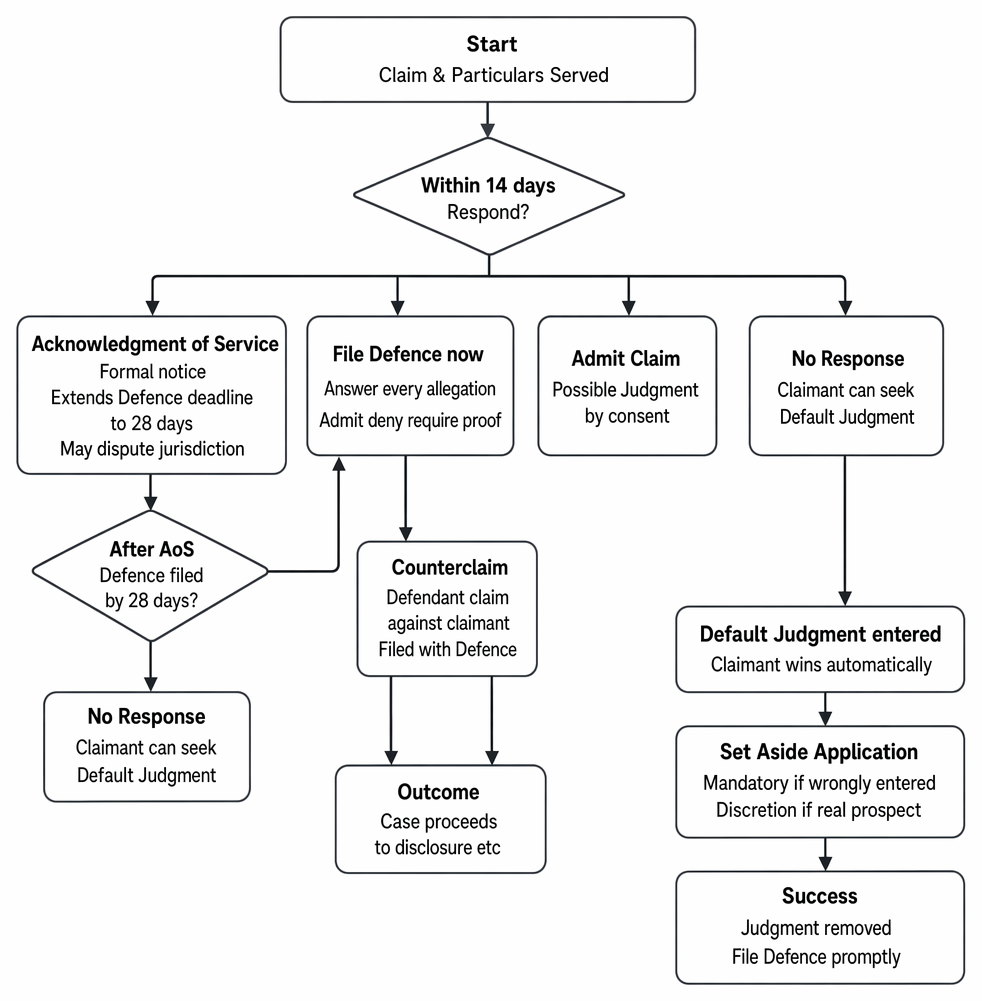
Procedural responses to a served claim and particulars, and the consequences for defence, counterclaim, default judgment and set aside.
Efficient, rule‑compliant responses support the overriding objective by narrowing issues early, enabling proportionate case management and encouraging resolution. Even at this stage, procedural choices are often tactical: an Acknowledgment of Service may be deployed to secure time to investigate facts, an early admission may limit costs and interest, a jurisdiction challenge may avoid litigation in the wrong forum, and a well‑targeted counterclaim may bring all disputes into a single proceeding.
Responding to the Claim Form and Particulars of Claim
Upon deemed service of the Particulars of Claim (whether included in the Claim Form or served separately), the defendant enters a critical timeframe governed by the Civil Procedure Rules (CPR). The defendant must choose one of several formal responses within this period to avoid the claimant obtaining judgment by default.
Time Limits for Response
The general rule under CPR Part 15 is that the period for filing a defence is 14 days after deemed service of the Particulars of Claim (CPR 15.4(1)(a)). However, this period can be extended.
If the defendant files an Acknowledgment of Service under CPR Part 10 within the initial 14‑day period, the time limit for filing the defence is extended to 28 days after deemed service of the Particulars of Claim (CPR 15.4(1)(b)).
Key Term: Relevant Period
In the context of responding to a claim, this generally refers to the initial 14-day period after deemed service of the Particulars of Claim within which the defendant must file either an Acknowledgment of Service or a Defence. Filing an Acknowledgment of Service extends the period for filing the Defence to 28 days.
In addition to the automatic extension triggered by a valid AoS, the parties may agree in writing to extend the time for filing a Defence by up to a further 28 days without court permission (CPR 15.5). Any such agreement must be notified to the court in writing. This agreed extension operates on top of the ordinary deadline that applies (i.e., beyond the 14‑day baseline or the 28‑day timeline where an AoS has been filed).
It is important to calculate these deadlines accurately, starting from the date of deemed service. Weekends and bank holidays count unless the period specified is 5 days or less (CPR 2.8(4)). If the deadline falls on a day the court office is closed, the deadline extends to the next day the office is open (CPR 2.8(5)). Particular care is needed if the Particulars of Claim are served separately from the Claim Form, as the defence timetable runs from deemed service of the Particulars, not the Claim Form.
Different response periods apply if the claim is served out of the jurisdiction. Unless the court orders otherwise, a defendant served out of the UK generally has longer to respond (commonly 21 days for an Acknowledgment of Service and 35 days for a Defence after service of the Particulars of Claim). Always check CPR Parts 6 and 15 and any relevant order for any claim served outside England and Wales.
Exam Warning: Missing the deadline to respond can allow the claimant to apply for judgment in default. Always calculate deadlines meticulously from the date of deemed service of the Particulars of Claim, not the Claim Form (if served separately).
Options for Response
The defendant typically has three main procedural options:
- Admit the claim: Accept liability for all or part of the claim (CPR Part 14).
- File an Acknowledgment of Service: Indicate an intention to defend the claim or dispute jurisdiction, thereby extending the time to file a defence (CPR Part 10).
- File a Defence: Formally contest the allegations made in the Particulars of Claim (CPR Part 15).
Additionally, the defendant might incorporate a Counterclaim within their Defence (CPR Part 20). Failure to take any of these steps can lead to Default Judgment (CPR Part 12).
Where a Response Pack has been supplied, use the correct standard forms:
- N9 Acknowledgment of Service
- N9A Admission (specified money claims)
- N9C Admission (unspecified claims or non‑money)
- N9B (specified) / N9D (unspecified or non‑money) Defence and Counterclaim
Using the correct form streamlines court processing and helps avoid avoidable defects.
Worked Example 1.1
A defendant is deemed served with Particulars of Claim on Wednesday, 7th June. They need more time to prepare their Defence. What is the latest date they must file an Acknowledgment of Service, and what will the new deadline be for filing the Defence?
Answer:
The initial 14-day period for responding ends on Wednesday, 21st June (counting clear days from 7th June). The defendant must file the Acknowledgment of Service by 4 pm on 21st June. Filing the AoS extends the time for filing the Defence to 28 days from the deemed service date (7th June). The new deadline for the Defence will be Wednesday, 5th July.
Worked Example 1.2
After filing an Acknowledgment of Service in time, the defendant becomes aware that they need further time to obtain expert input. Can the defence deadline be extended further without a court application?
Answer:
Yes. Under CPR 15.5 the parties may agree in writing to extend the time for filing the defence by up to 28 days without a court order. The defendant should seek the claimant’s written agreement and notify the court of the agreed extension. If granted, this extension runs in addition to the 28‑day period following the AoS.
Acknowledging Service
Filing an Acknowledgment of Service (AoS) is a formal notification to the court and the claimant that the defendant has received the claim and intends to respond.
Purpose and Effect
The primary effects of filing an AoS under CPR Part 10 are:
- Preventing Default Judgment: It stops the claimant from immediately obtaining judgment in default after the initial 14‑day period expires.
- Extending Time: It extends the deadline for filing a defence from 14 days to 28 days after deemed service of the Particulars of Claim.
- Indicating Intent: It signals whether the defendant intends to defend the claim (all or part) or dispute the court’s jurisdiction.
Key Term: Acknowledgment of Service
A formal court document filed by a defendant within 14 days of service of the Particulars of Claim, indicating receipt of the claim and their intention to either defend it or contest jurisdiction, thereby extending the time limit for filing a defence to 28 days.
If the defendant ticks the box to contest jurisdiction, a Part 11 application must be issued within 14 days after filing the AoS. Until the jurisdiction challenge is decided, the defendant should not file a Defence (as doing so will usually amount to submitting to the jurisdiction). If the application fails, the court will give directions for filing a defence promptly.
Procedural Steps
- Use Correct Form: Complete Form N9 (or the AoS module online where available) with accurate party details and the chosen option (defend/contest jurisdiction).
- File within Time: File the AoS at court within 14 days of deemed service of the Particulars of Claim (CPR 10.3(1)). Serve a copy on the claimant if required.
- Indicate Intention: Specify whether you intend to:
- Contest the jurisdiction (CPR 11).
- Defend the whole or part of the claim (CPR 15).
Practical points:
- Ensure the address for service and reference numbers are correct to avoid misfiling.
- If acting through solicitors, make sure authority to act is clear and recorded.
Worked Example 1.3
A defendant served in England believes the contract contains a valid exclusive jurisdiction clause in favour of another country’s courts. They file an AoS indicating an intention to contest jurisdiction on Day 10. By when must they issue their Part 11 application, and should they file a Defence at the same time?
Answer:
They must issue the Part 11 application within 14 days of filing the AoS. They should not file a Defence before the jurisdiction challenge is determined, as doing so could amount to submitting to the jurisdiction of the English court.
Filing a Defence
The Defence is the defendant's formal written response to the allegations set out in the Particulars of Claim. It is a key document that defines the issues in dispute.
Purpose and Content (CPR 16.5)
The Defence must address each allegation in the Particulars of Claim, stating clearly:
- Which allegations are admitted.
- Which allegations are denied.
- Which allegations the defendant is unable to admit or deny, but requires the claimant to prove (often referred to as 'putting the claimant to proof').
Importantly, where an allegation is denied, the defendant must state their reasons for the denial and, if they intend to put forward a different version of events, state their own version (CPR 16.5(2)). Failure to deal with an allegation will result in the defendant being deemed to admit it (CPR 16.5(5)), except for allegations relating to the amount of money claimed (CPR 16.5(4)).
Key Term: Defence
A formal statement of case filed by the defendant setting out their response to the allegations in the Particulars of Claim, indicating which allegations are admitted, denied (with reasons), or require proof.
Positive defences and other essential content:
- Affirmative defences: Raise any standalone defences such as limitation, contractual exclusion/force majeure, illegality, or immunity at this stage; these are usually lost if not pleaded.
- Set‑off and abatement: If claiming set‑off against a money claim, plead the legal basis and amount (CPR 16.6), and set out the facts supporting it.
- Contributory negligence: Where applicable (e.g., negligence claims), plead particulars.
- Mitigation: If alleging failure to mitigate, set out the relevant facts.
- Payment and accord: Plead discharge by payment; attach or refer to any documents evidencing settlement or accord and satisfaction.
As well as contesting liability, the Defence should respond to the claimant’s case on causation and quantum, identifying which heads of loss are admitted, denied or not admitted, and giving brief reasons.
Where the Particulars of Claim annex a contract, any alternative construction of the contract should be pleaded succinctly with reference to the relevant clauses. If the contract is oral or partly oral, plead the material terms and factual matrix at a proportionate level of detail.
Revision Tip: When drafting or reviewing a Defence, methodically go through each paragraph of the Particulars of Claim. Ensure every point is addressed with an admission, denial (plus reasons/alternative facts), or a statement requiring proof. Missing an allegation can be treated as an admission.
Statement of Truth
Like the Particulars of Claim, the Defence must be verified by a statement of truth signed by the defendant or their legal representative (CPR 22.1).
Key Term: Statement of Truth
A declaration required on certain court documents (including statements of case like the Defence) confirming the party believes the facts stated in the document are true. Making a false statement verified by a statement of truth can lead to contempt of court proceedings.
Worked Example 1.4
The Particulars of Claim alleges in paragraph 4: "The Defendant drove negligently by exceeding the speed limit of 30mph." The Defendant admits they were driving but disputes they were speeding or negligent. How should the Defence respond to paragraph 4?
Answer:
The Defence should state: "Paragraph 4 is denied. The Defendant admits driving the vehicle at the time and place alleged but denies driving negligently or exceeding the speed limit. The Defendant was driving at approximately 25mph in accordance with prevailing road conditions." This denies the core allegation (negligence/speeding), gives reasons (was driving below limit), and provides an alternative version of events (driving at 25mph). Practical drafting pointers:
- Keep the Defence concise and issue‑focused.
- Avoid bare denials; give short reasons and any alternative case.
- If more time is needed for evidence, consider using CPR 15.5 to agree a short extension rather than filing an underdeveloped Defence.
Making a Counterclaim
A defendant may have their own claim against the claimant arising out of the same or related facts. They can bring this claim within the existing proceedings by making a Counterclaim.
Purpose and Procedure (CPR Part 20)
A Counterclaim allows the defendant to seek remedies against the claimant without starting separate proceedings.
- It is usually included in the same document as the Defence (CPR 20.4(1)).
- No court permission is needed if filed with the Defence (CPR 20.4(2)(a)). Permission is required if filed at a later stage.
- The Counterclaim must set out the details of the defendant's claim against the claimant, similar to Particulars of Claim.
- A court fee is payable on issuing a counterclaim.
Key Term: Counterclaim
A claim brought by a defendant against the claimant within the same proceedings, typically included with the Defence.
If the defendant wishes to counterclaim against a person who is not already a party, they require the court’s permission and an order adding that person (CPR 20.5). Once a Counterclaim is served, the claimant must file a Defence to the Counterclaim within 14 days of service (CPR 15.8), unless the parties agree an extension or the court orders otherwise.
Tactical considerations:
- A counterclaim can secure a single, coherent determination of intertwined disputes, saving time and costs.
- The scope of disclosure, expert evidence and trial length may expand; budget and track allocation may be affected.
Failing to Respond: Default Judgment
If a defendant fails to file an AoS or a Defence within the relevant time limits (14 days, or 28 days if AoS filed), the claimant may apply to the court for judgment in default under CPR Part 12.
Grounds and Procedure
The claimant can obtain default judgment if:
- The defendant has not filed an AoS or a Defence by the deadline (CPR 12.3(1)).
- Where an AoS was filed, the defendant has not filed a Defence by the extended deadline (CPR 12.3(2)).
The method of obtaining default judgment depends on the type of claim:
- For specified amounts, the claimant may request judgment for the amount due, accrued interest to the date of judgment, fixed costs, and issue fee (usually by Form N225 or online).
- For unspecified amounts, the court enters judgment on liability, with the amount of damages to be assessed later (often at a disposal hearing).
Default judgment is not available in certain cases (e.g., where the claim is for delivery of goods under a regulated agreement or the claim is brought under Part 8). It is also inappropriate where the time for responding has not yet expired or where the defendant has in fact filed in time.
Key Term: Default Judgment
A judgment entered against a defendant who has failed to respond to a claim (either by filing an Acknowledgment of Service or a Defence) within the time limits prescribed by the CPR.
Interest on specified money claims:
- If interest is claimed, provide an up‑to‑date interest calculation and a daily rate to enable the court to enter an accurate sum without further hearing.
Multiple defendants:
- Default judgment can be sought against a defaulting defendant even if co‑defendants have acknowledged or defended, subject to the nature of the relief claimed.
Setting Aside Default Judgment (CPR Part 13)
A defendant against whom default judgment has been entered can apply to the court to have it set aside (cancelled).
-
Mandatory Grounds (CPR 13.2): The court must set aside a judgment entered wrongly (e.g., if entered before the deadline expired, or after the defendant had already filed an AoS/Defence, or if the claim was already paid).
-
Discretionary Grounds (CPR 13.3): The court may set aside judgment if:
- The defendant has a real prospect of successfully defending the claim; OR
- There appears to be some other good reason why the judgment should be set aside or varied, or why the defendant should be allowed to defend the claim.
-
Promptness: In exercising its discretion, the court must consider whether the application to set aside was made promptly (CPR 13.3(2)).
The merits threshold under CPR 13.3(1)(a) mirrors the summary judgment test: a “real prospect of success” is more than fanciful. The court will also consider the reasons for the default and any prejudice to the parties. Where the application succeeds, the court may impose conditions, such as payment into court.
Key Term: Set Aside
A court order cancelling or invalidating a previous judgment or order, such as a default judgment.
Worked Example 1.5
Default judgment for £15,000 was entered against Dave because his Defence was filed one day late due to a solicitor's oversight. Dave has evidence showing he does not owe the money. Should Dave apply to set aside the judgment, and on what grounds?
Answer:
Yes, Dave should apply promptly under CPR 13.3. He cannot use the mandatory ground (CPR 13.2) as the judgment wasn't entered wrongly in terms of timing. However, he can rely on the discretionary ground (CPR 13.3(1)(a)) that he has a real prospect of successfully defending the claim, supported by his evidence. He should also explain the reason for the short delay (solicitor oversight) and emphasise the promptness of his application to set aside.
Worked Example 1.6
The claimant seeks default judgment on an unspecified personal injury claim after the defendant missed the defence deadline. What order is the court likely to make?
Answer:
Judgment in default on liability with damages “to be assessed.” The court will later list a disposal or assessment hearing to determine quantum. It cannot enter a specific sum without assessment in an unspecified money claim.
Disputing Jurisdiction
If a defendant believes the courts of England and Wales do not have the legal power (jurisdiction) to hear the claim, they must follow a specific procedure under CPR Part 11.
- File an AoS indicating an intention to contest jurisdiction within 14 days of service of the Particulars of Claim.
- Make an application to the court challenging jurisdiction within 14 days after filing the AoS, supported by evidence (e.g., a governing law/jurisdiction clause, absence of sufficient connection with the forum, or service defects).
- Avoid filing a Defence before the application is determined; doing so may be treated as submitting to the jurisdiction.
If the challenge is successful, the court may set aside the claim form/service, stay the proceedings, or make any other appropriate order. If unsuccessful, the defendant must file a Defence by the date directed by the court, often within a short period.
Procedural tips:
- Evidence of the jurisdiction clause or the applicable choice‑of‑court agreement should be exhibited.
- Where service is contested (e.g., invalid method or place of service), identify the specific service rule infringed (CPR Part 6).
Key Point Checklist
This article has covered the following key knowledge points:
- A defendant must respond to the Particulars of Claim within 14 days of deemed service.
- Filing an Acknowledgment of Service within 14 days extends the time for filing a Defence to 28 days.
- The time for filing a Defence can be extended by written agreement under CPR 15.5 by up to 28 further days without a court order; the court must be notified.
- A Defence must respond to each allegation: admitting, denying (with reasons), or requiring proof. Failure to respond can be deemed admission (with a limited exception for sums claimed).
- A defendant can make a Counterclaim against the claimant, usually filed with the Defence; permission is needed to counterclaim against a non‑party.
- Failure to file an AoS or Defence allows the claimant to apply for Default Judgment. Different procedures apply to specified and unspecified money claims.
- Default Judgment can be set aside on mandatory grounds (if wrongly entered) or discretionary grounds (real prospect of success or other good reason), with promptness being critical.
- Jurisdiction must be challenged using the specific procedure in CPR Part 11 after filing an AoS indicating this intention; filing a Defence may amount to submission.
Key Terms and Concepts
- Relevant Period
- Acknowledgment of Service
- Defence
- Statement of Truth
- Counterclaim
- Default Judgment
- Set Aside