Responding to a claim - Entering and setting aside judgment …
Learning Outcomes
This article outlines the CPR framework for entering and setting aside judgment in default, including:
- identifying when the claimant is entitled to request default judgment and checking service, time limits, and any pending applications before doing so;
- distinguishing between specified and unspecified money claims, selecting forms N225 and N227 correctly, and calculating interest and the daily rate for specified sums;
- recognising the types of claim and procedures for which default judgment is unavailable and what alternative case management steps the court may take;
- applying the mandatory grounds for setting aside irregular default judgments, particularly defective service and premature requests;
- analysing discretionary set-aside under CPR Part 13, including the “real prospect of success” test, other good reason, and the requirement of promptness;
- preparing and evaluating the evidence needed for a set-aside application, such as witness statements, draft defences, and any explanation for the default;
- predicting likely case management directions, conditional orders, and costs consequences following a successful or unsuccessful set-aside application; and
- integrating CPR Parts 12, 13 and 24 with the Denton relief-from-sanctions principles in SQE1-style multiple-choice questions and practical scenarios.
SQE1 Syllabus
For SQE1, you are required to understand the procedures and legal principles relating to default judgment and setting aside default judgment, with a focus on the following syllabus points:
- the process for entering judgment in default when a defendant does not respond to a claim
- the mandatory and discretionary grounds for setting aside default judgment under the CPR
- the time limits and procedural requirements for both entering and challenging default judgment
- the consequences of failing to comply with CPR deadlines and directions
- selecting the correct procedure and form for specified and unspecified money claims, including interest calculations
- when default judgment is unavailable (e.g. Part 8 procedure or regulated Consumer Credit claims) and alternatives
Test Your Knowledge
Attempt these questions before reading this article. If you find some difficult or cannot remember the answers, look more closely at that area during your revision.
- What are the two main grounds on which a defendant can apply to set aside a default judgment?
- If a defendant is served with a claim form and particulars of claim but does not respond, what can the claimant do?
- What must a defendant show to succeed on a discretionary application to set aside default judgment?
- Why is promptness important when applying to set aside a default judgment?
Introduction
When a defendant fails to respond to a claim within the time limits set by the Civil Procedure Rules (CPR), the claimant may apply for judgment in default. This mechanism ensures that claimants are not left waiting indefinitely for a response. However, the CPR also provides defendants with the opportunity to apply to set aside a default judgment, either on mandatory or discretionary grounds. Understanding these procedures is essential for effective civil litigation practice and for SQE1 assessment.
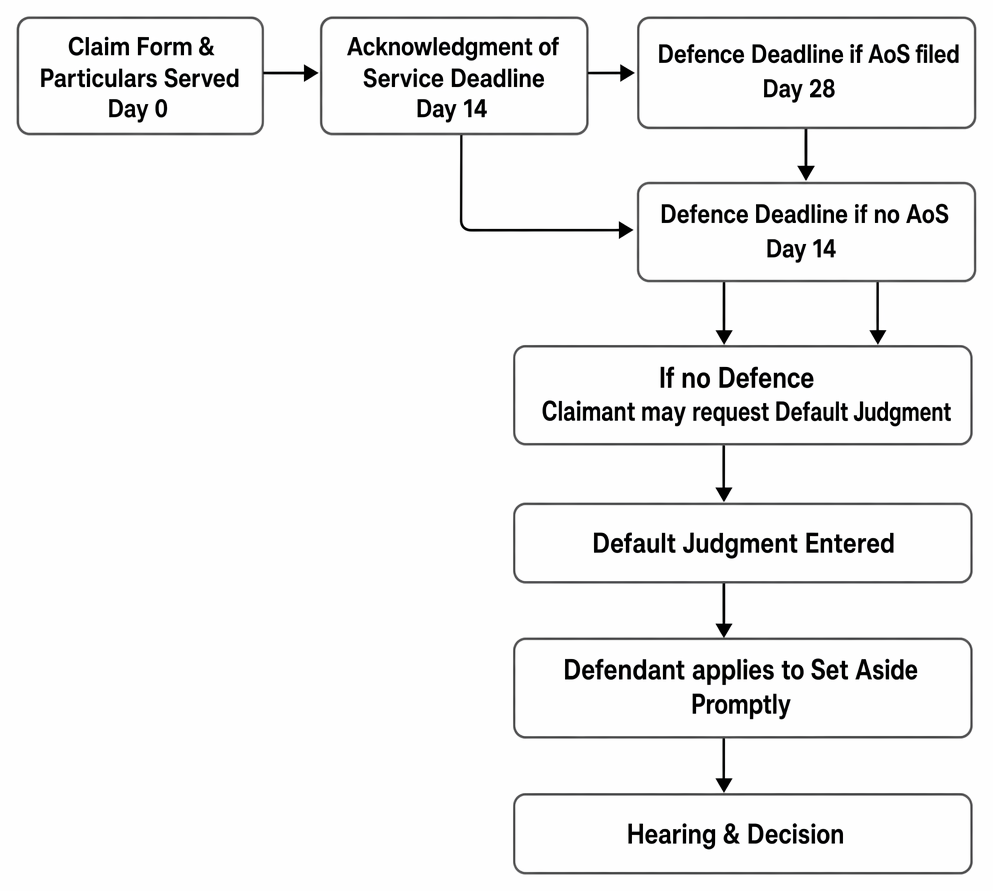
Procedural sequence from service of the claim form to default judgment and set-aside application under CPR Part 13.
Key Term: judgment in default
A court order made in favour of the claimant when the defendant fails to respond to a claim within the time limits set by the CPR. Key Term: acknowledgment of service
A short response filed by the defendant indicating receipt of the claim and extending time for defence to 28 days from service of the particulars of claim. Key Term: deemed service
The CPR rule that treats documents as served on a specific date depending on the method of service, regardless of actual receipt.
Entering Judgment in Default
If a defendant does not file an acknowledgment of service or a defence within the required time, the claimant can apply for judgment in default. This is a straightforward process, but strict compliance with the CPR is essential.
To enter judgment in default, the following conditions must be met:
- The claim form and particulars of claim must have been properly served on the defendant. Time is calculated using deemed service (for a claim form served by first-class post or DX, usually the second business day after posting; for documents other than a claim form, see the 4.30 p.m. business day rule).
- The defendant has not filed an acknowledgment of service or a defence within the relevant time limits (14 days after service of the particulars of claim; 28 days if an acknowledgment of service is filed).
- No application for summary judgment or to strike out has been made by the defendant before judgment is entered, and there is no pending jurisdiction challenge under CPR Part 11.
- Default judgment is not excluded by the nature of the claim or procedure used.
Key Term: specified claim
A claim for a fixed amount of money, such as a debt. Key Term: unspecified claim
A claim where the amount of damages is to be determined by the court, such as most personal injury claims.
The claimant applies for default judgment using the appropriate court form:
- N225 (request for judgment) for specified sums, including interest and costs
- N227 (request for judgment) where damages or an amount of money is to be decided by the court
In a specified money claim, the request must include the principal sum, interest accrued to the date of judgment, and the daily rate thereafter. Interest is typically sought under section 35A Senior Courts Act 1981 (High Court) or section 69 County Courts Act 1984 (County Court), at a rate the court considers just. The request should show the calculation (sum × rate ÷ 365 = daily rate).
Key Term: disposal hearing
A short hearing at which the court assesses the amount of damages payable following default judgment on liability in an unspecified claim.
Where a claim includes both specified and unspecified elements, the court will treat it as unspecified for default purposes, and will list a disposal hearing to assess quantum.
Default judgment may not be obtained:
- on a claim for delivery of goods under an agreement regulated by the Consumer Credit Act 1974
- using the Part 8 procedure
- where a practice direction otherwise excludes default judgment
In addition, if the defendant has filed an acknowledgment of service and made a jurisdiction challenge under CPR Part 11 within the 14-day window, default judgment should not be sought until that application is determined.
Key Term: real prospect of success
A genuine, not fanciful, chance of success. It is the same standard the court applies on summary judgment under CPR Part 24.
Worked Example 1.1
Question: A claimant serves a claim form and particulars of claim for £10,000 on a defendant. The defendant does not file an acknowledgment of service or defence within 14 days. What can the claimant do?
Answer:
The claimant can apply for judgment in default for the sum claimed, using form N225, as the defendant has failed to respond within the required time.
Worked Example 1.2
Question: The claimant posts a claim form and particulars of claim on Friday. When is the claim form deemed served and when does the defendant’s 14-day period start?
Answer:
For a claim form sent by first-class post or DX, deemed service occurs on the second business day after posting. If Friday is a business day, the second business day is Tuesday. The 14-day period runs from the deemed date of service of the particulars of claim.
Worked Example 1.3
Question: A defendant files an acknowledgment of service indicating an intention to dispute jurisdiction and issues a CPR Part 11 application within 14 days. The claimant requests default judgment because no defence has been filed by day 28. Is default judgment appropriate?
Answer:
No. A jurisdiction challenge must be determined before default judgment is entered. If default judgment is entered while the Part 11 application is pending, it will be set aside as wrongly entered.
Setting Aside Judgment in Default
A defendant who discovers that judgment in default has been entered against them may apply to have it set aside. The CPR provides two categories of grounds: mandatory and discretionary.
Key Term: set aside
The court’s power to declare a previous judgment or order invalid, so that the proceedings continue as if the judgment had not been made. Key Term: good reason
A substantial justification for the defendant’s failure to respond (e.g. serious illness, being abroad without access to documents, or genuinely not being aware of the proceedings due to circumstances beyond their control).
Mandatory Grounds
The court must set aside a default judgment if it was entered in error. This includes situations where:
- The defendant filed an acknowledgment of service or defence within the time limit, but the claimant applied for default judgment before the deadline expired.
- The defendant paid the claim in full before judgment was entered.
- The claim form or particulars of claim were not properly served.
- The defendant had already issued an application (e.g. to strike out or for summary judgment) before default judgment was entered and it was pending when the request was processed.
If the parties agreed an extension for defence under CPR 15.5 and the claimant nonetheless sought default judgment during the extended period, the judgment is irregular and must be set aside.
Discretionary Grounds
The court may set aside or vary a default judgment if:
- the defendant has a real prospect of successfully defending the claim, or
- there is some other good reason why the judgment should be set aside or varied, or the defendant should be allowed to defend the claim
The court will also consider whether the defendant applied promptly after learning of the judgment. Delay can lead to refusal of the application, even if the defendant has a real prospect of success.
Under CPR Part 13, in assessing “real prospect” the court applies the same standard as on summary judgment under CPR Part 24. After considering promptness and the grounds above, the court may also consider the three-stage analysis from Denton (seriousness/significance of the breach; reasons for the breach; all the circumstances), particularly where relief from the consequence of default is sought.
Key Term: conditional order
An order that sets aside judgment on condition (commonly payment into court or taking a specified procedural step by a deadline).
Worked Example 1.4
Question: A defendant was abroad when the claim form was served and did not respond. Judgment in default was entered. On returning, the defendant applies to set aside the judgment, explaining their absence and providing a draft defence with a real prospect of success. What is the likely outcome?
Answer:
The court is likely to set aside the default judgment on discretionary grounds, as the defendant acted promptly and has a real prospect of defending the claim.
Worked Example 1.5
Question: A claimant requests default judgment on Day 15. The defendant proves that they filed an acknowledgment of service on Day 14 (time-stamped at 16:10). What will the court do?
Answer:
The judgment is irregular and must be set aside on mandatory grounds because acknowledgment of service was filed within time.
Worked Example 1.6
Question: The defendant applies to set aside default judgment relying only on a draft defence that denies liability in bare terms and offers no factual or legal detail. They applied within 5 days of learning of the judgment. What is the likely result?
Answer:
Promptness weighs in the defendant’s favour, but a bare denial will usually not demonstrate a real prospect of success. Unless there is another good reason, the application is likely to be refused.
Procedure and Practical Points
- Applications to set aside must be made promptly. There is no fixed time limit, but any substantial or unexplained delay may be fatal. The application should be supported by a witness statement explaining the circumstances, addressing promptness, and attaching a draft defence that shows a real prospect of success.
- If the application is successful, the proceedings continue as if judgment had not been entered. Case management directions will be given for the future conduct of the claim.
- The court may impose conditions when setting aside, such as payment into court, filing a defence by a specified date, or costs orders reflecting any prejudice caused by delay.
Default judgment requests should be carefully checked against service and timing rules:
- Confirm deemed service date of the claim form and particulars of claim and calculate deadlines correctly.
- Confirm that no acknowledgment of service or defence has been filed and that no jurisdiction challenge, summary judgment, or strike-out application is pending.
- Use the correct request form (N225/N227), include an interest calculation and daily rate for specified claims, and provide the preferred hearing centre for assessment of unspecified damages.
Key Term: disposal hearing
The short hearing listed for assessment of damages where default judgment is entered on liability in an unspecified claim. Key Term: acknowledgment of service
Filing this extends the defence deadline to 28 days from service of the particulars of claim and can also be used to indicate a jurisdiction challenge.
Costs on set-aside applications
The usual costs orders include:
- Where judgment is set aside on mandatory grounds, the claimant will normally pay the defendant’s costs of the application (for having entered judgment wrongly).
- Where judgment is set aside because the defendant shows “good reason” only, costs are usually “in the case.”
- Where judgment is set aside because the defendant shows a real prospect of success but had no good reason for the default, the defendant will often be ordered to pay the claimant’s application costs.
- If the application fails, the defendant will pay the claimant’s costs of the application.
Worked Example 1.7
Question: Default judgment was entered before the defendant’s extended defence deadline agreed under CPR 15.5 expired. The defendant applies to set aside. What is the likely costs order?
Answer:
The judgment will be set aside on mandatory grounds, and the claimant will ordinarily be ordered to pay the defendant’s costs of the application.Exam Warning: If a defendant delays in applying to set aside default judgment, the court may refuse the application even if there is a defence with merit. Always act promptly.
Revision Tip: When preparing, memorise the difference between mandatory and discretionary grounds for setting aside default judgment, the impact of promptness, and the link to the Part 24 “real prospect” test. Practise interest calculations and daily rate for specified money claims.
Summary
| Step | Key Point |
|---|---|
| Entering judgment in default | Claimant can apply if defendant fails to respond within time limits after proper service. |
| Selecting the right process | Use N225 for specified sums (include interest and daily rate) and N227 for unspecified sums. |
| Claims excluded | No default judgment under Part 8, regulated Consumer Credit claims, or where an application is pending. |
| Interest | Claim interest to judgment and state the daily rate thereafter; court exercises discretion on rate. |
| Setting aside: mandatory grounds | Court must set aside if judgment was entered in error, e.g. before time expired or not served. |
| Setting aside: discretionary grounds | Court may set aside if defendant has a real prospect of success or another good reason. |
| Promptness | Applications to set aside must be made promptly; delay can be fatal. |
| Costs and conditions | Expect tailored costs orders and possible conditional set-aside (e.g. payment into court). |
Key Point Checklist
This article has covered the following key knowledge points:
- Judgment in default allows claimants to obtain judgment when a defendant fails to respond within CPR time limits.
- The correct request form is essential: N225 for specified money claims; N227 where damages or the amount is to be decided.
- Include interest to judgment and the daily rate in specified claims; the court may require a disposal hearing in unspecified claims.
- The court must set aside default judgment if it was entered in error or before the defendant’s time to respond expired, or where service was defective.
- The court may set aside default judgment if the defendant has a real prospect of success or another good reason; promptness is critical.
- The Part 24 “real prospect” test is applied on discretionary set-aside; Denton principles may inform relief where appropriate.
- Applications to set aside must be supported by evidence and a draft defence; the court may impose conditions on setting aside.
- Costs orders vary: mandatory set-aside usually leads to the claimant paying application costs; discretionary outcomes depend on reason for default.
Key Terms and Concepts
- judgment in default
- specified claim
- unspecified claim
- set aside
- real prospect of success
- good reason
- acknowledgment of service
- deemed service
- disposal hearing
- conditional order