Learning Outcomes
This article outlines the requirement to pay interest on client money under the SRA Accounts Rules, including:
- Triggers for the duty to account for a fair sum of interest under Rule 7.1 and entitlement (clients and relevant third parties)
- Alternative arrangements under Rule 7.2 and requirements of “informed consent”
- Interest policy components that produce a fair outcome: de minimis thresholds, rates, methods of calculation (e.g., daily balance), timing of payment, and treatment of long‑running matters
- Interest treatment in pooled general client accounts versus separate designated deposit client accounts (SDDCA) and the correct accounting entries in each case
- Payments of “sums in lieu of interest” from business funds, including offsets against bills and documentation of decisions
- Linked rules affecting whether interest is due and the amount (Rule 2.4 availability on demand, Rule 2.5 prompt return, Rule 3.3 prohibition on banking facilities)
- Record‑keeping evidencing interest calculations, payments or decisions not to pay (e.g., de minimis) and reconciliation within the firm’s systems and controls
- Fair and lawful treatment of special scenarios: stakeholder deposits, client’s own accounts, third‑party managed accounts, residual balances, and money held for trustees and deputies
SQE1 Syllabus
For SQE1, you are required to understand the requirement to pay interest on client money under the SRA Accounts Rules, with a focus on the following syllabus points:
- the general requirement to account for a fair sum of interest on client money (Rule 7.1)
- the possibility of agreeing alternative arrangements with the client in writing (Rule 7.2)
- the necessity and content of a firm's written interest policy
- the different treatment and accounting for interest depending on whether money is held in a general client account or a separate designated deposit client account (SDDCA)
- the specific accounting entries required for interest payments
- links with Rule 2.4 (money available on demand) and Rule 2.5 (prompt return when no longer properly held), and Rule 3.3 (no banking facilities)
- record-keeping: documenting policy decisions, calculations, de minimis application, and ledger entries tied to interest payable
Test Your Knowledge
Attempt these questions before reading this article. If you find some difficult or cannot remember the answers, look more closely at that area during your revision.
-
Under SRA Accounts Rule 7.1, when must a firm account for interest on client money?
- a) Only if the client requests it in writing.
- b) Only if the amount held exceeds £1,000.
- c) When it is fair and reasonable to do so in all the circumstances.
- d) Only when the money is held for more than 30 days.
-
A firm holds £50,000 in its general client account for Client X for six months. The firm's policy is to pay a fair sum in lieu of interest. Where do the funds for this payment primarily come from?
- a) The specific interest earned on the £50,000 within the general client account.
- b) The firm's business bank account.
- c) A deduction from the £50,000 held for Client X.
- d) The SRA Compensation Fund.
-
A firm holds £200,000 in a separate designated deposit client account (SDDCA) for Client Y. The SDDCA earns £400 interest. Who is entitled to this £400 interest?
- a) The firm.
- b) Client Y.
- c) The SRA.
- d) It is shared equally between the firm and Client Y.
Introduction
Law firms frequently hold money belonging to clients while providing legal services. This money is termed 'client money'. The Solicitors Regulation Authority (SRA) imposes strict rules, the SRA Accounts Rules ('the Rules'), to ensure this money is kept safe. A key aspect of these rules, found in Rule 7, is the obligation to account to clients for interest earned while the firm holds their funds. This prevents firms from unfairly benefiting from client money and maintains client trust. Understanding this obligation is essential for compliance and SQE1 assessment success.
Key Term: client money
Money held or received by a firm relating to regulated services delivered to a client; on behalf of a third party in relation to those services; as a trustee or holder of a specified office; or for fees and unpaid disbursements before a bill is delivered. Key Term: client account
A bank or building society account in England and Wales, held in the firm’s name and including the word ‘client’, used for holding client money separately from the firm’s own money.
The interest obligation interacts with other core principles in the Rules and the Codes of Conduct. Client money should be available on demand unless otherwise agreed in writing (Rule 2.4). Money must be returned promptly when there is no longer any proper reason to hold it (Rule 2.5). Firms must not use client accounts to provide banking facilities (Rule 3.3). All of these can affect whether interest is payable and for what period.
The Obligation to Pay Interest (Rule 7)
Rule 7.1 establishes the fundamental requirement: a firm must account to clients (or third parties for whom money is held) for a 'fair sum' of interest on any client money held on their behalf.
The fundamental principle is fairness. When a firm holds client money, the client cannot use or invest that money themselves. Therefore, it is generally fair for the client to receive some compensation in the form of interest.
The duty dovetails with the Codes of Conduct, which require firms to properly account to clients for financial benefits received as a result of their instructions. Interest earned on pooled balances is one such benefit that must be treated fairly.
Rule 7.2 permits firms to agree different arrangements with clients in writing, provided the client gives informed consent based on sufficient information. This might apply if, for instance, a client objects to receiving interest on religious grounds, or if the firm offers an alternative remuneration structure. Any opt‑out or variation should be demonstrably fair in the circumstances and transparent, and it should never be a device to deprive clients of a fair entitlement.
The obligation to pay interest applies irrespective of whether a single client’s balance would have, by itself, generated interest at the bank. The assessment is what is fair in the round taking into account the factors set out below and the firm’s policy.
Written Interest Policy
While the current Rules (2019) don't explicitly mandate a written interest policy as the previous 2011 Rules did (Rule 22.3), SRA guidance makes it clear that having one is essential for demonstrating compliance with the 'fair sum' requirement. The policy should typically specify:
- The circumstances under which interest will be paid (e.g., minimum balance, minimum time held).
- The method and rate used for calculation.
- Any 'de minimis' threshold below which interest is not paid.
- When the calculation is performed (e.g., at the end of the matter, periodically for long-term holdings).
- The base rate or benchmark rate used (e.g., an instant access rate with named UK banks), and whether simple or daily balance methods are used.
- How negative net returns or bank charges are treated (firms should not let bank charges reduce client balances; such charges are a business expense).
- The process for offsets against fees and for paying interest direct where appropriate.
Firms should communicate the policy clearly at the outset and keep it under review, especially when market rates change materially. The policy should be capable of producing a fair outcome across different types of matters and amounts held.
Calculating a 'Fair Sum'
The Rules do not define 'fair sum', leaving it to the firm's professional judgment, guided by their written policy. Key factors include:
- The amount of money held.
- The period for which the money is held (often calculated on a daily balance basis).
- Current interest rates available on comparable instant-access accounts (reflecting Rule 2.4's requirement for money to be available on demand unless agreed otherwise).
- Whether a separate designated deposit client account could reasonably and lawfully be used (with client agreement if notice is required).
- The administrative cost of calculation and payment (which informs any de minimis threshold).
Key Term: fair sum
An amount of interest paid to a client on money held by the firm, calculated reasonably based on the amount, time held, and prevailing interest rates, as outlined in the firm's policy.
A common feature of interest policies is a 'de minimis' provision.
Key Term: de minimis
A minimum threshold amount of calculated interest (e.g., £20 or £50) below which a firm will not pay interest to a client, because the administrative costs outweigh the small sum involved. The threshold must be reasonable.
Firms frequently adopt a daily calculation, applying a published comparator rate (e.g., an instant access rate) adjusted to reflect that client funds must be available on demand. Where a matter runs for many months with substantial funds, it may be fair to account periodically, not only at the end of the matter. Where a client instructs that money be held in an account with a notice period (permitted only by written agreement under Rule 2.4), the rate applied can reflect that higher-rate product.
Worked Example 1.1
A firm holds £15,000 for Client A for 60 days in its general client account. The firm’s policy states interest is paid at 1% per annum for sums over £10,000 held for more than 30 days, with a de minimis threshold of £25.
Is the firm required to pay interest to Client A?
Answer:
Calculation: (£15,000 x 1% x 60) / 365 = £24.66. This amount is below the firm's £25 de minimis threshold. Therefore, under its policy, the firm is not required to pay interest, and this would likely be considered 'fair' under Rule 7.1.
Linked rules that affect interest
- Money should be available on demand (Rule 2.4). Holding money in notice accounts without written agreement risks making any “enhanced” rate unfair to clients whose funds might be needed immediately.
- Client money must be returned promptly (Rule 2.5). If money is retained longer than necessary, clients lose the opportunity to use their funds. Even where interest is paid, unnecessary retention risks breach. The interest period should end when funds could and should have been returned.
- No banking facilities (Rule 3.3). Holding funds purely for convenience, or for personal transactions unconnected to legal services, not only breaches Rule 3.3 but can distort interest calculations and obligations.
Methods of Accounting for Interest
The practical handling of interest depends significantly on whether the client money is held in the firm’s general client account or a separate designated deposit client account (SDDCA).
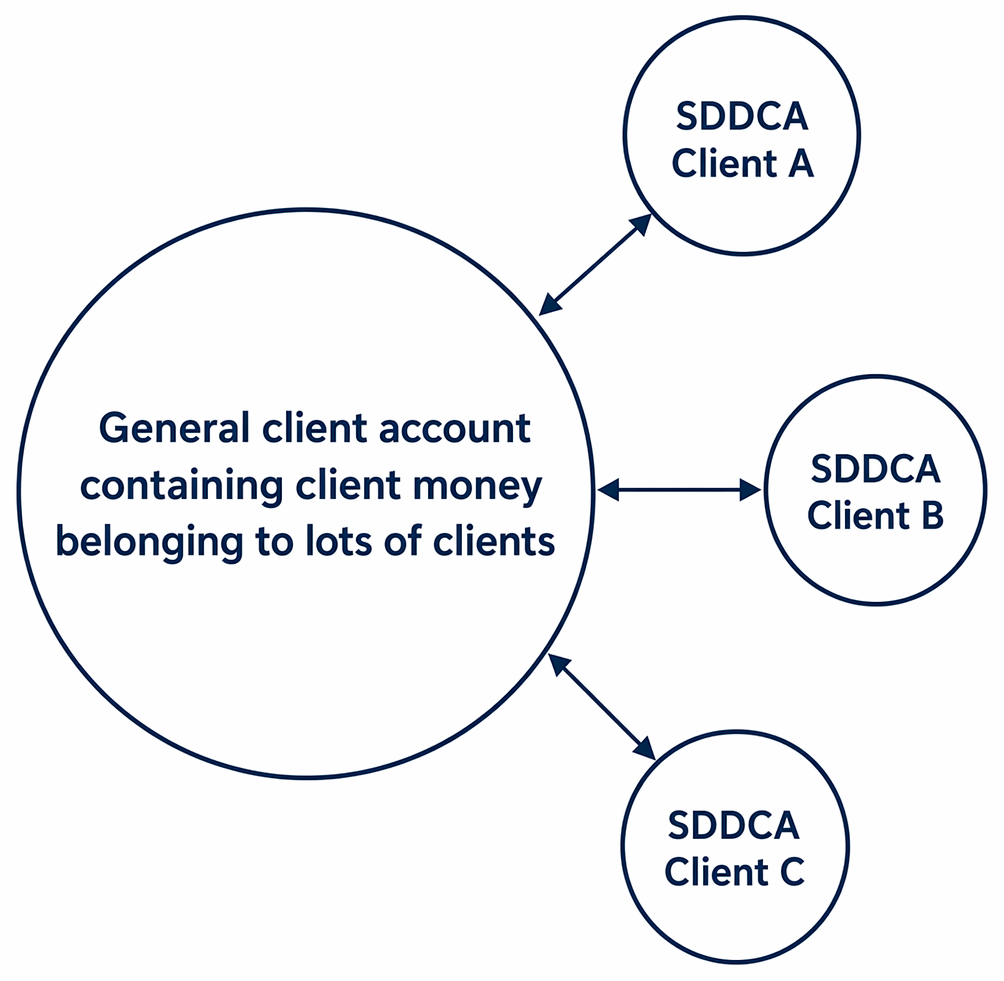
Interest treatment for client money is determined by amount, duration and client preference in selecting a general client account or SDDCA.
Money Held in the General Client Account
Most firms operate a general client account where money for many different clients is pooled. Interest earned on the overall balance of this account belongs to the firm, not individual clients, and is business money. In practice, firms will frequently instruct the bank to credit interest on the general client account directly to the firm’s business account; if a bank credits it to client account, the firm should transfer it out promptly to the business account.
However, the firm still has the obligation under Rule 7.1 to pay individual clients a 'fair sum' of interest where appropriate according to its policy. This payment must come from the firm's business account and is treated as a business expense. The firm calculates this 'sum in lieu of interest' based on the amount held for that specific client and the duration, using the rate and method defined in its policy.
Key Term: sum in lieu of interest
A payment made from the firm's business funds to compensate a client fairly for interest on money held for them within the pooled general client account. Key Term: interest payable
An expense ledger account used by the firm to record sums paid or due to clients in lieu of interest.
Firms may either:
- credit the sum in lieu to the client’s ledger in the business columns to reduce any outstanding debt (offset against the firm’s fee once billed), or
- transfer the sum from business to client account to be held as client money (e.g., to be added to proceeds due to the client), or
- pay the sum directly to the client from the business bank account after matter conclusion.
The choice should align with the policy and the client’s best interests.
Accounting Entries (Sum in Lieu of Interest):
This typically involves two stages:
-
Record the Interest Payable Expense:
- DR Interest Payable ledger (business account columns)
- CR Client Ledger (business account columns) – this recognises the firm’s liability to the client for interest.
-
Pay the Client (three common methods):
-
Offset against a billed balance (no cash movement at this step; the CR to the business side of the client ledger reduces the debit balance from the bill).
-
Transfer to client account (to add to client money):
- Out of Business: DR Client Ledger (business); CR Cash Sheet (business)
- Into Client: CR Client Ledger (client); DR Cash Sheet (client)
-
Direct payment to the client from the business bank account:
- DR Client Ledger (business); CR Cash Sheet (business) – no entry to the client account if no client money is to be held.
-
Worked Example 1.2
A firm holds £80,000 for Client B in its general client account for 90 days. Its policy requires payment of a sum in lieu of interest calculated at £150. The firm decides to pay this by transferring it to the client ledger.
What are the journal entries?
Answer:
- Record expense: DR Interest Payable £150; CR Client B Ledger (Business) £150.
- Transfer to client account:
- Out of Business: DR Client B Ledger (Business) £150; CR Cash Sheet (Business) £150.
- Into Client: DR Cash Sheet (Client) £150; CR Client B Ledger (Client) £150.
Offsetting versus paying out
Offsetting can be useful if the client has or will have a bill. The interest payable entry (DR Interest Payable; CR Client Ledger – business) reduces the business-side debit caused by the bill, meaning the client owes less. If there is no bill, or the matter has concluded, paying the client (either by transfer to the client account to join funds due, or by direct business bank payment) will usually be more appropriate.
Worked Example 1.3
Client C owes a billed balance of £1,775. The firm calculates £25 as a fair sum in lieu of interest. The firm decides to offset this against the bill.
What are the ledger entries?
Answer:
DR Interest Payable £25; CR Client C Ledger (Business) £25. No cash entries are required to offset the liability against the outstanding bill. The business-side balance reduces to £1,750.
Money Held in a Separate Designated Deposit Client Account (SDDCA)
For large sums held over long periods, a firm might open an SDDCA specifically for one client, which will typically earn a higher rate than a general client account. A written agreement is needed if funds are not available on demand (Rule 2.4).
Key Term: separate designated deposit client account (SDDCA)
A client account opened at a bank or building society specifically for a single client (or trust), often a deposit account, whose title includes the firm's name, the client's identity, and the word 'client'.
In this scenario, any interest earned on the money in the SDDCA belongs to the client, not the firm. The bank usually credits the interest directly to the SDDCA.
Firms use one of two common internal recording methods:
- Extra columns for deposit accounts on the main ledgers; or
- Separate “deposit” ledgers and a deposit cash sheet.
Choose one method and apply it consistently for clarity and audit trails.
Accounting Entries (SDDCA Interest): (using the separate “deposit” ledgers approach)
-
Bank Credits Interest to SDDCA:
- DR Deposit Cash Sheet (client columns)
- CR Client’s Deposit Ledger (client columns)
-
Transfer Principal + Interest from SDDCA to General Client Account (when needed):
- Payment out of SDDCA: CR Deposit Cash Sheet (client); DR Client’s Deposit Ledger (client)
- Receipt into General Client Account: DR Cash Sheet (client); CR Client Ledger (client)
(Note: Using extra columns instead of separate deposit ledgers produces equivalent entries, labelled to the deposit columns rather than separate ledgers.)
Worked Example 1.4
A firm holds £300,000 in an SDDCA for Client D. The bank credits £500 interest. The firm needs to transfer the full balance (£300,500) to the general client account to make a payment for Client D.
What are the journal entries for the interest accrual and the transfer back?
Answer:
- Record interest: DR Deposit Cash Sheet (Client) £500; CR Client D Deposit Ledger (Client) £500.
- Transfer £300,500 to general:
- Out of SDDCA: CR Deposit Cash Sheet (Client) £300,500; DR Client D Deposit Ledger (Client) £300,500.
- Into general: DR Cash Sheet (Client) £300,500; CR Client D Ledger (Client) £300,500.
Using extra columns – alternative presentation
If operating extra columns for deposit activity on the main client ledger and cash sheet, mirror the steps by posting to the “client deposit” columns rather than separate deposit ledgers. The sequence of debits and credits is identical.
Worked Example 1.5
Client E’s funds of £400,000 are placed in an SDDCA and earn £350 interest. On closure, £400,350 is transferred to the general client account.
What entries recognise the receipt into the general client account?
Answer:
CR Client E Ledger (Client) £400,350; DR Cash Sheet (Client) £400,350.
Methods of payment and VAT
Sums in lieu of interest are business expenses and do not attract VAT. Interest paid by banks to clients via an SDDCA is bank interest and also outside the scope of VAT. Accordingly, the firm’s HMRC-VAT ledger is not involved in interest postings.
Timing and documentation
Policies typically provide for calculation at the conclusion of the matter, unless a client’s funds are held for an extended period. In long matters or where large sums are held, periodic calculation and payment or credit can be fairer. Always retain workings and the policy basis applied, so decisions are auditable. Apply the policy consistently unless a documented exception is justified and fair to the client.
Special contexts affecting entitlement
- Joint or stakeholder holdings: If a deposit is held as stakeholder (e.g., a property buyer’s deposit), it is held on behalf of both parties pending completion. Any fair sum of interest should follow whoever ultimately becomes entitled to the principal under the contract.
- Trustees and deputies: Where money is held as a trustee or deputy, interest belongs to the trust/beneficiary or the person lacking capacity, and accounting must reflect fiduciary obligations in addition to the Rules.
- Client’s own accounts: Where a solicitor operates a client’s own bank account as signatory, money and any interest are the client’s. Rule 7 sums in lieu do not apply because money is not held in the firm’s client account.
Worked Example 1.6
A seller’s solicitor holds a £35,000 deposit as stakeholder between exchange and completion. The deposit is kept in the general client account. The firm’s policy would produce £42 interest across the period. The contract completes; the deposit becomes the seller’s money.
Who should receive the £42 and how is it recorded?
Answer:
The interest follows the principal; on completion, the seller becomes entitled to the deposit and a fair sum in lieu attributable to the stakeholder period. Record DR Interest Payable £42 (business); CR Seller’s client ledger (business) £42, then transfer to client account or offset as appropriate to the distribution. If the transaction aborts and the buyer becomes entitled to the deposit return, the fair sum should be paid to the buyer instead.
Alternative arrangements (Rule 7.2)
Firms can agree different interest arrangements in writing where the client has enough information to give informed consent. Examples include: not paying interest for negligible balances, paying at a fixed nominal rate, or applying a bespoke arrangement demanded by a sophisticated client. Any variation should be reasonable given the amounts and durations involved and should not undermine fairness.
Worked Example 1.7
Client F is advised at the outset and agrees in writing to waive any entitlement to sums in lieu of interest for balances under £100,000 held for fewer than 30 days. The firm holds £80,000 for 21 days and, under its standard policy, a small amount would have been due.
Is the firm required to pay interest to Client F?
Answer:
No, because a valid written agreement varies the default position. The client’s informed written waiver applies, and, in the circumstances, it is a reasonable variation. No interest is payable and no expense entry is necessary.Exam Warning: Be clear about the source of interest payments. For general client accounts, the payment to the client is a 'sum in lieu' funded by the firm's business money. For SDDCAs, the interest paid by the bank belongs directly to the client. Also keep the links with Rule 2.4 (availability on demand) and Rule 2.5 (prompt return) in mind: they can change the period for which interest is fairly payable. The prohibition on providing banking facilities (Rule 3.3) limits when it is proper to hold money at all.
Revision Tip: Focus on the distinction: interest on general client accounts benefits the firm initially, but a fair sum must be paid from the firm; interest on SDDCAs belongs entirely to the specific client. The accounting entries reflect this difference. Remember that sums in lieu of interest are a business expense and sit in an “interest payable” ledger. If the firm places bank interest on general client account by default, transfer it promptly to the business account.
Additional practical points
- Bank charges and negative returns: Where a bank levies charges on a client account, these must not be borne by clients’ balances. Treat them as business expenses and top up the client account from business funds immediately if necessary to avoid any shortfall.
- Residual balances: When paying residual client balances to charity under the SRA’s prescribed circumstances for small amounts, ensure any fair sum of interest accrued is calculated and paid to the rightful owner first if they can be identified. Keep full records of steps taken.
- Statements and reporting: If a client asks, provide a clear explanation of any interest paid or decision not to pay under a de minimis threshold. Where money is held over time, periodic statements can help clients understand accruals.
- Third‑party managed accounts (TPMAs): If a firm uses a TPMA, arrangements about interest are determined by the TPMA provider’s terms. The firm should ensure the client understands how any interest will be treated and that the overall outcome remains fair.
- Tax: Since 2016, UK banks pay interest gross. Clients may have to account for tax on bank interest they receive (e.g., from an SDDCA). Sums in lieu of interest are also taxable receipts for the client in the same way as interest; firms do not deduct tax at source.
Key Point Checklist
This article has covered the following key knowledge points:
- Firms must account for a fair sum of interest on client money held (Rule 7.1).
- Alternative arrangements are possible if agreed in writing with informed client consent (Rule 7.2).
- A written interest policy detailing calculation methods, benchmarks, timing, and any de minimis threshold is essential for compliance.
- ‘Fair sum’ considers amount, time held, and current instant-access rates, while respecting Rule 2.4 (availability) and Rule 2.5 (prompt return).
- Interest earned on the general client account balance belongs to the firm and is business money, but fair sums must be paid to clients from business funds.
- Sums in lieu of interest are recorded as an expense (DR Interest Payable; CR client ledger business side), then either offset, transferred to client account, or paid out from the business bank account.
- Interest earned in an SDDCA belongs entirely to the specific client for whom the account was opened; record interest in the client deposit records and transfer funds back when needed.
- Choose and consistently apply either extra deposit columns or separate deposit ledgers/cash sheets for SDDCA record‑keeping.
- Do not use client accounts as banking facilities; hold money only when necessary for regulated services, return it promptly when not needed, and agree notice arrangements in writing if applicable.
- Maintain clear documentation of calculations and policy application, and reconcile interest-related entries within the firm’s systems and controls.
Key Terms and Concepts
- client money
- client account
- fair sum
- de minimis
- sum in lieu of interest
- interest payable
- separate designated deposit client account (SDDCA)