Learning Outcomes
This article details the offence of aggravated criminal damage under s 1(2) of the Criminal Damage Act 1971. It distinguishes this offence from simple criminal damage (s 1(1)). For the SQE1 assessments, you will need to understand the actus reus and mens rea elements specific to aggravated criminal damage, particularly the requirement of endangering life, and how this differs from simple criminal damage concerning property ownership and lawful excuse. Your understanding will enable you to apply the relevant legal principles to SQE1-style single best answer questions. In particular, focus on how the danger to life must arise from the damage or destruction itself (not merely from the act causing it), that actual endangerment is not required, that aggravated criminal damage can be committed to property belonging to the defendant, and that the statutory lawful excuse defences for simple damage do not apply. You should also be comfortable with subjective recklessness (as clarified in modern authority) in both limbs of the offence, how aggravated arson under s 1(3) interacts with s 1(2), and the procedural classification and sentencing implications.
SQE1 Syllabus
For SQE1, you are required to understand the elements of aggravated criminal damage and how it contrasts with simple criminal damage. You will likely need to identify the correct offence based on a factual scenario, focusing on the endangerment to life aspect and the relevant mental state, with a focus on the following syllabus points:
- the specific actus reus elements of aggravated criminal damage, including the destruction or damage of property and the endangerment of life
- the mens rea requirements for aggravated criminal damage, covering both the damage/destruction and the endangerment to life (intention or recklessness)
- the key differences between simple criminal damage (s 1(1)) and aggravated criminal damage (s 1(2)), particularly regarding property ownership and the availability of the lawful excuse defence
- how the endangerment to life must arise from the damage or destruction itself.
- the subjective test for recklessness applicable to both limbs (damage and endangerment)
- the relationship between s 1(2) and s 1(3) (aggravated arson), including the requirement that damage be caused by fire
- the procedural classification: aggravated criminal damage and aggravated arson are indictable-only offences with a maximum of life imprisonment
- the fact that actual endangerment is not required; the offence turns on the defendant’s intention or recklessness as to life being endangered by the damage.
Test Your Knowledge
Attempt these questions before reading this article. If you find some difficult or cannot remember the answers, look more closely at that area during your revision.
-
Which of the following statements regarding aggravated criminal damage under s 1(2) CDA 1971 is correct?
- a) The property damaged must belong to another person.
- b) The defendant must intend to endanger life; recklessness is insufficient.
- c) Endangerment to life must actually occur for the offence to be committed.
- d) The defendant must intend or be reckless as to endangering life by the damage or destruction caused.
-
True or false? The defence of lawful excuse under s 5 CDA 1971 applies to aggravated criminal damage.
-
According to R v Steer, when considering aggravated criminal damage, the danger to life must arise from:
- a) The act which causes the damage.
- b) The damaged property itself.
- c) The defendant's motive.
- d) The presence of the victim near the damaged property.
Introduction
Criminal damage offences cover a spectrum of severity. While simple criminal damage under s 1(1) of the Criminal Damage Act 1971 (CDA 1971) addresses the basic act of damaging property belonging to another, aggravated criminal damage under s 1(2) introduces a more serious dimension: the endangerment of life. Understanding the specific elements and distinctions of aggravated criminal damage is essential for SQE1. This offence carries a higher maximum penalty (life imprisonment) reflecting the increased risk posed by the defendant's actions. In practice, aggravated criminal damage and aggravated arson (s 1(2) and s 1(3) combined) are indictable-only offences tried in the Crown Court, whereas simple criminal damage can be either way (subject to summary treatment for low-value damage under statutory thresholds).
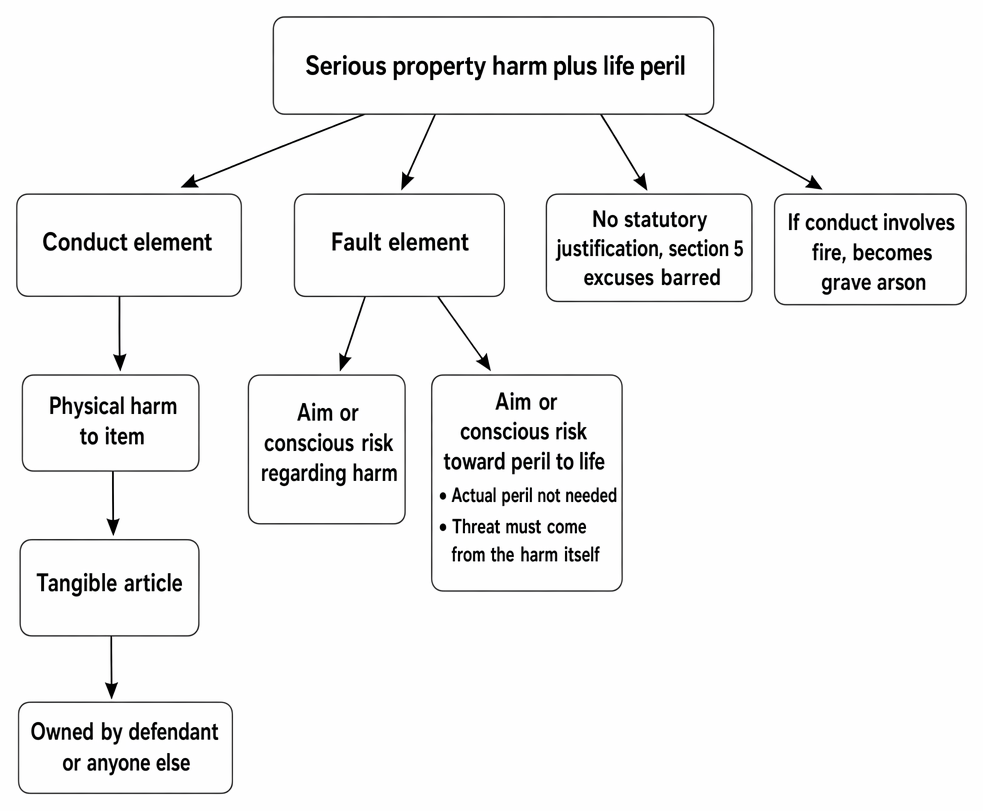
Aggravated criminal damage under s 1(2) Criminal Damage Act 1971 requires damage, fault, danger to life; s 5 excuses are unavailable.
Test Tip: In SQE-style questions on Aggravated criminal damage, identify the legal test, the triggering fact, and the consequence before choosing between similar answer options.
Aggravated Criminal Damage: Section 1(2) CDA 1971
The offence of aggravated criminal damage is defined in s 1(2) CDA 1971:
A person who without lawful excuse destroys or damages any property, whether belonging to himself or another— (a) intending to destroy or damage any property or being reckless as to whether any property would be destroyed or damaged; and (b) intending by the destruction or damage to endanger the life of another or being reckless as to whether the life of another would be thereby endangered; shall be guilty of an offence.
This section creates a more serious offence than simple criminal damage under s 1(1), primarily due to the element of endangering life.
Actus Reus
The actus reus of aggravated criminal damage consists of two main components:
- Destroying or damaging property: This element is the same as for simple criminal damage. The terms 'destroy' and 'damage' are interpreted according to their ordinary meanings and include permanent or temporary physical harm, or impairment of value or usefulness. Whether damage has occurred is a question of fact and degree. Criminal damage can be committed by acts or, where a duty arises (e.g., after creating a dangerous situation), by omission. Property for CDA purposes is tangible only; intangible property (e.g., data, copyright) cannot be “damaged” within s 10(1).
- Endangering the life of another: This is the key distinguishing feature. The damage or destruction caused by the defendant must endanger the life of another person.
Property Ownership
A key difference from simple criminal damage (s 1(1)) is that for the aggravated offence under s 1(2), the property damaged can belong to the defendant themself or to another person (see R v Maitland-Thomas [2013] EWCA Crim 1063). The focus shifts from property rights to the risk posed to human life. A defendant can therefore be liable for setting fire to his own home if, by that damage, he intends or is reckless as to endangering the life of another; but not where the only life endangered is his own (R v Thakar [2010] EWCA Crim 2136, where the defendant set fire to his own car with himself inside but was ignorant of any risk to others).
Endangerment to Life
Key Term: endangering life
For aggravated criminal damage, this means creating a risk or danger to the life of another person through the damage or destruction of property. Actual endangerment is not required; the focus is on the potential risk created by the damage itself.
The endangerment must arise from the damage or destruction caused, not merely from the act which caused the damage.
The principle was reinforced in the leading authorities. In one case, firing bullets through a window was not aggravated criminal damage because the danger to life came from the bullets (the act), not from the damaged window. By contrast, where a stone was pushed onto a train roof and the damaged roof threatened passengers below, the danger did arise from the damaged property. The same logic applies to scenarios involving damaged wiring, gas pipes, brakes or structural components: the life risk must be attributable to the condition of the damaged property.
Importantly, there is no requirement that anyone’s life was actually endangered by the damage. It is sufficient that the defendant intended, or was reckless as to, life being endangered by the damage/destruction.
Worked Example 1.1
Ahmed throws a brick at Chen's house window, intending to break it. Chen is standing just inside the window. The brick smashes the window, but the flying glass narrowly misses Chen. Ahmed knew Chen was inside and foresaw a risk that the broken glass might hit and injure Chen, potentially endangering his life.
Is Ahmed potentially liable for aggravated criminal damage?
Answer:
Yes, potentially. Ahmed intentionally damaged property (the window). The question is whether he intended or was reckless as to endangering Chen's life by the damage (the broken glass). If the flying shards of glass posed a danger to Chen's life, and Ahmed intended or was reckless as to this specific danger from the broken glass, the offence could be made out. If the danger was only from the brick itself, it would not satisfy the test from R v Steer. This principle was established in R v Steer [1988] AC 111. The defendant fired shots through a window. The danger to life came from the bullets, not the broken glass. Lord Bridge, upholding the Court of Appeal, held that on the true construction of s 1(2)(b) "the prosecution are required to prove that the danger to life resulted from the destruction of or damage to property; it is not sufficient for the prosecution to prove that it resulted from the act of the defendant which caused the destruction or damage."
Steer is, however, to be read with R v Dudley [1989] Crim LR 57 and R v Webster; R v Warwick [1995] 2 All ER 168, which clarify a further subtlety: the relevant enquiry is whether the defendant intended or was reckless as to life being endangered by the damage he intended or contemplated, not merely by the damage actually caused. In Dudley, the defendant threw a petrol bomb at a house; the occupants extinguished it quickly, so the actual damage was trivial, yet the Court of Appeal upheld aggravated criminal damage because the defendant's recklessness extended to much greater damage from which life would plainly have been endangered. In Webster, the defendants pushed a stone onto a railway bridge and then (in the companion case Warwick) rammed a police car with intent to cause damage; Lord Taylor CJ (calling it a "dismal distinction") confirmed that liability turns on the damage envisaged, not on how accurately the defendant's conduct delivered it. R v Wenton [2010] EWCA Crim 2361 applied the same logic the other way: where the defendant threw a brick then a lit petrol canister through the broken window, but the petrol failed to ignite, the aggravated conviction was quashed because the damage to the window was not the damage by which the defendant envisaged life being endangered.
Worked Example 1.2
D removes a safety guard and strikes the casing of an electrical junction box in a shared corridor, cracking it and leaving exposed, damaged wiring. D foresees that someone might touch the damaged box and be electrocuted.
Could this amount to aggravated criminal damage?
Answer:
Yes, potentially. The danger to life would arise from the damaged property (the compromised junction box/wiring). If D intended or was reckless as to damage and intended or was reckless as to life being endangered by that damage, the offence would be made out.
Worked Example 1.3
E throws a petrol bomb at F’s front door. F and their family quickly extinguish the small flames and no one is harmed.
Does the absence of actual harm prevent liability for aggravated criminal damage?
Answer:
No. Actual endangerment is not required. If E intended or was reckless as to life being endangered by the damage caused (the burning door and its consequences), the offence is complete even though the fire was swiftly extinguished.
Mens Rea
Aggravated criminal damage requires a 'double' mens rea:
- Intention or recklessness as to destroying or damaging property: This is the same mens rea as for simple criminal damage. The defendant must intend the damage/destruction or be subjectively reckless (aware of a risk and unreasonably taking it) as to causing it.
- Intention or recklessness as to endangering the life of another by the damage or destruction: The defendant must intend to endanger life through the damage/destruction, or be subjectively reckless as to whether life would be endangered by the damage/destruction.
It is essential that the second limb of the mens rea relates specifically to endangerment by the damage, aligning with the actus reus requirement established in Steer. Foreseeing a risk of endangerment from the act causing the damage (e.g., firing a gun) is not sufficient.
Key Term: recklessness
For criminal damage offences, recklessness is subjective: D must be aware of a risk (of damage or of life being endangered by the damage) and, in the circumstances known to D, it is unreasonable to take that risk.
This subjective approach applies to both the damage limb and the life-endangerment limb.
Intoxication and mens rea are treated in line with recognised principles. If the prosecution alleges an intention to endanger life, voluntary intoxication may be relevant to whether D formed that specific intention. However, where the allegation is recklessness as to endangering life, voluntary intoxication does not assist: recklessness with basic intent is not negated by voluntary intoxication.
Worked Example 1.4
G, heavily intoxicated, sets fire to a pile of paper outside a block of flats. The flames scorch the wooden porch but are put out. The indictment alleges G intended to endanger life by the damage; alternatively, that G was reckless as to life being endangered by the damage.
Can G rely on intoxication to avoid liability?
Answer:
If the prosecution proceeds on the basis that G intended to endanger life, voluntary intoxication may be relevant to whether G did in fact form that specific intent. If the prosecution proceeds on recklessness as to endangering life, voluntary intoxication will not absolve G: recklessness (a basic intent) can be committed while voluntarily intoxicated if the risk was appreciated and taken.
Lawful Excuse Defence
The specific lawful excuse defences available under s 5 CDA 1971 for simple criminal damage (belief in consent or acting to protect property) do not apply to the aggravated offence under s 1(2): see R v Merrick [1996] 1 Cr App R 130. The reference to "without lawful excuse" in s 1(2) therefore operates only as a signpost to general defences (self-defence, duress, necessity), not to the s 5 statutory excuses.
General defences may still be available on the facts. Note also that the s 5(2)(b) defence is in any event limited to protection of property (not persons), and so would not assist a defendant charged under s 1(2) even if s 5 were formally applicable.
Aggravated Arson
Section 1(3) CDA 1971 states that an offence under s 1(1) or s 1(2) committed by destroying or damaging property by fire shall be charged as arson.
Therefore, if the elements of aggravated criminal damage under s 1(2) are satisfied, and the damage or destruction was caused by fire, the offence is aggravated arson. The actus reus and mens rea requirements are the same as for aggravated criminal damage, but with the additional element that the damage/destruction must be caused by fire, and the defendant must have the corresponding mens rea (intention or recklessness) as to causing damage/destruction by fire. Damage caused solely by smoke, without fire, is not arson, though it may still constitute criminal damage.
Key Term: arson
Criminal damage committed by fire. Where the aggravated life-endangerment limb is also present, the offence is aggravated arson under s 1(2) and s 1(3).
Aggravated arson is indictable-only and carries a maximum sentence of life imprisonment, reflecting the particular hazards posed by fire to human life when property is damaged or destroyed.
Worked Example 1.5
H sets light to the wooden floor of a ground-floor hallway in a block, causing the floorboards to burn and weakening supports underneath. H foresees people might fall through or be trapped if the fire spreads.
Is this aggravated arson?
Answer:
Yes, if H intended or was reckless as to damage by fire and intended or was reckless as to life being endangered by the damage (the burning and weakened structure). The danger arises from the damaged property (burning floor/structure), not merely the act of lighting a match.Exam Warning: A common point of confusion relates to the source of the endangerment. Remember the principle from R v Steer: the danger to life must arise from the damaged property itself, not the initial act causing the damage. For example, if D shoots at a door knowing V is behind it, the danger is from the bullet (the act), not the damaged door. This would not be aggravated criminal damage. However, if D damages wiring knowing it could cause a fire or electrocution, the danger arises from the damaged wiring, potentially satisfying the test.
It is equally important to remember that actual endangerment to life is not required. It suffices that, by the damage or destruction, D intended or was reckless as to life being endangered. The recklessness assessment is subjective, applied to both limbs of the offence.
Key Point Checklist
This article has covered the following key knowledge points:
- Aggravated criminal damage under s 1(2) CDA 1971 requires destroying or damaging property (actus reus) with the intention or recklessness as to both the damage/destruction AND endangering the life of another by that damage/destruction (mens rea).
- Unlike simple criminal damage, the property damaged can belong to the defendant or another person.
- The endangerment to life must arise from the damaged property itself, not the act causing the damage (R v Steer).
- Actual endangerment to life is not required; intention or recklessness regarding the risk of endangerment by the damage is sufficient.
- The statutory lawful excuse defences under s 5 CDA 1971 (belief in consent, protection of property) are NOT available for aggravated criminal damage. General defences may apply if supported by the facts.
- If aggravated criminal damage is committed by fire, the offence is aggravated arson (s 1(2) and s 1(3) CDA 1971), which is indictable-only with a maximum of life imprisonment.
- Recklessness for both limbs is subjective: D must recognise the risk and unreasonably take it in the circumstances known to D.
- Voluntary intoxication may be relevant where the prosecution allege intention to endanger life, but it is not a defence where recklessness is alleged.
- The offence can be committed by omission where a duty arises (e.g., after creating a dangerous situation) and the omission results in damage that endangers life.
- Attempted aggravated criminal damage may be charged in appropriate circumstances (e.g., intent to cause damage coupled with recklessness as to endangering life, consistent with the structure of s 1(2)).
Key Terms and Concepts
- endangering life
- recklessness
- arson