Learning Outcomes
This article examines the general defences of duress (by threats and of circumstances) and necessity in criminal law, focusing on how these doctrines are framed and applied in SQE1-style problem questions. It explains the structure and operation of the two-stage Graham/Hasan test, the quality and sources of qualifying threats, the immediacy and “safe avenue of escape” requirements, and the required causal nexus between the threat and the offence. It analyzes the “reasonable firmness” standard, including which personal characteristics a jury may consider and which are excluded. It distinguishes duress by threats from duress of circumstances, clarifies their relationship with necessity, and contrasts excuse-based and justification-based reasoning. It details the strict limits on availability, including exclusion for murder and attempted murder, the impact of voluntary association with criminals, and the narrow circumstances in which necessity has been accepted, particularly in medical and emergency settings. It also reviews evidential and procedural aspects, including the defendant’s evidential burden, the prosecution’s legal burden, and typical evidential foundations. Throughout, it highlights recurring examination pitfalls and shows how to structure clear, case-supported arguments when advising on or applying these defences.
SQE1 Syllabus
For SQE1, you are required to understand the core principles of criminal liability, including the operation of general defences. Duress and necessity are key general defences that negate liability where specific conditions are met. Your understanding of these defences is essential for advising clients and assessing criminal culpability in practice-based scenarios, with a focus on the following syllabus points:
- The elements required to establish duress by threats, including the nature of the threat, its target, and the objective/subjective test for the defendant's response (R v Graham, R v Hasan).
- The scope of “to whom” threats may be directed, including persons for whose safety D reasonably regards themself as responsible (R v Shayler).
- The immediacy requirement, the need to take reasonable evasive action, and the availability of a safe route to avoid the threat (R v Hudson & Taylor, refined in R v Hasan; R v Cole on nexus).
- The elements required for duress of circumstances, focusing on the imminent danger and proportionality of the response (R v Martin (Colin), R v Willer, R v Conway, R v Pommell).
- How courts assess “reasonable firmness” and relevant personal characteristics (e.g. age, sex, recognised psychiatric conditions), and what factors are excluded (R v Bowen).
- The defence of necessity, its limited application, particularly in medical contexts (Re A (Children)), and its distinction from duress.
- The limitations on the availability of duress, especially its exclusion for murder and attempted murder (R v Howe, R v Gotts), and where the defendant has voluntarily associated with criminals (R v Sharp; R v Hasan).
- Burden and standard of proof: the defendant’s evidential burden to raise duress and the prosecution’s legal burden to disprove it; typical evidential foundations for duress of circumstances (e.g. Petgrave).
- Related statutory protection: the Modern Slavery Act 2015, s 45 (a distinct defence in trafficking/slavery contexts), and its relationship to duress principles.
Test Your Knowledge
Attempt these questions before reading this article. If you find some difficult or cannot remember the answers, look more closely at that area during your revision.
-
Which defence involves committing an offence due to threats of death or serious injury from another person?
- a) Necessity
- b) Self-defence
- c) Duress by threats
- d) Duress of circumstances
-
Which infamous case established that duress is not a defence to murder?
- a) R v Graham
- b) R v Hasan
- c) R v Howe
- d) Re A (Children)
-
True or False: The defence of necessity requires the defendant to subjectively believe they faced imminent danger, regardless of whether that belief was reasonable.
-
What is the key difference between duress of circumstances and necessity?
Introduction
When a defendant (D) has committed the actus reus of an offence with the required mens rea, they may still avoid criminal liability if they can successfully raise a defence. Duress and necessity are general defences, meaning they can potentially apply to a wide range of offences, unlike specific defences (e.g., loss of control for murder). Both defences operate on the principle that D was compelled to act unlawfully due to extreme circumstances, effectively negating the voluntariness of their actions (duress) or justifying their actions as the lesser of two evils (necessity). Clear distinctions matter: duress is an excusatory defence focused on compulsion; necessity is a justificatory defence focused on choosing the lesser harm. Both are tightly controlled by case law and subject to important exclusions.
Test Tip: In SQE-style questions on Duress and necessity, identify the legal test, the triggering fact, and the consequence before choosing between similar answer options.
Duress
Duress operates as an excusatory defence, meaning it excuses D's conduct because it was not truly voluntary. It arises where D commits an offence because they are threatened with death or serious injury, or reasonably believes they face such a threat from the surrounding circumstances.
Key Term: Duress
A general defence where the defendant is compelled to commit an offence due to threats of death or serious injury, or perceived imminent danger of death or serious injury arising from the circumstances.
The defence is traditionally divided into two types: duress by threats and duress of circumstances.
Duress by Threats
This applies where D commits an offence because another person (X) threatens D (or someone D is responsible for) with death or serious personal injury if D does not comply.
The leading authority is R v Hasan [2005] UKHL 22, which confirmed a strict two-part test derived from R v Graham [1982] 1 WLR 294:
- Subjective Test: Did D reasonably believe they faced a threat of death or serious injury, and was D compelled to act as they did because of that belief?
- Objective Test: Would a sober person of reasonable firmness, sharing D's relevant characteristics, have responded to the threat in the same way?
Key Term: Duress by threats
A defence available when D commits an offence due to threats of death or serious personal injury made by another person.
Nature of the Threat
- The threat must be of death or serious personal injury (GBH). Threats of lesser harm (e.g., damage to property, minor injury, revealing secrets, economic pressure) are insufficient.
- The belief in the threat must be both honestly held and reasonable in the Hasan sense; fanciful or intoxication-induced beliefs will not qualify.
Target of the Threat
- The threat can be directed at D, D’s immediate family, or someone for whose safety D would reasonably regard themself as responsible. The courts have recognised that “responsibility” may include broader categories depending on D’s role (e.g., colleagues, persons D is charged to protect), but the link must be reasonable (R v Shayler).
Immediacy, Nexus, and Evasion
- The threat must be operative on D’s mind at the time of the offence and sufficiently imminent to overbear the will. Historic threats or vague future dangers are unlikely to suffice.
- There must be a direct causal nexus between the threat and the offence: D must have acted because of the threat (R v Cole).
- D must have no reasonable opportunity to escape the threat or seek police protection. Earlier authorities (R v Hudson & Taylor) were more permissive; Hasan imposes a stricter approach requiring D to take reasonable evasive action where possible, including contacting law enforcement if safe.
Characteristics and the “Reasonable Firmness” Standard
- The objective limb asks whether a person of reasonable firmness sharing D’s relevant characteristics would have acted similarly. Relevant characteristics can include age, sex, recognised psychiatric conditions or pregnancy; traits like a low IQ, timidity or suggestibility are generally excluded (R v Bowen).
- The standard guards against idiosyncratic vulnerabilities expanding the defence inappropriately.
Voluntary Association with Criminality
- The defence is unavailable if D voluntarily associated with individuals engaged in criminal activity, knowing they might be subjected to compulsion by threats of violence (R v Sharp; R v Hasan).
- The question is whether D foresaw or ought reasonably to have foreseen the risk of being subjected to any compulsion by threats of violence. Merely being acquainted with wrongdoers is not automatically disqualifying; foreseeing compulsion is the focus. Contrast R v Shepherd, where association with non-violent criminals did not bar the defence.
Worked Example 1.1
Anya is forced by a violent gang leader, known for extreme brutality, to drive the getaway car for a robbery. The leader threatens to kill Anya's child if she refuses. Anya complies, terrified for her child's safety. She had no opportunity to contact the police between the threat and the robbery. Can Anya raise duress by threats?
Answer:
Yes, Anya may potentially raise duress by threats. The threat is of death to her child (someone for whom she is responsible). Assuming the threat was imminent and she had no reasonable opportunity to seek police protection or escape, the defence could apply if a sober person of reasonable firmness sharing Anya's relevant characteristics might have responded similarly. The prosecution would need to disprove one element beyond reasonable doubt. Her prior association with the gang (if any) and foreseeability of compulsion would be key factors (Hasan).
Worked Example 1.2
Priya’s former partner, a known violent trafficker, demands she carry a package across town. He tells her, “If you don’t, I’ll do to you what I did to Rina,” pointing to scarring on a mutual acquaintance. Priya delivers the package, which turns out to be cocaine. She argues duress. Evidence shows Priya knew of her ex-partner’s violent criminal network and had been warned previously about “doing favours” for them.
Answer:
Priya’s claim is weakened by voluntary association. If she foresaw or ought reasonably to have foreseen the risk of violent compulsion arising from associating with a violent criminal network, duress is likely excluded (Hasan; Sharp). The seriousness of the threat is clear, but foreseeability and the availability of contacting police before or during the act would be central. A distinct statutory defence (Modern Slavery Act 2015, s 45) may be relevant if the circumstances amount to slavery/trafficking; that defence operates separately from duress.
Duress of Circumstances
This defence arises where D is forced to commit an offence due to surrounding circumstances, rather than threats from a specific person. The perceived threat must still be of death or serious injury. The test is essentially the same as for duress by threats, adapted for the circumstances.
Key Term: Duress of circumstances
A defence available when D commits an offence due to external circumstances creating an imminent threat of death or serious personal injury.
Authorities include R v Martin (Colin), R v Willer, R v Conway, and R v Pommell. Typical situations involve driving offences committed to escape imminent violent attack or possessing a weapon temporarily to avert immediate danger.
Core elements adapted to circumstances:
- D must reasonably believe the circumstances pose a threat of death or serious injury.
- D’s actions must be a reasonable and proportionate response to that perceived threat.
- The threat must be sufficiently imminent; there must be no realistic alternative course of action.
- D’s conduct must have been directly caused by the threat (causal nexus).
Courts have accepted, for example, driving while disqualified to avert suicide (Martin), cutting through traffic signals to escape violent pursuers (Willer; Conway), or short-term possession of a firearm to hand to police the next day where immediate surrender was not safe (Pommell). However, the window is narrow: prolonged or speculative dangers, or convenient assertions of danger with alternatives available, will not suffice.
Worked Example 1.3
Roy finds a gun tucked into his car wheel arch outside his block after a neighbour warns that masked men were “looking” for him. He takes the gun into his flat to safeguard it and intends to surrender it to police the next morning, believing masked men are still outside. Charged with unlawful possession, he raises duress of circumstances.
Answer:
A short and genuinely necessary possession to avert imminent harm may fall within duress of circumstances (cf. Pommell). Key questions: the imminence of the perceived threat overnight; whether there was a safe, reasonable alternative (e.g., calling police immediately, safely locking the item away and contacting police at once); and proportionality. If the facts show continuing immediacy and lack of safe alternatives, the defence may succeed; otherwise it fails.Exam Warning: Duress of circumstances often overlaps with the defence of necessity. However, they remain distinct. Duress (of both types) focuses on the compulsion acting on D’s will, making the act involuntary in a moral sense. It is generally viewed as an excuse. Necessity, explored next, focuses on justifying the act as the lesser of two evils (necessity), usually assessed more objectively.
Limitations on Duress
Duress (both by threats and circumstances) is not available for:
- Murder: Established in R v Howe [1987] AC 417. The sanctity of human life outweighs the duress faced by D. This applies even to secondary parties.
- Attempted Murder: Confirmed in R v Gotts [1992] 2 AC 412. If duress is unavailable for the completed offence, it is likewise unavailable for the attempt.
- Treason: Historic authorities suggest duress is not available for certain forms of treason, though modern reliance is rare.
Further constraints:
- Proportionality and Nexus: The offence must be directly caused by the threat; opportunistic offending unrelated to averting the communicated threat fails (R v Cole).
- Immediacy and Reasonable Evasion: The threat must be sufficiently imminent; if D could reasonably and safely avoid the threat or seek protection, duress fails (Hasan).
- Voluntary Association: As above, duress will not assist where D foresaw or ought to have foreseen exposure to compulsion through criminal association (Sharp; Hasan).
- Characteristics: Only relevant characteristics bearing on firmness may be considered; idiosyncratic traits rarely qualify (Bowen).
On burden and proof:
- D bears an evidential burden to raise duress with some credible evidence, typically through D’s own testimony for duress of circumstances (see Petgrave). Once raised, the prosecution must disprove the defence beyond reasonable doubt.
Necessity
Necessity is a defence of justification, arguing that D's actions, although technically unlawful, were necessary to prevent a greater evil. It operates in extremely limited circumstances and is distinct from duress.
Key Term: Necessity
A defence justifying an otherwise unlawful act performed to avoid a greater harm, where the harm inflicted is not disproportionate to the harm avoided.
The courts have been reluctant to recognise a broad general defence of necessity, cautioning that it could become “a charter for lawlessness” (Southwark LBC v Williams [1971] Ch 734). Nonetheless, it has been successfully invoked in narrow settings, most notably in medical cases.
The best-known judicial distillation comes from the civil case Re A (Children) (Conjoined Twins: Surgical Separation) [2001] Fam 147 (obiter), often treated as persuasive guidance:
- The act was done only to prevent an act of inevitable and irreparable evil.
- No more was done than was reasonably necessary for the purpose to be achieved.
- The evil inflicted was not disproportionate to the evil avoided.
Necessity tends to be assessed more objectively than duress. Mistaken necessity based solely on D’s subjective view will generally not suffice: the harm avoided must be objectively imminent and “inevitable” on the facts as reasonably understood.
Worked Example 1.4
A firefighter breaks down the door of a burning house to rescue a trapped child, causing criminal damage. Can the firefighter rely on necessity?
Answer:
Yes. The act (breaking the door) was necessary to prevent inevitable and irreparable evil (the child's death or serious injury). No more was done than reasonably necessary (breaking the door was required for rescue). The evil inflicted (criminal damage) was not disproportionate to the evil avoided (saving a life).
Limitations on Necessity
- Murder: Necessity is generally not a defence to murder (R v Dudley and Stephens (1884) 14 QBD 273 – shipwrecked sailors killing a cabin boy). Re A created a very narrow exception for conjoined twins where one twin’s death was unavoidable and separation would save the other. This is highly fact-specific and does not establish a general necessity defence to murder.
- Narrow Application: Courts apply the defence restrictively. Necessity cannot be used simply because D believes their actions are morally justified or because disobedience seems preferable; objective conditions must be met and proportionality preserved.
Worked Example 1.5
David is driving dangerously over the speed limit. He claims he did so out of necessity because his passenger suddenly suffered a severe asthma attack, and he was rushing them to the hospital only a mile away, fearing they might die otherwise. The passenger recovered fully. Could necessity apply?
Answer:
Potentially, but it is difficult. David would need to show the danger (death from asthma attack) was imminent and inevitable without speeding, that speeding was reasonably necessary (e.g., no time to call an ambulance?), and that the “evil” of dangerous driving was not disproportionate to the evil of the passenger dying. It might be argued that dangerous driving itself creates a significant risk to others, making the proportionality difficult to establish. Duress of circumstances might be a more suitable, though still challenging, defence here, focusing on the compulsion created by the emergency.
Worked Example 1.6
Sahar, a doctor, administers a higher-than-approved dose of a painkiller during a mass-casualty incident because the standard dose is insufficient for a patient with catastrophic trauma and immediate surgery is unavailable. She breaches protocol.
Answer:
Necessity may justify deviation if Sahar can show an objectively imminent and irreparable evil (severe pain likely leading to shock and death), that no more was done than reasonably necessary in the emergency, and that the harm inflicted (protocol breach with increased medical risk) was not disproportionate to the harm avoided (preventing death or catastrophic deterioration). Medical necessity is among the few contexts where courts have been willing to recognise justification, provided strict criteria are met.
Additional Clarifications and Practical Points
Qualifying Threats and “Immediacy” in Duress
Courts are careful with “immediacy”. The threat need not be instantaneous but must be sufficiently proximate to overbear the will when D commits the offence. Continuing threats may suffice if the danger persists and avenues of escape are realistically closed. However, duress is unlikely where prior planning indicates alternatives or a failure to seek help when safe.
Police Protection and “Safe Avenue of Escape”
Where contacting police would reasonably be expected and safe, failure to do so undermines duress. Hasan emphasised that D must take reasonable steps to avoid offending, including seeking protection, unless doing so poses comparable immediate risk.
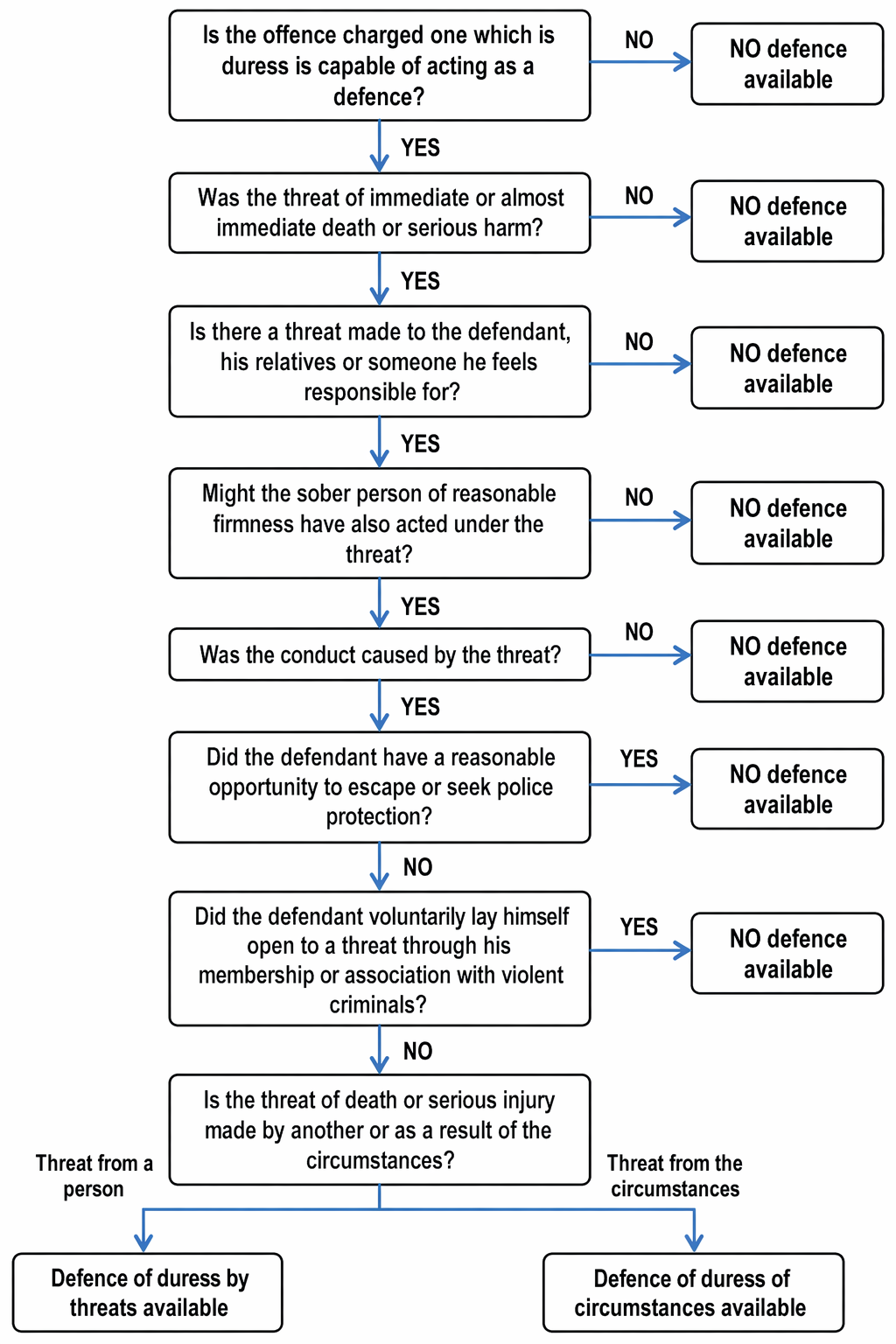
General criminal law defences of duress and necessity are presented by reference to their elements, recognised forms, exclusions, and limitations.
Objective Limits and Personal Characteristics
Bowen restricts characteristics to those materially affecting firmness (e.g., age, sex, recognised psychiatric conditions). Vulnerabilities like low IQ, naivety, or mere pliability are not typically relevant.
Evidential Foundations and Burden
Duress must be raised with evidence. In duress of circumstances, courts often expect a defendant’s own account of compulsion rather than bare assertion through counsel (see Petgrave). If raised, the prosecution must disprove the defence beyond reasonable doubt.
Duress and Intoxication-Induced Misperception
Because Hasan embeds an objective reasonableness component, an intoxication-induced misperception of threat will rarely satisfy duress. The necessary belief must be reasonable; self-induced intoxication undermines reasonableness.
Duress vs Necessity – Key Differences
- Duress focuses on excusing criminal conduct due to threats (or threatening circumstances) of death or serious injury; it requires D’s reasonable belief in imminent danger and a proportionate response.
- Necessity is a justification: an objectively assessed lesser-evils choice where harm is inevitable without intervention; mistaken necessity will not suffice unless the belief aligns with objective imminence and proportionality.
Related Statutory Defence
Victims of slavery or trafficking may raise a specific defence under the Modern Slavery Act 2015, s 45, where compelled to commit offences as part of exploitation. This is distinct from, but conceptually related to, duress. Availability depends on offence type and the statutory criteria; it does not automatically apply to all offences.
Worked Example 1.7
Luca, a delivery driver, is boxed in by hostile men wielding poles and told to “drive or be put in hospital.” He drives through a red light and mounts the kerb to escape, causing minor property damage. Charged with dangerous driving and criminal damage, he raises duress of circumstances.
Answer:
This is the standard example for duress of circumstances recognised in Willer and Conway. If Luca reasonably believed he faced imminent serious violence, lacked a safe alternative, and took proportionate steps to escape, duress of circumstances may excuse both offences. The prosecution would probe whether he could have waited safely, reversed, or called police; if realistic alternatives existed, the defence fails.
Key Point Checklist
This article has covered the following key knowledge points:
- Duress and necessity are distinct general defences in criminal law: duress is an excuse grounded in compulsion; necessity is a justification grounded in lesser-evils reasoning.
- Duress (by threats or circumstances) requires a threat of death or serious injury compelling D to act, subject to the Graham/Hasan test (subjective belief + objective reasonableness).
- The threat may be to D, D’s immediate family, or someone for whose safety D reasonably regards themself as responsible (Shayler).
- Duress demands imminence, causal nexus between threat and offence, and absence of a safe avenue of escape; failure to seek police protection where reasonably safe undermines the defence.
- Relevant characteristics for the “reasonable firmness” test are limited (Bowen); idiosyncratic vulnerabilities are generally excluded.
- Voluntary association with criminality that makes compulsion reasonably foreseeable defeats duress (Sharp; Hasan).
- Duress is not a defence to murder or attempted murder (Howe; Gotts). It is also restricted for certain treason scenarios by historical authority.
- Duress of circumstances covers emergency compulsion arising from the situation rather than a person’s threat; typical contexts include driving offences to escape violent attack or temporary weapon possession to avert immediate harm (Martin; Willer; Conway; Pommell).
- Necessity is narrowly applied, often in medical or emergency contexts; Re A’s three-stage guidance (inevitable and irreparable evil; reasonably necessary act; proportionality) frames the analysis.
- Necessity is generally unavailable for homicide, save exceptional medical scenarios like Re A; R v Dudley and Stephens confirms the prohibition in survival cannibalism.
- Burdens: D must adduce some evidence of duress; the prosecution bears the legal burden to disprove it beyond reasonable doubt. Courts often expect D’s own evidence in duress of circumstances claims (Petgrave).
- A distinct statutory defence is available for victims of slavery/trafficking under Modern Slavery Act 2015, s 45; this operates independently of common-law duress.
- Intoxication-induced misperceptions rarely satisfy duress due to Hasan’s requirement of reasonable belief.
Key Terms and Concepts
- Duress
- Duress by threats
- Duress of circumstances
- Necessity