Learning Outcomes
This article explains the general defence of self-defence (including defence of another and prevention of crime) and the application of statutory clarifications, including:
- the two core requirements: necessity (assessed by the defendant’s honest belief) and reasonable force (assessed objectively in light of those believed circumstances)
- the effect of mistaken belief and the exclusion where the mistake is induced by voluntary intoxication
- the distinction between ordinary cases and “householder cases,” including why disproportionate force may be reasonable if not grossly disproportionate
- the statutory framework: s 3 Criminal Law Act 1967 and s 76 Criminal Justice and Immigration Act 2008
- principles on pre‑emptive strikes, absence of a duty to retreat, and limits of the defence (excessive force, retaliation)
- the burden and standard of proof
- worked examples highlighting common pitfalls and edge cases (e.g., fleeing intruders, intoxicated mistakes, defence of another)
- exam-focused strategies for applying these principles to SQE1 multiple-choice scenarios, spotting distractors, and prioritising key statutory provisions under time pressure
SQE1 Syllabus
For SQE1, you are required to understand self-defence and defence of another, with a focus on the following syllabus points:
- the legal requirements for self-defence and defence of another as general defences to criminal offences
- the necessity of force and the requirement that force used is reasonable in the circumstances
- the treatment of mistaken belief (including honest but mistaken belief and the effect of intoxication)
- the statutory framework, including s 3 Criminal Law Act 1967 and s 76 Criminal Justice and Immigration Act 2008
- the special rules for householders and the use of disproportionate force
- the limits of the defence (e.g. excessive force, pre-emptive strikes, duty to retreat)
- how these defences operate in practice and their application to SQE1-style questions
Test Your Knowledge
Attempt these questions before reading this article. If you find some difficult or cannot remember the answers, look more closely at that area during your revision.
- What two requirements must be satisfied for self-defence or defence of another to succeed as a general defence in criminal law?
- Can a defendant rely on self-defence if they honestly but unreasonably believed force was necessary?
- What is the effect of voluntary intoxication on a mistaken belief in the need for self-defence?
- In what circumstances may a householder use disproportionate force against an intruder?
Introduction
Self-defence and defence of another are general defences available to all criminal offences in England and Wales. These defences justify conduct that would otherwise be criminal if the defendant used force to protect themselves, another person, or, in some cases, property. The law balances the right to personal safety with the need to prevent excessive or retaliatory violence.
Test Tip: In SQE-style questions on Self-defence and defence of another, identify the legal test, the triggering fact, and the consequence before choosing between similar answer options.
The Legal Basis for Self-Defence
Self-defence and defence of another are recognised at common law and are supplemented by statute. Section 3 Criminal Law Act 1967 authorises reasonable force in the prevention of crime or in effecting a lawful arrest. Section 76 Criminal Justice and Immigration Act 2008 (CJIA 2008) clarifies how necessity and reasonableness are assessed.
Key Term: self-defence
A general defence allowing a person to use reasonable force to protect themselves, another person, or, in some cases, property, where such force is necessary in the circumstances as the defendant believed them to be. Key Term: reasonable force
The level of force that is proportionate to the threat faced, judged objectively but in light of the circumstances as the defendant honestly believed them to be. Key Term: necessity
The requirement that force is used only when the defendant honestly believes it is needed to prevent harm to themselves or another.
Statutory Framework
The main statutory provisions are:
- Section 3 Criminal Law Act 1967: Allows reasonable force in the prevention of crime or in effecting a lawful arrest. It covers both self-defence and the broader public duty/power to prevent crime.
- Section 76 Criminal Justice and Immigration Act 2008: Clarifies the common law, including how reasonableness and mistaken belief are assessed, confirms there is no duty to retreat, recognises pre-emptive strikes, and provides the special rules for householders. It directs that reasonableness is judged on the circumstances as D honestly believed them to be (even if mistaken), but excludes mistakes due to voluntary intoxication.
Requirements for Self-Defence
To succeed, the defence must show:
- Necessity: The defendant honestly believed it was necessary to use force.
- Reasonable Force: The force used was reasonable in the circumstances as the defendant believed them to be.
Necessity of Force
The defendant must honestly believe that force is required to avert an imminent threat. The belief does not need to be correct, but it must be genuinely held. Section 76 CJIA 2008 confirms that genuine mistakes can be relied upon.
Key Term: mistaken belief
An honest but incorrect belief by the defendant that force was necessary. The defence is available if the belief is genuinely held, even if unreasonable, unless the mistake is caused by voluntary intoxication.
Reasonable Force
The force used must be proportionate to the threat. Section 76 recognises that a person under attack cannot “weigh to a nicety the exact measure of necessary action” and the jury must bear that in mind when judging reasonableness. However, force that is excessive will defeat the defence. Evidence of retreat is relevant to overall reasonableness, but there is no duty to retreat.
Worked Example 1.1
Scenario: Sam is attacked in the street. He punches his attacker once, knocking him to the ground. The attacker is incapacitated, but Sam continues to kick him repeatedly.
Answer:
Sam's initial punch may be justified as reasonable force in self-defence. However, once the attacker is incapacitated, further kicks are excessive. The defence will fail for the later force.
Mistaken Belief and Self-Defence
A defendant may rely on self-defence even if they were mistaken about the need for force, provided the mistake was honestly held. Section 76 clarifies that the reasonableness of the force is assessed against the facts as D believed them. The more unreasonable the mistake, the more closely juries scrutinise whether it was honestly held. If the mistake was due to voluntary intoxication, the defence is not available (CJIA 2008, s 76(5)).
Worked Example 1.2
Scenario: Alex, after drinking heavily, mistakenly believes someone is about to attack him and punches the person.
Answer:
Because Alex's mistaken belief was induced by voluntary intoxication, he cannot rely on self-defence.
Pre-Emptive Strikes and Duty to Retreat
Self-defence does not require waiting to be struck. Anticipatory self-defence is permitted: a pre-emptive strike may be lawful if D honestly believes an attack is imminent. There is no duty to retreat, although the ability to retreat is a relevant factor when assessing reasonableness. Section 76 confirms both propositions: pre-emptive action can be justified and absence of retreat does not, by itself, defeat the defence.
Force can, in rare cases, be used against an innocent person — for example, a police officer bundling a passer-by out of the way to prevent an imminent shooting, or as in R v Hichens where car keys were knocked away to prevent unfit driving.
Worked Example 1.3
Scenario: Nadia sees a man sprinting towards her, shouting threats and raising a clenched fist. She pushes him away forcefully before he reaches her.
Answer:
A pre-emptive push may be reasonable if Nadia honestly believed an attack was imminent. The absence of retreat is not fatal; the question is whether her force was proportionate in the circumstances she believed.
Special Rules for Householders
Section 76 CJIA 2008 provides that householders may use disproportionate force against intruders in their home, provided the force is not grossly disproportionate. A “householder case” requires that D is a person who is in a building, is not a trespasser in that building, and believes the victim to be in or entering the building as a trespasser. D must act in self-defence to protect themselves or others (not merely property).
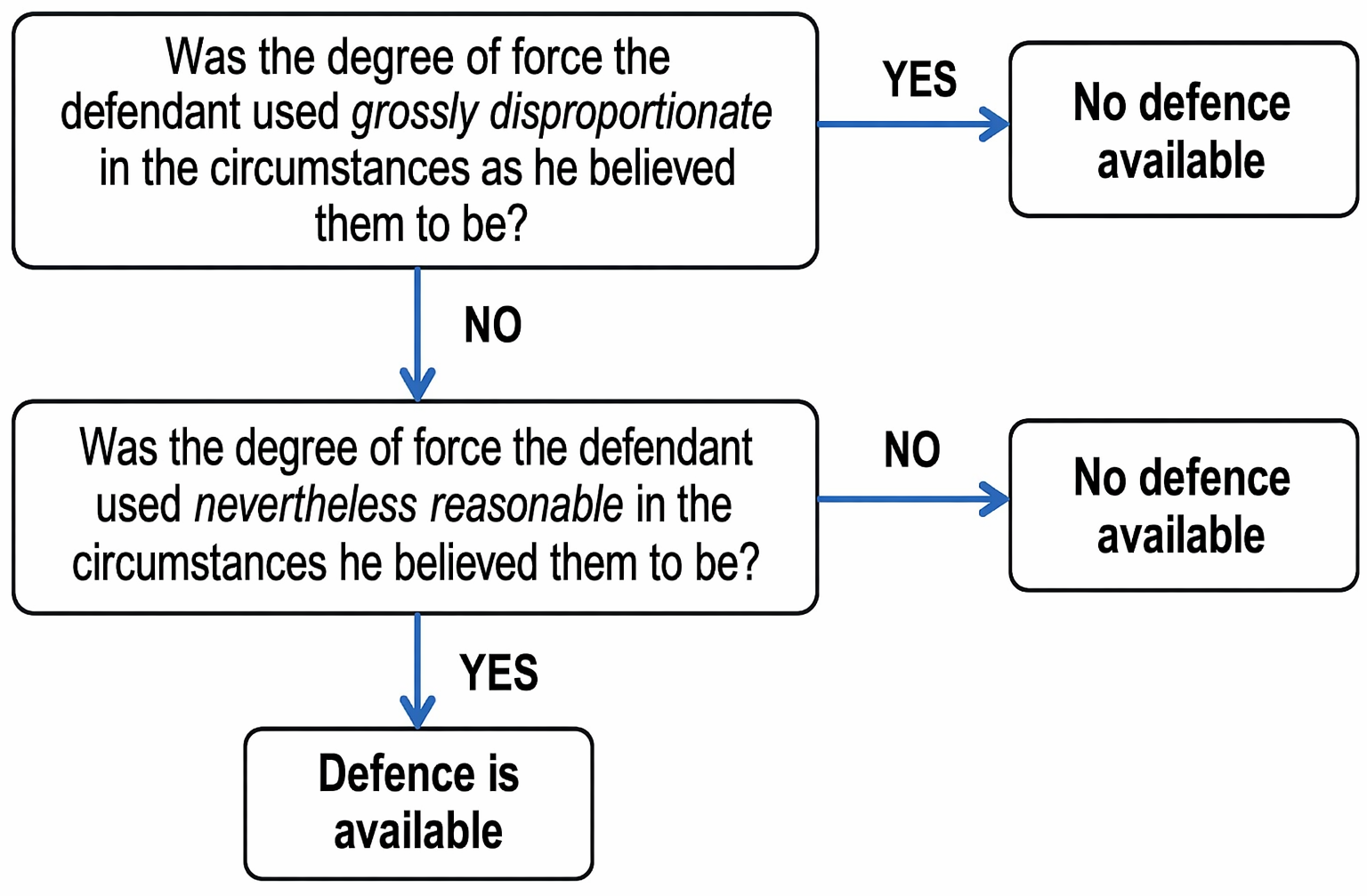
Self-defence and defence of another are presented by reference to common law, s 3 CLA 1967, and s 76 CJIA 2008.
Key Term: householder case
A situation where a person uses force in self-defence while in or partly in a dwelling, against a person they believe to be a trespasser.
Juries follow a two-stage inquiry: (1) was the force grossly disproportionate in the circumstances as the defendant believed them to be? If yes, the defence fails. (2) If not grossly disproportionate, was the force nevertheless reasonable? In evaluating reasonableness the jury should consider the shock of coming upon an intruder, the time of day, and the vulnerability of occupants, particularly children. Disproportionate force may still be reasonable for householders, but grossly disproportionate force is never reasonable.
Worked Example 1.4
Scenario: Jordan is woken by an intruder at night. He uses a cricket bat to strike the intruder, causing serious injury. The intruder is trying to escape at the time.
Answer:
If the force used was not grossly disproportionate, Jordan may be able to rely on the householder defence. However, if the intruder was fleeing and no longer a threat, the force may be excessive.
Worked Example 1.5
Scenario: Priya confronts a trespasser in her kitchen. Believing he may attack her, she stabs him once to stop him advancing. He survives.
Answer:
In a householder case, the jury asks first whether the force was grossly disproportionate. If not, they then assess reasonableness in Priya’s believed circumstances. One stabbing could be disproportionate yet still reasonable if the threat she believed was grave; multiple stabbings or continued stabbing after incapacitation would likely be excessive.
Limits of the Defence
- Excessive Force: If the force is unreasonable (or grossly disproportionate in a householder case), the defence fails.
- Retaliation or Revenge: Force used for retaliation, punishment, or to “teach a lesson” is not defensive.
- Mistake Due to Intoxication: A mistaken belief caused by voluntary intoxication cannot found the defence.
- Threat Passed: If the danger has passed, further force is not necessary and will be unreasonable.
- Initial Aggressor: A person who instigates violence may still rely on self-defence if the other party escalates beyond their own violence, but force must be defensive and proportionate, not retaliatory.
Exam Warning: The defence of self-defence is not available if the defendant's mistaken belief in the need for force was caused by voluntary intoxication. Always check the source of the mistake in SQE1 questions.
Application to Defence of Another
The same principles apply when force is used to protect another person. Section 76 applies equally: ask whether D honestly believed force was necessary to defend the other, and whether the force used was reasonable in those believed circumstances. Defence of another also overlaps with s 3 Criminal Law Act 1967 in preventing crime.
Key Term: defence of another
Self-defence applied to protecting another person; necessity is judged by D’s honest belief, and reasonableness is judged objectively in light of those believed circumstances. Key Term: prevention of crime
Under s 3 Criminal Law Act 1967, reasonable force may be used to prevent crime or in effecting a lawful arrest. This includes protecting persons and property from criminal acts.
Worked Example 1.6
Scenario: Leo sees two men pinning his friend to the ground and repeatedly punching him. Fearing serious harm, Leo hits one assailant with a single strike to stop the attack.
Answer:
Leo may rely on defence of another. His honest belief in the need to protect his friend satisfies necessity, and a single strike to stop the attack is likely reasonable.
Self-Defence and Defence of Property
Reasonable force may be used to protect property, but lethal force is rarely justified unless there is an immediate threat to life or limb. Force aimed solely at recovering goods (for example, chasing a fleeing thief and inflicting serious injury when no longer threatened) will normally be excessive. Under s 3 CLA 1967, force to prevent criminal damage or theft must still be reasonable.
Worked Example 1.7
Scenario: Marta sees someone snatching her phone and running away. She trips the fleeing thief, takes her phone back, and holds him briefly until security arrives.
Answer:
Using limited force to prevent crime and recover property may be reasonable. Inflicting serious injury on a fleeing thief when no longer threatened would not be justified.
Additional Clarifications under s 76 CJIA 2008
Section 76 provides the following guidance for juries:
- Reasonableness of force is judged by reference to the circumstances as D believed them to be (even if mistaken and even if unreasonable), save where the mistake is due to voluntary intoxication.
- D is not expected to precisely calibrate force under stress; juries should account for the “heat of the moment.”
- There is no duty to retreat; evidence that D tried to retreat may support reasonableness but absence of retreat does not defeat the defence.
- If D acted “honestly and instinctively,” that is strong evidence of reasonable action; it is not conclusive.
Worked Example 1.8
Scenario: Owen is cornered by two men in a car park. He swings a torch once to create space and runs away. He did not attempt to negotiate or retreat first.
Answer:
No duty to retreat applies. The question is whether the single strike was reasonable given Owen’s honest belief of an imminent attack. Creating space and fleeing can support reasonableness.
When Householder Protection Ends
The householder latitude applies only while D is in or partly in the dwelling (or forces accommodation) dealing with a trespasser. Once the intruder has left, ordinary rules apply. Chasing an intruder outdoors and inflicting serious violence typically exceeds necessity and reasonableness.
Worked Example 1.9
Scenario: Ravi chases an intruder out of his house and across the street, then punches and kicks him until he is unconscious.
Answer:
The householder provisions no longer apply outside the dwelling. The intruder is no longer an imminent threat within Ravi’s home; the prolonged attack is retaliatory and excessive. The defence will fail.
Burden and Standard of Proof
The defendant bears an evidential burden to raise a basis for self-defence. The legal burden remains with the prosecution to disprove self-defence beyond reasonable doubt. If the jury are not sure that the force was unnecessary or unreasonable, D must be acquitted.
Worked Example 1.10
Scenario: The prosecution proves a battery. D adduces evidence that he thought V was about to hit him. The jury think the belief may have been honest, but are unsure whether the force was unreasonable.
Answer:
The prosecution must disprove self-defence beyond reasonable doubt. If the jury are not sure the force was unreasonable or unnecessary, D is entitled to acquittal.
Summary Table: Self-Defence and Defence of Another
| Requirement | Explanation |
|---|---|
| Necessity | D honestly believed force was needed to prevent harm to self/another |
| Reasonable force | Force used was proportionate in the circumstances as D believed them to be |
| Mistaken belief | Defence available if belief was honest, unless mistake was due to voluntary intoxication |
| Householder cases | Disproportionate force may be reasonable, but not grossly disproportionate |
| Excessive force | Defence fails if force is excessive or grossly disproportionate |
| No duty to retreat | D not required to retreat, but evidence of retreat may support the defence |
| Pre-emptive strikes | Lawful if D honestly believes an attack is imminent |
| Prevention of crime | Reasonable force permitted to prevent crime or effect a lawful arrest |
Key Point Checklist
This article has covered the following key knowledge points:
- Necessity turns on D’s honest belief about an imminent threat; the belief may be mistaken unless caused by voluntary intoxication.
- Reasonableness is judged objectively in light of those believed circumstances; precise calibration is not required in the heat of the moment.
- There is no duty to retreat; pre‑emptive strikes can be lawful where an attack is honestly believed to be imminent.
- Householders may use disproportionate force provided it is not grossly disproportionate; ordinary rules apply once the intruder leaves the dwelling.
- Defence of another applies the same tests as self-defence and often overlaps with s 3 Criminal Law Act 1967.
- Force used for retaliation, punishment, or after the threat has passed is outside the defence.
- The prosecution must disprove self-defence beyond reasonable doubt once the issue is properly raised.
Key Terms and Concepts
- self-defence
- reasonable force
- necessity
- mistaken belief
- householder case
- defence of another
- prevention of crime