Learning Outcomes
This article examines voluntary manslaughter and its partial defences of diminished responsibility, loss of control, and suicide pact in the context of SQE1 Criminal Law assessment, including:
- the statutory foundations and legal tests for diminished responsibility, loss of control, and suicide pact
- how each partial defence operates to reduce liability from murder to voluntary manslaughter and affect sentencing discretion
- burdens and standards of proof for each defence, distinguishing evidential from legal burdens on the parties
- the role of psychiatric and other expert evidence in establishing abnormality of mental functioning
- how intoxication, alcohol dependency syndrome, and co-existing mental conditions interact with diminished responsibility and loss of control
- the objective elements of loss of control, including qualifying triggers and the ‘normal tolerance and self-restraint’ standard
- common exclusions and limitations to the loss of control defence, such as sexual infidelity and revenge
- requirements for proving a genuine suicide pact, including settled intention to die and killing in pursuance of the agreement
- techniques for applying these rules to SQE1-style multiple-choice questions and short, client-based problem scenarios
SQE1 Syllabus
For SQE1, you are required to understand the law and practical application of voluntary manslaughter, with a focus on the following syllabus points:
- the statutory requirements for diminished responsibility, loss of control, and suicide pact
- the effect of these partial defences on a charge of murder
- the burden and standard of proof for each defence
- how to apply these defences to realistic client-based problems
- the gatekeeping role of the judge (loss of control: evidential sufficiency; diminished responsibility: uncontroverted medical evidence)
- limits and exclusions to loss of control (sexual infidelity alone, incited triggers, revenge)
- how intoxication interacts with diminished responsibility and loss of control
- the objective element for loss of control (age/sex, normal tolerance and self-restraint, relevant circumstances)
- the “explanation” requirement in diminished responsibility linking the abnormality to the killing
Test Your Knowledge
Attempt these questions before reading this article. If you find some difficult or cannot remember the answers, look more closely at that area during your revision.
- What are the four elements a defendant must prove to rely on diminished responsibility?
- Name the two main qualifying triggers for loss of control under the Coroners and Justice Act 2009.
- Who bears the burden of proof for the defence of suicide pact, and what standard applies?
- Can voluntary intoxication alone amount to diminished responsibility?
Introduction
Voluntary manslaughter arises where a defendant has committed the actus reus and mens rea of murder, but their culpability is reduced by a partial defence. The law recognises three partial defences: diminished responsibility, loss of control, and suicide pact. If established, these defences reduce a conviction from murder to manslaughter, giving the judge discretion in sentencing. These are special (murder-only) defences and do not apply to other offences such as attempted murder. They come into play only once murder is otherwise made out: unlawful killing of a human being under the Queen’s peace and intention to kill or cause grievous bodily harm.
Partial defences aim to recognise reduced blameworthiness. For example, loss of control accommodates “slow burn” reactions to serious wrongdoing or fear of serious violence, and diminished responsibility addresses killings significantly driven by abnormal mental functioning arising from a recognised medical condition. In all cases, the focus is on careful analysis of statutory elements and causative links. Where a partial defence succeeds, the mandatory life sentence for murder does not apply and the court sentences for manslaughter, taking account of culpability and harm.
Test Tip: In SQE-style questions on Voluntary manslaughter, identify the legal test, the triggering fact, and the consequence before choosing between similar answer options.
Diminished Responsibility
Diminished responsibility is a statutory partial defence to murder, found in section 2 of the Homicide Act 1957 (as amended). It applies where a defendant was suffering from an abnormality of mental functioning that substantially impaired their responsibility for the killing.
Key Term: diminished responsibility
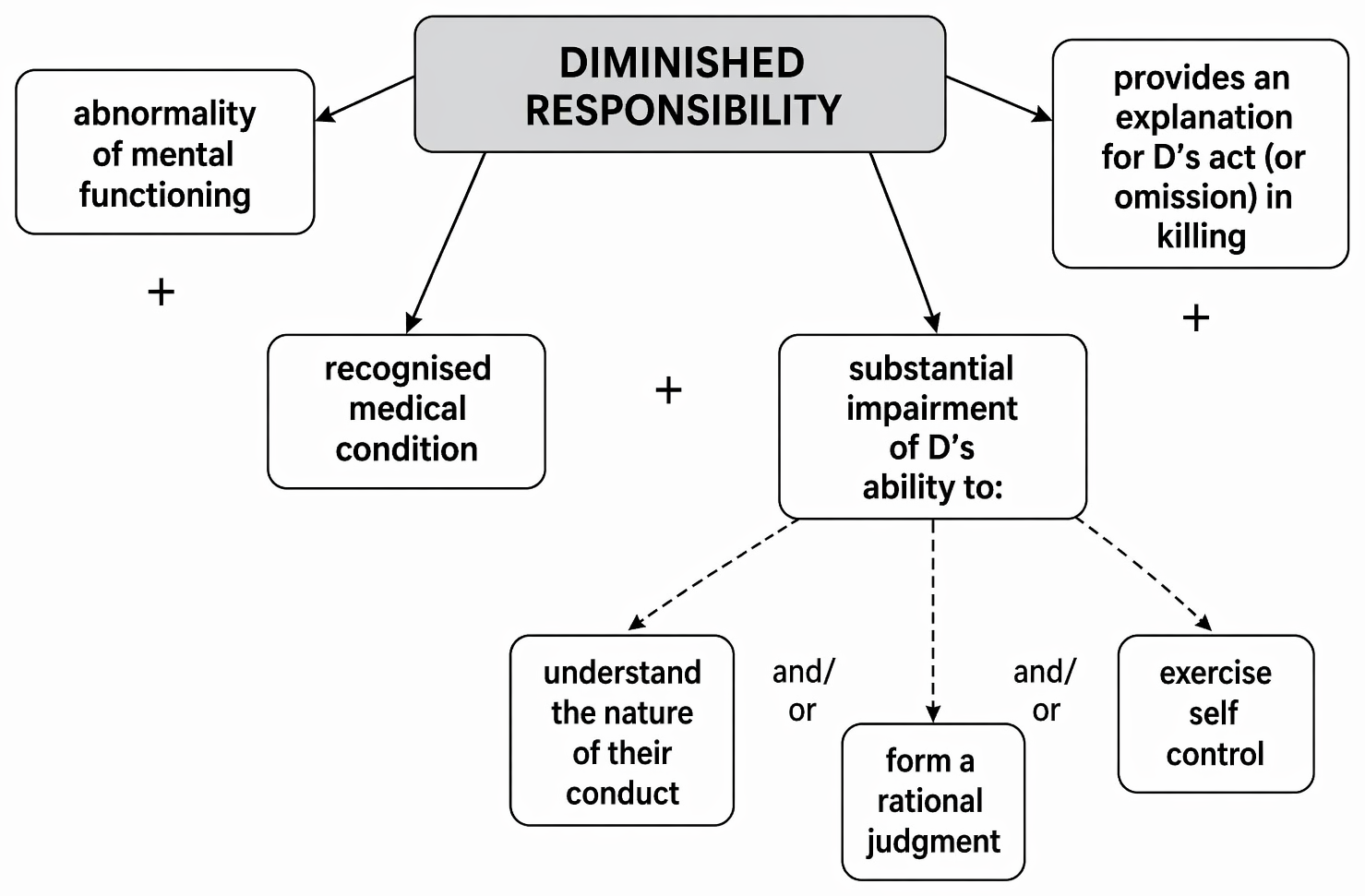
A partial defence to murder where the defendant proves they were suffering from an abnormality of mental functioning arising from a recognised medical condition, which substantially impaired their ability to understand their conduct, form a rational judgment, or exercise self-control, and which provides an explanation for the killing.
Legal Requirements
To rely on diminished responsibility, the defendant must prove:
Homicide offences are arranged by actus reus and mens rea, locating diminished responsibility and loss of control within voluntary manslaughter.
-
they were suffering from an abnormality of mental functioning
-
arising from a recognised medical condition
-
which substantially impaired their ability to:
- understand the nature of their conduct,
- form a rational judgment, or
- exercise self-control
-
and the abnormality must provide an explanation for the defendant’s acts or omissions in the killing
Each element must be carefully evidenced. “Abnormality of mental functioning” adopts the ordinary sense of a state of mind markedly different from that of the reasonable person. It is broader than psychiatric diagnoses alone and can include mental and certain physical conditions that affect mental functioning. Psychiatric evidence is ordinarily needed to demonstrate both the existence of the condition and its effect on mental abilities. The jury are the ultimate arbiters, but the judge may withdraw murder from the jury where medical evidence uncontrovertedly satisfies all elements of the defence, leaving manslaughter as the appropriate verdict.
Key Term: abnormality of mental functioning
A state of mind so different from that of ordinary people that the reasonable person would consider it abnormal. Key Term: recognised medical condition
A condition accepted by the medical profession, including mental disorders (e.g., schizophrenia, depression, PTSD, battered person syndrome) and some physical conditions (e.g., epilepsy, diabetes), where the condition impacts mental functioning. Key Term: substantial impairment
An important or significant reduction in the defendant’s ability to understand their conduct, form rational judgment, or exercise self-control—not merely trivial; it need not be a total impairment. Key Term: provides an explanation
The abnormality must be a significant cause or factor in the defendant’s involvement in the killing, ensuring the conduct is properly attributable to the abnormality rather than coincidental.
Substantial impairment concerns the quality and degree of impaired ability, not an absolute loss of function. Juries should be directed that “substantial” denotes something of real importance (more than minimal or trivial), akin to everyday usage (e.g., a “substantial meal”), and not necessarily “total”. The impairment must relate to at least one of the three listed abilities. For example:
- understanding the nature of conduct: appreciating the finality of killing or comprehending the physical nature of the act
- forming a rational judgment: decision-making compromised by a condition such as severe depression or long-term abuse impacting rational choices
- exercising self-control: inability to restrain violent impulses due to conditions such as psychopathy or battered person syndrome, even where the loss of control defence might fail due to the objective tolerance requirement
The “explanation” requirement is a causal question. The abnormality does not need to be the sole cause of the killing, but it must be an important contributory factor. The jury should be invited to consider whether, absent the abnormality, the defendant would likely have acted as they did. This question prevents reliance where the killing is primarily attributable to voluntary intoxication or other unrelated motives.
Burden and Standard of Proof
The defendant bears the legal burden of proving diminished responsibility on the balance of probabilities (more likely than not). This reversed burden is exceptional in criminal law. The prosecution still bears the legal burden to prove murder beyond reasonable doubt; diminished responsibility operates only after the elements of murder have been established and the defendant has proved the defence. Where medical evidence is uncontested and clearly supports diminished responsibility, the judge may remove murder from the jury and leave manslaughter based on diminished responsibility.
Diminished Responsibility and Intoxication
Voluntary intoxication alone does not amount to diminished responsibility. Acute intoxication from alcohol or drugs, without a recognised medical condition, is insufficient. However, if a recognised medical condition such as alcohol dependency syndrome (ADS) or brain damage exists, the jury should consider whether the abnormality substantially impaired the defendant’s responsibility. The key is whether the abnormality, rather than the transient effects of voluntary consumption, was a significant cause of the impairment and provides the explanation for the killing.
Jurors should be directed to focus on the impact of the recognised condition itself. If the defendant suffers ADS, the extent to which they could control drinking, the seriousness of dependence, and capacity for abstinence are relevant to whether consumption was truly voluntary and whether ADS contributed to substantial impairment. Where a separate recognised condition (e.g., schizophrenia, severe depression, PTSD) coexists with intoxication, the jury must decide whether the abnormality of mental functioning, taken alone, substantially impaired the defendant’s ability and explains the killing. If so, diminished responsibility can succeed notwithstanding concurrent intoxication.
Worked Example 1.1
A defendant with severe depression kills a neighbour after a period of delusional thinking. Medical evidence confirms the depression is a recognised medical condition. The jury finds that the depression substantially impaired the defendant’s ability to form rational judgment and was a significant factor in the killing.
Answer:
The defendant may be convicted of manslaughter, not murder, if the jury is satisfied all elements of diminished responsibility are met.
Loss of Control
Loss of control is a statutory partial defence to murder, replacing the old law of provocation. It is governed by sections 54 and 55 of the Coroners and Justice Act 2009.
Key Term: loss of control
A partial defence to murder where the defendant’s acts or omissions resulted from a loss of self-control caused by a qualifying trigger, and a person of the defendant’s sex and age with normal tolerance and self-restraint might have reacted in the same or similar way.
Loss of Control: Legal Requirements
To rely on loss of control, the defendant must show:
- their acts or omissions resulted from a loss of self-control
- the loss of control had a qualifying trigger
- a person of the defendant’s sex and age, with a normal degree of tolerance and self-restraint, and in the same circumstances, might have reacted in the same or a similar way
Loss of control need not be sudden, and the law recognises the reality of accumulative fear or distress (“slow burn”). Nevertheless, the longer the delay between trigger and killing, the greater the evidential challenge: delay can suggest planning or a considered desire for revenge, which excludes the defence. The defendant must genuinely have lost self-control, as opposed to acting out of calculated hostility or premeditation.
The objective limb requires a jury to assess the reaction of a hypothetical person of the defendant’s age and sex, with normal tolerance and self-restraint, in the defendant’s circumstances. Only circumstances relevant to the gravity of the qualifying trigger are considered; characteristics that serve solely to lower tolerance or self-restraint (such as intoxication) are excluded. Conditions affecting the gravity of the trigger (e.g., a history of abuse contextualising perceived threats) may be relevant; but general impulsivity or personality traits reducing restraint are not.
Qualifying Triggers
There are two main qualifying triggers:
- fear of serious violence from the victim against the defendant or another identified person
- things said or done (or both) which constituted circumstances of an extremely grave character and caused the defendant to have a justifiable sense of being seriously wronged
Key Term: qualifying trigger
A legally recognised reason for loss of control: either fear of serious violence or circumstances of an extremely grave character causing a justifiable sense of being seriously wronged.
Fear of serious violence requires more than apprehension of property damage or minor assault; it can be cumulative and may be for another person (e.g., a child or partner). The “grave character/seriously wronged” trigger sets an exacting threshold: routine relationship breakdowns or everyday slights will not ordinarily qualify. The sense of being seriously wronged must be objectively justifiable; the jury must be satisfied that the circumstances were extremely grave and the defendant’s sense of wrong was justified in those circumstances.
Circumstances relevant to gravity can include a prolonged pattern of humiliation or abuse. Sexual infidelity alone cannot be a qualifying trigger, but words or conduct relating to infidelity may form part of the relevant background when other qualifying triggers exist. If reliance is placed exclusively on sexual infidelity, the defence fails; if infidelity is part of a matrix of extremely grave circumstances (e.g., sustained taunting combined with other serious wrongs), the jury may consider the full context.
Exclusions
- Sexual infidelity alone cannot be a qualifying trigger.
- The defence is not available if the defendant acted in a considered desire for revenge.
- The loss of control need not be sudden, but a delay may make the defence less likely to succeed.
- The defence is excluded where the defendant incites the thing said or done or the violence as an excuse to act with violence.
The exclusions emphasise that the defence addresses genuine loss of self-control engendered by qualifying triggers, not excuse for retribution. A “considered desire for revenge” captures planned retaliation after reflection, even if the defendant was angry. Similarly, where the defendant deliberately sets up a scenario to provoke a trigger, the defence will not be left to the jury.
The third limb is objective. The hypothetical person is as old and of the same sex as the defendant and is placed in the same circumstances relevant to the gravity of the trigger. However, that person has a normal degree of tolerance and self-restraint. The jury must decide whether such a person might have reacted in the same or similar way—not whether the defendant did react that way, but whether it is a plausible reaction for the hypothetical person.
Intoxication requires careful handling. While being drunk does not automatically defeat the defence, intoxication is excluded where it only serves to lower tolerance or self-restraint; but the circumstances relevant to gravity may be evaluated with full context (e.g., intoxicated taunting by the victim can be part of “things said or done”). The jury must distinguish between circumstances that bear on gravity and those that simply diminish restraint.
Loss of Control: Burden and Standard of Proof
The defendant has an evidential burden to raise loss of control by adducing sufficient evidence on each limb so that a properly directed jury could reasonably find the defence made out. The judge acts as gatekeeper: if there is insufficient evidence of loss of self-control or of a qualifying trigger, the defence will not be left to the jury. Once raised, the prosecution must disprove the defence beyond reasonable doubt.
Worked Example 1.2
A woman, after years of domestic abuse, kills her partner during a violent argument. She feared serious violence and lost self-control. The jury is satisfied that a person of her sex and age with normal tolerance might have reacted similarly.
Answer:
The woman may be convicted of manslaughter, not murder, if the jury accepts the loss of control defence.Exam Warning: The loss of control defence is only available for murder. It cannot be used for attempted murder or any other offence.
Suicide Pact
A suicide pact is a statutory partial defence to murder under section 4 of the Homicide Act 1957. It applies where two or more people agree to die together, but one survives.
Key Term: suicide pact
An agreement between two or more persons to die together, whether or not each is to take their own life, in furtherance of the pact.
Suicide Pact: Legal Requirements
To rely on the suicide pact defence, the defendant must prove:
- there was a genuine agreement to die together (the pact must be real, not a spur-of-the-moment proposal without settled plan)
- the defendant had a settled intention of dying in accordance with the pact at the time of the killing
- the killing was done in pursuance of the pact (the conduct must further the agreed plan to die together)
The agreement may contemplate different means for each party and can be evidenced by communications, preparations, or actions consistent with a shared plan. “Settled intention” requires more than fleeting thoughts of self-harm; it is a firm plan to die in accordance with the pact. The killing must be in furtherance of the pact; opportunistic killing unconnected with any genuine pact does not qualify.
Suicide Pact: Burden and Standard of Proof
The defendant bears the legal burden to prove the existence of a suicide pact and their settled intention to die, on the balance of probabilities. If established, the charge of murder is reduced to manslaughter.
Worked Example 1.3
Two friends agree to end their lives together. One survives and is charged with murder. Evidence shows a genuine agreement and a settled intention to die.
Answer:
If the jury is satisfied, the defendant may be convicted of manslaughter, not murder.
Summary
| Defence | Statutory Basis | Key Requirements | Burden of Proof | Effect |
|---|---|---|---|---|
| Diminished responsibility | Homicide Act 1957, s 2 | Abnormality of mental functioning from a recognised medical condition, substantial impairment, explanation for killing | Defendant (balance of probabilities) | Reduces murder to manslaughter |
| Loss of control | Coroners and Justice Act 2009, ss 54–55 | Loss of self-control, qualifying trigger, normal person might react similarly | Prosecution (disprove beyond reasonable doubt) | Reduces murder to manslaughter |
| Suicide pact | Homicide Act 1957, s 4 | Genuine agreement to die, settled intention to die, killing in pursuance of pact | Defendant (balance of probabilities) | Reduces murder to manslaughter |
In sentencing for manslaughter, the court has discretion and applies guideline ranges reflecting culpability. For killings reduced by loss of control or diminished responsibility, the sentence focuses on culpability factors such as the gravity of the trigger or the extent and effect of the abnormality of mental functioning. By contrast, murder carries a mandatory life sentence with minimum terms set by statute and guidelines; successful reliance on a partial defence removes that mandatory consequence.
Key Point Checklist
This article has covered the following key knowledge points:
- Voluntary manslaughter arises where a defendant has committed murder but a partial defence applies.
- The three partial defences are diminished responsibility, loss of control, and suicide pact.
- Diminished responsibility requires proof of an abnormality of mental functioning from a recognised medical condition, causing substantial impairment of specified abilities and providing an explanation for the killing.
- Psychiatric evidence is ordinarily required; if clearly uncontroverted and sufficient, the judge may withdraw murder from the jury.
- Voluntary intoxication alone cannot found diminished responsibility; alcohol dependency syndrome and other recognised conditions can be relevant if they substantially impair responsibility and explain the killing.
- Loss of control requires a loss of self-control, a qualifying trigger (fear of serious violence, or extremely grave circumstances causing a justifiable sense of being seriously wronged), and that a person of normal tolerance and self-restraint of the defendant’s age and sex might have reacted similarly.
- Loss of control exclusions include sexual infidelity alone, incited triggers, and a considered desire for revenge; the loss of control need not be sudden, but delay may undermine the defence.
- For loss of control, the defendant has an evidential burden; once raised, the prosecution must disprove the defence beyond reasonable doubt.
- Suicide pact requires a genuine agreement to die together, a settled intention to die in accordance with the pact, and a killing in pursuance of that pact; the defendant proves this on the balance of probabilities.
- If any partial defence is established, the conviction is reduced from murder to manslaughter and sentencing becomes discretionary.
Key Terms and Concepts
- diminished responsibility
- abnormality of mental functioning
- recognised medical condition
- substantial impairment
- provides an explanation
- loss of control
- qualifying trigger
- suicide pact