Learning Outcomes
This article explains inheritance tax on lifetime transfers and transfers on death from a valuation and computational perspective, including:
- The statutory definition and practical measurement of a transfer of value and loss to the estate, and how these concepts underpin IHT charges on both lifetime gifts and death estates.
- Application of the open market value standard to complex assets, such as jointly owned property, minority and controlling shareholdings (quoted and unquoted), and life policies whose value changes on death.
- Operation of the related property rules and “pairs and sets” principles to prevent undervaluation, and when fractional discounts are or are not appropriate.
- The distinction between PETs and CLTs, seven‑year cumulation rules, and the identification of chargeable versus exempt transfers in common exam fact patterns.
- Step‑by‑step IHT computation on death, integrating earlier lifetime transfers, ordering of charges, taper relief on tax, and grossing‑up where tax is borne by the estate.
- Main exemptions and reliefs affecting value (spouse/civil partner exemption, charity exemption, normal expenditure out of income, BPR and APR) and their ordering within calculations.
- Identification and treatment of gifts with reservation of benefit, including when they override PET treatment and bring property back into the death estate.
- Restrictions on the deduction of debts and liabilities, with emphasis on anti‑avoidance rules for liabilities funding excluded property or relief‑qualifying assets.
SQE1 Syllabus
For SQE1, you are required to understand inheritance tax on lifetime transfers and on death, with a focus on the following syllabus points:
- the principles for valuing assets for inheritance tax purposes (including open market value, joint ownership, and shareholdings)
- the definition and calculation of a transfer of value
- how lifetime transfers (PETs and CLTs) and transfers on death are treated for IHT
- the aggregation of transfers and the effect of previous gifts
- the main exemptions and reliefs relevant to valuation and transfer of value
- the impact of anti-avoidance rules on valuation and transfer calculations
Test Your Knowledge
Attempt these questions before reading this article. If you find some difficult or cannot remember the answers, look more closely at that area during your revision.
- What is the statutory basis for valuing assets for inheritance tax purposes?
- How is the value of a minority shareholding in a private company determined for IHT?
- What is a transfer of value, and how is it calculated for lifetime gifts?
- How are previous lifetime transfers taken into account when calculating IHT on death?
- Name two key exemptions or reliefs that can affect the value transferred for IHT.
Introduction
Inheritance tax (IHT) applies to both lifetime transfers and transfers on death. For SQE1, you must understand how assets are valued for IHT, what constitutes a transfer of value, and how the rules differ for various types of transfers. Correct application of these principles is essential for calculating IHT liability and advising clients on estate planning.
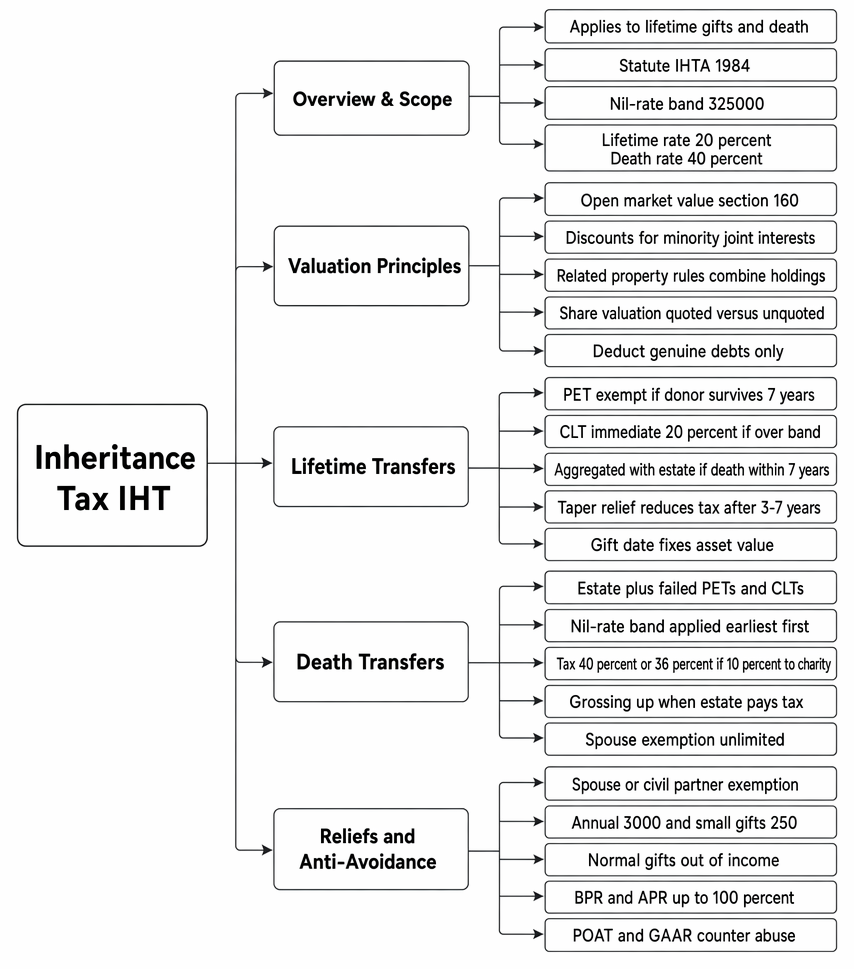
Inheritance tax under IHTA 1984 is presented across valuation, potentially exempt transfers, chargeable lifetime transfers, death estates, exemptions, reliefs, and anti-avoidance.
Valuation Principles for Inheritance Tax
The starting point for IHT is to determine the value of the property transferred. The law sets out clear rules for this process.
Key Term: open market value
The price an asset might reasonably be expected to fetch if sold on the open market at the relevant time, ignoring any forced sale or special purchaser.
Statutory Valuation Rule
Section 160 of the Inheritance Tax Act 1984 (IHTA 1984) requires all property to be valued at its open market value at the time of the transfer. This means the price a willing buyer would pay to a willing seller, with neither under compulsion, and with full knowledge of the relevant facts.
Where the value of an asset changes because of the death itself, the change is recognised for IHT. Section 171 IHTA 1984 adjusts the value to reflect post‑death effects. Common examples are:
- the valuation of a life policy owned by the deceased increases to its maturity value on death (not the lower surrender value)
- the personal goodwill attributable to a sole trader may reduce on death
Jointly Owned Assets
Where property is owned jointly, the value of a fractional interest may be discounted to reflect the difficulty of selling a part interest. For residential property, a discount of 10–15% is commonly accepted for minority holdings, but this is a question of fact in each case and depends on marketability and control. HMRC typically assumes equal beneficial shares unless evidence shows otherwise. For joint bank accounts, the beneficial share is generally based on contributions; absent evidence, an equal split is often applied.
On death, only the deceased’s beneficial share is included in the estate valuation. A discount for a fractional interest may be appropriate unless overridden by the related property rules.
Key Term: joint tenancy
A form of co-ownership where each owner has an equal, undivided share, and the interest passes automatically to the survivor(s) on death. Key Term: tenancy in common
A form of co-ownership where each owner has a distinct share, which can be unequal and is passed by will or intestacy.
Related Property Rules
Where the transferor or their spouse/civil partner owns related property, the value of the asset may be increased to reflect the enhanced value of combined ownership. This prevents undervaluation through artificial fragmentation of ownership. The rules also apply to “pairs and sets” where items together command a premium (e.g., matching vases or a set of silver).
Key Term: related property
Property owned by the transferor and their spouse/civil partner (or certain charities or companies) that, when combined, increases the value of the asset for IHT purposes.
Practical effects:
- spouses/civil partners each owning a half share of a house may not obtain a fractional discount; each share is valued as the appropriate proportion of the value of the whole
- for “pairs or sets” (e.g., a pair of vases), each single item is valued by reference to the aggregate value of the complete pair/set
Valuing Shares
The valuation of shares depends on whether they are quoted or unquoted.
- Quoted shares: Valued using the Stock Exchange Daily Official List for the relevant date, on the “quarter‑up” basis (lower quoted price plus one quarter of the bid‑ask spread).
- Unquoted shares: More complex; key factors include net asset value, earnings and dividend capacity, business prospects, restrictions on transfer (e.g., pre‑emption rights), and the degree of control. Minority holdings are often discounted for lack of control and marketability; conversely, a controlling stake may attract a premium.
Business reliefs (BPR) may eliminate the IHT charge on qualifying business interests, but valuation is still required.
Special Valuation Issues
- Restrictions on sale are generally ignored as to title, but their impact on price is considered in the open market value.
- The existence of a special purchaser willing to pay more can be relevant if such a buyer reasonably exists.
- Life policies owned outright by the deceased are valued at their death (maturity) value, not their surrender value.
Debts and Liabilities
Debts incurred for full consideration are deductible from the value of the estate, but important anti‑avoidance rules restrict deductions in several situations:
- no deduction if the liability is not actually repaid or is waived, unless there is a genuine commercial reason
- restriction where a liability finances, directly or indirectly, excluded property (e.g., certain non‑UK assets of a non‑dom), or is linked to property qualifying for specific reliefs unless conditions are met
- special limits apply to loans used to fund non‑resident foreign currency accounts of non‑resident/non‑dom individuals
- funeral expenses and reasonable estate administration costs are deductible
Always check both the existence and actual repayment/continuing liability to ensure deductibility.
Transfer of Value: Lifetime and Death Transfers
IHT is charged on the value transferred by a chargeable transfer. The rules differ for lifetime gifts and transfers on death.
Key Term: transfer of value
Any disposition that reduces the value of the transferor’s estate, measured by the difference in value before and after the transfer. Key Term: loss to the estate
The measure of value transferred on a lifetime gift: the difference between the transferor’s estate value immediately before the gift and immediately after. For grouped/paired assets, the loss can exceed the market value of the gifted item alone.
Not all dispositions are transfers of value. A disposition made without a gratuitous intent (for full commercial consideration) is not a transfer of value. Similarly, certain family maintenance payments may be outside the scope.
Lifetime Transfers
There are two main types of lifetime transfers:
- Potentially Exempt Transfers (PETs): Gifts to individuals that are exempt if the donor survives seven years. If the donor dies within seven years, the value of the gift is aggregated with the death estate. PETs are assessed by reference to the value at the date of the gift (not at the date of death). Common examples include outright gifts of cash or assets to adult children, or gifts into bare trusts.
- Chargeable Lifetime Transfers (CLTs): Transfers into most trusts (e.g., discretionary trusts) or companies are immediately chargeable if they exceed the nil‑rate band. The lifetime rate is 20% on the chargeable excess. If the donor dies within seven years, further tax may become payable to bring the effective rate up to the death rate (subject to taper relief on the additional tax).
Key Term: potentially exempt transfer (PET)
A lifetime gift to an individual that is exempt from IHT if the donor survives seven years, but becomes chargeable if the donor dies within that period. Key Term: chargeable lifetime transfer (CLT)
A lifetime gift (usually to a trust or company) that is immediately chargeable to IHT if it exceeds the nil-rate band. Key Term: gift with reservation of benefit (GWR)
A lifetime gift where the donor retains a benefit (e.g., continuing to occupy a gifted house rent‑free). On death, the property is treated as part of the donor’s estate unless the reservation ceased and the donor survived seven years thereafter.
Common GWR traps include giving away a home while continuing to live there without paying full market rent, or gifting an asset but continuing to use it. Limited statutory exceptions exist (e.g., shared occupation with fair sharing of costs or paying a full market rent).
Transfers on Death
On death, IHT is charged at 40% on the value of the estate above the nil‑rate band, after deducting exemptions and reliefs. Previous lifetime transfers within seven years are aggregated with the death estate, and the nil‑rate band is applied to the earliest transfer first.
Key Term: nil rate band
The band of value charged at 0% (frozen at £325,000 for current purposes) available for lifetime and death transfers, subject to seven‑year cumulation with earlier chargeable transfers. Key Term: residence nil rate band
An additional 0% band (currently £175,000) available on death where a qualifying residential interest is “closely inherited” by direct descendants. It tapers away for estates exceeding £2 million and can transfer between spouses/civil partners if unused.
Additional features on death:
- a reduced rate of 36% can apply to chargeable estates where at least 10% of the “baseline amount” is left to charity
- certain trust property is aggregated with the death estate if the deceased had a qualifying interest in possession (e.g., an immediate post‑death interest (IPDI)); the trust fund is then taxed as part of the estate
- assets subject to reservation of benefit are treated as part of the death estate
Aggregation and Grossing Up
When calculating IHT on death, all chargeable transfers in the seven years before death are aggregated in chronological order. PETs that “fail” because of death become chargeable transfers at the date of the gift; CLTs are recalculated to death rates with credit for any lifetime tax paid. The nil‑rate band is set against the earliest transfers first. The residence nil rate band does not apply to lifetime transfers.
If a specific gift is made “free of tax” or the estate bears the IHT on that gift, the amount of tax itself forms part of the value transferred, requiring grossing‑up.
Key Term: grossing up
A calculation used when tax is borne by the estate (or the transfer is stated to be “free of tax”). The tax is computed on the grossed‑up figure so that the beneficiary receives the stated amount net of tax. Key Term: taper relief
A reduction in the tax on lifetime transfers (PETs/CLTs) where death occurs more than three but less than seven years after the gift. It reduces the tax on the gift, not the value of the gift.
Taper relief scale (years between gift and death):
- more than 3 but ≤4 years: 20% reduction
- more than 4 but ≤5 years: 40% reduction
- more than 5 but ≤6 years: 60% reduction
- more than 6 but <7 years: 80% reduction
Note that taper relief applies only if the transfer is already chargeable (i.e., exceeds the available nil‑rate band at the time of aggregation) and only to the tax attributable to that gift. It does not reduce the value cumulated against the nil‑rate band.
Exemptions and Reliefs Affecting Value
Several exemptions and reliefs can reduce the value transferred for IHT:
- Spouse or civil partner exemption: Transfers between spouses/civil partners are exempt if both are UK domiciled. If the recipient spouse/civil partner is non‑UK domiciled, a lifetime cap applies unless an election is made to be treated as UK domiciled.
- Charity exemption: Transfers to qualifying charities are exempt. A reduced 36% death rate may apply where 10% of the baseline amount passes to charity.
- Annual exemption: Up to £3,000 per tax year can be given away free of IHT; unused allowance can be carried forward one year.
- Small gifts exemption: Gifts of up to £250 per person per year are exempt and cannot be combined with the annual exemption for the same recipient.
- Normal expenditure out of income: Regular gifts out of income, not affecting the donor’s standard of living, are exempt with adequate records.
- Marriage/civil partnership gifts: Exempt up to prescribed limits (e.g., £5,000 by a parent).
- Business property relief (BPR): Up to 100% relief on qualifying business interests and certain shareholdings, subject to trading nature and ownership period conditions.
- Agricultural property relief (APR): Up to 100% relief on the agricultural value of qualifying agricultural property, subject to occupation/ownership conditions.
Key Term: business property relief (BPR)
Relief of 100% or 50% from IHT for transfers of qualifying business interests or assets used in a business, subject to trading status and minimum ownership periods. Key Term: agricultural property relief (APR)
Relief of up to 100% from IHT on the agricultural value of qualifying agricultural property, subject to occupation/ownership conditions.
Reliefs and exemptions are applied in a logical order. Full exemptions (e.g., spouse/charity) are applied before reliefs. For lifetime transfers, reliefs (e.g., BPR/APR) apply before the “lifetime only” exemptions (e.g., annual exemption) where only part of a transfer is otherwise chargeable.
Worked Example 1.1
Worked Example 1.1 Details
Aisha owns 30% of the shares in a private company, XYZ Ltd. The company’s net assets are valued at £1,000,000. How should Aisha’s shares be valued for IHT if she dies, and what discount might apply?
Answer:
The starting point is Aisha’s proportionate share of net assets (£300,000). However, as a minority holding in a private company, a discount (commonly 10–15%) may be applied to reflect lack of control and marketability. If a 15% discount is accepted, the value for IHT would be £255,000. If BPR at 100% is available (e.g., trading company, qualifying ownership period), the charge on this holding may be eliminated, but valuation is still required.
Worked Example 1.2
Worked Example 1.2 Details
Ben gifts £400,000 to his daughter in June 2017. He dies in August 2022. How is the gift treated for IHT, and what relief may apply?
Answer:
The gift is a PET. As Ben died within seven years, the gift is aggregated with his estate for IHT. Taper relief applies as more than five but less than six years have passed, reducing the tax payable on the gift by 60%. The relief reduces the tax on the gift, not the gift’s value used in cumulation.
Worked Example 1.3
Worked Example 1.3 Details
Clara and her brother jointly own a house worth £500,000 as tenants in common (50% each). Clara dies, leaving her share to her son. What value is used for IHT?
Answer:
Clara’s 50% share is valued at open market value, but a discount (typically 10–15%) may be applied to reflect the difficulty of selling a half share. If a 10% discount is accepted, her share is valued at £225,000 for IHT. If Clara’s brother were her spouse, the related property rules could restrict the discount.
Worked Example 1.4
Worked Example 1.4 Details
Dion gave his niece £200,000 in May 2019 (no earlier gifts). He died in July 2023 with a net estate of £400,000 after liabilities and exemptions, leaving everything to friends (no spouse/charity). Compute the IHT outline.
Answer:
The £200,000 PET becomes chargeable. Cumulate transfers: the earliest is the May 2019 PET (£200,000), then the death estate (£400,000).
- Apply the nil‑rate band (£325,000) to the earliest transfer first: £200,000 of NRB used on the PET; £125,000 NRB remains for the estate.
- PET tax: no tax (fully covered by NRB at that stage), so no taper applies.
- Estate tax: £400,000 − £125,000 (remaining NRB) = £275,000 @ 40% = £110,000.
- Total IHT ≈ £110,000 (ignoring RNRB as no qualifying residence left to direct descendants).
Worked Example 1.5
Worked Example 1.5 Details
Eva settled £500,000 into a discretionary trust in April 2021 (a CLT). She paid the lifetime IHT. She dies in June 2024. Assume no earlier transfers and that no BPR/APR applies.
Answer:
Lifetime charge (at transfer): NRB £325,000; chargeable excess = £175,000. If the donor pays the lifetime tax, the transfer is “net” and must be grossed for lifetime tax. However, for outline:
- Lifetime IHT at 20% on excess: approximately £35,000 (precise grossing may modify slightly).
- On death within seven years, the CLT is recalculated at death rate. The tax on the £175,000 slice is 40% = £70,000. Credit the £35,000 paid in lifetime; additional tax due is £35,000, subject to taper relief because death is between 3 and 7 years after the gift. Here, just over 3 years, so a 20% taper applies to the tax on the gift: the death‑time tax on the gift reduces by 20% to £56,000; deduct £35,000 already paid = £21,000 additional due from the trustees. The estate is then computed with NRB exhausted by the CLT.
Worked Example 1.6
Worked Example 1.6 Details
Farah leaves a £100,000 pecuniary legacy to her friend “free of tax,” with residue to a charity. There are no lifetime transfers and no other exemptions/reliefs. The NRB is fully available.
Answer:
“Free of tax” requires grossing‑up because the estate bears the tax on the legacy.
- The taxable portion above the NRB is borne by the estate; here, residue is to charity (exempt), so the legacy absorbs the chargeable slice.
- If the estate aside from the legacy is insufficient to cover the NRB, assume the NRB covers part/all. If any IHT is due on the legacy, compute grossed‑up tax so that the friend receives £100,000 net. Illustratively, if the entire legacy is chargeable, the grossed‑up tax is £100,000 × 40/60 = £66,666.67, so the estate pays that tax and the friend takes £100,000. In practice, apply the NRB first, then gross any taxable balance.
Worked Example 1.7
Worked Example 1.7 Details
Gareth gave his home (worth £400,000 at the time) to his son in 2018 but continued to live there rent‑free. He dies in 2025.
Answer:
This is a gift with reservation of benefit. On death, the house is treated as part of Gareth’s estate at its open market value at death. The 2018 PET does not fall out: the value is included in the estate under the reservation rules. No seven‑year PET protection applies unless the reservation ceased and Gareth then survived seven years, or he paid a full market rent throughout the relevant period.Exam Warning:
- Taper relief reduces the tax on chargeable lifetime transfers if death occurs after three years, not the value used for cumulation. Do not reduce the value of the gift when applying the nil‑rate band.
- Apply the nil‑rate band to the earliest transfer first, then move forward through later gifts and the death estate.
- Where a gift is “free of tax” or the estate bears the tax on a specific legacy, remember grossing‑up.
- For jointly owned residential property, a fractional discount may apply unless the related property rules remove it.
Revision Tip: Start every IHT computation with a consistent sequence:
- identify the transfers (lifetime and on death) and dates
- value each property at the correct valuation date and basis
- apply exemptions (spouse, charity) and relevant reliefs (BPR/APR)
- cumulate chargeable transfers over seven years, apply the nil‑rate band to the earliest first
- calculate tax, considering taper relief on lifetime gifts and any grossing‑up
- check debt deductibility and any reservation of benefit
Key Point Checklist
This article has covered the following key knowledge points:
- The open market value rule is the basis for valuing assets for IHT; s171 recognises death‑driven changes in value.
- Jointly owned assets may be discounted for minority interests, unless related property rules apply; “pairs and sets” principles can increase value.
- Shares are valued differently depending on whether they are quoted (quarter‑up) or unquoted (control/marketability factors).
- A transfer of value is measured by loss to the estate; related property rules may affect that loss.
- PETs and CLTs are the main types of lifetime transfers for IHT, with seven‑year cumulation; PETs are chargeable only if the donor dies within seven years.
- On death, IHT is charged at 40% above the nil‑rate band; the residence nil rate band may apply to a qualifying residence passing to direct descendants.
- Previous lifetime transfers are aggregated with the death estate; the nil‑rate band is applied to the earliest transfer first; taper relief reduces tax on lifetime gifts.
- Grossing‑up applies where tax is borne by the estate or a gift is “free of tax”.
- Gifts with reservation of benefit are treated as part of the death estate unless the reservation ceased and the donor survived seven years thereafter.
- Exemptions (spouse, charity, annual, small gifts, normal expenditure out of income) and reliefs (BPR/APR) can significantly reduce the charge.
- Anti-avoidance rules restrict deductions for certain liabilities and excluded‑property funding; ensure liabilities are genuine and repaid.
Key Terms and Concepts
- open market value
- joint tenancy
- tenancy in common
- related property
- transfer of value
- loss to the estate
- potentially exempt transfer (PET)
- chargeable lifetime transfer (CLT)
- gift with reservation of benefit (GWR)
- nil rate band
- residence nil rate band
- taper relief
- grossing up
- business property relief (BPR)
- agricultural property relief (APR)