Learning Outcomes
This article outlines the different ways in which land can be held in England and Wales, including:
- the distinction between freehold and leasehold estates, focusing on duration, rights to possession, and practical consequences for owners and occupiers;
- the difference between legal and equitable interests in land, with examples of each and how they arise through formalities or equity;
- key principles of co-ownership, including joint tenancy, tenancy in common, the right of survivorship, and severance of the beneficial interest;
- the statutory framework for co-owned land under TLATA, trustees’ powers and duties, and how disputes over sale or occupation may be resolved;
- how estates and interests are created and transferred, with emphasis on deeds, written contracts, and the special rules for short leases and express easements;
- the operation of land registration, the difference between registered and unregistered land, and how entries on the register affect priority;
- methods of protecting third-party rights, including notices, restrictions, overriding interests, and land charges, and when each is required;
- the concept and mechanics of overreaching, its effect on beneficial interests under trusts, and how purchasers ensure overreaching occurs;
- common SQE1-style issues and traps when analysing fact patterns involving co-ownership, priority, overriding interests, and equitable rights.
SQE1 Syllabus
For SQE1, you are required to understand the different ways in which land can be held and the legal implications of each, with a focus on the following syllabus points:
- the distinction between freehold and leasehold estates in land
- the difference between legal and equitable interests in land
- how co-ownership operates, including joint tenancy and tenancy in common
- the statutory framework for co-ownership, especially the Trusts of Land and Appointment of Trustees Act 1996 (TLATA)
- the impact of land registration on estates and interests
- formalities for creation and transfer of estates and interests (deeds, contracts, short leases)
- the categories of legal interests (easements, profits, mortgages, rentcharges, rights of entry) and interests equitable by nature (restrictive covenants, beneficial interests, estate contracts)
- protection of third-party rights in registered land (notices, restrictions, overriding interests under Schedule 3 of the LRA 2002)
- protection of equitable rights in unregistered land (land charges under the LCA 1972 and the doctrine of notice)
- overreaching of beneficial interests and the role of trustees
Test Your Knowledge
Attempt these questions before reading this article. If you find some difficult or cannot remember the answers, look more closely at that area during your revision.
- What is the main difference between a freehold estate and a leasehold estate?
- Which of the following is an example of a legal interest in land?
- a) a beneficial interest under a trust
- b) a right of way granted by deed
- c) a restrictive covenant
- d) an estate contract
- What is the effect of holding land as joint tenants rather than tenants in common?
- True or false? An equitable interest in land can bind a purchaser of registered land even if it is not protected on the register.
Introduction
Land can be “held” in different ways, and those ways carry distinct consequences for duration, enjoyment, transfer, and how the rights bind third parties. The law distinguishes between estates (time-limited rights to possession) and interests (lesser rights over another’s land). Only two estates are capable of being legal: the freehold (fee simple absolute in possession) and the leasehold (term of years absolute). Interests may be legal if they fall within the statutory list and are created with the correct formalities; otherwise they take effect in equity. Modern land law also distinguishes between registered land (governed by the Land Registration Act 2002) and unregistered land (where rights are protected through the Land Charges Act 1972 and the doctrine of notice). Understanding how an estate or interest is created, protected, and prioritised in each system is essential.
Test Tip: In SQE-style questions on Different ways in which land can be held, identify the legal test, the triggering fact, and the consequence before choosing between similar answer options.
Estates in Land
The two principal estates in land are freehold and leasehold. These define the duration and nature of a person's right to possess and use land.
Conveyancing process for a registered land transaction, including pre-contract investigations, exchange, completion, post-completion formalities, and registration.
Freehold Estate
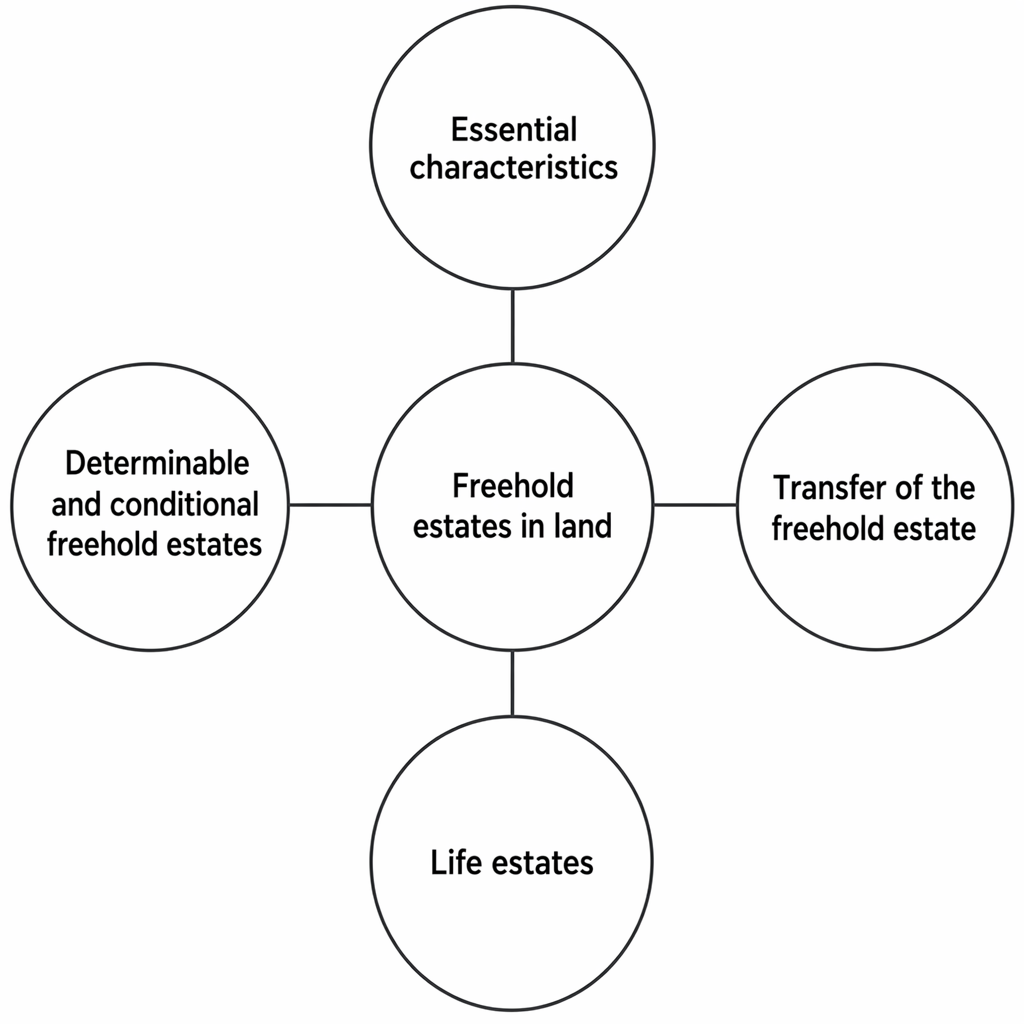
A freehold estate, also known as a "fee simple absolute in possession," is the closest form of outright ownership recognised by law. It lasts indefinitely and can be inherited or transferred. It gives an immediate right to possession and enjoyment, including the receipt of rents and profits, and is not conditional on any event.
Key Term: freehold estate
The right to possess and use land for an unlimited period, subject only to statutory restrictions.
A helpful way to read the phrase “fee simple absolute in possession” is:
- Fee: the estate is inheritable.
- Simple: it can pass to any class of heir.
- Absolute: it is not determinable on a specified event.
- In possession: there is a present, immediate right to possession.
If the owner dies intestate and without heirs, the estate escheats to the Crown. Historically determinable or conditional freeholds now typically arise as equitable interests rather than legal estates.
Leasehold Estate
A leasehold estate gives the right to possess and use land for a fixed period, as set out in a lease agreement. At the end of the term, the land reverts to the freeholder unless the lease is renewed. The essence of a lease is exclusive possession for a term.
Key Term: leasehold estate
The right to possess and use land for a defined period, granted by a lease.
A term of years may be of any length provided it is certain at the outset. Fixed-term leases (for example, six months, one year, 99 years) and periodic tenancies (weekly, monthly, yearly, continuing until notice is given) are both recognised. As a general rule, leases must be created by deed to be legal; however, a short lease (three years or less, in possession, at best rent without fine) can be granted without deed and still be legal. The tenant must have exclusive possession.
Commonhold is a modern form of freehold tenure used for multi-unit buildings and estates, where unit holders own their units outright and the common parts are owned and managed by an association. It remains rare but illustrates an alternative to long leasehold arrangements.
Legal and Equitable Interests
Not all rights over land amount to ownership. Some are lesser rights, known as interests. These can be legal or equitable.
Key Term: legal interest
A right in land recognised by statute as capable of binding third parties, provided the correct formalities are met. Key Term: equitable interest
A right in land recognised by equity, often arising where legal formalities are not fully satisfied or where fairness requires recognition.
Only interests within the statutory list can be legal. Legal interests include easements and profits, charges by way of legal mortgage, rentcharges, and rights of entry, provided they are created by deed and, where applicable, completed by registration in registered land. Interests equitable by nature include restrictive covenants, beneficial interests under trusts (express, resulting, constructive), and estate contracts (options and rights of pre-emption). An attempt to create a legal right without the requisite formalities may be upheld in equity if there is a valid, specifically enforceable contract (often described through the Walsh v Lonsdale principle). Equitable interests may also arise without writing through constructive or resulting trusts in appropriate circumstances.
Formalities in outline:
- Creation or transfer of a legal estate or interest generally requires a deed that is properly executed and delivered.
- Contracts to create or transfer an interest must be in writing, contain all agreed terms, and be signed by both parties.
- Short legal leases (three years or less) can be created without deed if granted in possession at the best rent without fine.
- Express legal easements created after 13 October 2003 are registrable dispositions and must be completed by registration to be legal; otherwise, they take effect in equity.
Co-ownership of Land
Land can be owned by more than one person at the same time. This is known as co-ownership. The two main forms are joint tenancy and tenancy in common.
Key Term: joint tenancy
A form of co-ownership where all owners have equal rights to the whole property and the right of survivorship applies. Key Term: tenancy in common
A form of co-ownership where each owner has a distinct share, which can be equal or unequal, and there is no right of survivorship.
The legal estate cannot be held in undivided shares. It must be held as a joint tenancy by the legal owners (trustees). The beneficial interest can be held as a joint tenancy or as a tenancy in common. Where co-owners hold the beneficial interest as joint tenants, on the death of one, their interest passes automatically to the survivors; where held as tenants in common, the deceased’s share passes under their will or the rules of intestacy.
Severance converts a beneficial joint tenancy into a tenancy in common. It may occur by written notice expressing an immediate intention to sever, by dealing with one’s beneficial share (such as sale, mortgage, or bankruptcy), by mutual agreement, or by a genuine course of dealings indicating that the co-owners treated their interests as held in shares. Severance never affects the legal joint tenancy.
Statutory Trusts and TLATA
Whenever land is co-owned, a statutory trust arises under the Trusts of Land and Appointment of Trustees Act 1996 (TLATA). The legal owners hold the land on trust for themselves and any other beneficiaries.
Key Term: statutory trust
A trust imposed by law whenever land is co-owned, with the legal owners acting as trustees for the beneficiaries.
Trustees have all the powers of an absolute owner but must exercise those powers in accordance with TLATA, including consulting beneficiaries with an interest in possession so far as practicable and having regard to their wishes. Typically, up to four trustees may hold the legal title; they must be adults. Trustees may be required to obtain consent through restrictions on the register. Disputes can be resolved by court order under TLATA: any person with an interest may apply to court for directions on functions (including sale), and the court will consider statutory factors such as the intentions of the creator(s) of the trust, the purposes for which the land is held, the welfare of any minor occupying or likely to occupy the property, and the interests of any secured creditors.
Where a sale takes place and the purchase price is paid to at least two trustees (or a trust corporation), beneficial interests are overreached: they are transferred from the land to the proceeds of sale, and the purchaser takes free of those interests. Overreaching does not extinguish the interest; it changes where the interest attaches.
Worked Example 1.1
Scenario: A and B buy a house together. The transfer states they hold the property as "joint tenants." A dies. Who owns the house?
Answer:
B becomes the sole owner automatically by the right of survivorship. The property does not pass under A's will.
Worked Example 1.2
Scenario: C and D buy a flat as tenants in common, with C owning 60% and D 40%. D dies, leaving her share to E in her will. Who owns the flat?
Answer:
C continues to own 60%. E inherits D's 40% share. There is no right of survivorship in a tenancy in common.
Land Registration
The Land Registration Act 2002 requires most land in England and Wales to be registered. Registration provides a definitive record of ownership and interests affecting the land.
Key Term: registered title
A title to land recorded at HM Land Registry, showing the legal owner and any registered interests.
Trigger events for compulsory first registration include a transfer on sale or gift, an assent by personal representatives, the grant of a legal lease for more than seven years, and the creation of a first legal mortgage over unregistered land. In registered land, certain dealings must be completed by registration to take effect at law, such as transfers of registered titles, grants of legal charges, legal leases for more than seven years, and express legal easements created after 13 October 2003. Failure to complete a registrable disposition by registration means the right generally takes effect only in equity.
Registered land is transferred by registration at the Land Registry. Unregistered land relies on title deeds and searches; a registrable dealing triggers first registration.
Worked Example 1.3
Scenario: F buys a house with unregistered title. The solicitor checks the deeds and finds a 30-year chain of ownership. What must happen when F completes the purchase?
Answer:
The purchase triggers compulsory first registration. F must apply to register the title at HM Land Registry.
Legal and Equitable Interests: Practical Consequences
Legal interests, if properly created and (where required) registered, bind everyone who acquires the land. Equitable interests may bind a purchaser, but only if protected appropriately in the relevant system or if special rules apply.
In registered land, most third-party rights are protected by entries on the register:
- Notices protect the priority of many equitable interests (e.g. restrictive covenants, estate contracts, equitable easements).
- Restrictions control dispositions by the registered proprietor (used commonly to protect trusts of land).
Some rights bind even without an entry on the register; these are overriding interests and include:
- short legal leases (seven years or less),
- the rights of persons in actual occupation (to the extent of their occupation),
- certain legal easements created by implication or prescription if they meet statutory criteria (e.g. known to the purchaser, obvious on inspection, or exercised in the year before the disposition).
In unregistered land, legal rights bind the world. Many equitable rights must be protected by registration as land charges against the estate owner’s name (for example, estate contracts, restrictive covenants, equitable easements, home rights). Failure to register a registrable land charge before completion makes it void against a purchaser for value of a legal estate. Equitable rights not registrable as land charges (such as pre-1926 equitable easements and covenants) are governed by the doctrine of notice: a purchaser for value of a legal estate without notice is not bound; otherwise, they are.
Overreaching affects both systems. If purchase money is paid to at least two trustees (or a trust corporation), beneficial interests under a trust are transferred from the land to the money and do not bind the purchaser. A purchaser should also check the register for restrictions indicating consent requirements or the existence of a trust.
Exam Warning: In registered land, an equitable interest will not bind a purchaser for value unless it is protected by a notice or restriction on the register, or qualifies as an overriding interest (such as a beneficial interest coupled with actual occupation). Equitable easements are not protected by actual occupation; they require a notice to bind a purchaser.
Worked Example 1.4
Scenario: G grants H a 10-year lease of a workshop by a written agreement signed by both parties, but not by deed. H moves in and pays rent. The freehold title is registered. G sells the freehold to J, and there is no entry on the charges register referring to H’s lease. Is J bound?
Answer:
The lease lacks the formality of a deed, so it takes effect as an equitable lease if specifically enforceable. It is a registrable interest protected by notice; none was entered. However, H is in actual occupation, and an equitable lease can be protected as an overriding interest only if the occupation falls within Schedule 3, paragraph 2. H’s occupation is obvious on inspection and linked to an interest; therefore, H’s equitable lease is likely to bind J as an overriding interest despite the absence of a notice.
Summary Table: Estates and Interests
| Type | Duration/Effect | Example |
|---|---|---|
| Freehold | Unlimited | House owned outright |
| Leasehold | Fixed period | Flat with 99-year lease |
| Legal interest | Binds third parties | Right of way by deed |
| Equitable interest | May bind if protected | Beneficial interest under a trust |
Key Point Checklist
This article has covered the following key knowledge points:
- The two main estates in land are freehold (unlimited duration) and leasehold (fixed term).
- Legal interests must be created by deed and, if required, registered to bind third parties; short legal leases can be created without deed.
- Equitable interests include beneficial interests under trusts, restrictive covenants, and estate contracts; Walsh v Lonsdale explains how equity may uphold attempted legal rights as equitable rights when formalities are incomplete.
- Land can be co-owned as joint tenants (with survivorship) or tenants in common (with distinct shares); severance turns a beneficial joint tenancy into a tenancy in common.
- Co-owned land is held on a statutory trust under TLATA, with trustees’ powers, a duty to consult, and the court’s power to order sale and resolve disputes; overreaching can protect purchasers.
- Registered land is recorded at HM Land Registry; many dealings must be completed by registration to be legal, and some interests override without entry.
- In unregistered land, legal rights bind the world; registrable equitable rights must be protected as land charges, and other equitable rights rely on the doctrine of notice.
- Overreaching transfers beneficial interests from the land to the proceeds of sale when purchase money is paid to at least two trustees (or a trust corporation).
Key Terms and Concepts
- freehold estate
- leasehold estate
- legal interest
- equitable interest
- joint tenancy
- tenancy in common
- statutory trust
- registered title