Learning Outcomes
This article outlines the legal principles governing the enforceability of mortgage terms and related regulatory controls, including:
- the nature and function of the equity of redemption, the doctrine of clogs and fetters, and how these principles limit lenders’ attempts to interfere with a genuine right to redeem
- how courts assess and strike down oppressive mortgage provisions, such as options to purchase, long postponements of redemption, collateral advantages and solus tie-ins, where they conflict with equitable principles
- the distinction between legal and equitable mortgages, the formalities for creation and registration, and the practical consequences of each form of security for priority and enforcement
- the compatibility of contractual devices and collateral arrangements with the equity of redemption, and how to identify when a transaction labelled as a sale-and-leaseback or similar device is in substance a mortgage
- core lender rights and duties on enforcement, including taking possession, exercising the power of sale, appointing a receiver, and the borrower protections arising from equity, the Administration of Justice Act 1970 and related case law
- the impact of statutory and regulatory controls on enforceability and remedies, particularly the Mortgage Credit Directive Order 2015 and FCA MCOB rules on affordability, disclosure, arrears handling and early repayment charges
- how to apply these principles to SQE1-style problem questions by identifying relevant issues, citing key authorities, and explaining whether specific mortgage terms are likely to be upheld, modified or struck down by the courts
SQE1 Syllabus
For SQE1, you are required to understand the enforceability of mortgage terms from both a doctrinal and practical standpoint, with a focus on the following syllabus points:
- the equity of redemption and the borrower's right to redeem
- the doctrine of clogs and fetters and its application to mortgage terms
- the distinction between legal and equitable mortgages
- the effect of statutory and regulatory controls on mortgage enforceability (including the FCA's MCOB rules and the Mortgage Credit Directive Order 2015)
- how courts balance contractual freedom with borrower protection
- how to apply these principles to practical problem questions
- core lender remedies and duties (possession, sale, appointment of a receiver) and their interaction with borrower protections (including the Administration of Justice Act 1970, s 36)
- priority for further advances (tacking) and how later charges may affect enforceability in registered land
Test Your Knowledge
Attempt these questions before reading this article. If you find some difficult or cannot remember the answers, look more closely at that area during your revision.
- What is the equity of redemption, and why is it fundamental to mortgage law?
- Which of the following would likely be struck down as a "clog or fetter" on the equity of redemption?
- a) A clause postponing redemption for 40 years in a commercial mortgage
- b) A clause requiring the borrower to buy all supplies from the lender for 10 years after redemption
- c) A clause granting the lender an option to purchase the mortgaged property as part of the mortgage
- d) A clause requiring the borrower to pay interest at a market rate
- What is the effect of the Mortgage Credit Directive Order 2015 on the enforceability of mortgage terms?
- True or false: An equitable mortgage can arise where the formal requirements for a legal mortgage are not satisfied.
Introduction
The enforceability of mortgage terms concerns whether the provisions in a mortgage agreement can be upheld by the courts. This area of law balances the lender's right to security with the borrower's right to redeem their property. For SQE1, you must know the limits placed on mortgage terms by equity, statute, and regulation, and how these limits protect borrowers from oppressive or unfair terms. In practice, this involves understanding the equitable basis of “once a mortgage, always a mortgage” (a mortgage cannot be turned into something else), recognising how the courts treat attempts to restrict redemption, and appreciating the overlay of modern consumer regulation and statutory safeguards on enforcement.
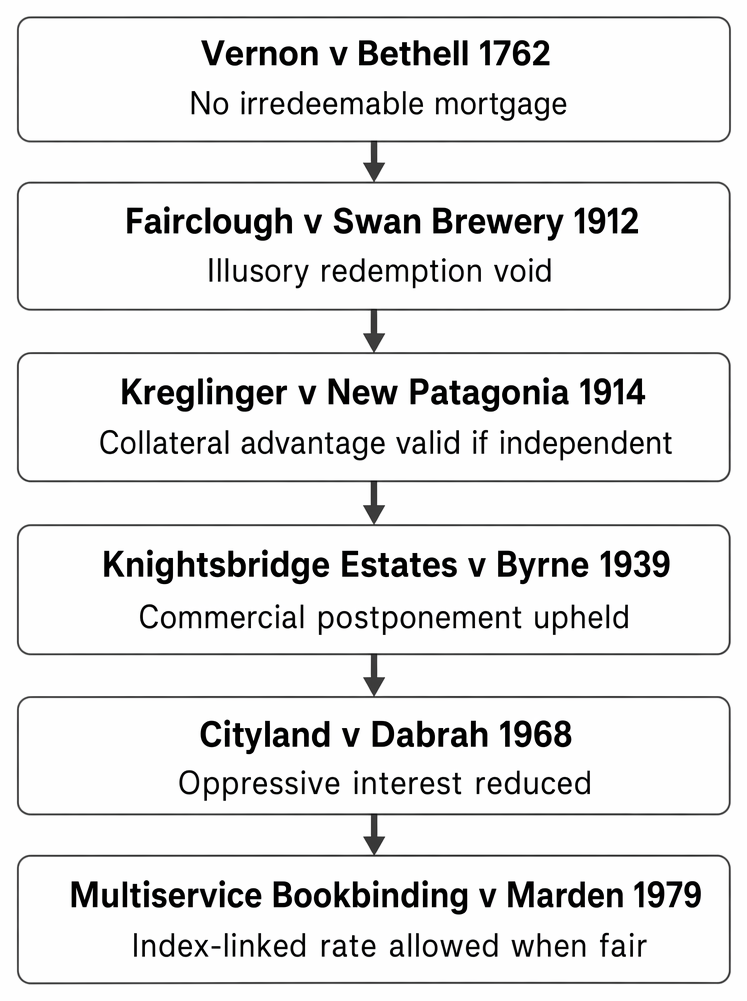
Key authorities on clogs on the equity of redemption, collateral advantages, postponement of redemption, and oppressive or fair mortgage interest terms.
Test Tip: In SQE-style questions on Enforceability of mortgage terms, identify the legal test, the triggering fact, and the consequence before choosing between similar answer options.
The Equity of Redemption
The equity of redemption is the borrower's right to redeem the mortgaged property by repaying the debt and any interest due. This right exists even after the contractual date for redemption has passed, provided the borrower pays all sums owed. Equity treats the mortgagor as the true owner, and the mortgage as security only.
Key Term: equity of redemption
The right of a mortgagor (borrower) to redeem their property by repaying the mortgage debt, even after the contractual redemption date.
Two principles flow from this:
- “Once a mortgage, always a mortgage”: a mortgage remains purely a security, and the lender cannot use it to acquire ownership or other inconsistent rights.
- Equity preserves a genuine right to redeem. Terms that make redemption illusory, or transform the security into a conveyance, will be refused enforcement.
A borrower’s substantive right to redeem is complemented by statutory and regulatory protections. For dwelling-houses, the court can postpone possession to allow repayment within a reasonable period (Administration of Justice Act 1970, s 36), and lenders are regulated by the FCA under FSMA 2000 and MCOB so that repossession should be a last resort.
The Doctrine of Clogs and Fetters
The doctrine of clogs and fetters prevents mortgage terms that unfairly restrict the borrower's right to redeem. The courts will strike down any provision that makes the mortgage irredeemable or imposes an unreasonable barrier to redemption.
Key Term: clog or fetter
A term in a mortgage that unfairly restricts or prevents the borrower's right to redeem the property.
Classic categories include:
- Options to purchase the mortgaged property granted to the lender as part of, or collateral to, the mortgage. Such options are inconsistent with the equity of redemption and are void, without any need to show that the bargain was also unconscionable (Samuel v Jarrah Timber & Wood Paving Corp Ltd [1904] AC 323). The rule was reaffirmed in Jones v Morgan [2001] EWCA Civ 995, where a provision entitling the lender to a share of the mortgaged land, even though contained in a later document, was treated as part of the original mortgage and struck down.
- Collateral advantages that continue after redemption unless clearly independent of the mortgage and not unconscionable (contrast Bradley v Carritt [1903] AC 253 with Kreglinger v New Patagonia Meat and Cold Storage Co Ltd [1914] AC 25).
- Postponements of the redemption date that render redemption illusory in residential or consumer contexts (Fairclough v Swan Brewery Co Ltd [1912] AC 565, where a 17-year postponement of a 20-year lease mortgage left the right to redeem valueless); long postponements may be upheld in commercial, arm’s-length transactions (Knightsbridge Estates Trust Ltd v Byrne [1940] AC 613, upholding a 40-year postponement in a commercial mortgage).
The courts look at substance over form. A label of “sale and repurchase” will not defeat equity if, in reality, the arrangement is a mortgage; conversely, a genuinely independent, arm’s-length agreement may be respected (Warnborough Ltd v Garmite Ltd [2003] EWCA Civ 1544; Reeve v Lisle [1902] AC 461, where an option to purchase granted in a genuinely separate later transaction was valid).
Typical outcomes:
- Options to purchase within or collateral to a mortgage are void as clogs (Samuel v Jarrah Timber; Jones v Morgan).
- Solus tie-ins (e.g., buying products exclusively from the lender) may be valid during the term if reasonably related to the security, and may even survive redemption in arm’s-length commercial bargains (Kreglinger), but not if oppressive or if they in substance restrict the borrower’s ability to redeem.
- Long redemption postponements may be valid commercially (Knightsbridge Estates), but oppressive in residential borrowing (Fairclough); context is decisive.
Worked Example 1.1
A lender includes a clause in a residential mortgage requiring the borrower to buy all home insurance from the lender for 15 years, even after the mortgage is repaid. Is this clause enforceable?
Answer:
No. This is a collateral advantage that continues after redemption and is likely to be struck down as a clog on the equity of redemption.
Collateral Advantages
A collateral advantage is a benefit to the lender that goes beyond repayment of the loan and interest. Collateral advantages are only enforceable if they are not unconscionable, do not prevent redemption, and do not continue after redemption unless they are truly independent of the mortgage. Courts assess whether the advantage is part of a fair bargain connected to the risk and administration of the loan, or whether it extracts additional, continuing value from the security relationship.
Key Term: collateral advantage
A benefit to the lender in a mortgage transaction that is separate from repayment of the loan and interest.
Illustrations:
- A brewery loan with a reasonable tie to buy beer from the lender during the mortgage term has been upheld where it reflected the commercial context, but it should not persist beyond redemption unless clearly independent.
- A term requiring purchases from the lender for years after the loan is repaid, with no independent commercial basis, is likely to be void as a clog.
Worked Example 1.2
A mortgage includes a clause giving the lender the right of first refusal to buy the borrower's crops for five years after the mortgage is repaid. Is this enforceable?
Answer:
No. Unless the right of first refusal is wholly independent of the mortgage, it is likely to be struck down as a clog or fetter.
Legal and Equitable Mortgages
A legal mortgage is created by deed and, for registered land, must be registered as a charge. If the formalities are not satisfied, but there is a valid contract to create a mortgage, an equitable mortgage may arise.
Key Term: legal mortgage
A mortgage created by deed (and registered if required), giving the lender a legal interest in the property. Key Term: equitable mortgage
A mortgage arising where the formalities for a legal mortgage are not satisfied, but there is a valid contract or other equitable basis for the lender's security.
Core points to remember:
- A legal mortgage over registered land must be completed by registration to take effect at law. Until registered, it takes effect only in equity.
- An equitable mortgage may arise from a specifically enforceable written agreement to create a mortgage (compliant with s 2 Law of Property (Miscellaneous Provisions) Act 1989), or when the mortgagor can only charge an equitable interest (which must itself be in signed writing).
- The historical “deposit of title deeds” is no longer sufficient by itself to create an equitable mortgage since written, signed contracts are required.
Equitable mortgages are enforceable in equity but may be less secure than legal mortgages, especially as to priority against third parties. For corporate borrowers, separate Companies House registration of charges within the statutory period is also needed to perfect security as against a liquidator or creditors.
Statutory and Regulatory Controls
Modern mortgage terms are also regulated by statute and the Financial Conduct Authority (FCA). The Mortgage Credit Directive Order 2015 and the FCA's Mortgage Conduct of Business (MCOB) rules impose requirements on lenders, including:
- Clear disclosure of terms and risks (standardised pre-contract information and adequate explanations)
- Assessment of the borrower's ability to repay (affordability and creditworthiness)
- Fair treatment of borrowers in financial difficulty (repossessions as a last resort and relevant pre-action expectations)
- Restrictions on unfair or high-risk terms and transparency in early repayment charges
- Conduct-of-business duties throughout the mortgage life-cycle, with a focus on treating customers fairly
Key Term: Mortgage Credit Directive Order 2015
UK legislation implementing EU rules to ensure fair, transparent, and responsible mortgage lending. Key Term: MCOB rules
The FCA's Mortgage Conduct of Business rules, setting standards for mortgage lending and customer protection.
Terms that breach these requirements may be unenforceable, may found a private right of action for breach of FCA rules, and can expose lenders to redress. Alongside MCOB, the Administration of Justice Act 1970, s 36 allows the court to adjourn or suspend possession where borrowers can repay within a reasonable period (often, the remaining term). Lenders have powerful property remedies (possession, sale, receiver), but the way they exercise them must meet equitable duties and regulatory standards.
Lenders’ sale duties:
- A statutory power of sale arises when the mortgage is by deed and the legal redemption date has passed; it becomes exercisable on defined trigger events (e.g., specified arrears).
- When selling, the lender must act in good faith and take reasonable care to obtain the true market value at the time of sale. It need not achieve the very best possible price or delay a sale hoping for a better market, but it must market properly and avoid self-dealing or conflicts.
Worked Example 1.3
A lender fails to provide clear information about an early repayment charge in a regulated mortgage. The borrower is charged a large fee when redeeming early. Is the fee enforceable?
Answer:
No. Under the MCOB rules and the Mortgage Credit Directive Order 2015, the lender must provide clear disclosure of all charges. Failure to do so may render the fee unenforceable. Further borrower protections on enforcement:
- The court can delay possession for a reasonable period if the borrower can clear arrears within the term.
- Lenders should explore alternatives to possession and comply with conduct rules on arrears handling.
- A borrower can challenge a sale where the lender failed to take reasonable care in achieving market value (for the difference), or where there was bad faith or conflict of interest.
Unconscionable and Oppressive Terms
The courts may refuse to enforce a mortgage term if it is unconscionable or amounts to an unfair bargain. This includes:
- Excessive interest rates not justified by risk or market conditions, or penal default interest
- Terms imposed by undue influence or misrepresentation
- Terms that are contrary to consumer protection legislation
In assessing interest rates, equity does not re-write hard bargains, but may relieve against terms that are “in substance objectionable” and imposed in a “morally reprehensible manner” (Multiservice Bookbinding Ltd v Marden [1979] Ch 84, where an index-linked capital and interest clause survived challenge because the borrower had legal advice and the bargain was not unconscionable). By contrast, in Cityland and Property (Holdings) Ltd v Dabrah [1968] Ch 166, an effective rate of around 57% in a residential mortgage was struck down as unconscionable and reduced to a reasonable figure. The penalty rule can invalidate purely punitive default charges. Transparency, proper explanation, and evidence of negotiation weigh in favour of enforceability; sharp practice weighs against it.
Undue influence and third-party guarantees:
- A lender taking security involving a non-borrower (e.g., spouse or partner) must take reasonable steps to ensure the third party’s consent is properly informed and free from undue influence. Typically, the lender should require the third party to receive independent legal advice, with sufficient information about the transaction and the risks. If the lender fails to do so, and undue influence is proved, the security may be set aside as against that party.
Worked Example 1.4
A home-owner grants a mortgage to a lender when also signing a collateral document granting the lender an option to purchase the property at any time during the mortgage term. The borrower later seeks to redeem and argues the option is void. What is the likely outcome?
Answer:
The option to purchase, granted in connection with the mortgage, is likely to be void as a clog on the equity of redemption. Equity will not allow the mortgage to be used as a vehicle to obtain ownership rights inconsistent with the borrower’s right to redeem.
Worked Example 1.5
A spouse, not a party to the loan, signs a charge of the family home to support the other spouse’s business borrowing. There was pressure at home, and the lender did not ensure the spouse had independent advice. The business fails and the lender seeks possession. Can the spouse set aside the charge?
Answer:
Possibly. If undue influence is established and the lender failed to take reasonable steps (e.g., ensuring independent legal advice with sufficient disclosure), the security may be set aside as against the influenced spouse. The lender would then enforce solely against the borrower’s interest.Exam Warning: The courts will not strike down a mortgage term simply because it is a "bad bargain" for the borrower. There must be evidence of oppression, unconscionability, or breach of statutory/regulatory requirements.
Tacking and Further Advances
Tacking allows a lender to add further advances to an existing mortgage, potentially gaining priority over later interests if the original mortgage provides for this and the lender has no notice of subsequent interests.
Key Term: tacking
The process by which a lender adds further advances to an existing mortgage, potentially gaining priority over later interests.
The Land Registration Act 2002 introduced additional requirements for tacking in registered land, including registration and notice provisions. In outline:
- Priority for further advances will generally be protected if the prior charge secures further advances as a matter of obligation (or the further advance is made without actual knowledge of the intervening charge, or with the intervening chargee’s consent).
- Subsequent chargees can protect themselves by entering an appropriate restriction requiring their consent to any further advance being secured with priority.
In unregistered land, the traditional rule centred on the first mortgagee’s lack of notice and the terms of the original security; in registered land the statutory scheme now governs. Parties should check the charges register and any restrictions to determine whether a later advance will retain priority.
Worked Example 1.6
Bank A registers a first legal charge which by its terms secures “all sums now or hereafter owing”. Bank B then registers a second charge. Later, Bank A makes a further advance. Will Bank A’s further advance have priority over Bank B?
Answer:
Usually yes if (i) Bank A was obliged by the original charge to make the further advance, or (ii) made it without actual knowledge of Bank B’s charge, or (iii) obtained Bank B’s consent. If Bank B had entered a restriction requiring its consent to further advances, Bank A would need to comply to retain priority.
Key Point Checklist
This article has covered the following key knowledge points:
- The equity of redemption guarantees the borrower's right to redeem the property by repaying the mortgage debt.
- The doctrine of clogs and fetters prevents mortgage terms that unfairly restrict redemption.
- Collateral advantages are only enforceable if they are not oppressive and do not continue after redemption unless truly independent.
- Legal mortgages require a deed (and registration if required); equitable mortgages arise where formalities are not satisfied but a valid contract exists.
- Statutory and regulatory controls (including the Mortgage Credit Directive Order 2015 and MCOB rules) protect borrowers and may render unfair terms unenforceable.
- The courts may strike down unconscionable or oppressive mortgage terms, but not merely "bad bargains."
- Tacking and further advances are subject to strict requirements, especially for registered land.
- Lenders’ enforcement must meet equitable duties and regulatory standards: reasonable care to obtain true market value on sale; good faith; and fair arrears handling, with the court’s power to postpone possession under AJA 1970, s 36.
Key Terms and Concepts
- equity of redemption
- clog or fetter
- collateral advantage
- legal mortgage
- equitable mortgage
- Mortgage Credit Directive Order 2015
- MCOB rules
- tacking