Learning Outcomes
This article outlines malicious wounding or inflicting grievous bodily harm under s.20 Offences Against the Person Act 1861, including:
- Legal definitions and core characteristics of "wound" and "grievous bodily harm" under s.20 OAPA 1861
- Actus reus and mens rea for malicious wounding or inflicting GBH, including the meaning of "maliciously" in s.20
- Distinctions between s.20 and s.18 offences, with attention to intent, harm, and level of seriousness
- Operation of causation (factual and legal), including medical interventions, victim actions, and third-party interventions
- Availability and limits of defences such as consent, self-defence, and the impact of intoxication on liability under s.20
- Relevance and admissibility requirements for evidence (medical, identification, and character), following Criminal Procedure Rules and evidentiary guidance
- Common pitfalls and misunderstandings, including overstatement of the intention required for s.20 and confusion regarding "wound" versus "GBH"
- Bail, public funding, and initial procedural issues for s.20 charges, and how offence classification affects proceedings
SQE1 Syllabus
For SQE1, you are required to understand the offence of malicious wounding or inflicting grievous bodily harm under s.20 OAPA 1861, with a focus on the following syllabus points:
- The elements of the offence under s.20 OAPA 1861, including both actus reus (wounding or inflicting grievous bodily harm) and mens rea (intention or subjective recklessness as to some harm).
- The precise legal meaning of "wound" and "grievous bodily harm", including their application to special situations such as psychiatric injury and disease transmission.
- Causation in criminal law, including the "but for" test (factual causation), legal causation ("substantial and operating cause"), the thin skull rule, and novus actus interveniens (intervening acts).
- The distinction in both actus reus and mens rea between s.20 ("basic intent") and s.18 ("specific intent") offences, and their relationship to sentencing and legal defences.
- The meaning and scope of "maliciously" for s.20 OAPA 1861, including its interpretation as intent or subjective recklessness for causing "some harm".
- The limits and exceptions of the defence of consent for s.20 offences, with reference to surgery, sport, and other public policy exceptions.
- The impact of intoxication on liability for s.20 (as a basic intent offence) and the irrelevance of voluntary intoxication as a defence.
- Key procedural matters, including bail, initial court procedure, evidentiary issues, and the availability of public funded legal representation.
- The proper application of the rules of criminal evidence for admission of relevant evidence (medical reports, eyewitness and character evidence) and exclusion of improper evidence (PACE ss. 76, 78).
Test Your Knowledge
Attempt these questions before reading this article. If you find some difficult or cannot remember the answers, look more closely at that area during your revision.
- What is the legal definition of a "wound" for the purposes of s.20 OAPA 1861?
- Does s.20 require the defendant to intend or foresee serious harm?
- How does the mens rea for s.20 differ from that required for s.18 OAPA 1861?
- Can psychiatric injury amount to grievous bodily harm under s.20?
Introduction
Malicious wounding or inflicting grievous bodily harm (GBH) under s.20 Offences Against the Person Act 1861 remains one of the most examined non-fatal offences against the person. Candidates must understand and apply both the statutory language and the layered judicial interpretation to accurately assess whether s.20 is made out. The essential ingredients—actus reus (unlawful wounding or infliction of GBH), mens rea (intention or subjective recklessness as to some harm), and causation—require careful analysis with reference to case law and current prosecutorial standards. This article provides a detailed analysis of each element, illustrates distinctions between s.20 and more serious s.18 offences, and considers key procedural and evidential considerations relevant to early case preparation under the SQE1.
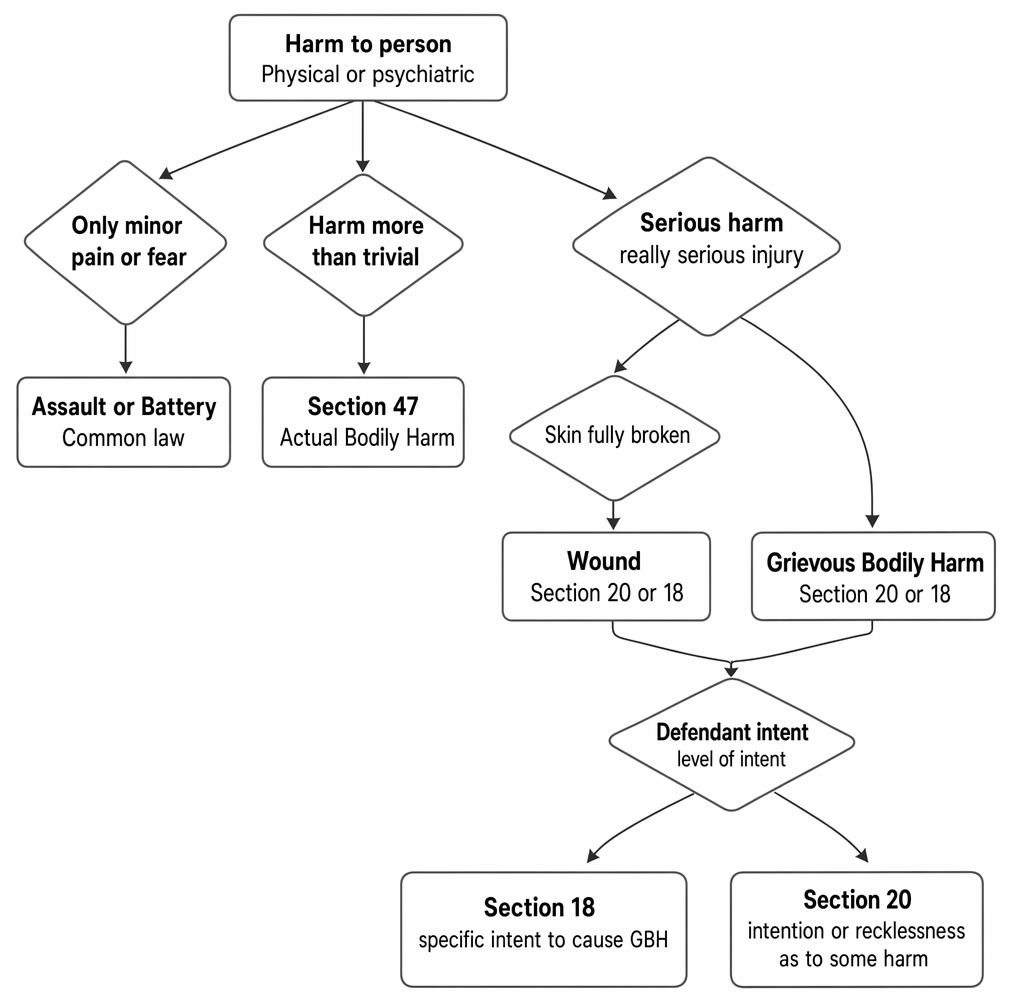
Assault, battery, s 47, s 20, and s 18 are distinguished by seriousness of harm, wounding, and mens rea.
Key Term: wound
A wound is a break in the continuity of both the dermis and epidermis—the outer and inner layers of the skin. For there to be a wound, the injury must break the whole skin, causing both an external breach and (usually) bleeding. Surface scratches or internal injuries without a breach in both skin layers do not constitute a wound. (Cases: JJC v Eisenhower (1984)). Key Term: grievous bodily harm (GBH)
Grievous bodily harm is defined as "really serious harm". It covers not only severe physical injuries (e.g., fractured bones, substantial blood loss, permanent disfigurement), but also serious psychiatric illness (provided it constitutes a clinically recognised psychiatric disorder: R v Burstow [1998]), and the reckless transmission of serious diseases such as HIV (R v Dica [2004]). Key Term: inflict
"Inflict" in s.20 means simply "to cause." There is no need for direct physical contact; indirect actions, including through psychological means, can amount to infliction if they result in really serious harm (R v Ireland, R v Burstow).
Actus Reus of s.20 OAPA 1861
To prove an offence under s.20, the prosecution must establish that the defendant unlawfully wounded or inflicted grievous bodily harm on another person. The actus reus can be satisfied in two alternative ways:
- Unlawfully wounding (breaking both skin layers).
- Inflicting GBH (causing really serious harm, whether physical, psychiatric, or through disease transmission).
Wounding
A wound requires a full break in the skin (both epidermis and dermis), not merely a scratch or internal bleeding. Medical evidence is often required to determine whether an injury amounts to a wound in law. Examples of wounds include knife cuts or deep accidental lacerations that breach the whole skin.
Injuries such as bruising, ruptured blood vessels, or fractured bones without skin breakage are not wounds (JJC v Eisenhower).
Key Term: chain of causation
The chain of causation refers to the unbroken sequence of events linking the defendant's conduct to the resulting injury. The prosecution must show both factual causation (using the "but for" test: "But for the defendant's act, would the injury have occurred?") and legal causation (the act must be an "operating and substantial" cause of the harm). The chain may be broken by a "novus actus interveniens"—a new and independent act occurring after the defendant's conduct.
Grievous Bodily Harm (GBH)
GBH covers any injury which, when viewed objectively, amounts to really serious harm. Factors considered include the type, severity, and duration of injury as well as the victim's unique vulnerabilities (e.g., age, pre-existing conditions). A series of minor injuries can, in aggregate, constitute GBH, especially if sustained by a vulnerable victim.
GBH also covers:
- Clinically recognised psychiatric injury (R v Burstow), including serious psychological injury
- Serious disease transmission (R v Dica—HIV; R v Golding—herpes)
- Permanent loss of sensory function (such as permanent loss of sight or hearing)
- Permanent disability
- Broken bones and fractured skull
- Substantial blood loss
Mere emotions such as distress, panic, or temporary fear do not suffice.
Inflicting GBH
The term "inflict" in s.20 is synonymous with "cause" for the purposes of establishing liability. Both direct infliction (e.g., striking the victim) and indirect or psychological infliction (e.g., silent threats resulting in psychiatric illness) are included. There is no requirement for physical force (R v Ireland; R v Burstow).
Key Term: intention
In criminal law, intention refers to where the defendant's aim or purpose is to bring about a particular result. For crimes of basic intent like s.20, the focus is whether the defendant intended to cause some harm, not the specific result of GBH or a wound. Key Term: recklessness
For the purposes of s.20, recklessness is subjective. The defendant must have foreseen the risk that their conduct could cause some harm to another and proceeded regardless, having unjustifiably taken that risk (R v Cunningham (1957); R v Savage; DPP v Parmenter).
Mens Rea of s.20 OAPA 1861
The mens rea for s.20 is satisfied by intention or subjective recklessness as to causing "some harm"—not necessarily GBH or a wound. The critical threshold is appreciation of a risk of physical harm, however minor (R v Mowatt; R v Savage; DPP v Parmenter). There is no requirement that the defendant intends or foresees serious harm.
Key Term: maliciously
Under s.20, "maliciously" means either intending to cause some physical harm or subjectively foreseeing the risk of some physical harm and acting recklessly in taking that risk.
The jury must be satisfied the defendant had in mind, or ought to have realised, the real risk of causing some form of harm—not the precise gravity of the wound or injury that resulted. This marks a clear distinction from s.18, where specific intent to cause serious harm is required.
- Direct intention: The defendant's aim or purpose was to cause some harm.
- Subjective recklessness: The defendant foresaw a risk of some harm and unjustifiably took that risk.
Where the defendant does not foresee any risk of harm at all, there is no liability under s.20.
Distinguishing s.20 from s.18 OAPA 1861
| Element | s.20 OAPA 1861 | s.18 OAPA 1861 |
|---|---|---|
| Actus reus | Wounding or inflicting GBH | Wounding or causing GBH |
| Mens rea | Intention or recklessness as to some harm | Specific intent to cause GBH or resist arrest |
| Level of harm intended | Some harm (not necessarily serious) | Serious harm (GBH) required |
- s.20 is a basic intent offence (intention or recklessness as to some harm).
- s.18 is a specific intent offence: the prosecution must prove intent to cause serious harm (GBH), or intent to resist or prevent lawful arrest with recklessness as to some harm.
- A person who acts intentionally but without foresight or intent regarding GBH may be guilty under s.20 but not s.18.
Causation
For s.20, the prosecution must prove both factual and legal causation linking the defendant's act to the wound or GBH.
- Factual causation: Apply the "but for" test. Would the harm have occurred but for the defendant's act?
- Legal causation: The defendant's act must be a significant, operative, and substantial cause of the injury. The sequence must not be broken by a novus actus interveniens (e.g., unforeseeable conduct by the victim or a third party).
If subsequent medical treatment is substandard or negligent, the chain of causation will usually not be broken unless the treatment is so independent and potent that it renders the original injury insignificant (R v Smith [1959]; R v Cheshire [1991]).
The "thin skull rule" applies: the defendant must take their victim as they find them, including vulnerabilities or health conditions.
Consent and Defences
Consent is generally not a defence to s.20 except in cases recognised by law, such as legitimate sport, surgery, or certain body modifications under professional standards. The public policy rationale is to prevent the creation of a "cult of violence" (R v Brown [1994]; R v BM [2018]). Consent is generally not available where there is a real risk of or actual infliction of ABH or more.
Valid defences to s.20 include:
- Self-defence: Force used must be reasonable and proportionate in the circumstances as the defendant believed them to be. Excessive force, or a mistaken belief in the necessity of force induced by voluntary intoxication, will void this defence (CJIA 2008, s.76).
- Mistake: Only available if genuinely (honestly) held—and not induced by voluntary intoxication.
- Intoxication: Voluntary intoxication is not a defence to s.20, as this is a basic intent offence (DPP v Majewski). Involuntary intoxication may in rare cases suffice if it means the defendant truly lacked the mens rea.
Key Term: causation
Causation in criminal law is the process by which the link between a defendant's conduct and the resulting harm is established. Both factual causation ("but for" test) and legal causation (including the substantial and operative cause, absence of intervening acts, and the thin skull rule) must be proven.Exam Warning: Exam Warning: Do not confuse the requirement for intention or recklessness as to serious harm (for s.18) with that for s.20, which only requires intention or subjective recklessness as to some harm, however slight. Failure to appreciate this distinction is a common error.
Revision Tip: Revision Tip: Always apply the factual scenario to the definitions: a wound must break both skin layers, and GBH must be "really serious harm." Scrutinise the medical evidence and circumstances surrounding the injury, and do not make assumptions about the degree of foresight or intention required.
Worked Example 1.1
Scenario: Jordan punches Sam in the face, causing a deep cut to Sam's cheek that bleeds heavily. Did Jordan commit a s.20 offence?
Answer:
Yes. The cut is a wound (both layers of skin are broken). Provided Jordan intended, or was subjectively reckless as to the possibility of causing some harm (even if only a minor injury), s.20 is made out. The prosecution need not prove intent or foresight of GBH or a wound of this severity.
Worked Example 1.2
Scenario: Priya, knowing she is HIV positive, has unprotected sex with Alex without informing him. Alex contracts HIV. Is this GBH under s.20?
Answer:
Yes. The transmission of a serious disease such as HIV is deemed GBH. If Priya either intended to cause some harm or subjectively foresaw the risk of harm and acted unreasonably, she is liable under s.20, provided other elements (unlawfulness, causation) are satisfied.
Worked Example 1.3
Scenario: Lee throws a glass intending to scare Pat, but the glass hits Pat and causes a minor cut. Lee foresaw the risk of some harm but did not intend serious injury. Is s.20 satisfied?
Answer:
Yes. Lee was reckless as to the risk of causing some harm by his conduct, and the cut constitutes a wound (break in both layers of skin). That Lee did not intend to cause serious harm is irrelevant for s.20 liability; the lesser threshold is sufficient.
Worked Example 1.4
Scenario: Charmaine and Jordan argue, and Charmaine pushes Jordan, who stumbles and falls backwards, striking his head on a kerb and fracturing his skull. Charmaine anticipated a risk of minor injury from her push, but not a skull fracture. What offence?
Answer:
Charmaine may be guilty under s.20. The actus reus is satisfied by the fractured skull (GBH). Even though she did not foresee or intend GBH, it is enough that she foresaw some risk of harm from her push. The injury does not have to be intended or foreseen in severity.
Further Procedural and Evidential Considerations
S.20 is classified as an either way offence. The defendant will always first appear before the magistrates’ court, and the case may proceed in either the magistrates’ court or (if more serious or elected) in the Crown Court. This impacts both pre-trial procedure—including summary trial, allocation, and committal procedures—and the eligibility for various sentencing options.
- Public funding and legal aid: Most defendants are eligible for at least initial legal advice and, subject to means and merits, continued representation throughout proceedings, especially if the risk of custody exists or the case involves substantial legal issues.
- Bail: There is a presumption in favour of bail, but common grounds for opposition are risk of absconding, further offences, or interference with witnesses. Typical bail conditions for s.20 defendants may include surety, residence, curfew, or non-association orders.
- Evidence: Medical reports, photographs, and witness statements are routinely required to prove both wounding and GBH. The Crown must ensure compliance with Criminal Procedure Rules regarding disclosure and service of evidence.
Character and confession evidence are governed by the same rules and gateways as in other criminal cases. Defence evidence of good character, or prosecution bad character evidence, will be permitted only where compliant with the Criminal Justice Act 2003 gateways.
- Visual identification evidence: When disputed, the Turnbull guidelines require the court to address the reliability of identification, especially where conviction depends heavily on eyewitness accounts.
- Exclusion of evidence: Evidence may be excluded if obtained improperly (PACE 1984, ss 76, 78), particularly confessions obtained by oppression or where unfairness would otherwise result.
Summary
| Offence | Actus Reus | Mens Rea | Notes |
|---|---|---|---|
| s.20 OAPA 1861 | Wounding (break in both skin layers) or inflicting GBH (really serious harm) | Intention or subjective recklessness as to some harm | No need to intend or foresee serious harm. Basic intent offence. |
| s.18 OAPA 1861 | Wounding or causing GBH | Specific intent to cause GBH or resist arrest | Must intend serious harm. Specific intent offence. |
Key Point Checklist
This article has covered the following key knowledge points:
- The actus reus of s.20: unlawful wounding (break in both layers of the skin) or inflicting GBH ("really serious harm").
- The mens rea of s.20: intention or subjective recklessness as to causing some (not necessarily serious) harm.
- For s.20, "maliciously" means intention or recklessness as to some harm, not serious harm.
- s.20 is a basic intent offence; voluntary intoxication is not a defence.
- s.20 differs from s.18, which requires specific intent to cause GBH.
- Causation must be established: the defendant’s act must be a substantial and operative cause of the harm, and the chain of causation must not be broken by a novus actus interveniens.
- Where wound or GBH arises from medical treatment, victim conduct, or third-party action, the chain must remain unbroken for liability to follow.
- Consent is not a defence except in recognised exceptions (e.g., properly conducted sport, medical treatment).
- Psychiatric injury and disease transmission can amount to GBH if sufficiently serious and properly evidenced.
- Visual identification evidence, confession evidence, and character evidence are subject to specific evidentiary rules.
Key Terms and Concepts
- wound
- grievous bodily harm (GBH)
- inflict
- maliciously
- chain of causation
- intention
- recklessness
- causation