Learning Outcomes
This article outlines wounding or causing grievous bodily harm with intent under s.18 Offences Against the Person Act 1861, including:
- the complete actus reus elements of s.18, clearly distinguishing a 'wound' from grievous bodily harm and illustrating how these thresholds are assessed in exam-style scenarios
- application of factual and legal causation, including novus actus interveniens, foreseeability, the thin skull rule, and how causation issues can upgrade or undermine a s.18 charge
- the specific intent requirement for s.18, the role of oblique intent, and the separate resisting lawful apprehension limb where recklessness as to some harm may suffice
- core differences between s.18, s.20, and s.47 in both actus reus and mens rea, enabling accurate charge selection and evaluation of alternative verdicts
- how serious psychiatric injury can constitute GBH, with emphasis on medically recognised conditions and typical exam traps around mere emotions or short‑term distress
- the burden and standard of proof, key evidential considerations, and important procedural features such as mode of trial and maximum sentence
- principal defences relevant to s.18, including self-defence, challenges to intent or causation, and the limited operation of voluntary intoxication in specific-intent crimes
- sentencing principles, aggravating and mitigating factors, and how judicial reasoning links harm, culpability, and previous convictions in determining appropriate sentences
SQE1 Syllabus
For SQE1, you are required to understand s.18 Offences Against the Person Act 1861 (wounding or causing grievous bodily harm with intent), with a focus on the following syllabus points:
- the actus reus: precise definitions of 'wound' and 'grievous bodily harm', need for unlawful conduct, and how causation is established
- the mens rea: specific intent to cause GBH or intent to resist/prevent lawful apprehension (plus the required mental state regarding potential harm for the 'lawful apprehension' limb)
- distinction between s.18 and s.20 (specific intent vs. recklessness; level of harm intended/foreseen)
- application of factual and legal causation to s.18, including issues of novus actus interveniens (intervening acts), foreseeability, and the thin skull rule
- the burden and standard of proof (prosecution must prove all elements beyond reasonable doubt)
- recognition of procedural points (e.g., trial on indictment only, maximum life sentence)
- understanding of available defences and limits of defences (including the limited role of voluntary intoxication)
- the principles guiding the imposition of sentence in s.18 cases, including relevant aggravating and mitigating factors
Test Your Knowledge
Attempt these questions before reading this article. If you find some difficult or cannot remember the answers, look more closely at that area during your revision.
- What are the two primary ways of committing the actus reus of s.18 Offences Against the Person Act 1861?
- How does the mens rea requirement for s.18 differ from that for s.20?
- When, if ever, can recklessness be sufficient for a s.18 conviction?
- What evidential standard must the prosecution achieve in proving intent under s.18?
- What is the maximum sentence, and which court deals with s.18 charges?
Introduction
Section 18 of the Offences Against the Person Act 1861 (OAPA 1861) creates the most serious non-fatal offence against the person: unlawfully wounding or causing grievous bodily harm (GBH) with intent. The distinguishing feature of s.18 is its specific intent requirement—this offence is only made out where the defendant acts with the precise purpose of causing really serious harm, or intends to resist or prevent lawful apprehension and is at least reckless as to the risk of causing some harm. The fault threshold for s.18 is therefore considerably higher than for other non-fatal offences under the Act, reflected in its maximum sentence of life imprisonment and exclusive trial on indictment in the Crown Court. For criminal practice and SQE1, the actus reus, mens rea, causation, and the legal limits of this offence is essential, alongside its procedural and practical ramifications.
Key Term: specific intent
In the context of s.18, 'specific intent' means that the defendant's aim or purpose—their direct intention—or, in limited circumstances, their foresight of a virtually certain outcome, was to cause GBH or to avoid lawful apprehension.Test Tip: In SQE-style questions on Wounding or causing grievous bodily harm with intent (s.18 Offences Against the Person Act 1861), identify the legal test, the triggering fact, and the consequence before choosing between similar answer options.
Actus Reus of s.18
The actus reus of s.18 OAPA 1861 is satisfied in law by either of two distinct means: (i) unlawfully wounding another person, or (ii) unlawfully causing another person grievous bodily harm. Both means must be 'unlawful', with no applicable defence such as self-defence, consent (except in recognised exceptions such as therapeutic surgery), or lawful authority.
Key Term: wound
A 'wound' is a break in the continuity of both layers of the skin—the epidermis and dermis. The wound does not have to be life-threatening or even particularly severe; even a minor injury can suffice, provided it penetrates both layers of the skin and causes external bleeding. Mere internal injury, bruising, or a broken bone that does not break the skin is not a wound. Key Term: grievous bodily harm (GBH)
'Grievous bodily harm' means 'really serious' harm. This includes, but is not limited to, broken limbs or bones, substantial loss of blood, injuries causing permanent disability or disfigurement, or the infliction of serious psychiatric injury recognised by medical authorities (e.g., severe depressive illness). The nature and impact of the injury must be considered cumulatively, including factors such as the age, health, and vulnerability of the victim.
Importantly, psychiatric harm may constitute GBH provided it is a serious, medically recognised condition, not merely transient emotional states (e.g., fear or panic).
Wounding and GBH are alternatives for the actus reus—proving either is sufficient. A single act may in fact satisfy both, but only one is required in law.
Causation
The prosecution must establish both factual and legal causation between the defendant's conduct and the wounding or really serious harm suffered by the victim.
Key Term: factual causation
Factual causation is demonstrated where, but for the defendant's conduct, the prohibited result (wound or GBH) would not have occurred ('but for' test). Key Term: legal causation
Legal causation requires that the defendant's act is a significant, operative, and substantial cause of the harm—more than minimal, and the result must not have been produced by a free, voluntary, and informed act of a third party or the victim themselves, except in limited circumstances (e.g., where the victim's response was reasonably foreseeable or in the 'agony of the moment').
The chain of causation may be broken by a 'novus actus interveniens' (a new intervening act), for example, grossly negligent medical treatment or a voluntary act by the victim which was not reasonably foreseeable. However, only acts that are extraordinary and unforeseeable will break the chain; poor but not 'palpably wrong' medical treatment will rarely suffice.
Key Term: thin skull rule
The 'thin skull' rule holds that the defendant must take their victim as they find them—if the victim has a particular vulnerability (e.g., a medical condition that worsens the harm), the full extent of harm will be attributed to the defendant.
Application to Psychiatric Injury
Following modern authority, the courts accept that the infliction or causation of serious psychiatric injury may fulfill the actus reus of GBH under s.18, provided the psychiatric harm is (i) medically recognised, and (ii) sufficiently serious to amount to "really serious" harm.
Mens Rea of s.18
S.18 is an offence of specific intent. Section 18 creates two distinct offences: malicious wounding with intent to cause GBH, and maliciously causing GBH with intent to cause GBH. In each case, the outcome required is that the defendant intended either:
- to cause grievous bodily harm to any person;
- or, to resist or prevent the lawful apprehension or detention of any person, while being at least reckless as to causing some harm.
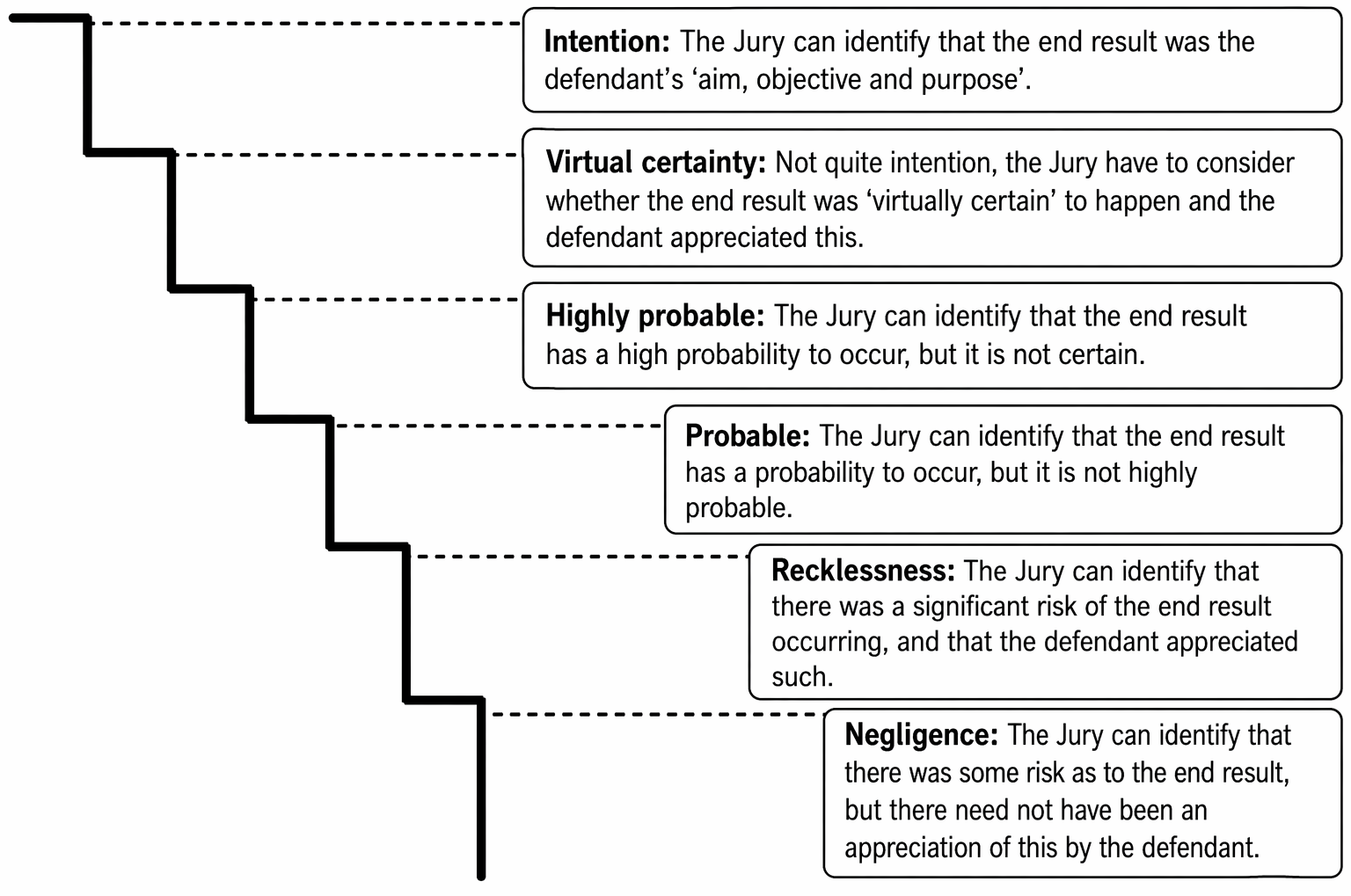
This mens rea must be contemporaneous with the conduct causing the wound or really serious harm. The key distinction from s.20 is that recklessness is not sufficient for s.18 — the defendant must actually intend to cause harm amounting to GBH, whether by direct intention (where it is the defendant's aim or purpose) or by oblique intention (where the defendant foresees GBH as a virtually certain consequence of their actions).
Key Term: oblique intent
Oblique intent arises where the defendant did not desire to cause GBH as their aim or purpose, but foresaw causing GBH as a virtually certain consequence of their actions, and the jury is satisfied that the defendant appreciated this virtual certainty.
It is not sufficient for the prosecution to show that the defendant intended only to wound, nor to show that they intended some harm short of GBH (except for the resisting lawful apprehension limb). Recklessness, alone, is never enough for the main limb of s.18.
Key Term: intending to resist or prevent lawful apprehension
Where the defendant intends to resist or prevent the lawful arrest or detention of any person (which may include themselves or another), recklessness as to causing some harm will suffice for the element of harm, but an intention to prevent apprehension must still be present.
The role of motive is not relevant—what matters is that the defendant's aim, purpose, or appreciation of a virtually certain outcome was to cause GBH or to avoid apprehension.
Proving Intention
Intention may be established through direct evidence (e.g., admissions) or inferred from the surrounding circumstances. The use of a weapon or targeting a vulnerable area, the nature of the attack (e.g., repeated blows, selecting a particularly dangerous means, or not ceasing despite visible harm), the defendant’s own words before or during the incident, or prior threats—these may all supply evidence from which intent can be inferred.
Non-fatal offences against the person, including s 47, s 20 and s 18 OAPA 1861, with mode of trial and maximum sentence.
Jurors will be directed that, for indirect or 'oblique' intent, they must be sure that GBH was a virtually certain result of the defendant’s action and that the defendant appreciated this fact.
Key Term: resisting or preventing lawful apprehension limb
This refers to the alternative mens rea for s.18, where the defendant’s intent is to resist or prevent the lawful apprehension or detention of any person (i.e., escape arrest), and they are at least reckless as to causing some harm. This is the only circumstance in which recklessness as to harm suffices for s.18.
Worked Example 1.1
Scenario: Mia stabs her rival's forearm with a broken bottle, causing a deep cut that severs both layers of skin, resulting in significant blood loss and nerve damage. She says she wanted to make sure her rival "could never fight again".
Answer:
Mia's conduct satisfies s.18. Both actus reus (wounding, and likely GBH) are present; Mia's statement demonstrates a clear specific intention to cause really serious harm.
Worked Example 1.2
Scenario: Liam, fleeing the police after a robbery, swings a heavy metal bar at an officer trying to arrest him. The officer dodges, but is instead hit in the leg, causing a compound fracture. Liam later claims he just wanted to "get away" and didn't care if he hurt anyone in the process.
Answer:
If the prosecution proves Liam intended to resist lawful arrest and was at least reckless as to causing some harm, the s.18 resisting apprehension limb is made out. The actus reus (causing GBH) is satisfied, and the correct men's rea limb is applied.
Worked Example 1.3
Scenario: Amira punches another person repeatedly in the face, shattering their jaw and causing permanent disfigurement. Amira says she only wanted to frighten, not seriously injure, but continued punching after seeing blood.
Answer:
The jury may find Amira liable under s.18 if they are sure that, in light of her conduct and the obvious risk, she must have intended to cause serious injury, or that serious injury was a virtual certainty of her acts and she realised this.Exam Warning: For s.18, intention to wound is not enough for a conviction—there must be intent to cause GBH or intent to resist/prevent lawful apprehension or detention, with recklessness as to some harm only applicable for this latter limb. It is not sufficient merely to foresee some harm for the primary limb.
Distinguishing s.18 from s.20
Understanding the differences between s.18 and s.20 is imperative. Both offences require proof of a wound or GBH (actus reus identical), but differ sharply as to the mental element:
- s.18 requires specific intent to cause GBH or to resist/prevent lawful apprehension, plus recklessness as to some harm for the latter only;
- s.20 requires only intention or subjective recklessness as to causing some harm (not GBH specifically).
Thus, intention to cause some physical harm (even if serious) will make out s.20, but only intention to cause really serious injury (GBH) or to resist arrest will suffice for s.18. Recklessness is never sufficient for s.18 unless the defendant is resisting or preventing lawful apprehension.
Comparative table:
| Element | s.18 (OAPA 1861) | s.20 (OAPA 1861) |
|---|---|---|
| Actus reus | Wound or cause GBH | Wound or inflict GBH |
| Mens rea | Specific intent to cause GBH or to resist/prevent arrest (plus recklessness as to some harm only for the resisting arrest limb) | Intention or recklessness as to some harm |
| Maximum sentence | Life imprisonment | 5 years' imprisonment |
| Trial | Indictment only (Crown Court) | Either way (Magistrates’ or Crown Court) |
Application of Causation in s.18
In all s.18 offences, the act or omission of the defendant must be both the factual and legal cause of the wound or GBH. As a result, challenges often arise where there is an intervening act or when the victim's own actions contribute to the injury. The courts have developed guidelines on when the chain of causation is broken (for instance, when a victim's act is so 'daft' or unforeseeable that it breaks the chain), but generally, so long as the result is a reasonably foreseeable response to the situation created by the defendant, causation will be found.
The chain will usually not be broken by subsequent negligent medical treatment unless the treatment is so 'palpably wrong' as to become the new, sole cause of injury. The defendant is liable for the full extent of harm, even where the harm is aggravated by a pre-existing medical condition (thin skull rule).
Key Term: novus actus interveniens
A 'novus actus interveniens' is a new intervening act, either by a third party or the victim, which is so unexpected and independent as to break the chain of legal causation, potentially exonerating the defendant.
Worked Example 1.4
Scenario: After stabbing Pat in the abdomen during a fight, Jo then flees. Pat, in panic, runs erratically into the road and is struck by a car, sustaining further injury. The wound caused significant bleeding but was not, in itself, fatal.
Answer:
If Pat’s attempt to escape is a reasonably foreseeable response to the attack and not a 'daft' act, Jo remains liable for the injuries. The chain of causation is not broken.
Worked Example 1.5
Scenario: Emma causes a deep wound with a knife; the victim fails to seek medical attention out of personal beliefs and later dies from an otherwise treatable infection.
Answer:
The chain of causation is not broken—Emma is liable for the death, applying the thin skull rule. Emma must 'take her victim as she finds them'.
Proving Specific Intent
Establishing specific intent for s.18 conviction often depends on drawing reasonable inferences from all the circumstances:
- The type and nature of weapon used—use of a highly dangerous weapon, repeated blows, or targeting vulnerable body parts can indicate intent.
- The conduct before, during, and after the assault, including preceding threats, comments, or conduct suggesting planning or foresight.
- Medically assessed severity of the injury, extent and location of the harm, and attempts to escalate or prolong the assault.
- Circumstances such as whether the defendant ceased the attack after seeing injury or continued, and the vulnerability of the victim.
The jury must be satisfied beyond reasonable doubt that intention, not recklessness, was present (except for 'resisting arrest' cases).
It is for the prosecution to prove, with admissible evidence and to the criminal standard, that specific intent was present.
Defences and Sentencing
Potential complete defences to a s.18 charge include self-defence, insufficient intent, or lack of causation. The defence of consent is almost never available except in tightly defined scenarios (e.g., reasonable conduct within regulated sporting contexts or surgery).
Key Term: voluntary intoxication
Voluntary intoxication may act as a partial defence to s.18, but only if it renders the defendant incapable of forming the specific intent required. Merely being drunk or intoxicated is insufficient if the jury are satisfied the defendant nevertheless formed the necessary intent.
Sentencing for s.18 OAPA 1861 reflects its status as the gravest non-fatal offence: the maximum penalty is life imprisonment. The seriousness of the penalty reflects both the harm caused and the high level of culpability required, with aggravating factors including use of weapons, attack on a particularly vulnerable victim, group participation, premeditation, or previous similar offending.
Mitigating factors may include genuine remorse, lack of premeditation, acting under duress or in self-defence, provocation falling short of a legal defence, or youth. A plea of guilty at the earliest opportunity attracts a significant reduction in sentence.
The court must follow the Sentencing Council’s relevant offence-specific guidelines, taking into account harm and culpility, aggravating/mitigating factors, and giving reasons for sentence in open court.
Summary
- Section 18 OAPA 1861 covers unlawfully wounding or causing grievous bodily harm with specific intent.
- The actus reus is satisfied by a wound (break in both layers of skin) or GBH (really serious harm: physical or psychiatric), with proof of unlawful causation.
- The mens rea is specific intent to cause GBH, or intending to resist/prevent lawful apprehension (with at least recklessness as to causing some harm for this latter limb).
- For the primary route, recklessness is insufficient; only direct or oblique intent to cause GBH suffices.
- Both factual and legal causation must be proven, including where the result is contributed to by medical or victim conduct, applying principles such as the thin skull rule and novus actus interveniens.
- The offence is triable only on indictment in the Crown Court and carries a maximum sentence of life imprisonment.
- s.18 is far graver than s.20 due to the requirement for specific intent; only evidence of intention to cause GBH (or to avoid or prevent lawful arrest, with at least recklessness as to harm) satisfies this crime.
- Defences such as insufficient intent or self-defence may apply, but voluntary intoxication is relevant only in rare circumstances and is often challenged.
Key Point Checklist
This article has covered the following key knowledge points:
- The actus reus of s.18 is wounding (break in both skin layers) or causing GBH (really serious harm, physical or psychiatric).
- GBH encompasses both severe physical injuries and serious psychiatric injury when medically recognised.
- The mens rea is specific intent to cause GBH, or intent to resist/prevent lawful apprehension (with recklessness as to some harm sufficient only for the latter).
- Recklessness alone is never enough for the main limb of s.18.
- The defendant’s aim or purpose, or their appreciation that GBH is a virtually certain result, is essential.
- Motive is not relevant, and intention to wound alone does not suffice.
- s.18 is triable only on indictment and carries a maximum penalty of life imprisonment.
- The burden of proof is on the prosecution to prove all elements beyond reasonable doubt.
- Voluntary intoxication is only relevant if it genuinely precludes formation of specific intent.
Key Terms and Concepts
- wound
- grievous bodily harm (GBH)
- factual causation
- legal causation
- novus actus interveniens
- thin skull rule
- specific intent
- oblique intent
- intending to resist or prevent lawful apprehension
- resisting or preventing lawful apprehension limb
- voluntary intoxication