Learning Outcomes
This article outlines how deposits are held at exchange—contrasting stakeholder and agent capacities—and the related SC and SCPC rules, practical risks, and drafting techniques, including:
- Identification of who may hold the deposit, in what capacity, and how this affects control of the money between exchange and completion
- The default positions under the Standard Conditions of Sale (SC) and the Standard Commercial Property Conditions (SCPC), and how these may be varied by special conditions
- Auction-specific rules on deposit holding, and the different consequences for buyers and sellers when the auctioneer acts as agent
- Risk allocation on buyer and seller default, insolvency, or contractual rescission, and how deposit capacity influences available remedies
- Treatment of reduced deposits, top‑up obligations on notice to complete, and the impact of dishonoured deposit cheques
- Use of deposits in chain and newbuild transactions, including lender requirements and typical negotiation points
- Professional, regulatory, and undertaking issues for conveyancers handling client money and holding deposits
- Operation, protection, and exam-significant consequences of a buyer’s lien where the deposit is held as agent
- Key drafting and problem‑spotting skills needed to answer SQE1 multiple‑choice questions on deposits, completion, and remedies.
SQE1 Syllabus
For SQE1, you are required to understand deposit handling at exchange—stakeholder versus agent—under the Standard Conditions of Sale (SC) and the Standard Commercial Property Conditions (SCPC), with a focus on the following syllabus points:
- The distinction between stakeholder and agent deposit holding
- Default rules under SC and SCPC; auction nuances
- Duties owed by a stakeholder to both parties; release only when entitled
- Consequences of agent capacity (seller’s immediate access; buyer recovery risk)
- Chain transactions and SC provisions permitting deposit use on a seller’s related purchase
- Reduced deposits and contractual top-up obligations on notice to complete
- Payment methods, bounced deposit cheques, and remedies
- Buyer’s lien where deposit is held as agent
- Drafting of special conditions to vary capacity and amount; clarity and certainty
- How deposit arrangements interact with completion, default, rescission, and damages
Test Your Knowledge
Attempt these questions before reading this article. If you find some difficult or cannot remember the answers, look more closely at that area during your revision.
- In a standard residential sale using the Standard Conditions of Sale, how is the deposit usually held?
- What is the main risk to a buyer if the deposit is held as agent for the seller?
- Who does a stakeholder owe duties to when holding a deposit?
- True or false: If the deposit is held as stakeholder, the seller can use it immediately for their own related purchase without the buyer’s consent.
Introduction
In property transactions, the handling of the deposit at exchange of contracts is critical. The contract must specify how the deposit is to be held. Capacity determines control, timing of release, and who bears risk between exchange and completion. The two principal capacities—stakeholder and agent—produce very different outcomes if completion is delayed or fails, if a party is insolvent, or if the deposit cheque is dishonoured. The Standard Conditions of Sale (Fifth edition – 2018 Revision) and the Standard Commercial Property Conditions (Third edition – 2018 Revision) also address who should hold the deposit and in what capacity, with separate provisions for auctions. Understanding these frameworks and their practical application is essential for accurate advice and safe contract drafting.
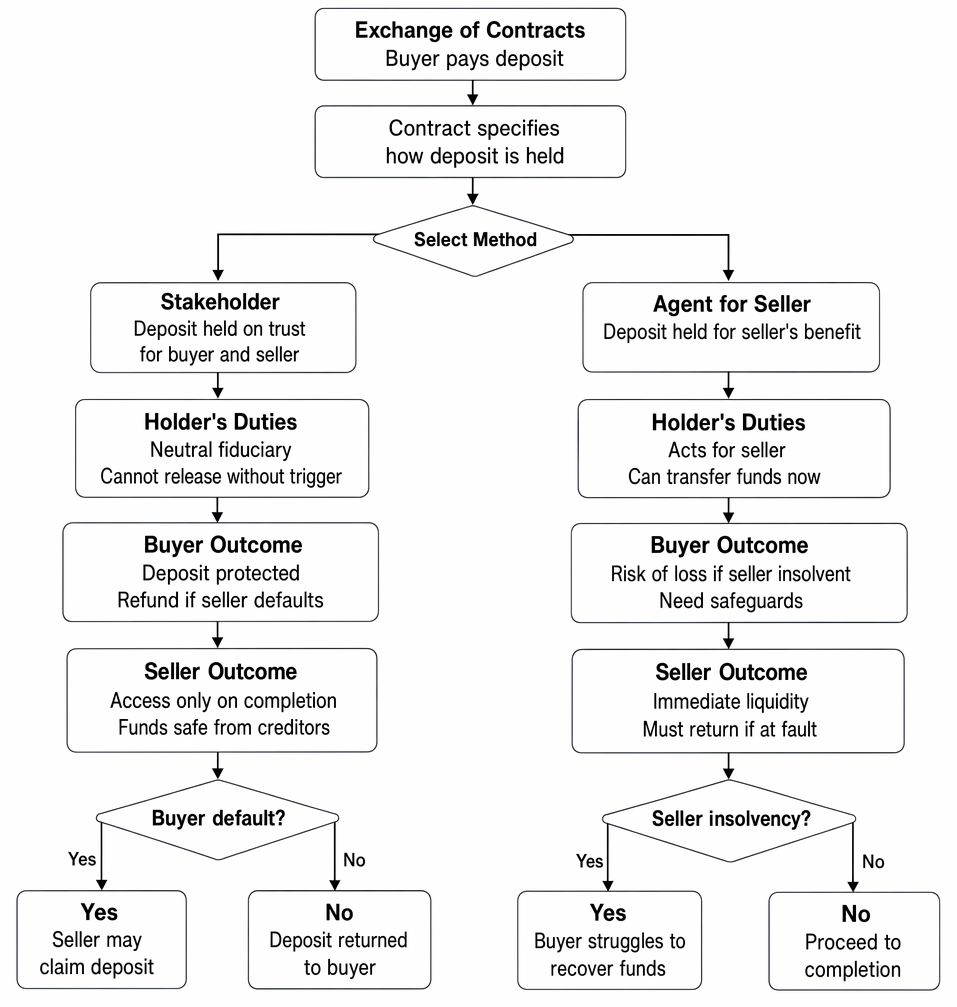
Deposit on exchange held as stakeholder or agent for the seller, including duties of the holder and consequences of default or insolvency.
Key Term: stakeholder
A person (usually the seller’s solicitor or licensed conveyancer) who holds the deposit on trust for both parties, and cannot release it to either party unless the contract entitles release, a condition is satisfied, or both parties agree. Key Term: agent (for the seller)
A person (often the seller’s solicitor or the seller directly) who holds the deposit at the seller’s disposal; the seller may access and use the deposit after exchange, subject to the contract. Key Term: special condition
A bespoke term that varies or supplements the standard conditions to, for example, change deposit capacity, permit use in a chain, or set a reduced deposit. Key Term: notice to complete
A contractual notice making time of the essence and fixing a final completion deadline (usually 10 working days); under both SC and SCPC it triggers the buyer’s obligation to top up any deposit paid at exchange to the full 10%. Key Term: buyer’s lien
An equitable security over the property for the amount of the deposit when paid as agent for the seller; the lien can be protected (registered land by a notice; unregistered land by a Class C(iii) land charge) to improve recovery prospects.
Methods of Holding a Deposit
When contracts are exchanged, the buyer typically pays a deposit (often 10% of the price). The contract must specify capacity and holder. The two principal methods are stakeholder and agent for the seller.
Stakeholder
Under SC 2.2.6 (residential) and SCPC 3.2.2 (commercial), where a conveyancer holds the deposit, it is held as stakeholder. A stakeholder has fiduciary duties to both parties and must hold the money pending completion or contractual entitlement to release (for example, following a buyer default). The stakeholder arrangement is deliberately protective: the deposit is trust property and is insulated from the seller’s bankruptcy or other creditors prior to completion.
Additional SC provisions matter in practice:
- SC 2.2.4 permits payment by electronic transfer from a conveyancer’s client account (which greatly reduces dishonour risk).
- SC 2.2.5 allows a seller to use the deposit in a related residential purchase, provided in that onward purchase it continues to be held on equivalent stakeholder terms. This “chain-use” provision helps synchronise completions without transferring agency risk down the chain.
In the auction context, the position differs: under SC 2.3.6 and SCPC 3.3.6, a deposit paid to the auctioneer is held as agent for the seller (see Agent below).
Agent
Alternatively, the contract may provide that the deposit is held as agent for the seller. This capacity is less common, but arises:
- In newbuild sales (developer may need deposit cash-flow for construction or site costs), and
- At auctions (see SC 2.3.6 and SCPC 3.3.6: auctioneer holds deposit as agent for the seller unless varied).
When held as agent, the seller may receive and use the deposit after exchange. This increases buyer risk: if completion fails due to the seller’s default, or the seller becomes insolvent, recovery of the deposit can be difficult—especially if the funds have been dissipated.
Legal Consequences and Practical Effects
Stakeholder: Rights and Risks
- Deposit is trust property; stakeholder owes duties to both buyer and seller.
- No release to seller until contractually entitled (e.g., buyer default after a valid notice to complete or forfeiture right arises).
- If the seller breaches or rescinds, stakeholder returns the deposit to the buyer.
- Protection against seller insolvency: trust money is generally not available to the seller’s creditors prior to completion.
- If a chain exists, SC 2.2.5 supports deposit transfer down-chain on equivalent stakeholder terms; despite physical movement of funds, stakeholder trust status persists.
Agent: Rights and Risks
- Deposit may be paid to the seller (or auctioneer) immediately post-exchange; seller can use for any purpose, including funding a related purchase or project.
- Buyer’s recovery risk rises if the seller defaults or becomes insolvent. A buyer may rely on a lien, but lien enforcement and recovery can be slow and uncertain, especially if the property’s value does not cover the lien or if the property is encumbered.
- In newbuilds, developers commonly stipulate agent capacity. Buyers and their lenders often resist or seek protective undertakings or escrow-like stakeholder arrangements.
Payment Method and Dishonoured Cheques
- SC 2.2.4 and SCPC 3.2.2 favour electronic payment from a conveyancer’s client account to reduce dishonour risk and timing issues.
- If a deposit cheque is dishonoured, the seller may treat this as a fundamental breach. Under SC 2.2.2 the seller can discharge the contract within seven working days of being told the cheque bounced (auction deposits are subject to SCPC 3.3.7). Practically, electronic transfer avoids this pitfall.
Reduced Deposits and Top‑Up on Notice
- A 10% deposit is standard. If a reduced deposit is agreed, the contract must be varied by special condition, and lenders may require approval.
- On service of a valid notice to complete, SC 6.8.3 and SCPC 9.8.3 require immediate top‑up to the full 10% deposit if less was paid at exchange. Failing to top‑up is a further default.
Interest on the Deposit
- Firms must operate a written client account interest policy (SRA Accounts Rules, Rule 7). Under SC 2.2.6, interest earned on stakeholder-held deposits is typically paid to the seller on completion unless varied by special condition. In commercial transactions, terms may be negotiated.
Buyer’s Lien and Protection
-
Where a deposit is held as agent for the seller, the buyer acquires an equitable lien over the property to the amount of the deposit. The lien can be protected:
- Registered land: by entering a notice on the charges register.
- Unregistered land: by registering a Class C(iii) land charge.
-
The lien improves recovery prospects but does not eliminate the risk; insolvency and prior charges may still defeat recovery.
Contractual Provisions
Clarity in drafting is essential. Consider the following:
-
Capacity and holder:
- SC/SCPC default: deposit held by a conveyancer is stakeholder (SC 2.2.6; SCPC 3.2.2).
- Auctions: deposit held by auctioneer as agent for the seller unless varied (SC 2.3.6; SCPC 3.3.6).
- Newbuild or special projects: if agent capacity is insisted upon, include robust protections or consider insisting on stakeholder capacity.
-
Amount and payment method:
- State deposit as a percentage (commonly 10%).
- If reduced deposit is agreed, add a special condition and ensure lender consent.
- Require electronic transfer from a conveyancer’s client account (SC 2.2.4; SCPC 3.2.2).
-
Chain-use:
- For residential chains, SC 2.2.5 permits deposit use on the seller’s related purchase, provided onward stakeholder terms mirror SC 2.2.5/2.2.6.
-
Top-up on notice:
- Confirm the obligation to top‑up to a full 10% if a notice to complete is served (SC 6.8.3; SCPC 9.8.3).
-
Professional undertakings:
- Avoid giving unconditional undertakings to pay the deposit before cleared funds are received; undertakings must be within your control.
Impact on Remedies and Completion
If the buyer defaults (e.g., fails to complete by the contractual date, does not comply with a valid notice to complete, or fails to top‑up to 10% on notice):
- Stakeholder capacity: stakeholder may release the deposit to the seller when the contractual right of forfeiture is established.
- Agent capacity: seller may already hold the deposit and be entitled to forfeit it if the contract allows.
If the seller defaults:
- Stakeholder capacity: deposit is returned to the buyer; trust status protects against seller creditors.
- Agent capacity: buyer must recover the deposit from the seller (risk if funds have been spent or the seller is insolvent; buyer can rely on a lien and pursue remedies).
Damages and rescission remain governed by the contract and common law. The deposit is typically treated as a genuine earnest of performance (10% is the accepted norm). Unusually high deposits may be scrutinised for penal effect, but this is rare in standard conveyancing.
Worked Example 1.1
A contract for the sale of a house states that the deposit is to be held by the seller’s solicitor as stakeholder. The buyer fails to complete. Can the seller’s solicitor release the deposit to the seller?
Answer:
Yes, but only if the contract entitles the seller to forfeit the deposit (for example, after serving a valid notice to complete and the buyer fails to comply). The stakeholder must be satisfied that the contractual right to release has arisen before paying the deposit to the seller.
Worked Example 1.2
A contract for a newbuild flat provides that the deposit is to be held as agent for the seller. The seller uses the deposit to fund construction. Before completion, the seller becomes insolvent. What is the risk to the buyer?
Answer:
High. The buyer may face difficulty recovering the deposit, as the funds may have been spent and could form part of the insolvency estate. The buyer can claim a lien and seek to protect it, but recovery is uncertain and may be subordinate to prior secured creditors.
Worked Example 1.3
The parties agree to a 5% deposit at exchange in a residential sale. Completion does not occur on the contractual date and the seller serves a notice to complete. Must the buyer pay more deposit?
Answer:
Yes. Under SC 6.8.3 the buyer must immediately top‑up the deposit to a full 10%. Failure to top‑up is an additional breach and may justify forfeiture if the buyer still fails to complete within the notice period.
Worked Example 1.4
At an auction sale adopting SC, the buyer pays a deposit to the auctioneer on the fall of the hammer. In what capacity does the auctioneer hold the deposit, and what does this mean for the buyer?
Answer:
Under SC 2.3.6 (and SCPC 3.3.6 for commercial) the auctioneer holds the deposit as agent for the seller. The seller may access the deposit; if completion fails due to seller default or insolvency, buyer recovery is riskier than with a stakeholder.
Worked Example 1.5
A buyer’s deposit cheque is dishonoured the day after exchange. The seller wishes to terminate quickly. Is this possible?
Answer:
Under SC 2.2.2, the seller can treat the contract as discharged for fundamental breach if they give notice within seven working days of being informed of dishonour. Using electronic transfer avoids this risk entirely.
Worked Example 1.6
In a chain transaction, the seller proposes to use the buyer’s deposit for the seller’s related residential purchase. Is buyer consent required?
Answer:
Not if SC applies and SC 2.2.5 is included. That condition allows use of the deposit on the seller’s related purchase provided the onward transaction holds the deposit on equivalent stakeholder terms. No separate buyer consent is needed.Exam Warning: If the contract is silent, the SC/SCPC default is that a conveyancer holding the deposit holds it as stakeholder. In auctions, the deposit paid to the auctioneer is held as agent unless varied. Always check capacity wording and auction conditions carefully and verify the payment method (prefer electronic transfer from a conveyancer’s client account).
Revision Tip: Stakeholder = safer for the buyer (trust protection, controlled release). Agent = riskier for the buyer (seller access; recovery issues). In a chain under SC, deposit can be used for the seller’s onward purchase but must remain on stakeholder terms.
Summary
| Method | Who Holds? | Who Benefits? | When Can Seller Use? | Buyer’s Risk Level |
|---|---|---|---|---|
| Stakeholder | Seller’s solicitor/conveyancer | Both parties | Only on completion or buyer default | Low |
| Agent (seller) | Seller/auctioneer/seller’s solicitor | Seller | Immediately after exchange | High |
Key Point Checklist
This article has covered the following key knowledge points:
- Under SC and SCPC, a conveyancer holds the deposit as stakeholder; at auction, the auctioneer holds as agent unless varied.
- Stakeholder capacity creates a trust over the deposit, insulating it from the seller’s creditors and controlling release.
- Agent capacity allows the seller to access and use the deposit after exchange; buyer recovery is riskier on seller default or insolvency.
- SC 2.2.4/SCPC 3.2.2 favour electronic payment; dishonoured cheques may permit contract discharge (SC 2.2.2).
- Reduced deposits require a special condition; on service of a notice to complete, the buyer must top‑up to a full 10% (SC 6.8.3; SCPC 9.8.3).
- SC 2.2.5 permits deposit use in a residential chain provided onward stakeholder terms are equivalent.
- A buyer’s lien arises if the deposit is held as agent; protect it by notice (registered) or Class C(iii) land charge (unregistered).
- Professional undertakings must be within control; never undertake to pay a deposit without cleared funds.
Key Terms and Concepts
- stakeholder
- agent (for the seller)
- special condition
- notice to complete
- buyer’s lien