Learning Outcomes
This article outlines remedies for delayed completion in property transactions, including:
- Circumstances in which delayed completion amounts to breach of contract, when time is or is not of the essence, and when common law damages become available.
- The legal effect of making time of the essence, how this alters the seriousness of delay, and its impact on termination rights and damages.
- The procedural requirements for serving a valid notice to complete, including timing, form, and the readiness, willingness and ability requirement.
- Principles for calculating common law damages, covering causation, foreseeability, mitigation, and the distinction between direct and special losses.
- The interaction between contractual compensation at the contract rate under the SCs/SCPCs and common law damages, and how to avoid double recovery.
- Deposit mechanics on exchange, obligations to top up the deposit on service of a notice to complete, and the consequences of deposit forfeiture on buyer default.
- How prolonged delay and non-compliance with a valid notice to complete can amount to repudiatory breach, enabling termination and a claim for non-completion damages.
- Typical heads of recoverable loss on delayed completion, including extra finance costs, wasted expenditure, loss of profit and loss on resale, with an exam-focused approach to applying these in SQE1 problem questions.
SQE1 Syllabus
For SQE1, you are required to understand the remedies available for delayed completion in property transactions, including the principles of common law damages, with a focus on the following syllabus points:
- The legal consequences of delayed completion as a breach of contract
- The meaning and effect of "time is of the essence" in property contracts
- The procedure and effect of serving a notice to complete
- The principles for calculating common law damages, including foreseeability and mitigation
- The distinction between contractual compensation and common law damages
- The interaction between contractual remedies (e.g., Standard Conditions of Sale) and common law rights
- Deposit handling on exchange, top-up obligations on notice, and forfeiture on buyer default
- The requirement that the party serving a notice to complete is ready, willing and able to complete
Test Your Knowledge
Attempt these questions before reading this article. If you find some difficult or cannot remember the answers, look more closely at that area during your revision.
- What is the effect of serving a notice to complete in a property transaction?
- When can a party claim common law damages for delayed completion?
- What is the duty to mitigate loss, and how does it affect the calculation of damages?
- How do contractual compensation provisions interact with common law damages?
Introduction
Delayed completion in a property transaction is not simply an inconvenience—it is a breach of contract that may entitle the innocent party to remedies at common law. Understanding when and how common law damages are available, and how they interact with contractual remedies, is essential for SQE1. This article explains the legal framework for claiming damages, the importance of "time is of the essence," the procedure for serving a notice to complete, and the calculation of damages for loss caused by delay. It also examines how the Standard Conditions of Sale (SCs) and Standard Commercial Property Conditions (SCPCs) allocate contractual compensation and the practical consequences for deposit handling and forfeiture.
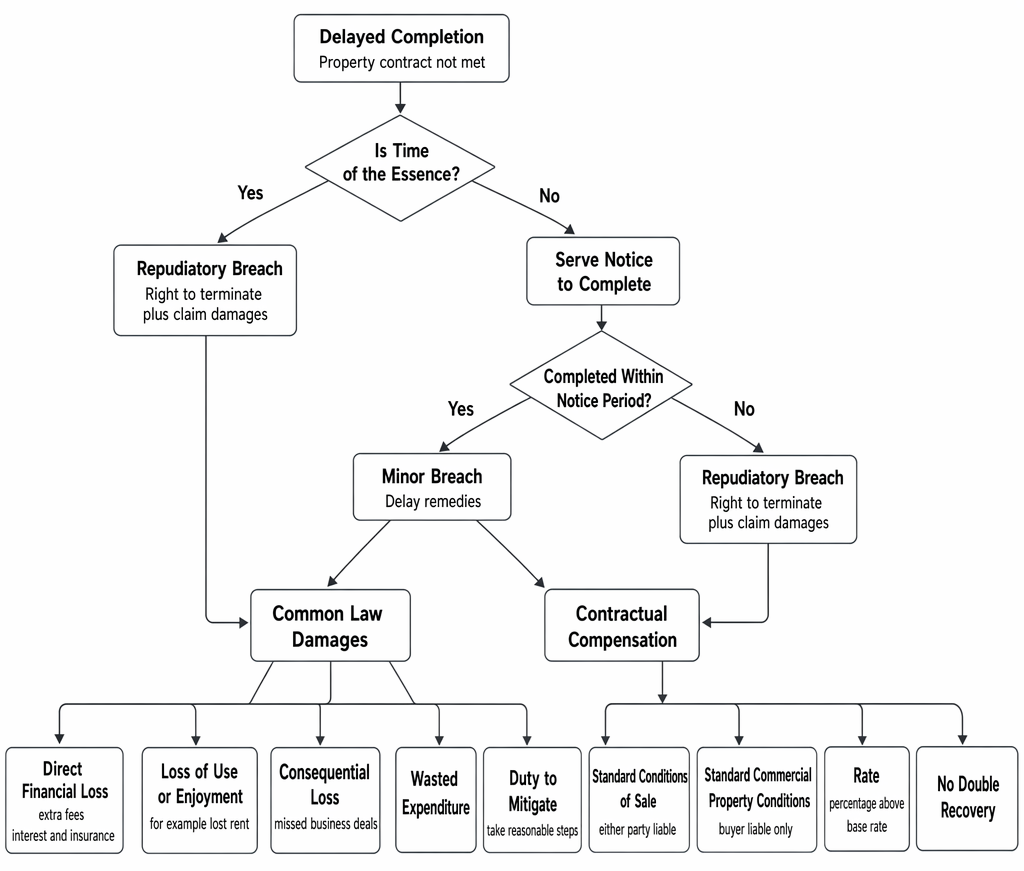
Delayed completion in property contracts is analysed by reference to repudiatory breach, notice to complete, damages, and contractual compensation.
Key Term: breach of contract
A failure by one party to perform their contractual obligations, entitling the innocent party to remedies such as damages or, in some cases, rescission.Test Tip: In SQE-style questions on Common law damages, identify the legal test, the triggering fact, and the consequence before choosing between similar answer options.
Delayed Completion as a Breach of Contract
When a party fails to complete a property transaction on the agreed date, this constitutes a breach of contract. The innocent party may be entitled to damages, but the nature and extent of the remedy will depend on whether time is of the essence and the terms of the contract. Under the SCs and SCPCs, time is not normally of the essence for completion unless a valid notice to complete has been served. Until time is made of the essence, delayed completion is usually treated as a breach of a non-fundamental term (a warranty), giving rise to damages but not an immediate right to terminate the contract.
Key Term: repudiatory breach
A serious breach of contract entitling the innocent party to terminate and claim damages. In conveyancing, failure to complete after time has been made of the essence (e.g., after a valid notice to complete expires) will usually be a repudiatory breach.
Time Is of the Essence
Whether a delay in completion is a serious breach depends on whether "time is of the essence." If time is of the essence, any delay entitles the innocent party to terminate the contract and claim damages. If not, the innocent party may claim damages for loss caused by the delay, but cannot immediately terminate. The usual effect is that, without a notice to complete, a delayed completion is not repudiatory and the remedy is damages for the period of delay.
Key Term: time is of the essence
A contractual term making the completion date a fundamental condition, so that any delay is a repudiatory breach.
Time is of the essence in three main situations:
- The contract expressly states that time is of the essence.
- The circumstances or nature of the contract make timing critical.
- A party serves a notice to complete, making time of the essence after an initial delay.
This distinction matters because, before time is of the essence, the innocent party is limited to damages and (under the SCs/SCPCs) contractual compensation. Once time is made of the essence and the default continues beyond the notice period, the innocent party may terminate, pursue damages for non-completion, and (if the buyer is in default) forfeit the deposit.
Notice to Complete
If time is not originally of the essence, the innocent party can serve a notice to complete. This notice requires the defaulting party to complete within a specified period (usually ten working days). After this period, time becomes of the essence, and failure to complete entitles the innocent party to terminate the contract and claim damages. Under unamended SCs and SCPCs, a notice to complete is typically served after the contractual completion time on the completion date (commonly 2 p.m.). Parties may vary this by special condition.
The party serving the notice must be ready, willing and able to complete themselves at the time the notice is served and remain so throughout the notice period. A notice served by a party who is not in that position risks being ineffective.
Key Term: notice to complete
A formal notice served by one party requiring the other to complete the contract within a specified period, after which time becomes of the essence. Key Term: readiness, willingness and ability
The requirement that a party serving a notice to complete is in a position to complete on the terms of the contract, both when serving the notice and throughout the notice period.
Upon service of a notice to complete, the buyer must pay a 10% deposit if not already paid, or top up any lower deposit to 10% (as provided in SC 6.8.3 / SCPC 9.8.3). This ensures adequate security for the seller during the notice period.
Key Term: deposit
A sum (usually 10% of the purchase price) paid on exchange as security for performance. Typically held by the seller’s solicitor as stakeholder and released on completion. Key Term: deposit forfeiture
The seller’s right, on buyer default after time is of the essence and termination, to retain the deposit as liquidated security for the breach (subject to any contrary term).
Worked Example 1.1
A buyer fails to complete on the agreed date. The seller serves a notice to complete, giving the buyer ten working days to complete. The buyer still does not complete. What are the seller's rights?
Answer:
The seller may treat the contract as terminated, forfeit the deposit, and claim damages for losses caused by the delay and non-completion.
Calculating Common Law Damages
Damages at common law aim to compensate the innocent party for losses caused by the breach, putting them in the position they would have been in had the contract been performed. In the context of delayed completion, before time is of the essence, damages will be for loss suffered during the period of delay. After termination for non-compliance with a notice to complete, damages are assessed for non-completion.
Key Term: common law damages
Monetary compensation awarded for loss suffered as a result of a breach of contract, subject to rules of foreseeability and mitigation.
The leading case is Hadley v Baxendale (1854), which established that damages are recoverable for:
- Losses arising naturally from the breach (direct losses)
- Losses that were in the contemplation of both parties at the time of contract (special losses)
In conveyancing, this framework has been applied consistently. Delayed completion without time being of the essence is treated as breach of warranty, giving rise to damages for the delay (see Rainieri v Miles). Once time is made of the essence and the breach persists, the failure to complete will generally be repudiatory, with damages assessed on the usual contractual basis.
Types of Recoverable Loss
- Additional legal or professional fees (e.g., rebooking completion arrangements, liaising with lenders)
- Extra mortgage interest or insurance costs caused by the delay
- Bridging finance costs incurred due to late completion
- Loss of rental income or alternative accommodation expenses
- Wasted removal and storage costs
- Wasted expenditure in reliance on completion (e.g., survey fees in limited circumstances, though pre-contract expenditures are usually irrecoverable)
- Loss on resale (for a seller) if the market has moved, subject to giving credit for any profit
- For developers or investors, loss of development profit or sub-sale profit if such loss was within the parties’ contemplation when the contract was made
The starting point for damages on non-completion often includes the difference (if any) between the contract price and the market value at the date of breach, plus consequential losses within reasonable contemplation.
Loss of development profit or sub-sale profit is recoverable only if the defendant knew of the claimant’s intended use or onward sale at the time the contract was made. If the seller knew the buyer needed timely completion to secure a sub-sale, late completion impacting that sub-sale may be recoverable as special loss.
Mental distress is generally not recoverable for breach of a land sale contract; the focus remains on financial loss.
Duty to Mitigate
The innocent party must take reasonable steps to reduce their loss. Losses that could have been avoided by reasonable action are not recoverable. Reasonable mitigation might involve a seller attempting a prompt resale or a buyer arranging temporary accommodation rather than incurring disproportionately high hotel costs for an extended period.
Key Term: duty to mitigate
The obligation on a claimant to take reasonable steps to minimise their loss following a breach of contract.
Failing to mitigate may reduce the award. Equally, reasonable mitigation that increases loss (for instance, arranging a necessary bridging facility that proves costly) remains recoverable; the defendant bears the costs caused by the breach.
Worked Example 1.2
A seller incurs storage costs because the buyer delays completion. The seller could have arranged cheaper storage but did not. Can the seller recover the full cost?
Answer:
The seller can only recover costs that are reasonable. If cheaper storage was available and the seller unreasonably failed to use it, damages may be reduced.
Interest on Damages
Courts may award interest on damages to reflect the time the claimant has been out of pocket. The rate and period are at the court’s discretion. This statutory interest is distinct from the contractual compensation payable under the SCs/SCPCs and will be assessed by reference to the circumstances of the case.
Contractual Compensation vs. Common Law Damages
Most property contracts incorporate the Standard Conditions of Sale (SCs) or Standard Commercial Property Conditions (SCPCs), which provide for contractual compensation for delayed completion.
- Under the SCs, either party may be liable to pay compensation at the contract rate on the balance of the purchase price for the period of delay.
- Under the SCPCs, only the buyer is liable to pay compensation for delay.
Key Term: contractual compensation
A sum payable under the contract for delay in completion, usually calculated at a specified interest rate. Key Term: contract rate
The interest rate specified in the contract for calculating compensation on delayed completion (commonly a margin above a bank base rate, e.g., Law Society interest rate).
Receiving contractual compensation does not prevent a claim for additional common law damages, but any compensation received must be deducted from damages to avoid double recovery. If the contract is rescinded after non-compliance with a notice to complete, the contractual compensation regime ceases and the claimant must pursue common law damages.
Practical points on compensation calculation under SCs/SCPCs:
- Daily compensation is calculated on the relevant sum (for a defaulting buyer, the balance of the purchase price after deducting the deposit; for a defaulting seller under SCs, the whole price excluding chattels).
- Count the number of days of delay, including the contractual completion date but not the actual completion date.
- Compensation runs at the contract rate and is payable on completion.
- Where both parties are at fault for parts of the delay, days when the non-defaulting party also defaulted are typically excluded.
Worked Example 1.3
Contracts incorporate the Standard Conditions. Completion is delayed by three days due to the buyer. The contract rate is 4.75%. The price is £300,000 and the buyer has paid a 10% deposit.
Answer:
Compensation is calculated on £270,000 (the balance after deducting the £30,000 deposit). Annual compensation is £270,000 × 4.75% = £12,825. The daily rate is £12,825 ÷ 365 ≈ £35.13. For three days, compensation ≈ £105.39. This amount is payable on completion and must be credited against any common law damages to avoid double recovery.Exam Warning: If the contract provides for compensation for delay, you must consider whether additional losses are recoverable at common law. Double recovery is not permitted.
Interaction with Other Remedies
If the delay is prolonged and a notice to complete is served but not complied with, the innocent party may terminate the contract, forfeit or recover the deposit, and claim damages for any further loss. Termination rights depend on the notice being validly served and time being of the essence after expiry of the notice period.
Specific performance may also be available if damages are inadequate. As a discretionary equitable remedy, courts consider whether common law damages suffice, whether performance can be feasibly supervised, and the balance of hardship. Contracts for the sale of land frequently qualify for specific performance because land is unique. However, equitable bars apply: the claimant must come with clean hands, act promptly, and be ready, willing and able to complete.
Where the buyer is in default and termination follows, deposit forfeiture is a powerful remedy. The seller may retain the deposit and seek further damages. If the seller is in default after time is of the essence, the buyer may terminate and recover the deposit, plus damages for losses caused by the breach.
Procedural considerations:
- The notice to complete should be served in accordance with the contract’s notice provisions and after the contractual completion time unless varied by special condition.
- The serving party should ensure readiness, willingness and ability to complete, including having funds, executed documents, and any necessary lender releases in place.
- On service of a notice to complete, the buyer must pay or top up the deposit to 10% immediately; failure to do so may itself constitute breach.
Worked Example 1.4
A buyer contracts to purchase development land for £2m, intending to sub-sell part to a third party on the same completion date for a profit. The seller is informed of the intended sub-sale during negotiations. Completion is delayed by the seller by ten days, causing the sub-sale to fall through and the buyer to incur bridging finance costs. Can the buyer recover the lost sub-sale profit and bridging costs?
Answer:
Lost sub-sale profit may be recoverable as special loss if the seller knew of the intended sub-sale at the time of contracting; bridging finance costs arising naturally from the delay are also recoverable, subject to reasonableness and mitigation. Any contractual compensation received must be deducted to avoid double recovery.
Summary
| Issue | Standard Conditions (SCs) | Standard Commercial Property Conditions (SCPCs) |
|---|---|---|
| Who pays compensation? | Either party | Buyer only |
| Rate of compensation | Contract rate (e.g., 4% above base) | Contract rate (e.g., 4% above base) |
| Additional common law damages | Yes, but no double recovery | Yes, but no double recovery |
| Notice to complete | Makes time of the essence | Makes time of the essence |
Key Point Checklist
This article has covered the following key knowledge points:
- Delayed completion is a breach of contract that may entitle the innocent party to damages.
- "Time is of the essence" determines whether delay is a repudiatory breach.
- A notice to complete makes time of the essence if it was not already.
- The serving party must be ready, willing and able to complete when serving a notice to complete.
- On service of a notice to complete, the buyer must pay or top up the deposit to 10%.
- Common law damages compensate for foreseeable loss, subject to mitigation.
- Contractual compensation is usually provided for in the SCs/SCPCs.
- Contractual compensation and common law damages may both be claimed, but double recovery is not allowed.
- Deposit forfeiture is available to the seller on buyer default after termination.
- Courts may award interest on damages; this is separate from contractual compensation.
Key Terms and Concepts
- breach of contract
- time is of the essence
- notice to complete
- readiness, willingness and ability
- deposit
- deposit forfeiture
- common law damages
- duty to mitigate
- contractual compensation
- contract rate
- repudiatory breach