Learning Outcomes
This article examines how concurrent and consecutive sentences are structured in English criminal law, including:
- The distinction between concurrent and consecutive sentences, the policy rationale for each approach, and how these choices affect overall sentence length
- The statutory framework in the Sentencing Code 2020, Sentencing Council guidelines, and key common law principles, with particular emphasis on the totality principle
- How courts assess related and unrelated offences, multiple victims, and courses of conduct when deciding whether sentences should run concurrently or consecutively
- The impact of different sentence structures on calculation of custody, release and licence dates, eligibility for parole, and practical management of sentences in both magistrates’ courts and the Crown Court
- Application of the totality principle to exam-style problem questions, including standing back to review aggregate sentences and adjusting individual terms to avoid unjust or "crushing" outcomes
- The interaction between suspended sentences and new offences, including activation, partial activation, and decisions on concurrent or consecutive running in accordance with guidelines
- Typical judicial reasoning in realistic scenarios, highlighting common pitfalls, appellate scrutiny, and issues that SQE1 candidates must be ready to analyse under exam time pressure
SQE1 Syllabus
For SQE1, you are required to understand concurrent and consecutive sentencing in English criminal law, with a focus on the following syllabus points:
- the distinction between concurrent and consecutive sentences
- the statutory and guideline structure for multiple sentences, including relevant provisions in the Sentencing Code 2020
- application of the totality principle in sentencing for multiple offences and its relationship to proportionality and overall criminality
- how the courts activate and order concurrent or consecutive operation of suspended sentences in response to breaches or new convictions
- key judicial and procedural considerations for structuring sentences in cases involving multiple indictments
- impact of consecutive and concurrent sentencing on sentence calculation, release, parole, and judicial reasoning
Test Your Knowledge
Attempt these questions before reading this article. If you find some difficult or cannot remember the answers, look more closely at that area during your revision.
- What is the totality principle, and how does it affect the decision to impose concurrent or consecutive sentences?
- In what circumstances will a court usually impose concurrent sentences rather than consecutive sentences?
- What happens if an offender commits a new offence during the operational period of a suspended sentence?
- Can the court order the activation of a suspended sentence to run concurrently with a new custodial sentence?
Introduction
Where a defendant is convicted of more than one offence, the sentencing process requires the court to structure the sentence in a manner that reflects both the individual seriousness of each offence and the cumulative wrongdoing. The court must determine whether sentences should run at the same time (concurrently) or one after another (consecutively). At the core of sentencing for multiple offences lies the necessity to ensure justice—no sentence should be "crushing" nor should it fail to mark the total criminality. This structure is governed primarily by the Sentencing Code 2020 and the Sentencing Council's guidelines, alongside long-standing legal doctrines such as the totality principle, which together safeguard proportionality and fairness in the outcome for both the defendant and society.
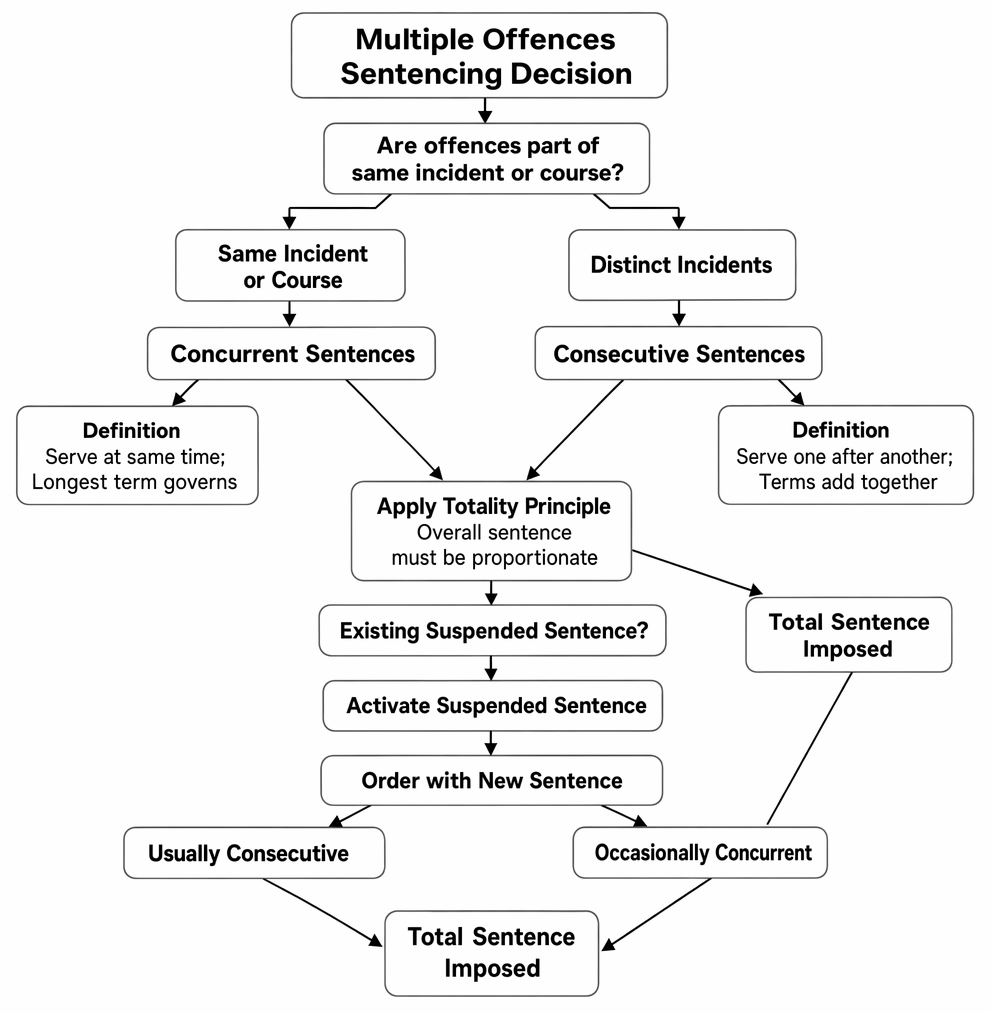
Concurrent and consecutive sentencing for multiple offences is set out by reference to offending, totality, and activation of a suspended sentence.
Key Term: concurrent sentence
A sentence imposed to run at the same time as another or other sentences. The sentences are served simultaneously, with the longest sentence determining the period of custody. Key Term: consecutive sentence
A sentence ordered to start after another sentence has ended. The offender serves each term in turn, producing a longer total period in custody.Test Tip: In SQE-style questions on Concurrent and consecutive sentences, identify the legal test, the triggering fact, and the consequence before choosing between similar answer options.
Concurrent and Consecutive Sentences: The Core Principles
When faced with multiple convictions, the court must consider the relationship between the offences, the sequence in which they occurred, and whether there is any overlap in the physical acts or victims harmed. These considerations inform the choice between ordering sentences to be served concurrently or consecutively.
Concurrent sentences are primarily imposed where the offences are linked by facts, timing, or circumstance and essentially form part of the same criminal episode or course of conduct. This ensures that the aggregate punishment does not disproportionately exaggerate the defendant's overall wrongdoing. In contrast, consecutive sentences are generally imposed for offences that are unconnected in time, purpose, or victim, where treating them as a single episode would underestimate the seriousness of combined offending.
When Are Concurrent Sentences Used?
Concurrent sentences reflect the legal recognition that a single criminal episode involving multiple charges should not lead to excessive punishment simply because an offender could be convicted under different legal provisions relating to the same conduct. They are most often used when:
- All or several offences arise out of the same facts (a single incident or event)
- Offences are committed as part of one transaction, even if several legal definitions are satisfied
- There is a continuous course of conduct against a single victim over a relatively short period
- The criminality is best encapsulated by the custodial term required for the most serious offence, and additional sentences would not require extra time to achieve a proportionate outcome
For example, in a violent confrontation where the defendant is convicted of both causing actual bodily harm and affray, the court is likely to order concurrent sentences, recognising that the offences form part of the same event.
When Are Consecutive Sentences Used?
Consecutive sentences recognise the need to reflect the reality of separate acts of wrongdoing, particularly when these acts are distinct in time, place, or harm multiple victims. Consecutive sentencing ensures the overall seriousness is marked and the court does not minimise the extent of offending. They are usually imposed when:
- The offences are factually and temporally distinct—different incidents, victims, or motives
- Each offence demonstrates a separate and additional criminal wrong
- Offences are committed while on bail for another offence, or while serving another sentence
- To avoid undermining statutory minimum sentences or to ensure that the consequences of separate wrongdoing are not artificially collapsed into one
The court must be careful, however, not to impose consecutive sentences if doing so would result in a cumulative penalty that is disproportionate to overall culpability.
Worked Example 1.1
Scenario: Sam is convicted of two assaults committed during a single fight. The court imposes 12 months for the first assault and 6 months for the second.
Answer:
The court will usually order the sentences to run concurrently, as both offences arise from the same incident. Sam will serve a total of 12 months.
Worked Example 1.2
Scenario: Maria is convicted of burglary committed in January and fraud committed in June, involving different victims and circumstances.
Answer:
The court will likely impose consecutive sentences, as the offences are unrelated. If Maria receives 18 months for burglary and 12 months for fraud, she will serve a total of 30 months.
Additional Factors and Nuances
Courts may impose a mix of concurrent and consecutive sentences across a range of offences. For example, if a defendant is convicted of three offences—two arising from the same incident, and a third from a different incident—the court may order the first two to run concurrently to each other, but consecutively to the third.
Further, while the default rule is as above, procedural law sometimes mandates that certain sentences must run consecutively. For example, minimum sentences (such as those under mandatory statutory provisions) cannot normally be evaded or reduced by imposing concurrent sentences for similar offences.
The Totality Principle
Key Term: totality principle
The principle that, upon sentencing for multiple offences, the aggregate sentence passed must be just and proportionate to the offender’s overall criminality, marking the culpability and harm caused without being either excessive or unduly lenient.
The totality principle is fundamental to all sentencing for multiple offences in English criminal law. Its aim is to ensure that the defendant is punished appropriately for the full criminal conduct proved, but without crossing the line into disproportion. The court must stand back and review the combined sentences imposed to determine whether the aggregation correctly reflects the total seriousness of the defendant's offending.
When applying totality, the court carries out a two-stage process:
- Assess the seriousness of each individual offence and pass the sentence that is appropriate for each
- Step back and review the overall sentence to ensure it is just and proportionate, adjusting the structure (by employing concurrency or consecutivity in full or in part) to reach the appropriate overall outcome
Where multiple sentences risk producing a "crushing" result if handled consecutively, or fail to reflect the totality of wrongdoing if handled concurrently, the court may adjust the structure to avoid injustice. The reasoning behind the use of either structure (or a combination) should always be made explicit in open court.
Calculation and Adjustment
The totality principle ensures, for example, that if the court finds that imposing four consecutive sentences of one year each would result in a four-year total, yet the overall criminality is only justly marked by three years, it must adjust sentencing accordingly. Adjustments can be made either to the individual sentences (where appropriate) or through the order in which sentences are to be served.
Exam Warning: The court must always apply the totality principle when sentencing for multiple offences. Failing to do so may result in an appeal against sentence, as the appellate court looks for express consideration of totality and open reasoning in sentencing remarks.
Worked Example 1.3
Scenario: A defendant is convicted on an indictment containing four burglary counts, each relating to thefts from different premises over a period of two weeks. Each offence attracts a one-year sentence.
Answer:
The judge determines that while the offences are distinct, imposing four years' custody would be excessive in light of the total criminality, especially if the burglaries were committed as part of a spree rather than as isolated incidents. The court may impose partially concurrent sentences (e.g. two pairs of concurrent sentences, each pair served consecutively) or otherwise adjust individual terms downward, ensuring the overall sentence reflects the totality principle.
Statutory and Guideline Framework
The Sentencing Code 2020 (particularly ss 59–64 and 231–237) and the Sentencing Council's Definitive Guidelines together establish the legal platform for the structuring of multiple sentences. Courts must follow these guidelines unless satisfied that it would be contrary to the interests of justice to do so.
The guidelines urge courts to:
- Consider the relationship between each offence and the context of offending
- Assess whether consecutive or concurrent sentences will adequately reflect the defendant’s criminality
- Take into account statutory maximum and minimum terms applicable to individual offences
- Be alert to the potential for double counting of aggravating factors
Courts are also required to consider the effect of the sentence structure on parole eligibility, release dates, and the practical functioning of the sentence. For example, in the magistrates' court, the maximum available consecutive term cannot, as a general rule, exceed the maximum sentence for a single offence unless otherwise provided by statute.
Factors Influencing the Court's Decision
When deciding between concurrent and consecutive sentences, courts will consider:
- The degree of factual overlap, connection, or continuity between offences (same or different acts, course of conduct, or transactions)
- Whether the offences involved the same or different victims
- The gravity, harm, and culpability involved in each offence in the context of the overall pattern of wrongdoing
- Whether a consecutive sentence is necessary to reflect additional harm or to give effect to any statutory minimum terms
- The overall effect of aggregation—ensuring the result is not manifestly excessive or lenient when compared to the whole criminality of the case
Where there is uncertainty or risk of disproportion, the courts err on the side of not imposing a sentence that is crushing or fails to do justice to the seriousness of all the offences taken together.
Example—Concurrent and Consecutive Sentences in Indictable versus Summary Offences
It is important to note that certain summary-only offences and some types of low-value criminal damage must be tried summarily, and the magistrates’ court can only impose sentences up to its maximum permitted aggregate. For either-way offences or where offences are sent to the Crown Court, longer consecutive sentences may be permissible provided that the overall sentence imposed reflects both statutory limitations and the totality principle.
Suspended Sentences and New Offences
Key Term: suspended sentence
A custodial sentence imposed but not immediately served, subject to the condition that the offender does not commit another offence within the designated operational period and complies with all requirements set by the court.
Suspended sentences, as defined under the Sentencing Code, are an important sentencing tool that allow courts to defer the implementation of a custodial sentence for offenders who do not pose an immediate risk to the public and for whom rehabilitation or strong personal mitigation is present.
A suspended sentence consists of:
- The original custodial period
- An operational period (6 months to 2 years) during which any further offence leads to the automatic consideration of activating the suspended term
- Conditions or requirements (e.g., unpaid work, programme attendance)
If an offender breaches a condition or is convicted of a further offence during the operational period, the court must consider activating the suspended sentence in addition to sentencing for the new offence, unless it would be unjust in the circumstances to do so.
Activation of a Suspended Sentence—Principles and Practice
Upon breach or a new conviction during the operational period, the general rule is that the suspended sentence must be activated unless there are strong reasons otherwise. The court has three basic options:
- Order the suspended sentence to take effect in full, to be served immediately
- Activate a substituted, lesser sentence where justice demands
- In exceptional circumstances, impose a fine not exceeding £2,500 as an alternative (if justified)
The court must decide whether any activated term should run concurrently or consecutively to a new custodial sentence. As a general rule, when the new offence and the original suspended-sentence offence are unrelated, the sentences will run consecutively, reflecting the need to adequately mark distinct criminality. If the new and original offences are closely linked (which is unusual), the court may order concurrent running, but this is not the norm.
Worked Example 1.4
Scenario: Liam receives a suspended sentence of 8 months for theft, with an operational period of 18 months. Six months later, he is convicted of affray and sentenced to 12 months' immediate custody.
Answer:
The court will usually activate the suspended sentence and order it to run consecutively to the new sentence, resulting in a total of 20 months.
Judicial Discretion and Statutory Guidance
Statute and guidance expect courts to provide reasons in open court for both the decision to activate and the manner in which sentences are to be served (concurrently or consecutively). The Sentencing Code and guidelines reserve activation for cases where the defendant’s criminal conduct during the operational period demonstrates that immediate custody is now required to protect the public and punish the defendant.
Extended and Life Sentences
More serious offences such as certain sexual or violent crimes may attract extended sentences or life sentences according to specific statutory provisions. The court, when imposing such sentences for multiple qualifying offences, must consider whether periods of imprisonment, minimum terms, or extended licences for each offence should run concurrently or consecutively.
- For life sentences, minimum terms may run concurrently where offences are closely linked in facts and criminal conduct, but can run consecutively in exceptional cases to mark truly distinct wrongdoing
- For extended determinate sentences relating to specified offences (such as under the Sentencing Code), extended licence periods typically run concurrently, reflecting that ongoing oversight need not be artificially lengthened by aggregating terms
Practical Consequences
The structure chosen for concurrent or consecutive running of serious sentences will affect parole eligibility, calculation of minimum terms, and the offender's overall time subject to supervision or incarceration. Clarity in judicial reasoning and adherence to totality remain essential.
Sentencing in Practice: Key Considerations
The determination of concurrent versus consecutive sentences goes beyond theoretical principles. In practice, the sentencing structure chosen by the court may significantly affect:
- The period the defendant spends in custody or under supervision
- Release dates and eligibility for parole or licence, particularly where longer sentences apply
- The approach to time served if a conviction is subsequently quashed for one offence but not others
- The messaging to victims and the public—ensuring that the sentence imposed marks each element of the criminal conduct
- The importance of transparent judicial reasoning, as appellate courts will require evidence that the totality principle and statutory guidance were conscientiously applied
Where a defendant faces sentencing for both offences committed before and after a period spent on remand, or is serving a sentence at the time of conviction for an unrelated offence, the totality principle and the statutory framework for consecutive and concurrent terms must be meticulously followed to avoid error.
Worked Example 1.5
Scenario: An individual is convicted of multiple counts of fraud against several victims and has outstanding unrelated convictions for theft from previous years. The judge must sentence for all matters simultaneously.
Answer:
For the fraud offences against multiple victims, the judge may order consecutive sentences to reflect distinct offending. If the previous theft conviction was already sentenced and was unrelated to the fraud, any new custodial sentences for the fraud may also run consecutively, unless the facts justify concurrency per the totality principle.
Summary
| Feature | Concurrent Sentence | Consecutive Sentence |
|---|---|---|
| Offences arise from | Same incident or course of conduct | Separate incidents, courses, or victims |
| Sentence served | At the same time (simultaneous) | One after the other, sequentially |
| Total time in custody | Length of the longest sentence imposed | Total of all sentences imposed in succession |
| Totality principle | Ensures overall sentence is proportionate and just | Ensures overall sentence is not excessive or lenient |
Key Point Checklist
This article has covered the following key knowledge points:
- The difference between concurrent and consecutive sentences and core definitions for each
- The structure and operation of the totality principle in determining just and proportionate sentences for multiple offences
- The application of the Sentencing Code 2020 and Sentencing Council guidance governing sentence structure
- Courts' duty to state clear reasons for structuring sentences as concurrent or consecutive, including for activation of suspended sentences
- When concurrent sentences are used—typically for linked incidents, same facts, or a continuous course of conduct
- When consecutive sentences are used—typically for distinct acts, separate victims, or where the totality principle would be undermined by concurrency
- Mechanisms for activating suspended sentences, and typical principles for ordering how such terms run alongside new custodial sentences
- The effect of concurrent and consecutive sentences on release, parole, and the practical impact for offenders and victims alike
Key Terms and Concepts
- concurrent sentence
- consecutive sentence
- totality principle
- suspended sentence