Learning Outcomes
This article examines robbery under s.8 Theft Act 1968, including:
- the statutory definition of robbery, breaking down each actus reus and mens rea element and how they interrelate;
- how to distinguish robbery from simple theft, burglary, and assault with intent to rob in problem questions;
- the legal threshold for "force" or "threat of force", including minimal contact, indirect force through property, and implied threats;
- the requirement for a completed theft, how dishonesty and intention to permanently deprive are proved, and when a claim of right defeats robbery;
- the timing requirement for force, with emphasis on appropriation as a continuing act and when post-theft violence does or does not amount to robbery;
- the meaning of using force "in order to steal", separating robbery from situations where violence is motivated by revenge or unrelated disputes;
- the breadth of "any person" and "then and there" in threats, including force directed at bystanders or security staff;
- application of these rules to SQE1-style multiple-choice and single-best-answer questions, highlighting common traps and examiner favourites.
SQE1 Syllabus
For SQE1, you are required to understand robbery as a property offence, including identifying the elements of robbery, distinguishing it from theft and burglary, and applying the relevant legal rules to practical scenarios, with a focus on the following syllabus points:
- the statutory definition and elements of robbery under s.8 Theft Act 1968
- the requirement for a completed theft as part of robbery
- the meaning and threshold of "force" or "threat of force" in law
- the timing of force in relation to the theft and the notion of appropriation as a continuing act
- the intent required for robbery and how it differs from related offences
- how to distinguish robbery from theft and burglary in practical situations
- the relevance of “any person” and “then and there” in threats of force
- the separate offence of assault with intent to rob (s.8(2)) where theft does not occur
Test Your Knowledge
Attempt these questions before reading this article. If you find some difficult or cannot remember the answers, look more closely at that area during your revision.
- What are the essential elements that must be proved for a conviction of robbery under s.8 Theft Act 1968?
- Does the victim need to actually feel fear for a threat to amount to robbery?
- At what point must force or the threat of force occur for an offence to be robbery rather than theft?
- How does robbery differ from burglary in terms of the required conduct and intent?
Introduction
Robbery is a serious property offence that combines theft with force or the threat of force. It is defined by section 8 of the Theft Act 1968 and is always tried in the Crown Court (triable only on indictment). Robbery is distinct from theft and burglary, requiring specific elements to be proved. For SQE1, you must be able to identify and apply these elements, and distinguish robbery from related offences.
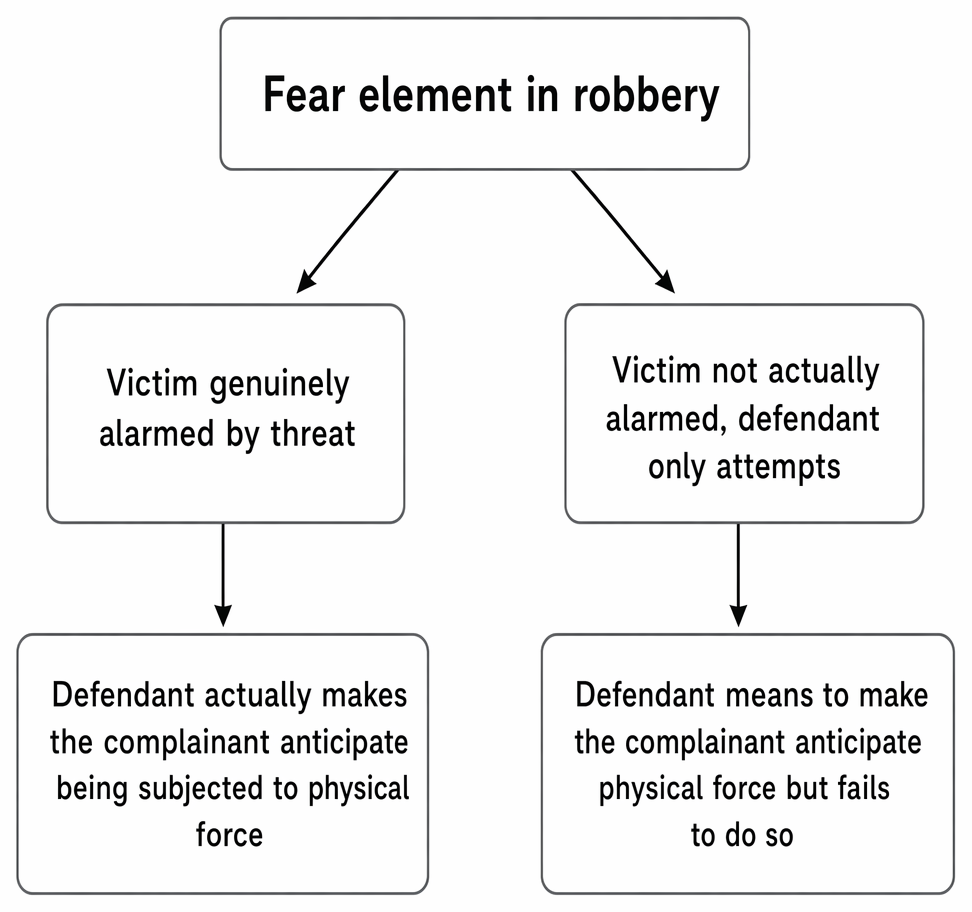
Robbery under s 8 Theft Act 1968 includes actual apprehension of force and a failed attempt to induce it.
Definition and Elements of Robbery
Section 8 of the Theft Act 1968 states that a person is guilty of robbery if they steal, and immediately before or at the time of doing so, and in order to do so, they use force on any person or put or seek to put any person in fear of being then and there subjected to force.
Key Term: robbery
Robbery is theft accompanied by the use or threat of force, used immediately before or at the time of the theft and in order to steal.
The offence consists of both actus reus (physical elements) and mens rea (mental elements). Each must be satisfied for a conviction.
The Actus Reus of Robbery
There are two main requirements:
- A completed theft: All elements of theft must be present—dishonest appropriation of property belonging to another with the intention to permanently deprive.
- Use or threat of force: The defendant must use force on any person, or put or seek to put any person in fear of being then and there subjected to force. The force or threat must occur immediately before or at the time of the theft, and must be used in order to steal.
Key Term: force (in robbery)
Any physical power, however slight, applied to a person or their property, or conduct intended to cause fear of such force.
Force is a matter for the jury and includes minimal contact such as nudging or jostling to facilitate the taking. Force can also be applied “through” property (for example, wrenching a handbag from someone), because the person is subjected to the physical power used to remove the item.
The Mens Rea of Robbery
The defendant must:
- have the mens rea for theft (dishonesty and intention to permanently deprive)
- intend to use force or the threat of force in order to steal
Key Term: intent to use force in order to steal
The defendant must intend that the force or threat is used to facilitate the theft, not for another purpose.
There is no additional mens rea requirement as to the level of harm involved in the force; the mental element relates to theft and the intention to use force (or seek to cause fear of force) in order to steal.
The Requirement for a Completed Theft
Robbery cannot occur unless all elements of theft are satisfied. If the theft fails (for example, if the property does not belong to another or there is no intention to permanently deprive), there can be no robbery.
Dishonesty is assessed by the objective standards of ordinary decent people (the Ivey/Barton approach) once the defendant’s actual belief as to facts is ascertained. A genuine claim of right (for instance, believing you have a legal right to take the money owed) can negate dishonesty under s.2(1)(a) of the Theft Act and therefore defeat robbery even where force is used.
Appropriation can occur at a single moment or be treated as continuing in certain circumstances to meet the timing requirement for robbery. Remember that once theft is complete, later force unrelated to the theft (for example, to escape arrest) will not convert a theft into robbery.
Worked Example 1.1
Scenario: Sam snatches a handbag from a woman's shoulder, using enough force to pull it away. The woman lets go and Sam runs off with the bag.
Answer:
Sam is guilty of robbery. There is a completed theft (dishonest appropriation of property belonging to another with intent to permanently deprive) and force was used on the woman immediately before the theft in order to steal.
The Meaning of "Force" or "Threat of Force"
The threshold for force in robbery is low. Even minimal physical contact can be sufficient. The force does not need to be substantial.
- Force can be applied directly to a person or indirectly (e.g., wrenching a bag from someone's hand).
- Slight jostling or pushing to distract or move the victim can count.
- Snatching a cigarette without contacting the person is unlikely to amount to force; snatching a bag from the person typically does.
- The threat of force is also sufficient, even if the victim is not actually frightened, as long as the defendant seeks to put them in fear.
Key Term: threat of force
Conduct or words intended to make a person apprehend immediate force, regardless of whether the victim is actually afraid. Key Term: immediately before or at the time of theft
The force or threat must occur just before or during the theft, not after the theft is complete.
Threats may be express (words) or implied by conduct (e.g., raising a fist, brandishing an object). A threat to use force “later” does not satisfy the requirement; the fear must be of being “then and there” subjected to force. For example, handing a bank cashier a note which demands that the cashier hand over money otherwise the defendant will hurt a customer standing behind does not amount to robbery, because the threat must be to put a person in fear of being “then and there” subjected to force directed at them — a threat to harm a third party who is not put in fear of immediate force to their own person does not satisfy this element. Using a fake weapon is sufficient if it is used to seek to put a person in fear of immediate force.
Worked Example 1.2
Scenario: A shoplifter pushes a security guard out of the way while escaping with stolen goods.
Answer:
If the force is used to facilitate the theft and the appropriation is still ongoing (e.g., the thief is still in the process of removing the goods), this can amount to robbery. If the theft is already complete and the force is used only to escape, it is not robbery.
Timing: When Must Force Occur?
The force or threat must be used immediately before or at the time of the theft, and in order to steal. Appropriation can be a continuing act, so force used during the ongoing theft may be sufficient. The courts have treated appropriation as continuing where the use of force is part of the same transaction as the taking (for example, tying up a victim moments after seizing property from their home).
- Force used during the struggle for possession of the item is at the time of stealing.
- If force occurs only after the thief has completed the theft (and is used purely to evade capture), there is no robbery.
- Where the intention to permanently deprive is formed at a later point in time than when force is used, there would not have been a completed theft at the time force was applied and therefore no conviction for robbery can follow.
- Where the threat is made while the offender is still securing the property (e.g., forcing a victim not to resist or not to call the police during the taking), timing is satisfied.
Exam Warning: For SQE1, pay close attention to the timing of force. If force is used only after the theft is complete and not as part of the theft, it is not robbery. The courts may treat appropriation as continuing if the force is part of the same transaction.
Worked Example 1.3
Scenario: Dana stealthily removes a wallet from Vic’s coat at a club. Vic notices moments later and confronts Dana outside. Dana then punches Vic and runs.
Answer:
This is theft followed by a separate assault. The punch comes too late to be “immediately before or at the time of” stealing. Unless the prosecution can show the appropriation was continuing when the force was used, it is not robbery.
The Victim of Force or Threat
The force or threat can be directed at any person, not just the owner of the property. For example, threatening a bystander to prevent them from intervening can satisfy this element. Force can be applied through the person’s property, such that the person is subjected to physical power (e.g., violently pulling a bag from someone’s grip). The person threatened must apprehend immediate force; a threat against some future time or unknown target does not suffice.
Worked Example 1.4
Scenario: Lee threatens a passerby with violence if they interfere while Lee steals a bicycle from another person.
Answer:
Lee is guilty of robbery. The threat of force is directed at a person (the passerby) and is used in order to steal, satisfying the requirements of s.8.
The Intent to Use Force "In Order to Steal"
The force or threat must be used to facilitate the theft. If force is used for another reason (e.g., personal revenge), and the theft is incidental, this is not robbery. Where the use of force or threat is ancillary to securing or retaining the property (for example, preventing resistance or compelling the victim to hand it over), the “in order to steal” requirement is met.
- Using force because of a grudge, then opportunistically stealing, does not make the earlier force “in order to steal”.
- Using force to remove property from the person, or to secure compliance during the taking, does.
Revision Tip: When analysing robbery, always check that the force or threat is used to enable the theft, not for a separate purpose.
Worked Example 1.5
Scenario: Pat slaps Joe during an argument about football, then notices Joe’s phone on a table and pockets it before leaving.
Answer:
The slap was not “in order to steal”; the theft was an afterthought. Pat is liable for theft and a separate assault, but not robbery.
Additional Points on Theft within Robbery
- Dishonesty: Apply the two-stage approach—ascertain the defendant’s actual belief about the facts, then apply the objective standards of honest and reasonable people to decide if the conduct was dishonest. If a s.2(1) Theft Act honest-belief scenario applies (e.g., belief in a legal right), dishonesty is negated.
- Intention to permanently deprive: Standard meaning applies; s.6 may deem an intention to permanently deprive where property is treated as one’s own to dispose of regardless of the owner’s rights (for example, pawning property and risking non-return).
- Appropriation: Any assumption of any right of the owner (including taking, keeping, selling) suffices. It can be a continuing act where necessary to align timing with the force element.
Distinguishing Robbery from Theft and Burglary
- Robbery vs. Theft: Robbery requires force or threat of force; theft does not. If the defendant steals without using or seeking to cause fear of immediate force, it is theft. If minimal force is used to facilitate the taking (e.g., a tug-of-war over a bag), it is robbery.
- Robbery vs. Burglary: Burglary involves entering a building or part of a building as a trespasser with intent to commit theft, GBH or criminal damage (s.9(1)(a)), or entering as a trespasser and later committing/attempting theft or GBH (s.9(1)(b)). Robbery concerns theft accompanied by force or threat against a person, wherever it occurs. Where theft and force are used during a burglary (for example, confronting occupants and demanding property), robbery can be charged in addition or instead, depending on the facts and prosecutorial guidance.
- Assault with intent to rob (s.8(2)): If theft does not occur (for example, force or threats are used but the offender leaves without taking property), an offence of assault with intent to rob may be committed. Robbery itself requires that the defendant “steals”.
Procedurally, robbery is tried only in the Crown Court due to its seriousness. Burglary is either-way; aggravated burglary (s.10) is indictable only.
Summary
| Offence | Key Elements |
|---|---|
| Theft | Dishonest appropriation of property belonging to another with intent to permanently deprive |
| Robbery | Theft + force or threat of force on any person, immediately before or at the time, in order to steal |
| Burglary | Entry as a trespasser into a building with intent to steal, GBH, or criminal damage |
Practical Applications and Common Pitfalls
- Minimal force suffices: Do not assume “violence” is necessary. Nudging or jostling can be enough if it facilitates the theft.
- Force via property: A violent tug on a bag can be treated as force on the person. Conversely, a purely stealthy removal without contact is theft only.
- “Then and there” in threats: The threat must relate to immediate force. A threat to harm someone later does not satisfy robbery.
- Any person: The target of force or fear can be a bystander or security guard; it does not have to be the owner of the property.
- Timing traps: Where the force comes too late (after theft is complete) and is used only to escape, it is not robbery. Look carefully for facts supporting a continuing appropriation if timing appears borderline.
- Claim of right: If a defendant genuinely believes they have a legal right to the property, dishonesty is negated and robbery fails (although other offences may be committed).
- Assault with intent to rob: If force is used to try to obtain property but nothing is stolen, consider s.8(2).
Exam-Focused Illustrations
- Jostling and distraction used to remove a wallet is likely robbery.
- A pickpocket who removes property without contact with the person (and only touches clothing or items) may still commit robbery where force on the person can be inferred (for example, wrenching a bag); otherwise, it is theft.
- Using a fake gun to demand property will amount to robbery even if the victim knows the gun is fake, provided the offender seeks to put the victim in fear of immediate force.
- Confronting householders during a trespass and demanding property under threat typically satisfies both theft and the force element—robbery can be made out alongside burglary. If the offender is armed with a weapon, aggravated burglary may also be committed.
Key Point Checklist
This article has covered the following key knowledge points:
- Robbery under s.8 Theft Act 1968 requires a completed theft and force or threat of force.
- Force can be minimal and may be direct or indirect; threat of force is sufficient if intended to cause fear.
- The force or threat must occur immediately before or at the time of theft, and in order to steal.
- Appropriation can be treated as a continuing act where force is part of the same transaction as the taking.
- The force or threat can be directed at any person, not just the owner.
- A genuine claim of right can negate dishonesty, defeating robbery even if force is used.
- Robbery is distinct from theft (no force) and burglary (entry as trespasser with intent to commit certain offences).
- Assault with intent to rob (s.8(2)) applies where no theft occurs but force is used with intent to steal.
Key Terms and Concepts
- robbery
- force (in robbery)
- intent to use force in order to steal
- threat of force
- immediately before or at the time of theft