Learning Outcomes
This article covers authority validation and citation for statutes, statutory instruments, and case law, including:
- distinguish official reports from unreported transcripts and select the preferred law report in line with court practice directions
- verify currency and status of legislation and case law using citators and official update tools, and record the date and version consulted
- compile a systematic research record with complete citations, source location, access dates, and precise pinpoints for every authority relied upon
- use neutral citations, tribunal neutral formats and, where relevant, ECLI for EU decisions, with accurate paragraph pinpoints
- apply the correct order of preference for case citations (Law Reports, Weekly Law Reports, All England Law Reports, then others) and include parallel citations only where necessary
- deploy pinpoint references for statutes (section, subsection, paragraph, subparagraph), statutory instruments (regulation, rule, article), and judgments (paragraph or page) and comply with requirements for any Hansard references
SQE2 Syllabus
For SQE2, you are required to understand authority validation and citation from a practical standpoint, with a focus on the following syllabus points:
- Determining whether a source is authoritative and up-to-date.
- Recording all sources, including legislation and cases, with precise and complete citations when undertaking legal research or preparing for client matters.
- Applying the correct conventions for citations of statutes, statutory instruments, and court judgments.
- Using pinpoint references to paragraph, section, or page numbers where direct quotations or specific legal propositions from authorities are relied upon.
- Recognising the professional and ethical duties relating to authority citation in written advice and oral submissions.
Test Your Knowledge
Attempt these questions before reading this article. If you find some difficult or cannot remember the answers, look more closely at that area during your revision.
- What is a "pinpoint citation," and how does it differ from a general case or statute citation?
- Why must every direct quotation from a legal authority in written advice be supported by a pinpoint reference?
- Which of the following is a complete citation for a statutory provision:
- a) "Human Rights Act"
- b) "Human Rights Act 1998 s 3(1)"
- c) "Section 3"
- d) "Human Rights"
- If you rely on a judgment with multiple law report citations, which version should you cite in written advice for England and Wales?
Introduction
Accurate authority validation and citation are essential professional research and advisory skills for the SQE2. You must be able to check the authority and currency of cases and statutes, record correct and complete citations in all research notes and advice, and provide pinpoint citations to support the legal propositions you rely on—both in written and oral form.
Pinpointing is not optional: where you quote passages or rely on specific propositions, you should guide the reader to the exact paragraph, page, section, or regulation. Professional obligations also require you to avoid misleading the court or client; this includes using only authoritative versions, acknowledging limits or ambiguity, and promptly correcting or clarifying citations when updates affect the position.
Test Tip: In SQE-style questions on Recording sources and pinpoint citations, identify the legal test, the triggering fact, and the consequence before choosing between similar answer options.
Validating Legal Authorities
Before citing any statute, statutory instrument, or case as authority, confirm the text is official, authoritative, and up-to-date.
Key Term: authority validation
Authority validation is the process of ensuring that a legal source is official, reliable, and current, suitable for referencing in professional advice.
Always use official, or otherwise recognised, versions of the law. For legislation, prefer versions from legislation.gov.uk, LexisLibrary, or Westlaw UK. For cases, prefer the Official Law Reports published by the Incorporated Council of Law Reporting (Appeal Cases, Queen’s Bench, Chancery, Family). Where a case is reported in multiple series, cite the version specified by court practice directions: where an Official Law Report exists, use it. If not, use the Weekly Law Reports or the All England Law Reports; specialist series can be used if more complete and no Official Report is available.
Key Term: official report
The official, authoritative published version of a legal source, such as the Law Reports for cases, or published legislation from an official source.
Legislation currency checks:
- legislation.gov.uk shows “Changes to legislation” and “Latest available (revised)” indicators; use point-in-time views to match the date relevant to your advice.
- Halsbury’s Statutes (LexisLibrary) and Westlaw UK “Legislation Analysis” provide consolidated text in force, commencement details, amendments, and related case law.
- Chronological Table of the Statutes and “Is It In Force?” can confirm whether older Acts (pre-1963) are still in force and indicate amendments.
Case currency checks:
- Use a citator (Westlaw UK Case Analysis, LexisLibrary Case Search, or JustCite/Justis) to identify subsequent appellate history, consider whether the case is still good law, and locate alternative reports.
- Check for “overruled”, “distinguished”, or “considered” signals, and read the citing judgments where relevant to your point.
Key Term: citator
A citator is a tool that tracks subsequent judicial consideration of a case and provides status signals (e.g., good law, overruled), parallel citations, and references to commentary.
Where using free resources, verify authenticity:
- BAILII often provides neutral-cited judgment texts and tribunal decisions. Confirm the version matches the approved judgment (not only a press summary) and cross-check with a reported version where available.
- For EU case law, use Curia/EUR-Lex; for European Court of Human Rights decisions, use HUDOC.
Worked Example 1.1
You locate a judgment on a free legal website and wish to quote a key paragraph in your written advice. What two steps must you take before relying on it?
Answer:
First, confirm that the judgment is the official or approved version and is current (not subsequently corrected or superseded). Second, identify the law report citation and pinpoint paragraph before quoting, ensuring your research note records the precise details for later reference.
Recording Sources in Research
You must keep a clear and accurate record of every source you consult when preparing legal advice, conducting research, or assembling bundles of authorities for proceedings.
Key Term: research record
A research record is a systematic note of sources checked, how they were accessed, with full citation and pinpoint reference for each.
Your research record should include:
- full citation (including short title and section/regulation for legislation; party names and neutral citation for cases; EU case number/ECLI where used)
- database or print source (e.g., Westlaw UK, LexisLibrary, legislation.gov.uk, BAILII, Curia, HUDOC), with the exact path or URL if relevant
- version and date accessed, including any “point in time” date for legislation
- the specific paragraphs, pages, sections, or regulations relied upon
- search terms used and key filters (date, jurisdiction, subject) if this will be useful to replicate or audit the search
- any cross-checks made (citator status, alternative reports, commencement notes)
Decode abbreviations using reliable tools:
- Cardiff Index to Legal Abbreviations and Raistrick’s Index to Legal Citations and Abbreviations help avoid misreading series titles (e.g., All E.R. vs EHRR vs W.L.R.).
Where your library has both print and online, state which you used, and why (e.g., print Current Law Case Citator gave a quick confirmation of parallel citations).
Worked Example 1.2
You advise a client on s 4 of the Dangerous Dogs Act. You note:
- "s 4 Dogs Act" What is wrong?
Answer:
The citation is incomplete and ambiguous. A proper research record would note "Dangerous Dogs Act 1991 s 4," the source of text (e.g., Westlaw UK), and include relevant subsection(s) or pinpoint references. Add the date accessed and, if relevant, the point-in-time version, plus any commencement or amendment notes affecting s 4.
Citation and Pinpoint References
Legal writing demands both accurate citations and, when supporting a specific legal proposition or quoting directly, a pinpoint citation to the exact section, subsection, regulation, rule, or judgment paragraph.
Key Term: pinpoint citation
A pinpoint citation directs the reader to the specific section, subsection, rule, or paragraph relied upon within a source, not just the general source.
Pinpoint cites are used in all contexts: written advice to clients, formal opinions, written submissions or skeleton arguments, and in bundles of authorities for hearings.
Key Term: complete citation
A complete citation includes sufficient information (party names, year, abbreviation, page or paragraph) to enable the reader to locate the authority without ambiguity.
For judgments, neutral citation (court-assigned, year and division with case number) is standard, with paragraph pinpoints in square brackets, e.g., [34]. If you cite a report without paragraph numbers, pinpoint pages (e.g., at 210). Many modern reports retain paragraph numbering that mirrors the neutral citation.
For statutes and statutory instruments:
- use the short title and year, plus provision and sub-provision, e.g., “Equality Act 2010 s 19(2)(b)” or “Working Time Regulations 1998 reg 10(2)”
- for complex provisions, include subparagraphs (e.g., reg 4(2)(a)(iii)) where precision is needed
Only cite Hansard (parliamentary debates) where admissible—typically following Pepper v Hart principles—when statutory wording is ambiguous or obscure and the minister’s statement is clear and directed to the mischief addressed. Serve copies of any extracts to the other side and the court in advance, in accordance with the relevant practice directions.
Worked Example 1.3
You wish to quote Lord Reed’s reasoning in R (Miller) v Secretary of State for Exiting the European Union [2017] UKSC 5 at paragraph 40. How should you cite this in your memorandum to a supervisor?
Answer:
Use the full neutral citation and the pinpoint: "R (Miller) v Secretary of State for Exiting the European Union [2017] UKSC 5 at [40]". If quoting a published report, add the law report citation and any pinpoint page if required.
Worked Example 1.4
You have two report citations for the same case and a neutral citation: one in the Law Reports and one in the All England Law Reports. Which do you use, and how do you present the citation?
Answer:
Prefer the Official Law Reports where available. Cite the neutral citation with the Official Law Report: e.g., "[2019] EWCA Civ 123; [2019] Ch 456 at [32]". Only include the All England Law Reports if there is a specific reason (e.g., the Official Law Report is unavailable to your audience), and avoid duplicative parallel citations unless justified.
Citation Conventions
Case report citation priority is shown from Law Reports to neutral citation, followed by adding a court identifier where necessary.
Citing Statutes
When recording or citing primary legislation:
Key Term: statutory citation
A statutory citation is a reference to an Act or statutory instrument using its formal short title, year, and specific section, regulation, or article.
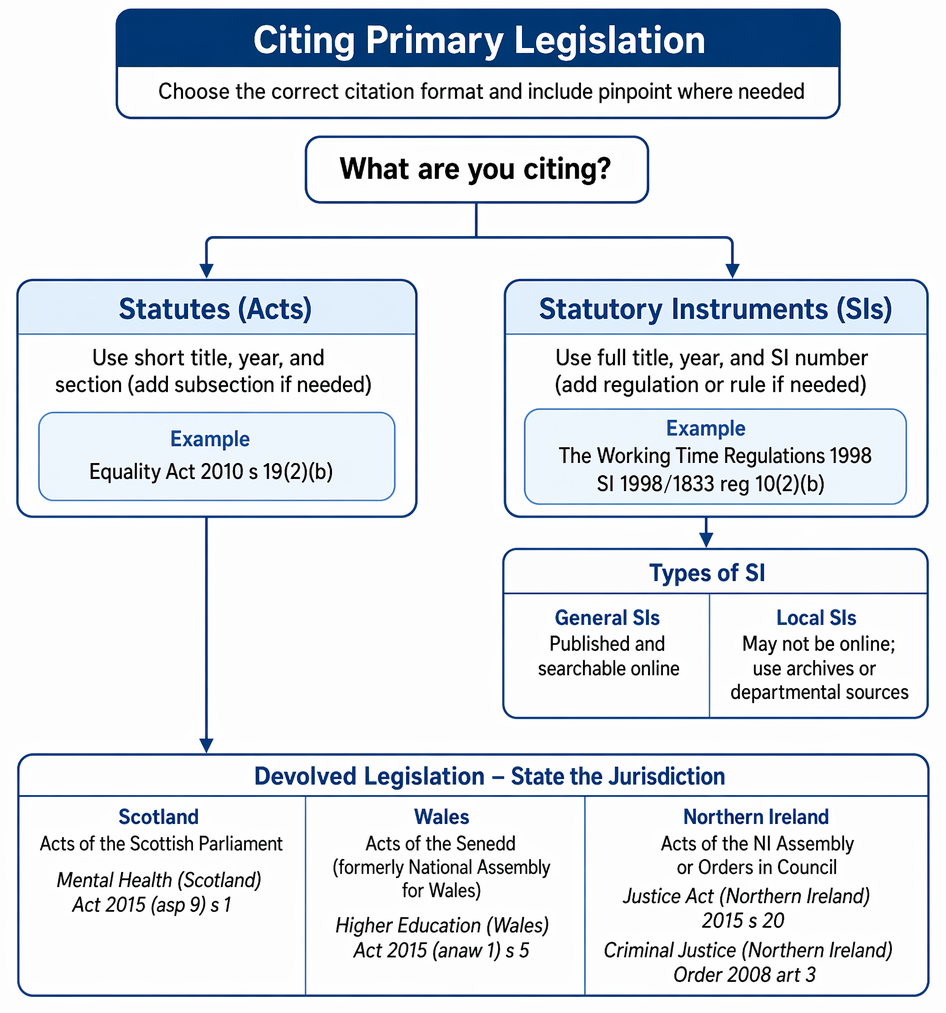
Always use the statute's short title and year, e.g., “Equality Act 2010 s 19,” and, if necessary, subsection (“s 19(2)(b)”). Where older Acts are concerned, regnal year formats exist but are rarely needed for citation in practice; ensure you trace older material correctly using tables or consolidated sources.
For statutory instruments, give full title, year, and SI number (e.g., “The Working Time Regulations 1998 SI 1998/1833”). For pinpoint, include the paragraph or subparagraph, e.g., “reg 10(2)(b).” Distinguish general SIs (published and searchable online) from local SIs, which may not appear on legislation.gov.uk and sometimes require retrieval from the National Archives or official departmental sources.
Key Term: statutory instrument citation
This refers to the formal reference to a statutory instrument by title, year, and SI number, and, if necessary, by regulation or rule number.
Citations for devolved legislation:
- Scotland: Acts of the Scottish Parliament, e.g., “Mental Health (Scotland) Act 2015 (asp 9) s 1”
- Wales: Acts of the Senedd (formerly National Assembly for Wales), e.g., “Higher Education (Wales) Act 2015 (anaw 1) s 5”
- Northern Ireland: Acts of the NI Assembly or Orders in Council, e.g., “Justice Act (Northern Ireland) 2015 s 20,” “Criminal Justice (Northern Ireland) Order 2008 art 3”
State the relevant jurisdiction where context requires.
Citing Cases
Where a case is reported in the Law Reports (AC, QB, Ch, Fam), cite that version. If not, cite the Weekly Law Reports (WLR) or the All England Law Reports (All ER). Always provide the parties, year, abbreviation, volume (where applicable), and starting page. Include the court if not obvious ("(CA)", "(SC)"). Use neutral citation if available ("[2021] EWCA Civ 10"), together with paragraph pinpoints ("at [34]").
Key Term: neutral citation
A neutral citation is the court-assigned reference for a case, independent of report series, e.g., "[2011] EWCA Civ 123".
For EU decisions, use the case number (prefix “C-” for Court of Justice, “T-” for General Court), parties, and then ECLI and/or ECR/CMLR where relevant. Modern practice accepts ECLI as a neutral form for EU decisions.
Key Term: European Case-Law Identifier (ECLI)
ECLI is a standardised, neutral identifier for EU and national court decisions, e.g., “EU:C:2005:446” with paragraph pinpoints as “para 22”.
If quoting or referring to only part of a judgment, give the pinpoint paragraph(s) or page(s): "at [42]" or "at p 100". For ECHR cases, HUDOC references include paragraph numbering; UK reports such as EHRR may use case numbering rather than pages, so follow the series conventions for pinpoints.
Worked Example 1.5
You need to cite an EU decision with a precise paragraph. How should you cite Case C-403/03 Schempp?
Answer:
“Case C-403/03 Schempp v Finanzamt München EU:C:2005:446, para 22.” If adding the report citation, include “[2005] E.C.R. I-6421” or a UK report such as CMLR if relevant to your audience.
Recording Pinpoint Citations in Practice
You must record full pinpoint references for each authority at the research stage, even if you are only summarising in a memo or email. This avoids ambiguity and ensures that if a proposition is challenged, you can immediately justify your advice.
For litigation documents:
- in skeleton arguments, include neutral citation and preferred report, each with pinpoints
- in bundles, provide an authorities index with complete citations and page/paragraph references; for EU/ECHR decisions, include ECLI/HUDOC identifiers and pinpoints
For advisory memos:
- embed the citation with neutral citation and paragraph pinpoints on first mention; later references can be shortened, provided the exact paragraph remains clear
- where a statutory provision is discussed across multiple parts, use parenthetical pinpoints (e.g., “s 3(1), (2)(b)”) and state the date/version consulted
Hansard and specialist materials:
- cite Hansard only when admissible; serve extracts in advance as required by practice directions and explain the statutory ambiguity and the relevance of the ministerial statement
- for tribunal decisions, use designated neutral citation formats (e.g., “[2023] UKUT 10 (AAC)”) and paragraph pinpoints, as set by the Upper Tribunal and First-tier Tribunal practice statements
Worked Example 1.6
You intend to rely on a minister’s statement in Hansard to clarify the meaning of an ambiguous statutory term. What must your record and citation include?
Answer:
Identify the statutory ambiguity and explain why Pepper v Hart criteria are met. Cite the Hansard extract with date, volume and column, and serve copies on the other parties and the court in advance per the relevant practice direction. Record in your research note the exact extract relied upon, its location, and the date and version accessed.
Worked Example 1.7
You are citing the Working Time Regulations 1998 on rest breaks and need a pinpoint. What should your citation look like?
Answer:
“Working Time Regulations 1998 SI 1998/1833 reg 12(1)–(3).” If quoting, add the precise subparagraphs (e.g., “reg 12(1)(a)”).
Worked Example 1.8
You have a Scottish Outer House judgment with a neutral citation. How do you cite and pinpoint?
Answer:
“W v Advocate General for Scotland [2015] CSOH 111 at [27].” If using a report, add the Scots Law Times citation, e.g., “2015 S.L.T. 537.”Revision Tip: Whenever you copy a legal proposition supported by an authority, always record the specific section, rule, paragraph, or page, as well as the source and date accessed. This habit is essential for all SQE2 research and writing tasks.
Key Point Checklist
This article has covered the following key knowledge points:
- Authority validation requires ensuring that sources are official, reliable, and current.
- Prefer the Official Law Reports where available; otherwise, use WLR, then All ER or specialist series. Always include neutral citations and pinpoints.
- Verify case status using citators; verify legislation in force using consolidated sources (Westlaw Legislation Analysis, Halsbury’s Statutes, legislation.gov.uk point-in-time) and note commencement and amendments.
- All sources relied upon in research, advice, or submissions must be recorded with complete, standardised citations at the time they are used, including access dates and pinpoints.
- Complete citations for statutes include short title, year, and section(s). For statutory instruments, include official title, year, SI number, and reg/rule pinpoint.
- EU and ECHR citations may use ECLI/HUDOC identifiers; ensure paragraph pinpoints and report references follow the relevant series conventions.
- Pinpoint citations are required for every legal proposition quoted or relied upon, in both written and oral advice; compliance with practice directions (e.g., Hansard extracts) is essential.
- Accurate and systematic research records are a professional, ethical, and assessment requirement for SQE2.
Key Terms and Concepts
- authority validation
- official report
- research record
- pinpoint citation
- complete citation
- statutory citation
- statutory instrument citation
- neutral citation
- citator
- European Case-Law Identifier (ECLI)