Learning Outcomes
This article explains the key rules and practical steps governing disclosure and inspection of documents in civil litigation, including:
- The scope of standard disclosure under the Civil Procedure Rules (CPR), what documents must be disclosed, and the duty to conduct reasonable and proportionate searches.
- The meaning of a “document” and “control”, including electronic documents, metadata, and documents held by group companies, agents, or third parties.
- How to prepare and verify a compliant disclosure list (Form N265), structure Parts 1–3 correctly, and draft an accurate statement of truth.
- The types and operation of privilege (legal advice, litigation, and without prejudice), when inspection can be withheld, and how to use redactions lawfully.
- The mechanics and timelines of inspection, how opponents request copies, when inspection may be refused, and the consequences of non‑compliance.
- How to challenge inadequate disclosure or disputed claims to privilege, and make or respond to applications for specific, pre‑action, and non‑party disclosure.
- Practical strategies for planning and managing electronic disclosure, multi‑track disclosure reports, and proportionate disclosure directions in SQE2‑style scenarios.
SQE2 Syllabus
For SQE2, you are required to understand the main principles and practical steps concerning disclosure and inspection within civil proceedings. These underpin many litigation scenarios and procedural tasks, with a focus on the following syllabus points:
- The scope and requirements of standard disclosure under the Civil Procedure Rules (CPR).
- The definition of a “document” and the duty to search for relevant documents.
- Rules for inspection—when, how, and by whom documents can be inspected.
- The concept and types of privilege (legal advice, litigation, without prejudice).
- The process for challenging inadequate disclosure or claims to privilege.
- Applications for specific disclosure or inspection of documents.
Test Your Knowledge
Attempt these questions before reading this article. If you find some difficult or cannot remember the answers, look more closely at that area during your revision.
- What is the test for whether a document must be disclosed as part of standard disclosure in civil proceedings?
- Name two key types of privilege that may be claimed over documents in the disclosure process.
- Can a party inspect all documents listed on an opponent’s disclosure list? If not, what are the main exceptions?
- What procedural step is available if a party believes the other side’s disclosure is inadequate or privilege is wrongly claimed?
Introduction
Disclosure and inspection expose the key evidence and documents that parties must exchange before a civil trial. Correct application of the rules is fundamental for progressing litigation, ensuring fairness, and assisting effective client advice. The Civil Procedure Rules (CPR), especially Part 31, set out clear obligations for parties, failure of which can result in sanctions and adverse inferences.
A “cards on the table” approach is embedded in case management and the overriding objective. On the small claims track, parties typically serve copies of documents they intend to rely on shortly before the hearing. In fast track and most multi‑track cases, disclosure is dealt with by orders, directions, and (for multi‑track) a disclosure report. Failure to comply can lead to orders restricting reliance on undisclosed documents, costs penalties, and, in serious cases, contempt consequences where a false disclosure statement is signed.
Key Term: disclosure
The process of informing other parties about the existence of relevant documents within a party’s control in civil proceedings. Key Term: control (documents)
A party has “control” if they possess, have the right to possess, or have the right to inspect or take copies of a document.
What is “inspection”?
Inspection is the next step: unless an exception applies, the parties may inspect disclosed documents to review their content.
Key Term: inspection
The right of a party to view and take copies of disclosed documents unless inspection is properly withheld.
The scope of standard disclosure
Under CPR 31.6, standard disclosure requires a party to disclose only:
- Documents on which it relies;
- Documents which adversely affect its own case, adversely affect another party’s case, or support another party’s case;
- Documents it is required to disclose by a relevant practice direction.
This test focuses on whether a document has a bearing on issues in dispute—not whether it is helpful. Documents merely relating to agreed or immaterial matters need not be disclosed. Courts will tailor disclosure to the needs of the case and may dispense with disclosure or order disclosure on an issue-by-issue basis where proportionate.
Reasonable searches for documents
A party must conduct a reasonable and proportionate search for documents that meet the disclosure test. Factors include the number of documents, the nature and complexity of the proceedings, the ease and cost of retrieval, and the significance of the documents likely to be found. Where a party decides not to search a class or category (for example, documents before a particular date, or certain backup archives) because to do so would be disproportionate, this must be explained in the disclosure statement, identifying the categories not searched and the reasons.
Practice directions emphasise practical planning for searches. Defining custodians (who holds the data), locations (shared drives, email servers, physical files), date ranges, and search terms upfront reduces cost. For electronic material, agreeing keyword sets, deduplication methods, and file formats before searching helps avoid later disputes. Sampling and staged disclosure can be approved to keep costs proportionate.
The duty to disclose: practical points
- The duty covers documents within a party’s control, not just those in their possession. Control includes a right to obtain copies from third parties (such as group companies or agents).
- “Document” means anything on which information is recorded—this includes emails, digital files, drafts, photographs, metadata, USB keys, audio/video, and database entries. If the content of a copy differs (e.g., annotations, track changes), both original and copy can be separate documents.
- The duty is ongoing: if new documents are found after initial disclosure but before trial, a supplemental list must be served. This continuing duty underpins fairness; failure to promptly disclose could prevent reliance on the document at trial.
- Documents referred to in statements of case or witness statements may be subject to inspection requests under the rules governing documents mentioned in those pleadings; parties should be ready to supply copies or explain why inspection is resisted (for instance, privilege).
Disclosure list and statement
Disclosure is usually given by exchanging a disclosure list (Form N265), identifying disclosed documents. The list is divided into three parts:
- Part 1: documents within control for which inspection is not objected to;
- Part 2: documents within control for which inspection is objected to (e.g., privileged documents), with brief reasons;
- Part 3: documents which were within control but are no longer, with an explanation of what has happened to them and where they are now.
The party making the disclosure must verify it with a statement of truth, certifying that they have complied with the duty to search and disclose. The statement should confirm all reasonable and proportionate searches, and must also identify any categories not searched and why. Signing a false statement without an honest belief is punishable as contempt.
Inspection of documents
The opponent may request to inspect any document disclosed, unless:
- The document is no longer within the control of the party disclosing it;
- The party has the right or duty to withhold inspection (most often due to privilege);
- The court orders otherwise (e.g., where inspection would be disproportionate).
If inspection is requested, copies of documents must be supplied within seven days of the request, subject to reasonable copying costs. Inspection can be at the solicitor’s office or by providing copies. For large volumes of electronic material, secure file transfer or data rooms can be used. Redactions are permitted to remove irrelevant sensitive material (e.g., personal data not relevant to issues) provided the basis is explained; the remainder of the document must be available for inspection.
Exam Warning: Do not confuse disclosure (stating that relevant documents exist or existed) with inspection (showing the document’s contents). A party may need to disclose a document but can lawfully refuse inspection if a valid privilege or other exception applies. Conversely, failing to disclose a document while intending to rely on it can prevent reliance at trial and attract sanctions.
Privilege: when can a party withhold inspection?
Privilege is an exception to the right of inspection and is essential for protecting confidential legal communications and settlement negotiations.
Key Term: privilege
The right to withhold inspection of a document on grounds of confidentiality recognised by law. Key Term: legal advice privilege
Confidential communications between a client and their solicitor or barrister for the purpose of giving or obtaining legal advice. Key Term: litigation privilege
Confidential communications between a client (or their lawyer) and third parties made for the dominant purpose of conducting existing or reasonably contemplated litigation. Key Term: without prejudice privilege
Communications genuinely made in a settlement context, which cannot be shown to the court about the substance of settlement offers.
Legal advice privilege protects communications within the lawyer–client continuum for the purpose of advice; it does not extend to communications with third parties (such as accountants) unless litigation privilege applies. Litigation privilege requires: (1) litigation reasonably contemplated or on foot; and (2) the dominant purpose of the communication being advice or evidence for that litigation. Both forms of privilege attach to the communication itself, not general facts; facts can be proved by other means.
Without prejudice privilege protects genuine settlement communications. The label “without prejudice” is helpful but not decisive—the substance must be negotiation. “Without prejudice save as to costs” communications remain privileged for liability/quantum but can be shown to the court on costs issues after judgment.
If a document is privileged, it must still be listed, but may be described in general terms (e.g., “correspondence with solicitors—privileged”), and the reason must be given for refusing inspection. Redactions for privileged passages are allowed, with the non‑privileged parts available for inspection.
Claiming privilege: key considerations
- Privilege attaches to the document, not the information. The same factual information may be discoverable elsewhere.
- Privilege can be lost by waiver (e.g., supplying the document to the opponent). Referencing the content in a statement of case or witness statement can trigger inspection rights and may amount to waiver in context.
- Inadvertent disclosure of privileged material should be addressed immediately; the recipient should notify the sender and refrain from reading further. The court can restrict use where an obvious mistake has occurred and fairness demands.
- “Once privileged, always privileged” is a useful shorthand: privilege, once established for a communication, generally remains unless waived. However, conduct and content references can give rise to partial waiver.
- Corporate clients should define who counts as the “client” for communications; not all employees will be treated as the client for legal advice privilege, so structure advice channels carefully.
If there is a dispute over a claim to privilege, the court may inspect the document to determine whether the claim is valid. Judges will look at purpose, timing, and participants to decide whether legal advice or litigation privilege applies.
Without prejudice material and disclosure
Parties should disclose the existence of genuine settlement communications as documents that exist, but inspection of substance is withheld under without prejudice privilege. In multi‑party cases, privilege may be more complex; parties should consider how privilege applies to different relationships and seek directions where needed.
Challenging inadequate disclosure or privilege
If a party believes disclosure is incomplete, or privilege is inappropriately claimed, the following steps are available:
- Write to the other side, identifying the missing documents or disputing the privilege claim, and suggest practical next steps (such as additional custodians, date ranges, or search terms).
- If still unsatisfied, apply to the court under CPR 31.12 for an order for specific disclosure or inspection.
Key Term: specific disclosure
A court order requiring a party to carry out a further search, or to disclose or permit inspection of specific documents or classes of documents.
The application should explain why documents are likely to exist (e.g., references in other material, gaps in email chains), the reasonable searches proposed or omitted, and any prejudice caused. Evidence, typically via a witness statement, should address proportionality. The court can also make “unless” orders, requiring compliance by a deadline failing which consequences follow (such as being debarred from relying on documents).
Disclosure and inspection: practical sequence
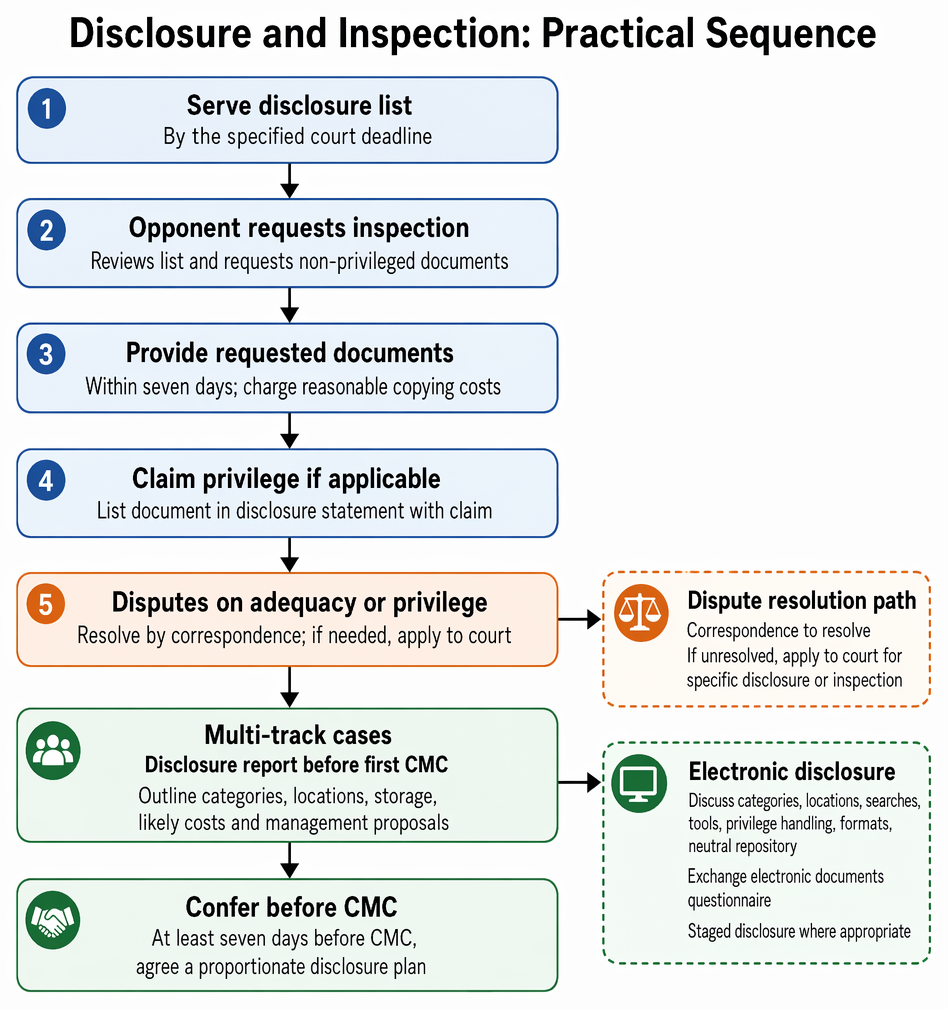
Requests to inspect disclosed documents lead either to refusal or limitation on stated grounds, or to copies supplied within seven days.
- Serve disclosure list by the specified court deadline.
- Opponent reviews and requests inspection of non-privileged documents.
- Provide requested documents within seven days, charging reasonable copying costs.
- If any document is claimed to be privileged, list it in the disclosure statement with the claim of privilege.
- If disputes arise as to adequacy or privilege, seek to resolve by correspondence, and if necessary, apply to the court for specific disclosure or inspection.
In multi‑track cases, a disclosure report verified by a statement of truth is often required before the first case management conference (CMC), outlining categories of documents, locations, storage, likely costs, and proposals for how disclosure should be managed. Parties should confer at least seven days before the CMC to agree a proportionate disclosure plan.
Electronic disclosure (e‑disclosure)
Electronic documents must be preserved and managed efficiently. Proportionality guides the process. Parties should discuss:
- Categories of electronic documents and where they are held (servers, cloud, devices).
- Scope of reasonable searches (date ranges, custodians, sources).
- Tools and techniques (keyword searches, deduplication, sampling, early case assessment).
- Methods for identifying and separating privileged material and handling inadvertent disclosure.
- Formats for exchange and inspection (PDF/native, load files) and whether to use a neutral repository.
An electronic documents questionnaire can be exchanged to crystallise the approach. Where appropriate, disclosure can be staged (e.g., initial key documents, then extended categories if needed).
Exam Warning: In heavy Business and Property Court cases, disclosure is governed by a specialist practice direction with “models” of extended disclosure (from disclosing only known adverse documents to wider train‑of‑enquiry searches in exceptional cases). Outside those courts, CPR Part 31 and PD31A/31B continue to apply. Identify the court and regime before advising on the scope of disclosure.
Worked Example 1.1
You act for the claimant in a business dispute. Your client’s opponent serves its disclosure list, describing “legal advice from external solicitors—privileged” and refuses inspection. Your client believes the advice relates not to legal advice but routine commercial discussions. What should you do?
Answer:
Raise a prompt written challenge to the claim to privilege, giving reasons. If the issue cannot be resolved, apply for disclosure of that advice or for the court to decide if privilege is valid. The court may review the document to determine if it genuinely attracts legal advice privilege.
Worked Example 1.2
Your client in a negligence claim receives the defendant’s disclosure list. Several emails between the defendant and its insurers are listed as privileged. You need to know whether these are properly withheld under litigation privilege. What questions must you consider?
Answer:
Check if there was litigation in progress or reasonably contemplated when the emails were written, and whether the dominant purpose of the emails was obtaining advice or evidence for that litigation. If not, privilege may not apply and inspection could be required.
Worked Example 1.3
You represent a defendant in a multi‑track case with large volumes of emails and shared drive material. The claimant asks for “all emails for five years” and any shared drive files “relating to the project”. Costs will be very high. How do you respond?
Answer:
Propose a reasonable and proportionate e‑disclosure plan: agree custodians, date ranges aligned to issues, targeted keywords, deduplication, and sampling. Offer staged disclosure—start with key custodians and refined searches, then widen if needed. Record categories not searched with reasons in the disclosure statement.
Worked Example 1.4
A potential claimant asks you to seek records from a prospective defendant before proceedings. The defendant refuses voluntary disclosure. What route is available and what must be shown?
Answer:
Apply for pre‑action disclosure. You must show the respondent is likely to be a party to future proceedings; your client is likely to be a party; the documents sought would fall within standard disclosure if proceedings had started; and that early disclosure would fairly dispose of the case, assist resolution without proceedings, or save costs.
Worked Example 1.5
In existing proceedings, you believe a non‑party (a consultant) holds key reports supporting your case. The defendant says it no longer has them. How do you proceed?
Answer:
Apply for non‑party disclosure. Show that the documents are likely to support your case or adversely affect another party’s case, and that disclosure is necessary for fair disposal of the claim or to save costs. Identify the specific documents or classes and why the non‑party has them.
Worked Example 1.6
Your opponent inadvertently emails a privileged letter of advice. A junior fee‑earner begins to read it before realising it is privileged. What should you do?
Answer:
Stop reading, notify the sender immediately, and confirm the document will not be used without the court’s permission. The court can restrict use where there is an obvious mistake and fairness requires it. Do not reveal the contents to your client.Exam Warning: Be careful to distinguish between the duty to disclose (which extends to all relevant documents within control) and the right to withhold inspection (which applies only to privileged documents or as otherwise permitted by the court). Do not withhold disclosable documents just because they are not helpful to your client's case. Inadequate disclosure can lead to orders preventing reliance on undisclosed material and costs sanctions. The disclosure statement is a serious document; ensure searches and limitations are accurately recorded.
Multi‑track disclosure management
In multi‑track cases (other than many personal injury claims), parties must file a disclosure report at least 14 days before the first CMC and discuss proposals at least seven days before. The report should:
- Describe categories of potentially relevant documents and where they are;
- Explain electronic storage (e.g., servers, cloud systems, mobile devices);
- Estimate disclosure costs and identify opportunities to reduce them;
- Propose directions (dispensing, issue‑based disclosure, standard disclosure, staged disclosure).
The court may then order standard disclosure or select a different form to meet the overriding objective. Directions can specify searches to be undertaken (by whom, where, and for what periods), whether lists are required, formats for exchange, and whether disclosure should be staged.
Practical mechanics: requests and timelines
- Lists are usually exchanged within 28 days of directions, with inspection or provision of copies within seven days of request.
- Requests to inspect should be precise (identify documents or categories). Parties may resist inspection on proportionality grounds for broad categories and should record that stance in the disclosure statement.
- Where a document is referred to in a statement of case, an opponent can request a copy under the rules relating to inspection of documents mentioned in statements of case; respond promptly or justify refusal (e.g., privilege).
- For redactions, keep a record explaining the basis (irrelevance, privilege, confidentiality). If challenged, the court can review or order a confidentiality ring.
Sanctions and reliance on undisclosed documents
A party who fails to disclose a document they intend to rely on may be barred from relying on it without the court’s permission. If a party wishes to rely on a later‑found document, the continuing duty allows supplemental lists; permission to rely on late material will turn on fairness, explanation, and impact on trial dates. False disclosure statements or deliberate withholding can lead to serious sanctions.
Pre‑action and non‑party disclosure
Pre‑action disclosure orders help narrow disputes before proceedings. They are available where the test is met and are used to facilitate settlement or save costs. Once proceedings are underway, non‑party disclosure orders can be sought where third parties (such as auditors, consultants, agents) hold relevant documents, and disclosure is necessary for the fair disposal of the claim or to save costs. Orders must be specific, identifying documents or classes clearly to avoid fishing expeditions.
Track‑based overview
- Small claims: Typically, parties file and serve copies of documents to be relied on at least 14 days before the hearing.
- Fast track: Standard disclosure is common, with lists exchanged, inspection requested, and copies provided.
- Multi‑track: Tailored directions, disclosure report and discussion, and where appropriate staged or issue‑based disclosure. In Business and Property Courts, a specialist practice direction provides extended disclosure “models”; know which regime applies.
Exam Warning: In Business and Property Courts, extended disclosure may require parties to disclose known adverse documents at a minimum and select models that range up to issue‑specific reasonable searches. The court actively manages proportionality; model selection should be reasoned against case issues and cost.
Key Point Checklist
This article has covered the following key knowledge points:
- Disclosure requires stating the existence of relevant documents within a party’s control, not just documents they intend to rely on.
- Only documents meeting the CPR’s standard disclosure test must be disclosed.
- Inspection may be withheld if privilege applies or if inspection would be disproportionate.
- The duty to search for documents is to be reasonable and proportionate, and is ongoing until the case is finished.
- Privilege protects legal advice, litigation documents, and settlement negotiations from inspection, but not from being disclosed as existing.
- If inadequate disclosure or improper privilege is suspected, correspondence should be attempted first, then an application for specific disclosure or inspection under CPR 31.12 may be made.
- Electronic disclosure must be managed efficiently; agree custodians, date ranges, search terms, and formats to keep costs proportionate.
- Multi‑track cases require a disclosure report and discussion before the CMC; the court may order standard, issue‑based, or staged disclosure, or dispense with disclosure.
- Redactions are permitted for irrelevance or privilege; reasons should be recorded and explained if challenged.
- Inadvertent disclosure of privileged material should be addressed immediately; courts can restrict use where fairness requires.
Key Terms and Concepts
- disclosure
- control (documents)
- inspection
- privilege
- legal advice privilege
- litigation privilege
- without prejudice privilege
- specific disclosure