Learning Outcomes
This article explains where to start civil proceedings in England and Wales, including:
- Assessing claim value, complexity, and public importance to choose between the County Court and High Court
- Distinguishing the roles and jurisdictions of the High Court divisions and key specialist courts
- Applying the criteria for track allocation to the small claims track, fast track, and multi-track
- Evaluating jurisdiction and venue where parties, events, or legal issues fall outside England and Wales
- Identifying proper parties, correctly stating the value of the claim, and selecting appropriate remedies and interim measures
- Complying with pre-action protocols and considering ADR before issuing proceedings
- Drafting, issuing, and serving the claim form and particulars of claim in accordance with procedural rules
- Using these principles to advise clients and analyse practical scenarios involving contract and tort claims
SQE2 Syllabus
For SQE2, you are required to understand the court system, the allocation of business between courts, and the rules governing where and how proceedings may be brought, with a focus on the following syllabus points:
- Identifying the correct forum for dispute resolution, and differentiating between County Court, High Court, and specialist courts, including their respective jurisdictional limits and functions
- Recognising the three High Court divisions and their areas of specialist jurisdiction (King’s Bench, Chancery, Family), and understanding the remit of the principal specialist courts such as the Commercial, Technology and Construction, and Intellectual Property Courts
- Applying the applicable thresholds for value, type, and complexity of claims, particularly in contract and tort disputes, as well as understanding the significance of public importance and technical issues
- Explaining track allocation procedure, and the criteria by which claims are assigned to the small claims, fast track, or multi-track
- Recognising the importance of pre-action protocols, including the requirement to consider and use alternative dispute resolution (ADR) where appropriate, and the consequences of non-compliance
- Understanding the rules on parties, causes of action, and capacity—including how to identify the proper parties for civil claims (including sole traders, partnerships, companies, and minors or protected parties)
- Knowing the procedural requirements for the claim form and particulars of claim, how and where to serve proceedings, and the rules on extensions and service outside the jurisdiction
- Appreciating the connection between choice of court and enforcement routes, including costs and interest
Test Your Knowledge
Attempt these questions before reading this article. If you find some difficult or cannot remember the answers, look more closely at that area during your revision.
-
A claimant wishes to bring a claim for £18,000 for breach of contract. Which court will be the appropriate starting point for proceedings?
- a) County Court
- b) High Court
- c) Supreme Court
- d) Magistrates’ Court
-
In what circumstances can a claim for damages for personal injuries be issued in the High Court?
-
What main factors are used to decide to which track a claim will be allocated?
Introduction
When a civil claim—such as for breach of contract or tortious loss—cannot be resolved through negotiation or alternative dispute resolution, the proper commencement of proceedings becomes essential. The decision as to where and how to issue proceedings directly affects procedure, potential remedies, costs, speed of resolution, and the enforceability of outcomes. The correct approach is structured around both statutory rules and a series of practical considerations, including the value and complexity of the dispute, the need for judicial intervention, and the suitability of the case for one of several possible forums.
The civil court structure in England and Wales is rooted in two main tiers: the County Court and the High Court.
Key Term: County Court
The County Court is England and Wales’s primary civil trial court with national jurisdiction for most claims up to £100,000 (excluding most personal injury claims with a lower threshold), including monetary claims in contract, tort, and a wide range of statutory actions. Key Term: High Court
The High Court is the superior civil court, serving as a court of first instance for higher-value, more complex, or high-profile civil claims. It is structured into three divisions: King’s Bench (contract, tort, some appeals), Chancery (property, business, equity), and Family.
Most general contract and tort claims are commenced in the County Court. Escalation to the High Court arises primarily where specific jurisdictional, value, or complexity criteria are satisfied, or where there are significant issues of public importance or technical specialism.
Test Tip: In SQE-style questions on Where to start proceedings, identify the legal test, the triggering fact, and the consequence before choosing between similar answer options.
Criteria for Deciding Where to Issue Proceedings
The initial threshold question is the identify the correct court according to:
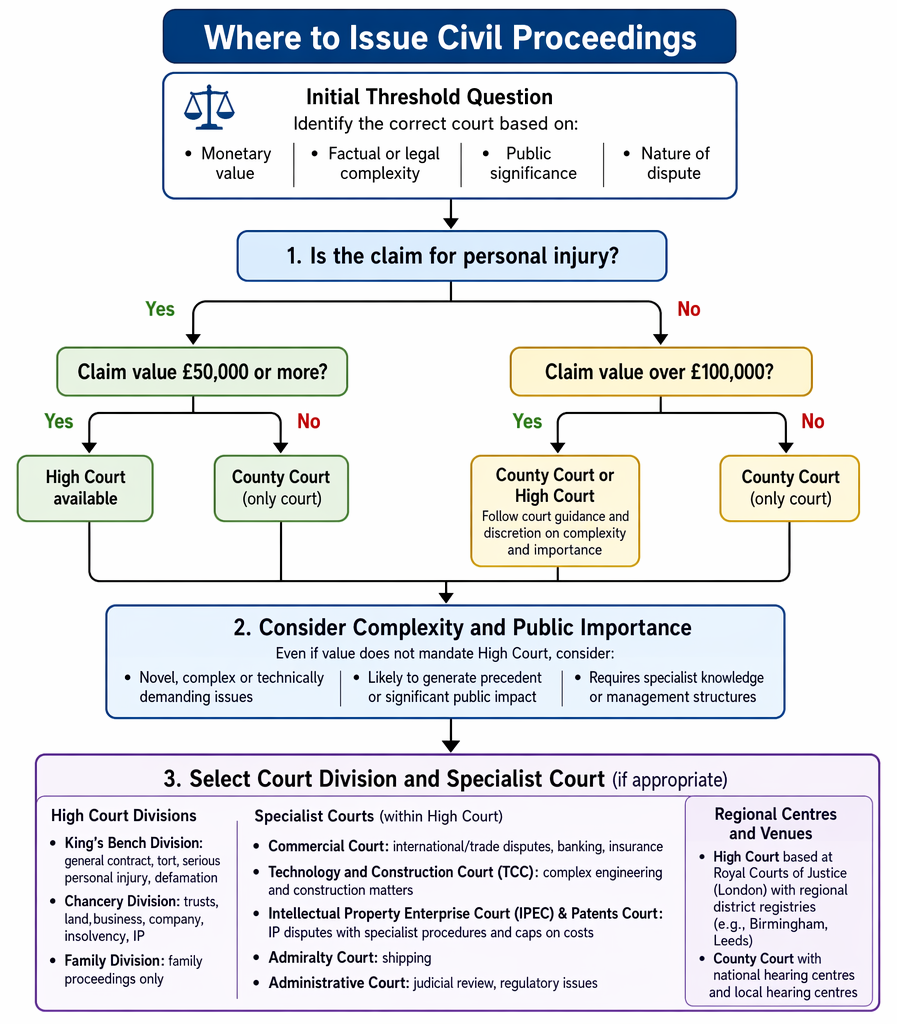
Claim value thresholds for personal injury and other claims determine provisional track allocation, subject to final adjustment for complexity.
- The monetary value of the claim
- The factual or legal complexity involved
- Any element of public significance
- The nature of the dispute (e.g., personal injury, business, property, trusts)
Value Thresholds
- Claims valued at £100,000 or less (excluding interest, costs, and amounts not genuinely in issue) must be started in the County Court, unless they are personal injury claims.
- Personal injury claims must be commenced in the County Court unless the value is £50,000 or more, in which case the High Court becomes available.
- For non-personal injury claims over £100,000, either the County Court or High Court may be used, but the court’s own guidance and discretion regarding complexity and importance must be followed.
When valuing a claim, disregard interest, potential costs, any claim for contributory negligence, and sums conceded or plainly unmeritorious.
Complexity and Public Importance
Even where value alone does not mandate High Court issue, claims may be appropriately brought there if they:
- Raise novel, complex, or technically demanding legal or factual issues
- Are likely to generate precedent or have a significant public impact
- Require the specialist knowledge or management structures of a higher court
For example, multi-party professional negligence claims involving complex technical questions, or business disputes with international elements, might properly be issued in the High Court even if the value is only slightly above the threshold.
Court Divisions and Specialist Courts
The High Court comprises three divisions, each with specialist jurisdiction, together with a network of dedicated courts for discrete areas:
- King’s Bench Division: General contract and tort, serious personal injury, defamation
- Chancery Division: Trusts, land, business, company, insolvency, IP
- Family Division: Family proceedings only; not relevant to most civil commercial claims
Within these divisions, a number of specialist courts provide specialist subject-matter knowledge, such as:
- Commercial Court (international/trade disputes, banking, insurance)
- Technology and Construction Court (TCC) (complex engineering and construction matters)
- Intellectual Property Enterprise Court (IPEC) and Patents Court (intellectual property disputes with specialist procedures and caps on costs)
- Admiralty Court and Administrative Court (shipping, judicial review, regulatory issues)
Key Term: Specialist Court
Courts within the High Court exercising exclusive or specialist jurisdiction over certain claim types, such as those relating to construction, commerce, or intellectual property.
Choosing a Specialist Court
Cases falling within the stated remit of a specialist court should normally be commenced there. For example, a dispute about alleged design defects in major construction projects should usually be issued in the TCC.
Regional Centres and Venues
- The High Court is physically based at the Royal Courts of Justice in London but maintains regional district registries (e.g., Birmingham, Leeds), delivering similar services.
- The County Court has multiple national hearing centres, including specialised Money Claims Centres for the administrative processing of most money claims, and local Hearing Centres where trials are held.
Track Allocation
Track allocation is essential to efficient case management and cost proportionality. Civil cases are assigned to one of three tracks depending primarily on their value and complexity, each with its own procedural framework:
- Small Claims Track: Generally, for claims up to £10,000 (or £1,000 for most personal injury claims). Emphasises informality, minimal cost exposure, and self-representation.
- Fast Track: For straightforward claims over £10,000 up to and including £25,000, typically with trials lasting no more than a day and limited to a single expert per party in one field.
- Multi-Track: For claims over £25,000 or, regardless of value, any claims involving substantial complexity, multiple parties, difficult points of law or expert evidence, or of considerable public importance.
Key Term: Track Allocation
The procedural process by which the court, following the filing of a defence and consideration of the parties’ directions questionnaires, assigns a claim to a track best suited to its complexity and value.
Criteria for Track Allocation
The court is required to consider (in addition to claim value):
- Nature of the remedy sought
- Complexities of fact, law, or required expert evidence
- Number and configuration of parties (including additional claims, counterclaims, or multiparty actions)
- Counterclaims and the complexity/value of those claims
- Amount and type of oral evidence needed
- Significance of the dispute to third parties or public interest
- Views expressed by the parties on management and preparation
- Whether the dispute should be heard by a court with a particular region or technical competence
Where the claim is for money only, and there are cross-claims (counterclaims) or Part 20 claims, the court considers the highest-value claim for allocation purposes, rather than aggregating all claims.
Worked Example 1.1
A claimant suffers a workplace injury valued at £45,000. Should the claim be commenced in the County Court or the High Court?
Answer:
The claim must be started in the County Court, as personal injury claims—unless they exceed £50,000—should not be initiated in the High Court.
Worked Example 1.2
A dispute over a £140,000 business contract involves complex factual issues about international supply chains. Should this be issued in the County Court or High Court?
Answer:
The claim may be issued in the High Court, given the value is over £100,000 and substantial complexity is involved. The discretion to use the High Court arises even though the County Court would also have jurisdiction.
Track-Specific Overview
Small Claims Track
Reserved for claims with a value (excluding interest, costs, or non-monetary remedies) up to £10,000, but for personal injury claims this is usually limited to £1,000 unless otherwise specified. The small claims procedure is intentionally simplified and conducive to self-representation, with the general rule being that legal costs are unrecoverable except for specific allowances (e.g., court fees, witness expenses).
Fast Track
Suited for claims exceeding £10,000 but not more than £25,000, provided the issues are relatively straightforward, the trial will not last more than one day, and a single joint expert is anticipated if expert evidence is needed. There are set timetables for disclosure, witness statement exchange, and trial.
Multi-Track
Allocated where the claim exceeds £25,000 or regardless of value if specialist case management is required—for example, where multiple parties, complex expert evidence, or significant legal or factual questions arise. The multi-track is highly flexible, with bespoke case management directions including case summaries, costs budgets, disclosure reports, and pre-trial reviews.
In multi-track claims, especially those under £100,000, the general rule is that the case may be transferred for trial to the County Court rather than being retained at the High Court unless specific factors dictate otherwise (such as extreme complexity, scale, or public significance).
Exam Warning: Always address both value and complexity when advising on the choice of court and track. Many claims straddle value thresholds; do not ignore factors such as novelty, number of parties, need for specialist judicial management, or technical subject matter.
Worked Example 1.3
A consumer claims in tort for damage to chattels worth £900, caused by a defective product. Which track is likely to be appropriate?
Answer:
The claim would be allocated to the small claims track as it is below the £10,000 limit and for personal injury below £1,000, unless the court deems there are heightened complexities.
Specialist Claims, Foreign Elements, and Jurisdiction
Some civil actions—intellectual property, commercial contracts, admiralty, family or trust disputes—have exclusive regimes or specialist procedural tracks. Similarly, where the claim or one of the parties or events is based abroad, jurisdiction is determined by rules on service, governing law, and forum conveniens, including practice updates following Brexit. If the defendant is domiciled or resident outside England and Wales, consider the rules on service and, where applicable, seek the court’s permission for service outside the jurisdiction. For foreign law cases, the parties may have to prove the content and effect of that law.
Pre-Action Protocols and ADR
Modern civil litigation is underpinned by the principle that parties should take reasonable steps to resolve disputes before commencing litigation. Pre-action protocols (PAPs)—some general, some tailored to specific types of claims (including personal injury, clinical negligence, construction, housing disrepair, and professional negligence)—prescribe structured exchanges of information, evidence, and proposals for settlement. They require:
- Early communication of claim and defence
- Disclosure of key documents and evidence supporting or negating liability
- Consideration of alternatives to litigation such as mediation, negotiation, or arbitration
- Allowing sufficient time for responsive investigation and, where possible, early or amicable settlement
Failure to comply with pre-action protocols, or the Practice Direction on Pre-Action Conduct, can lead to cost sanctions, interest adjustments, or stays of proceedings. The protocols are mandatory in all relevant claims and apply even if parties issue proceedings due to expiring limitation periods.
Key Term: Pre-Action Protocol
A prescribed or court-approved code of conduct for parties, specifying steps and information to be exchanged before formal litigation is commenced. Key Term: Alternative Dispute Resolution (ADR)
Any method of resolving a dispute outside court proceedings, including negotiation, mediation, and arbitration; considered mandatory to explore for the avoidance of unnecessary litigation.
Sanctions for Non-Compliance
If any party fails to comply with the applicable protocol, the court may order adverse costs, deprive a successful party of interest, or stay proceedings until proper steps are taken. In the most egregious cases, a party's claim or defence may be struck out. The court will consider whether non-compliance has led to unnecessary proceedings, additional costs, or failure to narrow issues before trial.
The Claim Form and Particulars of Claim
Once the proper forum is determined and pre-action steps have been completed or justified, proceedings are commenced by issuing a claim form at court and (if not done at the same time) serving particulars of claim.
Key Term: Claim Form
The formal document that inaugurates civil litigation, typically filed using Form N1, setting out the essential information on the parties, summary of the claim, remedy sought, and (for money claims) the value bracket.
Claims can be issued by post, online, or in person, with most routine money claims processed through the County Court Money Claims Centre. Particulars of claim may be served with the claim form or within 14 days (ensuring that both are served within four months of issue for defendants in England and Wales, or six months for service abroad).
Key Term: Particulars of Claim
The full narrative or pleading, separate from or embedded in the claim form, setting out the material facts relied upon as the basis for the claim and supporting any remedies or damages calculations.
Accurate identification of parties is essential—in the case of companies, ensure the correct legal name and status is used; for partnerships or sole traders, the relevant trading or individual names must be given.
Service Requirements
Valid service is a mandatory step for initiating litigation. The claim form and particulars must be validly served according to detailed court rules:
- Within England and Wales, acceptable methods include first-class post, service by solicitor (if authorised), personal service, leaving at a permitted address, DX, and, by agreement, email or electronic transmission.
- For individuals, service is at the usual or last known address; for companies, the registered office or principal place of business.
- Where the defendant is outside England and Wales, strict rules apply on service and, often, court permission is required.
- “Deemed service” principles apply to most non-personal forms of service, specifying when documents are treated as received for time limits—usually, claim forms are deemed served on the second business day after posting.
Where a claim form cannot be served in time, the court’s permission to extend time may be available if the application is made promptly with satisfactory reason (e.g., difficulty in locating the defendant).
Key Term: Deemed Service
The legal fiction by which a document is considered served on a specified date, regardless of actual receipt, enabling the operation of fixed time limits and procedural certainty.
Amendments, Parties, and Causes of Action
A proper claim must join all relevant parties—claimants or defendants—by name, designation (e.g., trading as, partnership name), or representative description (for children, protected parties). If parties need to be added, substituted, or removed, this must be dealt with in accordance with the CPR, with court permission required after service.
An amendment to the claim form or particulars may require court permission if already served, and if seeking to introduce a new cause of action, it must arise out of the same or substantially the same facts as the original claim—otherwise, restrictions apply, particularly if limitation periods are in play.
Next Steps: Responding to a Claim and Case Management
Upon service, defendants must respond promptly—by admission, defence, or acknowledgment of service. Failure may result in default judgment. The subsequent management of the case will be governed by the track allocation and will follow strict timelines for statements of case, disclosure, expert evidence, and trial lists, as appropriate to the assigned procedural track.
Key Point Checklist
This article has covered the following key knowledge points:
- Civil claims in England and Wales may be commenced in the County Court or High Court, depending on value, complexity, subject matter, and public importance.
- The High Court has three divisions, and several specialist courts, each with defined subject-matter jurisdiction. Where a matter falls under a specialist regime, it should be commenced in the appropriate court.
- Track allocation (small claims, fast track, multi-track) is driven principally by monetary value, but complexity, number of parties, need for expert evidence, public dimension, and case management also play essential roles.
- Pre-action protocols and the requirement to consider ADR are mandatory steps; failure to comply may result in costs or procedural sanctions.
- Service of the claim form and particulars of claim must comply with strict procedural rules regarding identity, address, timing, method, and where required, international service.
- The claim form must include proper party names, statement of value, relief sought, and any known facts constituting the cause of action.
- Cases with foreign elements require careful attention to jurisdiction, governing law, and the rules of service outside the jurisdiction.
- Explanation and justification of the selected court and track are expected in advice and in practice.
Key Terms and Concepts
- County Court
- High Court
- Specialist Court
- Track Allocation
- Pre-Action Protocol
- Alternative Dispute Resolution (ADR)
- Claim Form
- Particulars of Claim
- Deemed Service