Learning Outcomes
This article covers the principles and practice of precise, unambiguous legal drafting and quality control for SQE2, including:
- Recognise why clarity and certainty matter and identify common sources of ambiguity (unclear references, inconsistent terms, complex sentences)
- Use defined terms consistently and avoid synonyms for the same concept
- Select and apply modal verbs appropriately (shall, must, may, will) and avoid "should" for obligations
- Draft precise connectors and list structures (and/or; and; or) and state whether lists are cumulative or alternative
- Write unambiguous dates, times, deadlines and time-zone references, and avoid "midnight"
- Prefer active voice, short sentences, and plain English over archaic legal jargon
- Distinguish recitals/background from operative provisions and signpost binding terms
- Reduce uncertainty in endeavours obligations by adding objective standards and measurable steps
- Avoid ambiguous cross-references and the unintended effect of "subject to", using "without prejudice to" where appropriate
- Implement a systematic proofing and quality control process (definitions, cross-references, numbering, schedules, third-party rights, metadata, tracked changes, execution)
- Ensure transparency and prominence for consumer terms under the Consumer Rights Act 2015
SQE2 Syllabus
For SQE2, you are required to understand the drafting principles necessary to prepare clear, unambiguous legal documents, with a focus on the following syllabus points:
- ensuring precision, certainty, and unambiguous language in legal drafting
- identifying and avoiding common sources of drafting ambiguity
- using defined terms and consistent language throughout legal documents
- recognising and eliminating unnecessary jargon or excessive formality
- reviewing and quality checking draft documents for clarity and completion
- handling dates, times, deadlines and time zones correctly to avoid uncertainty
- using connectors (and/or; and; or) and list structures safely
- distinguishing recitals from operative provisions and using definitions appropriately
- selecting appropriate modal verbs (shall, must, may, will) to signal obligation or discretion
- applying plain and intelligible language for consumer terms (transparency and prominence under Consumer Rights Act 2015)
Test Your Knowledge
Attempt these questions before reading this article. If you find some difficult or cannot remember the answers, look more closely at that area during your revision.
- What is meant by "ambiguity" in legal drafting, and why is it a risk for legal documents submitted in the SQE2 exam?
- Explain the difference between a "defined term" and "legal jargon". How do they affect clarity?
- What is the risk of using a lengthy sentence with multiple subordinate clauses in a contract?
- Give two techniques you could use to quality check a draft for precision and completeness.
Introduction
Accurate legal drafting is essential for clear and enforceable documents. In the SQE2 exam, unclear, ambiguous, or inconsistent drafting can result in loss of marks, misunderstandings, or even legal disputes if used in real practice. This article explains key principles of drafting with precision, the avoidance of ambiguous language, and the critical steps for ensuring quality control. It also highlights specific high-risk areas—such as modal verbs, connectors (and/or; and; or), dates and time zones, definitions, and recitals versus operative terms—where small wording choices have large legal consequences.
Key Term: Precision
The use of clear, exact words and expressions to eliminate uncertainty or vagueness in a legal document.
The Importance of Precision
Legal documents must communicate their effect accurately to all readers, including clients, opposing parties, and courts. Precise drafting ensures obligations and rights are understood, helps prevent disputes, and supports your credibility as a legal professional. Precision is achieved by aligning legal effect with wording: choose verbs that correctly impose duties or confer permissions; structure obligations in numbered, cross-referenced clauses; and remove any phrasing that suggests alternative, unintended meanings.
Precision also interacts with enforceability. Courts interpret agreements objectively against their text, context and admissible background. The clearer your wording, the less scope there is for competing interpretations, argument over implied terms, or reliance on pre-contract negotiations (which are generally not admissible to construe the final contract). A precise document reduces litigation risk and gives commercial certainty.
Common Sources of Ambiguity
Ambiguity usually arises from:
- Unclear references (e.g., "it", "such", "thereby" with an unclear subject)
- Inconsistent use of defined terms or switching between synonyms
- Overly complex sentences or poor punctuation
- Use of words with multiple meanings (e.g., "may", "shall", "and/or")
- Grouping items without clear separation or logical structure
- Vague time expressions or date references (e.g., "by 3 December", "at midnight", "COB Friday")
- Undefined industry jargon or technical terms with special meanings
- Recitals that stray into binding obligations, blurring with the operative provisions
Key Term: Ambiguity
The quality of language that allows two or more possible meanings, causing uncertainty as to interpretation. Key Term: Defined Term
A word or phrase given an explicit meaning within a contract or legal document, usually capitalised and set out in a definition clause or section.
Ambiguity can also be introduced by modal verbs. "Shall" typically signifies an obligation; "may" confers discretion; "must" increasingly appears in modern drafting for duties; "will" can denote future action but is not best used for obligations. Using "should" in obligations is risky and may be read as non-binding. Selecting the wrong modal verb can change the legal effect.
Worked Example 1.1
A clause states: "The tenant may sublet or assign the property and/or terminate the lease early."
Question: What ambiguity does the use of "and/or" create in this provision, and how should it be resolved for SQE2 drafting?
Answer:
"And/or" suggests all combinations: sublet, assign, terminate, or any combination together, which can confuse the intended options. For clarity, each option should be drafted as a separate, numbered subclause, each with specific conditions if necessary, avoiding "and/or".
Techniques to Ensure Clarity
Use Defined Terms Consistently
Once a term is defined in a document, use it exactly as defined throughout the text. Do not use synonyms for the same concept. Where a word has a special sector meaning, define it. If the parties intend technical or industry usage (e.g., "exclusive" in licensing; "completion" in a project contract), define the scope and exclusions rather than relying on custom or expert evidence.
If you include a carve-out such as "unless the context otherwise requires" in the definitions section, use it sparingly. Courts start from the definition you agreed; only plain contextual contradiction should displace it. The safest route is to define clearly and then apply consistently.
Avoid Archaic Language and Legal Jargon
Use modern English where possible and avoid unnecessary Latin phrases or complex constructions unless legally required. Do not assume your recipient understands technical or historical terminology. Replace "forthwith" with "immediately"; "pursuant to" with "under"; "heretofore" with "previously"; "hereinafter" with "below" (or omit if unnecessary).
Key Term: Legal Jargon
Specialised legal phrases or archaic words that may be unclear or unnecessary in modern drafting.
Simplify Sentence Structure
Prefer short, direct sentences. Avoid long sentences with multiple clauses and excessive punctuation. Complex ideas should be broken into numbered subclauses, each addressing a single step or requirement. This reduces reliance on disputed punctuation and keeps the "who does what, when, and how" clear.
Use Lists, Headings, and Numbering
Lists and headings break up complex obligations into clear points. Numbering helps cross-reference within the document and avoids confusion. Use tabulation (e.g., (a), (b), (c)) for options and clarify whether the list is cumulative ("all of") or alternative ("one only of").
Check for Unclear Pronouns or References
Replace ambiguous references ("it", "they", "herein") with precise nouns or defined terms. Where a list of parties or items precedes a pronoun, recast the sentence so that the defined party or item is repeated if necessary.
Use the Active Voice
State clearly who must do what. E.g., "The Tenant must pay the Rent," not "Rent must be paid." The passive voice hides the "doer" and can produce unhelpful ambiguity around who must act.
Key Term: Active Voice
A grammatical construction where the subject of the sentence performs the action (e.g., "The Buyer pays the Price"), preferred for allocating obligations in contracts.
Avoid Double Meanings with Connectors
Words like "and", "or", or "and/or" are regular sources of ambiguity if not used carefully. Clarify whether "or" is exclusive (one only) or inclusive (one or more). For multiple options, consider formulations like "any or all of" or "one only of".
Choose Modal Verbs Carefully
- "Shall"/"must": indicate obligation.
- "May": confers discretion or permission.
- "Will": future action or prediction, not usually obligation.
- "Should": avoid for obligations; it may be interpreted as advisory.
Be consistent: mixing "shall" and "will" for the same party across the document invites argument about whether different legal effects were intended.
Clarify Dates, Times, Deadlines and Time Zones
Dates and times are common sources of dispute. Avoid "by 3 December" without clarifying whether 3 December is included. Avoid "midnight" (each day has two). Use "23:59 [UK time]" or specify a city time ("London time"). If the document crosses borders, define the governing time zone and any adjustment for daylight saving.
Write dates in full ("12 January 2025"), not numerically (12/01/2025), to avoid international confusion.
Recitals vs Operative Provisions
Use recitals for factual background, not obligations. Start recitals with "Recitals" or "Background", then clearly signal the operative provisions (e.g., "IT IS AGREED as follows"). Do not place enforceable terms in recitals. If referencing prior agreements or a roadmap (e.g., heads of terms), be explicit and consistent.
Avoid Ambiguous Cross-References and "Subject to"
"Subject to clause X" can unintentionally subordinate or disapply earlier obligations. If you intend an additional obligation rather than a carve-out, consider "Without prejudice to clause X, ..." or restructure the obligations so each stands on its own. Always test whether a cross-reference reverses or narrows a primary obligation.
Deal Carefully with Endeavours Obligations
Expressions like "reasonable endeavours", "all reasonable endeavours" and "best endeavours" are frequently used. They carry different weights and can require different levels of effort, potentially including incurring expense or taking steps against short-term financial interests. Reduce uncertainty by adding objective standards (e.g., steps to be taken, deadlines, budget ranges) or measurable outcomes where possible.
Technical or Industry Terms
If a word carries a special industry meaning (e.g., "exclusive" for airport operations; "FOB" in trade terms), define it expressly or incorporate a recognised code (e.g., Incoterms). Do not rely on unstated trade usage.
Worked Example 1.2
Original clause: "The buyer must pay the balance and collect goods within 14 days."
Question: Does this mean both actions must be completed within 14 days, or may payment be required before collection? How can the ambiguity be eliminated?
Answer:
The clause can be read either as one deadline for both payment and collection, or as allowing one to come before the other. To clarify, use: "The Buyer must pay the balance within 14 days of this agreement. Collection of the goods must also take place within 14 days of this agreement." If a sequence is intended, specify it (e.g., "The Buyer must pay the balance within 14 days; the Seller will make the goods available for collection within 3 Business Days after receipt of payment, and in any event no later than 21 days after this agreement.").
Worked Example 1.3
Original wording: "Subject to clause 1, the Supplier shall supply 10 crates of beer every month. In December the Supplier shall supply two crates of champagne."
Question: What is the risk in using "Subject to" here, and how would you fix it?
Answer:
"Subject to clause 1" can be read as subordinating clause 1 to clause 2, so that the beer obligation is disapplied in December. If the intention is to add a champagne obligation without reducing the beer obligation, use: "The Supplier shall supply 10 crates of beer every month. Without prejudice to the preceding sentence, in December the Supplier shall also supply two crates of champagne."
Worked Example 1.4
Deadline wording: "X shall apply for a Permit by 3 December 2026."
Question: Is 3 December included? How should a drafter avoid this ambiguity?
Answer:
"By 3 December" is ambiguous as to inclusion. Use either "on or before 3 December 2026" (inclusive) or "before 3 December 2026" (exclusive). For time-specific deadlines, add a time and time zone, e.g., "by 17:00 (London time) on 3 December 2026."
Worked Example 1.5
Time wording: "The Option expires at midnight on 31 December 2026."
Question: Why is "midnight" risky, and how should the clause be recast?
Answer:
Each date has two midnights (start and end). "Midnight" can mean 00:00 or 24:00 depending on usage. Use "The Option expires at 23:59 (London time) on 31 December 2026." Also consider daylight saving. "London time" adjusts for British Summer Time automatically; avoid "GMT" where BST may apply.
Worked Example 1.6
Sentence: "I’ve read all the cases on this point which support our argument."
Question: How can this be read in two ways, and how should it be clarified?
Answer:
Without a comma, "which" could either qualify "all the cases" (all cases support us) or define a subset (only the supportive cases were read). Use: "I’ve read all the cases on this point, which support our argument" (qualifies) or "I’ve read all the cases on this point that support our argument" (defines subset). Prefer "that" for defining clauses and "which" (with a comma) for non-defining clauses.
Worked Example 1.7
Provision: "The Licensee shall use best endeavours to commercialise the Product."
Question: What risks arise from this wording, and how might you reduce uncertainty?
Answer:
"Best endeavours" may oblige the Licensee to take all reasonable steps, potentially including incurring material expense or prioritising the obligation over some competing interests, until further effort is futile. Reduce uncertainty by specifying required steps and objective milestones, e.g., "including (a) allocating a marketing budget of at least £X in Year 1; (b) appointing a sales agent for [Territory] within 90 days; and (c) launching in three target markets within 12 months, unless pre-launch regulatory approvals are not obtained despite the Licensee’s reasonable efforts."
Reviewing and Quality Control
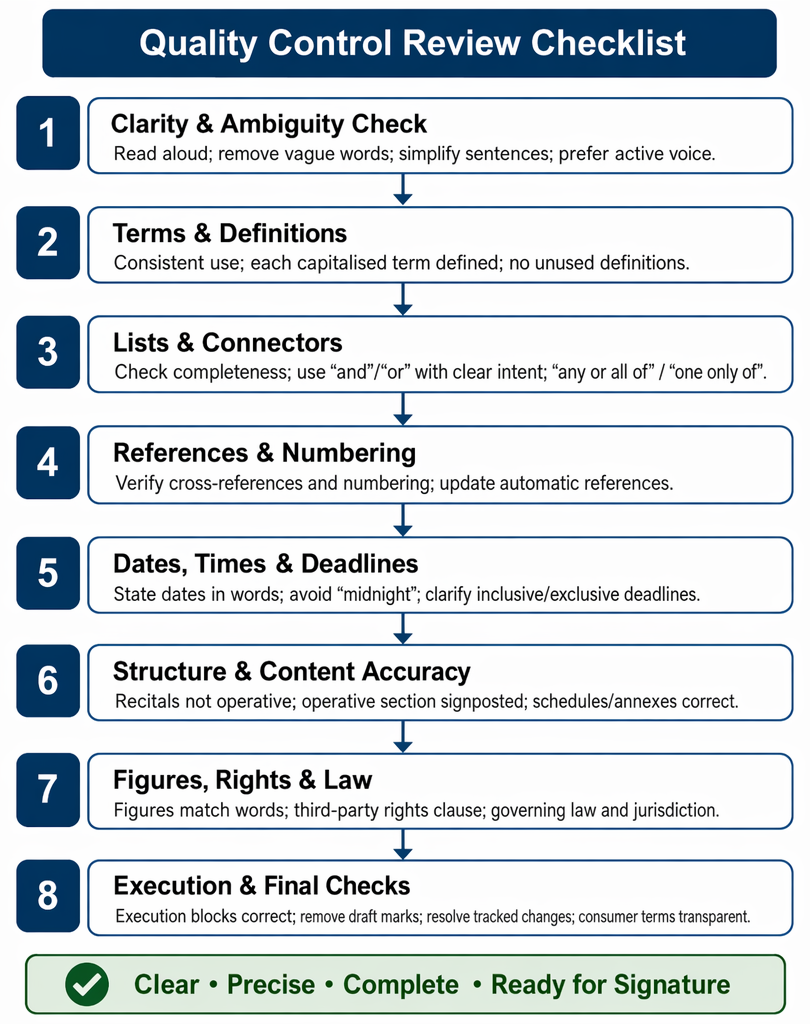
Drafting is not finished when the words are on the page. A thorough quality check is essential. Follow these steps:
List relationships determine whether drafting should use and, separate alternative subclauses, or the connector or for exclusive options.
- Read your draft aloud—does it sound confusing, or are there places where the subject is unclear?
- Check every defined term for consistent use. Confirm that each capitalised term has a definition, and that no definitions are unused.
- Watch for vague words like "appropriate", "substantial", "necessary", or "forthwith" that are not specifically defined.
- Confirm lists are complete and that "and"/"or" are used with clear intent. For multi-option lists, consider "any or all of", or "one only of".
- Review all cross-references and numbering for accuracy; regenerate automatic cross-references if your software supports it.
- Verify dates, times and time zones; state dates in words (e.g., "12 January 2025"), avoid "midnight", and clarify inclusive/exclusive deadlines.
- Check "shall/must/may/will" usage aligns with obligation, discretion, or future action.
- Prefer active voice. Insert the responsible party where passives obscure who must act.
- Simplify overlong sentences; split complex obligations into subclauses.
- Remove archaic wording and legalese; adopt plain English consistent with precision.
- Confirm recitals do not contain operative obligations; ensure the operative section is clearly signposted (e.g., "IT IS AGREED as follows").
- Validate schedules and annexes: are they referred to correctly, attached, coherent with the main agreement, and internally numbered?
- Check figures and words if both are used (e.g., "£123,750 (one hundred and twenty-three thousand seven hundred and fifty pounds)")—they must match.
- Remove draft marks and version metadata before signature (document properties, headers/footers).
- Accept/resolve tracked changes and comments. Turn off comparison marks in the execution version.
- Check for third-party rights: if the Contracts (Rights of Third Parties) Act 1999 applies/excludes, is this stated and coherent with the parties’ intent?
- Confirm governing law and jurisdiction wording matches the parties’ bargain, and whether jurisdiction is exclusive or non-exclusive.
- Ensure execution blocks match the parties’ legal forms (company, LLP, individual) and are compliant with formalities for contracts/deeds.
- If dealing with consumers, ensure terms are transparent (plain and intelligible language) and prominent where required by the Consumer Rights Act 2015; highlight key charges or limitations.
Key Term: Quality Control
The process of systematically reviewing drafted legal documents to confirm they meet standards for clarity, precision, and completeness. Key Term: Commencement Date
The date on which the contract (or a particular obligation) takes effect. It may differ from the date of the agreement and should be defined expressly if different. Key Term: Transparent (consumer terms)
For consumer contracts, a term is transparent if expressed in plain and intelligible language and, if written, is legible. Core terms must also be prominent to be exempt from fairness assessment.Revision Tip: Take a break before reviewing your draft. Fresh eyes are more likely to notice unclear wording, repetition, or omitted points.
Exam Warning: SQE2 drafting tasks may test your ability to identify ambiguous provisions or correct them. Never assume the examiner intends a vague meaning—always prefer precise and singular interpretations. If a clause could be read two ways, demonstrate a clearer redraft that removes the alternate meaning.
Worked Example 1.8
Original sentence: "Landlord or managing agent may inspect the premises at any time upon giving notice."
Question: What might be ambiguous here? Rewrite for clarity.
Answer:
"At any time" could mean at 3am, which is unlikely to be intended. Instead, clarify: "The Landlord or Managing Agent may inspect the premises during business hours upon giving at least 24 hours' prior written notice to the Tenant." If both may inspect independently, keep "or"; if you require both to attend, say "acting together".
Key Point Checklist
This article has covered the following key knowledge points:
- The need for precise, unambiguous drafting in legal documents for SQE2.
- Common causes of ambiguity (unclear references, inconsistent terms, poor sentence structure, vague time/date expressions).
- Techniques for avoiding ambiguity, including defined terms, plain English, careful choice of connectors and modal verbs, and clear list/tabulation structures.
- How to draft unambiguous dates, deadlines and time zones; avoid "midnight" and clarify inclusive or exclusive end dates.
- The difference between recitals and operative provisions and how to keep binding terms in the operative section.
- The role of endeavours clauses and the value of objective standards to reduce dispute risk.
- Practical steps to review and ensure quality in legal drafting, including checks on definitions, cross-references, schedules, third-party rights, metadata, and execution formalities.
- The importance of transparency and prominence for consumer-facing terms under the Consumer Rights Act 2015.
Key Terms and Concepts
- Precision
- Ambiguity
- Defined Term
- Legal Jargon
- Quality Control
- Active Voice
- Commencement Date
- Transparent (consumer terms)