Learning Outcomes
This article sets out the practical rules and procedures for the administration of estates in England and Wales, including:
- The duties, powers, and standard of care owed by personal representatives (executors and administrators)
- Collecting, securing, and identifying estate assets and items that pass outside the estate
- The statutory order for paying expenses and debts, and the application of assets (secured versus unsecured)
- Priority, abatement, and treatment of specific, general, demonstrative, and pecuniary legacies
- Distribution to beneficiaries using appropriation and assent, and the meaning of residue
- Beneficiaries’ rights during administration, fiduciary obligations of PRs, and court remedies
- Creditor claims and PR protections, including Trustee Act 1925 s.27 notices and prudent waiting periods
- Managing insolvent estates and avoiding preference of creditors
- Options where beneficiaries or creditors are missing, such as reserves, indemnities, insurance, payment into court, and Benjamin orders
- Asset realisation, sales, and tax-aware decision-making in administration
- Preparing estate accounts, obtaining receipts/releases, and achieving discharge
SQE2 Syllabus
For SQE2, you are required to understand the administration of estates from a practical standpoint, including the legal duties of personal representatives and client-focused advice on key administrative issues, with a focus on the following syllabus points:
- understanding the duties and powers of executors and administrators (personal representatives) in administering estates
- implementing procedures for collecting in, managing, and distributing assets
- applying the order and rules for the payment of estate debts and liabilities
- understanding rights and remedies of beneficiaries during administration
- addressing creditor claims and utilising protection measures for personal representatives
- undertaking practical steps and problem-solving in estate administration scenarios
- using appropriation and assent appropriately in the distribution of assets
- distinguishing secured from unsecured liabilities and applying the statutory order for assets
- managing insolvent estates and avoiding preference of creditors
- ensuring protection against missing beneficiaries or claimants, including Benjamin orders and insurance
- preparing estate accounts and obtaining receipts and releases to achieve discharge
Test Your Knowledge
Attempt these questions before reading this article. If you find some difficult or cannot remember the answers, look more closely at that area during your revision.
- What is the primary obligation of personal representatives during the administration of an estate?
- How can personal representatives protect themselves from unknown creditors after distributing the estate?
- In what order should personal representatives use estate assets to pay debts and liabilities?
- Do beneficiaries have enforceable rights against personal representatives before completion of estate administration?
Introduction
The administration of estates is a critical area of probate practice for SQE2. When a person dies, their property, debts, and obligations must be managed and distributed strictly in accordance with the law. Personal representatives (PRs)—either executors (if named in a will) or administrators (if appointed when there is no will or valid appointment)—are responsible for this process. Understanding their powers, duties, and liabilities is essential both for providing client advice and for ensuring correct legal outcomes.
PRs are expected to administer efficiently. Although there is no strict deadline for completion, the law recognises the “executor’s year”: PRs are not bound to distribute before the expiry of one year after death, and that period is often treated as a reasonable target for completing core administration tasks.
Key Term: personal representative (PR)
A person—either an executor or administrator—legally responsible for administering the estate of a deceased individual.
Key duties of personal representatives
Upon death, the PRs owe a range of legal obligations to the estate and persons interested in it. Their fundamental duty is to collect, preserve, and distribute the estate according to the law and any valid will.
PRs must exercise reasonable care and skill. The statutory duty of care under Trustee Act 2000 applies to PRs, requiring them to act with the care and skill that is reasonable in the circumstances, taking account of any specialist knowledge or professional status. A serious failure to administer properly may amount to a devastavit (wasting the estate), exposing PRs to personal liability for loss.
Key Term: executor
A personal representative appointed by a valid will to administer the deceased’s estate. Key Term: administrator
A personal representative appointed by the court (usually under the intestacy rules or where no valid executor acts) to administer the estate.
Collecting and securing estate assets
PRs must locate all assets belonging to the deceased, take control of them, and ensure their preservation. This includes valuables, property, investments, and any business interests. PRs may need to insure assets and take practical steps to prevent loss or damage. PRs should identify assets which pass outside the estate—such as jointly held property passing by survivorship, life policies written in trust, and discretionary pension death benefits—as these do not devolve on PRs and are not available for estate liabilities.
Title to assets that pass under the grant vests in PRs, but in practical terms institutions will require production of the grant (or an office copy) before releasing or transferring assets. PRs should also ascertain and collect debts owed to the deceased.
Paying debts, liabilities, and expenses
Before making any distributions to beneficiaries, PRs must identify and pay all debts and liabilities of the deceased. This includes funeral and administration expenses as well as any taxes due. PRs should promptly settle any loan taken to fund inheritance tax or administration costs, and ensure they comply with undertakings given to lenders.
Order of payment
PRs must strictly follow the statutory order when using estate assets to pay debts:
- Funeral, testamentary and administrative expenses
- Preferential debts (if any)
- Ordinary debts (including unsecured creditors)
- Deferred debts (such as debts to family members that are postponed in priority)
Assets are also applied in a statutory order for payment of unsecured debts and expenses. Broadly:
- Property undisposed of by will (including property falling into a partial intestacy) is applied first
- Residue is then used
- After residue, any property specifically given for the payment of debts, then property charged with that purpose
- Next, any fund retained to meet pecuniary legacies
- Finally, specifically devised or bequeathed property, rateably according to value
Secured liabilities (such as a mortgage over real property) are, unless the will shows a contrary intention, borne by the property subject to the security. A direction that a gift is “free of mortgage” or a specific direction to pay a mortgage from residue may show such contrary intention.
Abatement of legacies occurs where estate funds are insufficient: pecuniary legacies abate rateably, and general legacies are taken for payment of debts before specific legacies. Demonstrative legacies are treated as specific to the extent the named fund can satisfy them and otherwise as general.
Distribution to beneficiaries
The PRs distribute what remains after all debts and expenses are paid. Distribution should occur to entitled beneficiaries in accordance with the will or, if none or in part, under the intestacy rules. PRs should use appropriation to satisfy pecuniary legacies or shares of residue with specific assets where appropriate, ensuring fairness between beneficiaries. An assent evidences the transfer of legal title and confirms that the asset is no longer required for administration purposes.
Key Term: residue
The remainder of the estate after payment of all debts, taxes, expenses, and specific legacies.
Beneficiary rights and remedies
During administration, beneficiaries do not have strict legal ownership of estate assets. Instead, they hold a “chose in action”—the right to compel proper administration. They cannot normally demand particular assets or interfere with administration until completion. However, PRs owe fiduciary duties, including to act in good faith, keep proper accounts, and avoid conflicts. Beneficiaries can seek court intervention or an account if these duties are breached. In serious cases, beneficiaries may apply for directions or removal of PRs.
Key Term: chose in action
A right enforceable only by legal action, such as a beneficiary’s right to compel due administration.
Creditor claims and PR protection
Creditors of the estate have the right to claim payment out of estate assets. PRs can be personally liable to creditors if they distribute the estate without having settled all valid claims. However, statutory protections exist if PRs follow the correct procedure.
PRs are also exposed to claims by persons who allege reasonable financial provision was not made for them. To reduce risk, PRs commonly delay final distribution until six months have elapsed from the grant to see if any claim under the Inheritance (Provision for Family and Dependants) Act 1975 is issued.
Statutory advertisements and limitation of liability
To protect against unknown claims, PRs should place statutory “Trustee Act notices” in the London Gazette and a local newspaper under s.27 Trustee Act 1925. In appropriate cases, further adverts (for example, in trade publications) may be prudent. PRs should also make standard searches in land and charges registries relating to estate property. After a minimum two-month waiting period following publication, PRs can distribute assets without risk of personal liability to any later-appearing creditor or beneficiary of whom they were unaware (although the recipient may remain liable to account for their share).
If a known beneficiary cannot be traced, PRs can seek protection by: retaining a reserve; obtaining indemnities from recipients; taking out missing beneficiary insurance; paying money into court; or applying for a Benjamin order allowing distribution on the assumption that the missing person has died. A Benjamin order offers strong protection, but requires evidence of full and diligent enquiries.
Worked Example 1.1
Scenario: An executor pays out all estate assets to beneficiaries shortly after obtaining the grant, without placing any statutory advertisements. Three months later, an unknown creditor approaches for payment of a substantial debt. Is the executor personally liable?
Answer:
Yes. If statutory notices were not placed as required by law, the executor remains personally liable to the creditor for failing to take reasonable precautions before distribution.
Asset realisation and distributions
PRs may need to sell estate assets to generate funds for paying debts or making distributions, subject to any restrictions in the will. They must take reasonable care in carrying out sales and investment decisions and consider tax implications (inheritance tax loss reliefs, capital gains tax annual exemptions, and the timing of disposals). Where possible, PRs should consult residuary beneficiaries about proposed sales of assets forming part of residue. As a general rule, property specifically gifted should not be sold unless required by the statutory order after other assets have been exhausted.
Appropriation can be useful to satisfy pecuniary legacies or shares of residue in specie, but PRs must ensure appropriations are fair and do not prejudice specific beneficiaries.
Beneficiaries’ powers before administration is complete
Generally, beneficiaries cannot demand immediate distribution or take direct action against PRs unless there is breach of duty. However, they can apply to court for administration, for an account, or for removal of PRs in cases of misconduct. PRs should communicate progress and provide accounts to maintain transparency and avoid disputes.
Worked Example 1.2
Scenario: Two beneficiaries under a will believe the executor is delaying distribution without good reason. What remedies, if any, are available?
Answer:
The beneficiaries can apply to court for an account of administration, seek directions, or in severe cases, seek removal and replacement of the executor.
Further statutory orders and special situations
PRs frequently confront issues around secured liabilities and insolvent estates. Correct application of statutory asset orders and creditor ranking rules avoids personal exposure.
Worked Example 1.3
Scenario: A house subject to a mortgage is specifically gifted to a niece. The will contains no statement about the mortgage. Residue is left to the testator’s child. Who bears the mortgage?
Answer:
Unless the will shows a contrary intention, the niece takes the property subject to the mortgage. Secured debts are borne by the property on which they are secured. A direction “free of mortgage” or a specific direction to discharge the mortgage from residue would shift the burden to residue.
Worked Example 1.4
Scenario: The estate is insolvent. There is a secured mortgage over a house, unpaid funeral and administration expenses, unpaid wages to two employees, HMRC tax, and a loan from a family member. How should PRs apply estate assets?
Answer:
Secured creditors look to the charged property. For unsecured debts, first pay reasonable funeral and administration expenses; then any preferential debts (e.g., specified wage claims); then ordinary debts including HMRC; lastly deferred debts (such as family loans). Creditors in the same category rank equally and abate proportionately.
Worked Example 1.5
Scenario: A residuary beneficiary cannot be located despite initial efforts. Other beneficiaries are keen to conclude the administration. What options can protect the PRs?
Answer:
PRs could retain a reserve, obtain indemnities, take out a missing beneficiary insurance policy, pay the missing beneficiary’s share into court, or apply for a Benjamin order authorising distribution on the assumption the missing beneficiary has predeceased. A Benjamin order offers strong protection but requires evidence of thorough searches.
Limitations and liabilities of personal representatives
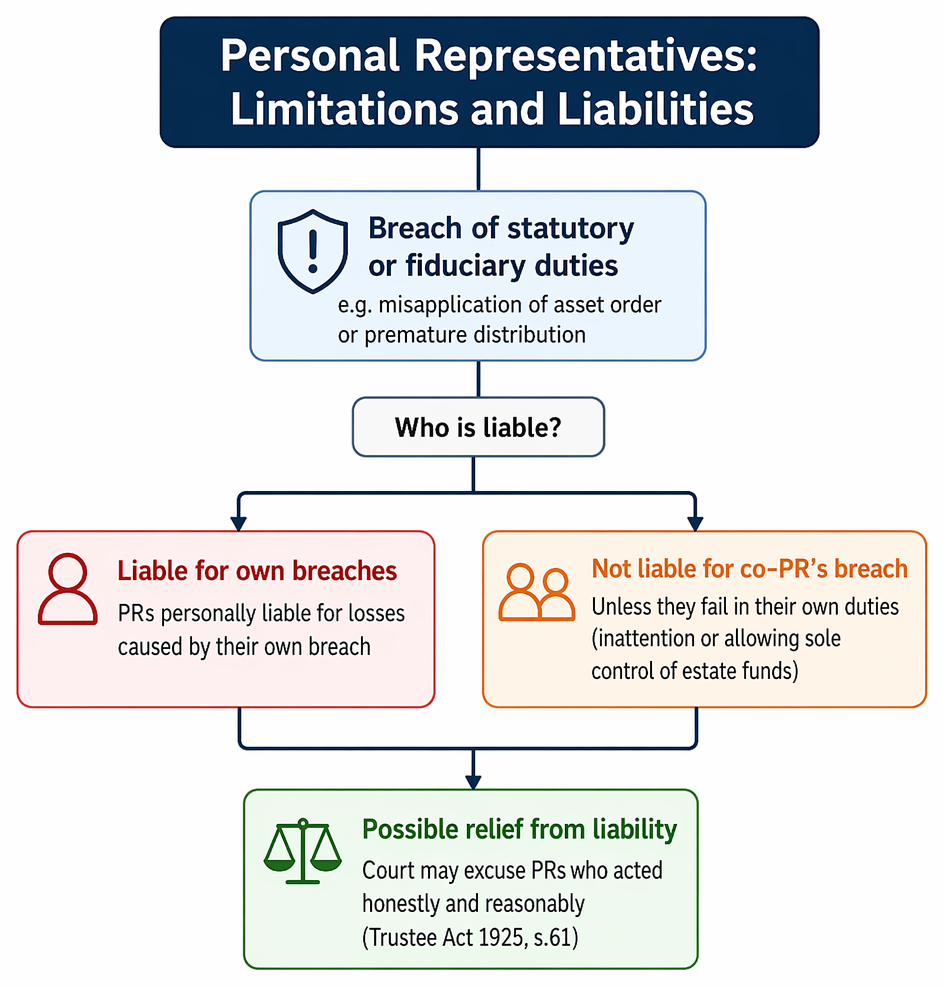
PRs are personally liable for losses caused by a breach of their statutory or fiduciary duties. Misapplication of the statutory asset order or premature distribution may expose PRs to personal claims. Liability is generally limited to breaches for which the PR is responsible; PRs are not vicariously liable for a co‑PR’s breach unless they have failed in their own duties (for example, by inattention or allowing sole control of estate funds). The court has a discretion to relieve PRs from personal liability if they acted honestly and reasonably and ought fairly to be excused (Trustee Act 1925, s.61).
Order of payment for estate liabilities and sequence for applying assets, beginning with undisposed property and residue before other property.
Administering a business in the estate requires care. PRs may only continue a business temporarily and primarily with a view to sale, unless the will grants wider powers. PRs should ensure appropriate insurance, regulatory compliance, and professional advice.
Final accounts and discharge
On completion, PRs must prepare clear estate accounts showing receipts, payments, and balance distributions. Accounts should evidence the application of the statutory asset order, settlement of liabilities, and the calculation of residue. Obtaining signed receipts or formal releases from beneficiaries provides additional protection. Paying minors their entitlement requires care: minors do not give a valid discharge for money; PRs should work with guardians or trustees as appropriate. An assent confirms transfer of property and marks the end of PRs’ responsibility for that asset.
Exam Warning: Failing to strictly follow the statutory order of paying debts may expose PRs to personal liability. Always check the asset order and type of debt involved in client scenarios.
Revision Tip: When advising on estate administration, always consider whether PRs have taken advantage of all statutory protections before distribution or payment to beneficiaries.
Key Point Checklist
This article has covered the following key knowledge points:
- The definition, appointment, and distinction between executors and administrators
- The main legal duties and practical steps for personal representatives in administering an estate and the applicable duty of care
- The correct order in which PRs must pay estate debts and liabilities, and statutory asset orders (including secured versus unsecured liabilities)
- Protection of PRs from personal liability via statutory advertisements, prudent conduct before distribution, and options for missing beneficiaries (including Benjamin orders and insurance)
- The position and remedies of beneficiaries during administration, including their chose in action and rights to an account or removal of PRs
- Asset realisation, appropriation, assent, and tax-aware distribution, including avoiding sale of specifically gifted property unless necessary
- The liability of PRs for breach, available court relief, and the importance of final accounts and signed receipts/releases
Key Terms and Concepts
- personal representative (PR)
- executor
- administrator
- residue
- chose in action