Learning Outcomes
This article covers research planning and methods for identifying and locating primary and secondary sources, including:
- Explaining the difference between primary and secondary legal sources
- Identifying and locating both types using print tools and electronic databases
- Judging the authority, reliability, and currency of a source and its suitability for advice
- Applying systematic methods to update and correctly reference legal information
- Tracing statutes and statutory instruments using Halsbury’s Statutes and Halsbury’s Statutory Instruments
- Using case citators and neutral citations to find and verify authoritative case law
- Performing efficient keyword, Boolean, truncation, and proximity searches across databases and targeted fields
- Consulting Hansard appropriately where statutory meaning is ambiguous to clarify legislative intent
- Recording update dates, versions consulted, and coverage limits when presenting research
SQE2 Syllabus
For SQE2, you are required to understand the practical research methods used to answer legal problems efficiently and accurately, with a focus on the following syllabus points:
- identifying, distinguishing, and accurately describing primary and secondary sources used in legal research
- locating and selecting the correct source for the problem at hand
- choosing appropriate print and online resources and using keywords, index systems, and search techniques
- judging a source's currency, authority, and reliability when preparing advice or reports
- understanding the correct approach to updating legal materials
- presenting and citing primary and secondary sources in line with exam requirements
- using citators and neutral citations to trace case history and treatment
- checking commencement, amendments, and status of legislation and statutory instruments using tools such as Westlaw Legislation Analysis, Halsbury’s Statutes, Current Law Legislation Citator, and the Chronological Table of the Statutes
- tracing commentary efficiently (e.g., Legal Journals Index, HeinOnline) and verifying editorial quality
- integrating print and online sources sensibly (e.g., starting with a trusted encyclopedia or practitioner text, then moving to primary materials)
Test Your Knowledge
Attempt these questions before reading this article. If you find some difficult or cannot remember the answers, look more closely at that area during your revision.
-
Which of the following is a primary legal source?
- a) Halsbury’s Laws of England
- b) The Family Law Reports
- c) Macdonald’s Immigration Law and Practice (textbook)
- d) Practical Law commentary
-
What is the main advantage of a practitioner textbook over a general legal encyclopedia?
-
What features help you judge the reliability of a legal source?
-
True or false? The Current Law Monthly Digest is a primary source.
Introduction
Legal research planning requires clear methods to identify which sources give authoritative answers to client problems. For SQE2, you must be able to find and use both primary and secondary materials and explain your approach. This section outlines the efficient identification, location, and evaluation of key legal sources for written assessments and client-focused research problems.
Key Term: primary source
The direct, original text of the law, such as Acts of Parliament, statutory instruments, or reported cases that establish legal rules. Key Term: secondary source
Commentary, interpretation, or analysis about the law—examples include textbooks, practitioner texts, legal encyclopedias, and journal articles. Key Term: citator
A tool—usually digital or a print index—that tracks the history and treatment of cases and legislation, showing whether they have been amended, repealed, overruled, or followed. Key Term: authority
The degree to which a source can be relied upon as evidence of the law, based on its origin (e.g., legislation, judicial decisions, or commentary by experts).
Primary and Secondary Sources: The Essentials
Legal research depends on distinguishing between primary sources (the law itself) and secondary sources (commentary about the law).
Why the Distinction Matters
- Only primary sources are authoritative evidence of the law to courts and clients.
- Secondary sources help you understand complex areas, explain context, and direct you to relevant primary texts.
- Awareness of the law-report hierarchy matters: official ICLR Law Reports are preferred where available; other series (e.g., Weekly Law Reports or All England Law Reports) may be cited if authoritative reports are unavailable.
- Transcripts and unreported judgments can be useful for speed, but you must check for a reported version and subsequent judicial treatment.
Key Term: neutral citation
A court-assigned, medium-neutral citation (e.g., [2023] EWCA Civ 123) that uniquely identifies a judgment independent of any published law report.
Worked Example 1.1
A client asks you whether a recent statutory amendment affects their contract. Where should you look to find the actual legal rule?
Answer:
You must consult the primary source—the relevant Act of Parliament and any associated secondary legislation (such as a statutory instrument). You can then use an annotated statute or reliable secondary commentary to check for interpretation.
Locating Legal Sources
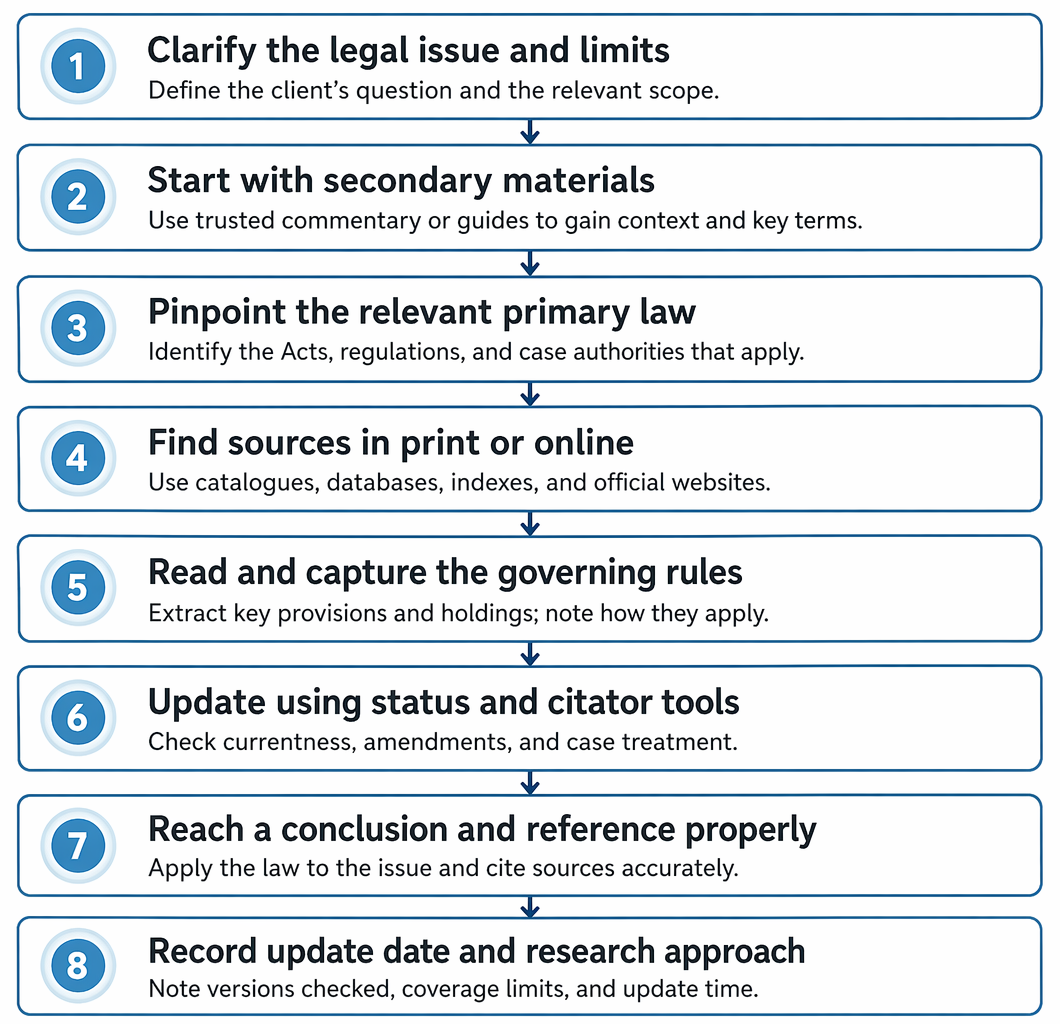
Client-focused legal research proceeds from issue definition and preliminary commentary to primary authority retrieval, verification of current status, citation, and audit trail.
Using Print and Online Resources
You may need to locate information quickly using physical books or digital tools. Your method depends on the type of information and availability.
Print resources
- Use the library catalogue to find texts by title, year, or subject. If unsure, search for words anywhere in the title and use advanced options to filter.
- Decode abbreviations for law reports and journals (e.g., WLR vs L.R.) using standard references such as a library’s abbreviations index or trusted tools like the Cardiff Index to Legal Abbreviations. Catalogues list full titles, not abbreviations.
- Use index volumes for law reports (e.g., Red/Pink Index to the Law Reports) and citators (e.g., Current Law Case Citator) to identify case citations and judicial treatment. These include “Cases Reported” and “Cases Judicially Considered”.
- For statutes, start with Halsbury’s Statutes (subject arrangement), then check the Cumulative Supplement and Noter-Up. For statutory instruments, use Halsbury’s Statutory Instruments (subject arrangement) and the Service binder’s “Monthly Survey” to confirm changes.
Digital resources
- Subscription databases (Westlaw UK, LexisLibrary) provide current, searchable texts with status indicators for amendments, commencement, and case history, and often link commentary, analysis, and journal articles. Use “Legislation” and “Cases” search functions, and check “Legislation Analysis” or annotations for status and related materials.
- Free official websites (legislation.gov.uk, BAILII, CURIA/EUR-Lex) give access to laws and judgments. They may not carry all editorial features. Legislation.gov.uk indicates whether changes are yet to be applied; record the version and date checked.
- Verify coverage. Not all printed series or journals are on a single platform—check your library catalogue or A–Z lists to confirm access.
Worked Example 1.2
You need to find current statutory wording for a specific consumer protection law, ensuring it is fully amended. What is your most reliable option?
Answer:
Use a subscription service such as Westlaw or LexisLibrary, which updates statutes to reflect amendments and indicates the provision's status. Always check any update warnings.
Worked Example 1.3
Researching for a report on data privacy, your keyword search retrieves irrelevant results. What adjustments should you make?
Answer:
Try narrowing your keywords, using phrase searches (e.g., "data protection"), or searching within a particular field (such as "legislation title" or "case digest") to exclude unrelated materials.
Worked Example 1.4
You have the neutral citation for a case: [2021] EWCA Civ 999. How do you locate the best report and check whether it remains good law?
Answer:
Use the “Cases” search with the neutral citation in Westlaw or LexisLibrary to retrieve the judgment and alternative published reports. Consult the case analysis/citator to check subsequent treatment (followed, distinguished, overruled) and to locate the preferred ICLR report where available.
Source Reliability, Authority, and Currency
Found a source—can you trust it? SQE2 assessment expects you to judge:
- Who is the publisher? Official sources (ICLR Law Reports; UK National Archives for legislation) or reputable legal publishers carry greater weight than general websites.
- When was it published or last updated? Check update notes (e.g., “changes not yet applied” flags on legislation.gov.uk; currency panels in databases; cumulative supplements/Noter-Up in print).
- Report hierarchy. Prefer ICLR Law Reports where available; if not, cite reputable alternatives and include the neutral citation. Newspaper case notes are not a substitute for a full report.
- Editorial process. Secondary materials (encyclopedias, practitioner texts) should reflect peer review, consistent update cycles, and transparent citations to primary law.
- For official publications (Law Commission reports, Command Papers), cite the official reference (e.g., Cm No.) and ensure you refer to the final version.
Key Term: Halsbury’s Laws of England
A comprehensive legal encyclopedia arranged by subject, summarising the law with citations to cases and legislation, updated by cumulative supplements and a monthly Noter-Up.
Search Methods: Using Indexes and Keywords
Whether in print or online, you must search efficiently.
- Choose legally significant keywords, then test alternatives and synonyms. For subject searches, encyclopedias and practitioner texts can supply precise terminology.
- Use Boolean operators to refine searches: AND narrows, OR broadens, NOT excludes. Combine with phrase searches (quotation marks) for precision.
- Employ truncation and wildcards to capture word variations (e.g., defin* to include define/definition; wom _n to retrieve woman/women) but use with care to avoid unintended results (e.g., defin_ may catch definite).
- Use proximity operators to ensure keywords appear near each other (e.g., Lexis w/6; Westlaw /6).
- Search within fields (title, jurisdiction, court level, subject keywords) to filter results effectively.
- For journal commentary, use Legal Journals Index (LJI) and HeinOnline; library catalogues and Google Scholar can supplement but require careful source evaluation.
Worked Example 1.5
You are searching for commentary on provocation linked to domestic violence. Your initial results are too broad. How do you refine them?
Answer:
Use Boolean combinations—provocation AND “domestic violence”—and add OR for related phrases (e.g., “battered women”). Limit the search to “journals” and apply proximity (provocation w/10 “domestic violence”) to improve relevance. Check LJI for targeted indexing and summaries before retrieving full text.
Updating and Cross-Referencing
Reliable research requires ensuring the law is up to date:
-
For statutes and statutory instruments, confirm commencement and amendments:
- Use Westlaw “Legislation Analysis” or Lexis annotations to check status and see related cases, SIs, and commentary.
- Consult Halsbury’s Statutes (main volumes plus Cumulative Supplement and Noter-Up) and Halsbury’s Statutory Instruments (plus Service binder’s “Monthly Survey”).
- For older or complex histories, use the Chronological Table of the Statutes to verify whether provisions are in force.
- Legislation.gov.uk offers versioning and “changes not yet applied” flags—note the point-in-time view used.
-
For case law, use citators (Westlaw Case Analysis, Current Law Case Citator) to check subsequent treatment and alternative reports.
-
For parliamentary materials (Hansard), consider Pepper v Hart guidance: only where statutory wording is ambiguous and a ministerial statement clearly identifies legislative intent.
Key Term: Current Law Legislation Citator
A systematic index tracking amendments, repeals, commencement, and related case law and commentary for UK legislation. Key Term: Chronological Table of the Statutes
A consolidated print resource indicating whether Acts (by year) remain in force and the main changes affecting them—particularly useful for older Acts.
Worked Example 1.6
Your supervisor asks for a status check on section 1 of an Act, including commencement date, amendments, and any leading cases interpreting it. What is your process?
Answer:
Retrieve the section in Westlaw or Lexis and open the analysis/annotations panel to check commencement, current status, and related instruments. Cross-check in Halsbury’s Statutes (main text, Cumulative Supplement, Noter-Up) and the Current Law Legislation Citator for a consolidated history and cited cases. Where needed, verify the point-in-time text and note the date/time of your check.Exam Warning: The law you find in a textbook or online is only as valid as its update date. For SQE2, always state the date you last checked the source, especially if relying on secondary material.
Choosing the Right Source for the Problem
Use secondary sources for complex or unfamiliar areas to orient yourself quickly. For direct legal obligations or precedents, always quote the relevant primary law. Practitioner texts (e.g., the White Book, Archbold, Blackstone’s) or Halsbury’s Laws can provide structure and key references. In reporting to supervisors or clients, set out your conclusion, then cite the sources and method used. Where devolved or international sources are relevant, ensure you consult the correct jurisdiction (e.g., Session Cases for Scotland; ECHR judgments via HUDOC).
Worked Example 1.7
You locate a detailed blog post commenting on a recent Court of Appeal decision. Can you rely on it, and how should you proceed?
Answer:
Treat blogs as tertiary commentary. Use them to identify issues and references, but verify everything against primary sources and authoritative reports. Retrieve the judgment via its neutral citation and check case analysis/citators. If you need commentary, prefer peer‑reviewed journals or practitioner texts and cite those alongside the case.Revision Tip: For efficiency, start research with a secondary source for background, then identify and consult the relevant primary legal texts. This approach is often the quickest for SQE2.
Key Point Checklist
This article has covered the following key knowledge points:
- Distinction and examples of primary and secondary legal sources
- Methods to locate each type in print and digital formats
- Techniques for identifying source authority, reliability, and up-to-dateness
- The use and importance of citators in updating law and tracking judicial treatment
- Efficient keyword searching, Boolean logic, truncation, proximity, and index use
- Preferred use of neutral citations and report hierarchies when citing case law
- How to verify legislation status and commencement using Halsbury’s, database analysis, citators, and the Chronological Table
- Appropriate use of Hansard where statutory meaning is ambiguous
- Finding commentary using Legal Journals Index and other indexes; caution with blogs
- Importance of recording update dates and versioning in research notes
Key Terms and Concepts
- primary source
- secondary source
- citator
- authority
- neutral citation
- Halsbury’s Laws of England
- Current Law Legislation Citator
- Chronological Table of the Statutes