Learning Outcomes
This article covers:
- Distinguishing clearly between representations, warranties, conditions and innominate terms, and how classification shapes termination rights and damages
- Identifying when rescission is available for misrepresentation and when damages in lieu may be awarded under section 2(2) Misrepresentation Act 1967
- Evaluating and drafting risk allocation devices: entire agreement and non‑reliance clauses, indemnities, conditions precedent and subsequent, “time of the essence” provisions, materiality thresholds and cure periods
- Advising on enforceability and statutory controls, including section 3 Misrepresentation Act 1967, reasonableness tests, and Consumer Rights Act 2015 fairness in consumer contexts
- Applying the principles to transactional and dispute scenarios to decide whether to terminate, affirm, claim damages, or pursue rescission or section 2(1) damages
- Predicting how courts interpret disputed clauses and the effect of express “condition” labels, mercantile context, and innominate term analysis
- Drafting practical termination architecture: material and repeated breach triggers, notice‑and‑cure mechanisms, and making time essential where appropriate
- Integrating disclosure, knowledge and “sandbagging” concepts into warranty suites and managing caps, baskets and claim procedures
SQE2 Syllabus
For SQE2, you are required to understand the legal and practical distinction between representations, warranties, and conditions in commercial agreements, and the consequences of each for risk allocation and available remedies, with a focus on the following syllabus points:
- understanding what constitutes a representation, a warranty, a condition and an innominate term
- explaining the difference in legal effect between these terms
- identifying the remedies available for breach of each, including damages and/or termination
- analysing the impact of incorrect statements or breaches on parties’ rights and obligations in commercial contracts
- applying these concepts to practical fact patterns as found in contract drafting and examination scenarios
- assessing entire agreement and non‑reliance clauses, and when s3 Misrepresentation Act 1967 and reasonableness tests (and in consumer cases, fairness under the Consumer Rights Act 2015) constrain them
- advising on conditions precedent and subsequent, “time of the essence”, cure periods and material breach constructs, including how to draft and operate them
Test Your Knowledge
Attempt these questions before reading this article. If you find some difficult or cannot remember the answers, look more closely at that area during your revision.
- If a statement in pre-contract negotiations turns out to be false but is not included in the contract, what is the usual legal remedy available?
- What is the principal legal effect of classifying a contractual clause as a 'condition' rather than a 'warranty'?
- In what circumstances can a party terminate a contract for breach of a warranty?
- How does a misrepresentation differ from a breach of warranty, and what are the typical remedies in each case?
Introduction
Clear contract drafting requires an appreciation of how risk is allocated through key substantive clauses. In SQE2, a common focus is on the difference between representations, warranties, and conditions, and the consequences of their breach. This article provides the essential knowledge to approach such scenarios systematically and advise on practical outcomes in commercial agreements.
Test Tip: In SQE-style questions on Representations vs warranties; conditions and remedies, identify the legal test, the triggering fact, and the consequence before choosing between similar answer options.
Representations, Warranties, and Conditions: Definitions and Legal Effect
Commercial contracts use the terminology of representations, warranties, and conditions to allocate risk between the parties. Each term carries distinct legal consequences for breach or inaccuracy, affecting both the remedies and the contract’s future.
Key Term: Representation
A statement of fact made by one party before or at the time of contracting, which induces the other to enter into the contract. If untrue, a misrepresentation may entitle the other party to rescind or claim damages (in defined circumstances). Key Term: Warranty
A contractual promise by one party concerning facts or future events, included as a term (but not as a condition) in the contract. Breach allows for a claim in damages but not termination, unless otherwise stated. Key Term: Condition
A fundamental term of the contract that goes to the root of the agreement. Breach entitles the innocent party to terminate the contract and/or claim damages. Key Term: Innominate term (intermediate term)
A contract term neither classified in advance as a condition nor as a warranty. The remedy depends on the seriousness of the breach and its consequences: only if the breach deprives the innocent party of substantially the whole benefit of the contract will termination be available; otherwise the remedy is damages.
Classification is primarily a matter of construction, assessed objectively: labels used by the parties, the context, mercantile expectations (for example, punctuality in certain trading contracts), statutory guidance and the parties’ allocation of risk. Courts may treat time stipulations in mercantile contracts as conditions, especially where time is expressly “of the essence”, whereas many technical performance obligations are innominate in nature.
Representations
A representation induces the contract but usually does not form part of its terms. If untrue, it constitutes a misrepresentation rather than a breach of contract. Statements of opinion, intention or law can still be actionable where they imply facts that are false, are not honestly held, or create a half-truth. A pre‑contract statement may be a continuing representation up to completion or signing; if it ceases to be true and the maker knows or ought to know, they should correct it.
Inducement is required. The representee must have relied on the statement in deciding to contract. Courts do not insist on exhaustive checks by the representee; a misled party may still rely even if they could have discovered the truth with reasonable diligence.
Key Term: Misrepresentation
A false statement of fact or law by one party to another, which induces that party to enter into the contract. Remedies may include rescission and, in some cases, damages.
Warranties
A warranty is a contractual promise that specified facts or states of affairs are or will be true. They are commonly used to allocate risk in corporate and asset transactions, often supported by disclosure letters. Drafters frequently use qualifiers (for example, “to the Seller’s knowledge”, “so far as the Seller is aware”, “material”, “in all material respects”) and define knowledge to calibrate risk. It is prudent to “bring down” warranties at completion and to clarify whether reliance is permitted post‑completion even if the buyer had knowledge of breach (so‑called “sandbagging” provisions).
Conditions
A condition is a term whose performance or truth is fundamental to the entire purpose of the contract. Parties often expressly define certain terms as conditions to establish clear termination rights for breach. Time clauses can be drafted as conditions (for example, “time is of the essence”), and in mercantile contexts courts are more inclined to treat them as such. Where classification is unclear, courts may treat the term as innominate and assess the gravity of breach before allowing termination.
Key Term: Condition precedent
A term specifying that the agreement (or an obligation within it) does not come into effect until a stated event occurs. If the event does not occur, the relevant obligations never arise. Key Term: Condition subsequent
A term specifying that the agreement (or a provision) will cease to operate on the occurrence (or non‑occurrence) of a stated event. Functionally, it acts as a contractually agreed termination trigger.
Risk Allocation: The Commercial Effect
The classification of a contractual statement significantly affects each party’s legal risk. Particularly in business transactions involving significant sums—such as business sales, asset purchases, or supply contracts—the risk of loss is managed by carefully negotiated representations, warranties, conditions, innominate terms and remedial architecture. The parties’ ability to claim damages or to terminate the contract hinges on this classification.
- Entire agreement and non‑reliance clauses are frequently used to confine liability to the four corners of the contract. However, effectiveness depends on statutory controls and careful drafting (see below).
- Indemnities are used to shift specific risks, usually on a pound‑for‑pound basis, with fewer issues about foreseeability or mitigation than general damages, subject to contract wording.
Key Term: Indemnity
A contractual promise to hold the other party harmless against specified losses. Indemnities are commonly used to allocate identified risks or known liabilities and may operate differently to damages clauses, depending on the drafting.
- “Material” and “substantial” thresholds are often used to limit termination or warranty liability to significant breaches. These terms can be uncertain; specifying objective thresholds (for example, a financial amount or percentage) reduces ambiguity.
- Cure periods and “repeated breach” provisions are practical tools: a non‑breaching party may acquire termination rights if a breach is not remedied within a defined timeframe or if breaches recur.
Worked Example 1.1
A buyer is purchasing a company. The seller’s contract includes a warranty that “the accounts give a true and fair view of the company’s financial position.” After completion, the buyer discovers the accounts are inaccurate but the contract does not classify this warranty as a condition.
Answer:
The buyer may sue for damages for breach of warranty. However, unless the warranty is classified as a condition or the contract contains a separate termination right for material or repeated breach (or the breach amounts to a repudiatory breach of an innominate term), the buyer cannot terminate the contract based solely on this breach.
Remedies: What Happens When Clauses Are Breached?
Breach of Representation (Misrepresentation)
If a statement is a representation but not a term, an untruthful statement may allow for:
- Rescission (setting aside) of the contract; and/or
- Damages, depending on whether the misrepresentation was fraudulent, negligent, or innocent.
Key Term: Misrepresentation Act 1967
The principal statute governing misrepresentation in English law. Section 2(1) creates a statutory claim for damages for negligent misrepresentation (with a measure akin to fraud) unless the maker establishes reasonable grounds to believe the statement was true. Section 2(2) gives the court discretion, for non‑fraudulent misrepresentation, to award damages in lieu of rescission. Section 3 regulates exclusion or restriction of liability for misrepresentation, permitting it only insofar as it satisfies the statutory test of reasonableness (and, in consumer contracts, fairness under the Consumer Rights Act 2015). Key Term: Rescission
An equitable remedy that sets aside the contract and seeks to restore the parties to their pre‑contract positions. Rescission may be barred by affirmation, lapse of time, third‑party rights, or if restoration has become impossible (equity allows flexibility, for example by making monetary adjustments).
Fraudulent misrepresentation (deceit) yields tortious damages designed to put the claimant in the position as if the representation had not been made; remoteness is generous (all losses flowing directly) and contributory negligence does not apply. Negligent misrepresentation under section 2(1) is measured similarly to fraud, and the burden shifts to the representor to prove reasonable grounds for belief. Innocent misrepresentation generally gives rescission; the court may grant damages in lieu under section 2(2) if it is equitable, considering the nature of the misrepresentation and the losses that would flow from rescission or its refusal.
Bars to rescission include affirmation (express or implied election to proceed), undue delay (particularly for non‑fraud), impossibility of substantial restoration and the intervention of bona fide purchaser rights. Electing between rescission and affirming the contract while claiming damages must be addressed promptly once the misrepresentation is discovered.
Excluding or limiting liability for misrepresentation engages section 3 of the Misrepresentation Act 1967. Entire agreement and non‑reliance clauses commonly operate as “basis” clauses to define the parties’ relationship, but if their effect is to exclude or restrict liability or remedies for misrepresentation, they must satisfy statutory controls. In business contracts, the section 3 reasonableness test is applied by reference to factors such as bargaining power, availability of insurance, and whether the clause was fairly brought to the other party’s attention. In consumer contracts, the Consumer Rights Act 2015 fairness test applies, and attempts to exclude statutory rights are generally unenforceable.
Key Term: Entire agreement clause
A provision stating that the written contract constitutes the whole agreement and supersedes prior statements. It may also include non‑reliance wording. Where it excludes or restricts remedies for misrepresentation, it must satisfy statutory controls on reasonableness or fairness. Key Term: Non‑reliance clause
A provision by which a party states it has not relied on any statement other than those expressly set out in the contract. If its effect is to exclude liability for misrepresentation, it is subject to section 3 Misrepresentation Act 1967 (and fairness controls in consumer contracts).
Breach of Warranty
If a statement is included as a warranty, breach enables the innocent party to claim damages only. The contract remains in force—there is no general right of termination for breach of warranty. The measure is the contractual expectation interest: placing the innocent party in the position it would have been in had the warranty been true or the contract properly performed, subject to causation, foreseeability and mitigation principles.
Indemnities, if present, may yield recovery without the usual remoteness constraints, but that depends on the wording and judicial interpretation of the indemnity promise. Caps, baskets and de minimis thresholds frequently apply to warranty claims and must be read together with the notification and time limit provisions.
Breach of Condition
Where a condition is breached, the innocent party may:
- Terminate the contract (repudiate); and/or
- Claim damages for any loss caused.
In practice, where a clause is not expressly a condition, the safer analysis is to ask whether the breach is repudiatory (that is, it substantially deprives the innocent party of the benefit of the contract) or whether it is an innominate term breach yielding damages only. If time is important but not stipulated as “of the essence”, a party can, in some contexts, make time essential by serving a reasonable notice requiring performance by a specified date.
Worked Example 1.2
A contract states, “Time for delivery is of the essence.” Delivery is late.
Answer:
Because time is “of the essence” (making it a condition), late delivery allows the aggrieved party to terminate the contract and claim damages, provided it has not affirmed the contract and any contractual cure or notice provisions have been observed.
Drafting Consequences: Conditions Precedent and Subsequent
Conditions precedent prevent obligations arising until a stated event (for example, a buyer obtaining regulatory consent, or delivery of a specified “compliance letter”). If the event does not occur by a stated longstop, the parties’ obligations may never arise and the agreement may simply fail to come into effect. Conditions subsequent terminate the contract (or a clause) on a specified event (for example, failure to obtain a licence by a date), and operate like agreed termination provisions. The contract should specify what happens on failure: return of payments, release of security and any surviving clauses.
Contracts with Both Warranties and Representations
Warranties and representations are frequently set out together but serve distinct functions. Warranties allocate contractual risk. Representations address pre‑contractual factual accuracy. Commonly, contracts try to exclude liability for pre‑contractual representations (via an entire agreement and non‑reliance clause), but courts scrutinise such limitations. Non‑reliance language can trigger section 3 Misrepresentation Act 1967 and must satisfy reasonableness (and fairness in consumer contracts). Fraud is ordinarily excluded from any exclusion.
Worked Example 1.3
A seller states in pre-contract discussions that equipment meets certain emission standards. The signed contract includes an entire agreement clause and a warranty that the machinery complies. Equipment fails the standard.
Answer:
The buyer can likely claim damages for breach of warranty. Whether rescission or misrepresentation damages are available depends on factors including the precise wording and enforceability of the entire agreement/non‑reliance clause and whether the buyer can prove reliance and inducement. Any clause excluding misrepresentation must satisfy the statutory reasonableness/fairness tests.
Worked Example 1.4
A share purchase agreement includes: “The Buyer acknowledges it has not relied upon any statement or representation not set out in this Agreement.” The seller’s pre‑contract data‑room answer was materially wrong. The buyer sues for misrepresentation.
Answer:
A non‑reliance clause of this type can engage section 3 of the Misrepresentation Act 1967 as it restricts misrepresentation liability. It will only be effective if it meets the statutory reasonableness test (and in a consumer context, fairness under the Consumer Rights Act 2015). If unreasonable/unfair, the buyer can pursue misrepresentation (and possibly rescission), in addition to any warranty remedy.
Innominate Terms in Practice
Many performance obligations (for example, service levels, quality benchmarks) are innominate. The right to terminate depends on the consequences of breach. Drafting often addresses this by:
- declaring particular obligations “conditions”; or
- creating express termination rights for “material breach”, “repeated breach” or failure to cure within a set period; and
- defining “material breach” and “repeated breach” to reduce uncertainty.
Worked Example 1.5
A managed services agreement requires 99.5% uptime, with service credits for shortfalls. A two‑day outage occurs; the customer seeks to terminate.
Answer:
Unless the uptime clause is expressly a condition or the contract creates an express termination right for such a breach, the term is likely innominate. A single outage will justify termination only if the breach deprives the customer of substantially the whole benefit of the contract. Service credits and cure mechanisms often indicate that the intended remedy is damages/credits rather than termination, unless repeated or persistent breaches occur.
Worked Example 1.6
An agreement states it will “not come into effect unless and until” the consultant delivers a compliance certificate by a stated date. The consultant fails to deliver it by that date.
Answer:
This is a condition precedent to the agreement coming into force. If unmet by the longstop date, no binding obligations arise (beyond any express provisions dealing with the fallout), and neither party owes substantive performance obligations. If the clause allows an extension or waiver, those must be used to avoid the agreement lapsing.Exam Warning: The classification of a term as a condition, warranty or innominate term affects available remedies. Terms not expressly labelled may be interpreted by the courts, considering the parties’ intentions and statutory provisions (for example, Sale of Goods Act 1979 context). Be alert to these points:
- Pre‑contract negotiations and draft versions are normally inadmissible in construing the final contract; focus on the language, defined terms and admissible background.
- “Material” and “substantial” can be vague; where possible, define thresholds (for example, a percentage of contract price or a revenue impact).
- Avoid ambiguity with “and/or”, “subject to” and unqualified “and”/“or” lists. If you mean to add a separate obligation, use “without prejudice to clause X”. If you mean “one or more of the following”, say so.
- If time is not originally of the essence, a party may need to serve a notice making time essential before terminating for delay, unless a mercantile context or express wording already makes time a condition.
- Ensure “completion” and any conditions precedent/subsequent are clearly defined, including consequences of failure, repayment mechanics and survival of clauses.
Summary Table: Key Differences
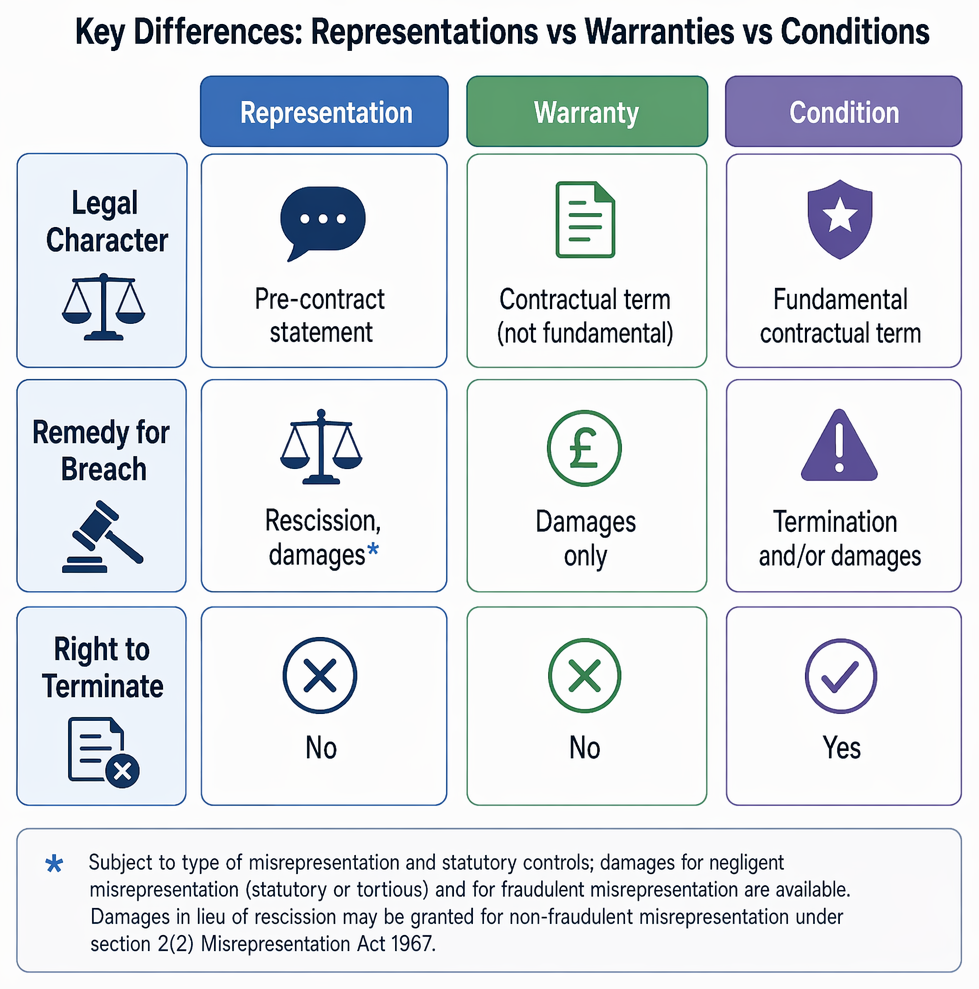
False statements inducing a contract are classified as fraudulent, negligent, or innocent misrepresentations, with the remedy structure shown for each category.
| Aspect | Representation | Warranty | Condition |
|---|---|---|---|
| Legal Character | Pre-contract statement | Contractual term (not fundamental) | Fundamental contractual term |
| Remedy for Breach | Rescission, damages* | Damages only | Termination and/or damages |
| Right to Terminate | No | No | Yes |
*Subject to type of misrepresentation and statutory controls; damages for negligent misrepresentation (statutory or tortious) and for fraudulent misrepresentation are available. Damages in lieu of rescission may be granted for non‑fraudulent misrepresentation under section 2(2) Misrepresentation Act 1967.
Key Point Checklist
This article has covered the following key knowledge points:
- Representations are statements inducing a contract; their breach gives rise to misrepresentation remedies (rescission and/or damages depending on type and statute).
- Warranties are promises within the contract; breach gives rise to damages only, usually subject to caps, baskets and time limits.
- Conditions are primary terms; breach permits termination and a damages claim. Where classification is unclear, assess repudiatory breach of an innominate term.
- Entire agreement and non‑reliance clauses are common risk tools but must satisfy statutory reasonableness/fairness where they exclude misrepresentation liability.
- Conditions precedent and subsequent must be precisely drafted, with clear longstops and consequences of failure or occurrence.
- “Time of the essence” clauses make timing a condition; late performance permits termination unless the right is lost by affirmation.
- Define “material breach”, cure periods and repeated breach consequences to reduce uncertainty; avoid ambiguous drafting (for example, “and/or”).
- Pre‑contract negotiations are generally inadmissible for interpretation; the contract’s wording and defined terms control.
- Misrepresentation remedies are subject to bars to rescission (affirmation, delay, third‑party rights, impossibility) and to statutory controls on exclusions.
- Indemnities allocate specific risks; their operation and limits depend on wording and may differ from general damages rules.
Key Terms and Concepts
- Representation
- Warranty
- Condition
- Innominate term (intermediate term)
- Misrepresentation
- Misrepresentation Act 1967
- Rescission
- Entire agreement clause
- Non‑reliance clause
- Condition precedent
- Condition subsequent
- Indemnity