Learning Outcomes
After studying this article, you will be able to recognize common features of academic listening passages in the TOEFL iBT. You will identify how listening tasks differ from conversations, define key types of spoken structures, and contrast repeated listening task formats. These skills will help you answer listening questions accurately and efficiently.
TOEFL iBT Syllabus
For TOEFL, you are required to identify main features of academic listening passages. For revision, focus on these syllabus points:
- Distinguish academic listening passages from campus conversations and service encounters.
- Recognize formal definition statements and contrast structures in lectures and discussions.
- Identify examples used to support spoken explanations.
- Understand how contrast is signaled in academic listening tasks.
- Apply these features to answer main idea and detail listening questions correctly.
Test Your Knowledge
Attempt these questions before reading this article. If you find some difficult or cannot remember the answers, look more closely at that area during your revision.
- What is the main structural difference between an academic lecture and a campus conversation in TOEFL listening?
- Which signal word in a lecture usually introduces a contrast with the previous information?
- Give one example of a phrase a professor might use to define a key term during a lecture.
- True or false: Academic lectures in TOEFL listening always avoid examples and only state facts.
Introduction
In the TOEFL iBT Listening section, understanding academic features is critical. Academic listening passages differ from conversations and require you to recognize how speakers define terms, use examples, and contrast ideas. Questions often test whether you can identify these listening features and use them to answer detail, main idea, and inference items.
Key Term: Academic Listening Passage
A recorded lecture, classroom discussion, or presentation on an academic subject typical of introductory university courses in TOEFL iBT Listening.
When approaching academic listening, you need to tell the difference between features specific to these passages and those common to campus-based conversations or announcements.
Features of Academic Listening
Academic listening tasks rely on clear organizational patterns and explicit discourse markers. The main features tested are:
Definitions in Academic Listening
Professors often pause to define important vocabulary. Recognizing definitions allows you to answer questions correctly when asked about terms or phrases used by a lecturer.
Key Term: Definition Statement
A sentence or phrase in which a speaker directly explains the meaning of a concept or term, often introduced with markers like "is known as," "means," or "refers to."
Common definition cues include:
- "X is known as..."
- "To define Y, we can say..."
- "Term Z refers to..."
Listen for these cues to capture the precise meaning given in the passage.
Use of Examples
Academic talks frequently include examples to illustrate abstract ideas or support explanations.
Key Term: Example Statement
A verbal illustration provided by the speaker to clarify or support an academic point, typically marked by "for example," "for instance," or "such as."
These examples help clarify definitions and make challenging academic ideas more understandable.
Contrasts in Academic Listening
Academic listening passages often feature contrasting information, showing how two ideas differ or how a process changes under different conditions.
Key Term: Contrast Statement
A sentence or phrase that highlights the difference between two concepts, ideas, or processes, usually introduced by "however," "on the other hand," "in contrast," or "but."
Contrast statements are essential for detail and inference questions, especially when the listening passage compares two theories or approaches.
Recognizing Structure and Organization
Most academic listening passages are structured around a main idea supported by:
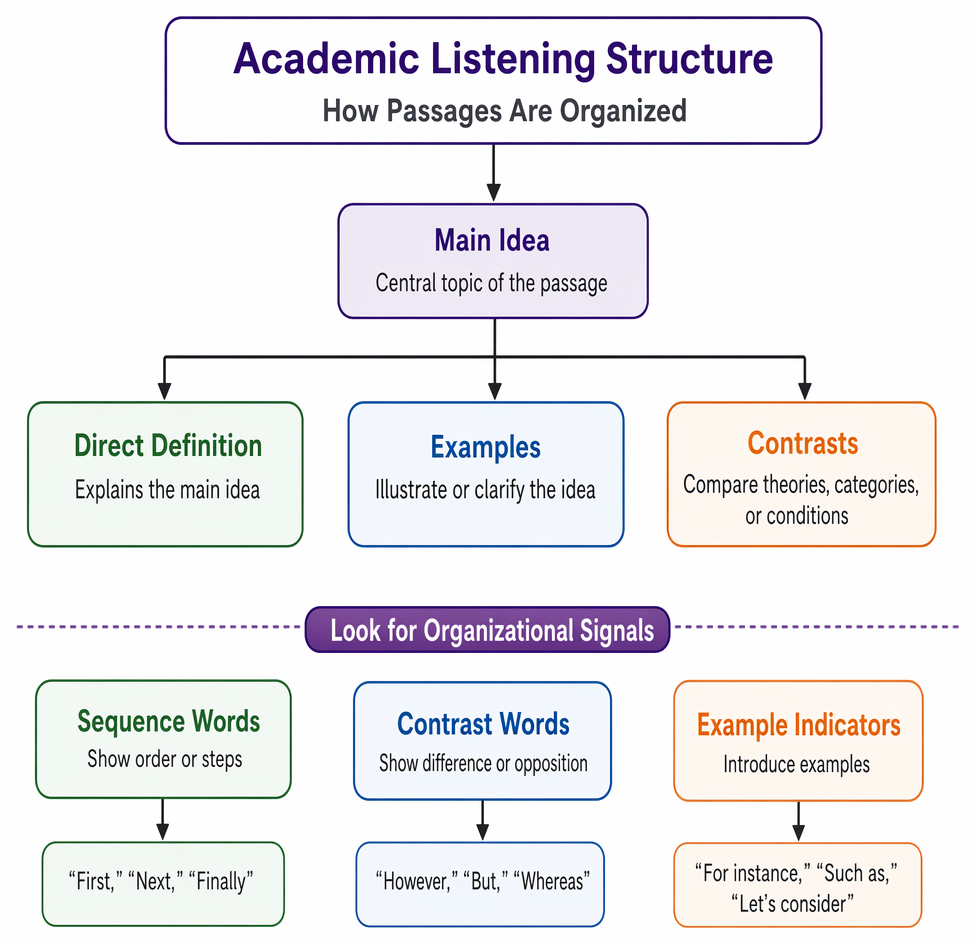
Cue words branch into four organizational categories: definition, example, contrast, and sequence markers with representative expressions.
- A direct definition
- One or more examples
- Contrasting theories, categories, or conditions
Common organizational signals include:
- Sequence words: "First," "Next," "Finally"
- Contrast words: "However," "But," "Whereas"
- Example indicators: "For instance," "Such as," "Let's consider"
Spotting Features in Practice
Worked Example 1.1
Excerpt from a Biology Lecture:
Transcript
"Photosynthesis is the process by which plants make their own food using sunlight. For example, green plants in your backyard use sunlight and carbon dioxide to produce glucose. However, not all plants perform photosynthesis in the same way—cacti store water and close their stomata during the day."
Question: What is the main process discussed, and how is a contrast shown?
Answer:
The main process is photosynthesis, defined at the beginning. The contrast is shown by "however," which introduces a difference in how cacti perform the process compared to the earlier example.
Worked Example 1.2
Excerpt from a Psychology Class:
Transcript
"In classical conditioning, also called Pavlovian conditioning, a neutral stimulus comes to elicit a response after being paired with a stimulus that naturally brings about that response. For instance, Pavlov's dogs learned to salivate at the sound of a bell because it was paired repeatedly with food. In contrast, operant conditioning involves learning through consequences like rewards and punishments."
Question: Identify the definition, example, and contrast features in this lecture.
Answer:
The definition is "classical conditioning, also called Pavlovian conditioning..." The example is "For instance, Pavlov's dogs learned..." The contrast is between "classical conditioning" and "operant conditioning," signaled by "In contrast."
Ways Exam Tasks Use These Features
- Main idea and gist questions often require you to recognize the subject defined at the start.
- Detail questions may ask for the meaning of a term or the specific process in an example.
- Inference questions frequently involve contrasting ideas or exceptions.
Exam Warning: Many students miss details in academic listening by not noticing contrast markers like "however" or "whereas." Always focus when you hear these cue words—they indicate important differences.
Revision Tip: During a TOEFL listening passage, write down definition, example, and contrast cues as abbreviations (DEF, EX, CON) beside your notes for each main idea.
Summary
Academic listening passages in TOEFL iBT focus on presenting definitions, supporting ideas with examples, and contrasting related concepts or theories. Spot these features by listening for typical signal phrases. Recognizing them helps you answer main idea, detail, and inference questions more accurately.
Key Point Checklist
This article has covered the following key knowledge points:
- Recognize academic listening passages as distinct from campus conversations.
- Identify definition statements using explicit language like "X is known as."
- Listen for example statements signaled by "for example," "for instance," or "such as."
- Spot contrast statements introduced by words like "however," "in contrast," or "whereas."
- Understand how definition, example, and contrast structures are typically combined in academic listening tasks.
- Use these features to improve accuracy on main idea, detail, and inference questions in TOEFL Listening.
Key Terms and Concepts
- Academic Listening Passage
- Definition Statement
- Example Statement
- Contrast Statement