Learning Outcomes
After studying this article, you will be able to identify common signposting and discourse markers in academic listening passages on the TOEFL. You'll recognize explicit transition words, understand how speakers highlight structure, and accurately follow the organization of lectures and discussions by listening for important cues.
TOEFL iBT Syllabus
For TOEFL, you must develop skills in recognizing cues that indicate structure and meaning in listening passages. Review the following syllabus points relevant to this topic:
- Identify and interpret signposting phrases that signal lecture structure, topic changes, or key points.
- Recognize discourse markers that indicate relationships such as contrast, addition, cause, or sequence.
- Use listening cues to anticipate main ideas, examples, and conclusions in academic speech.
- Understand transitions in academic conversations and lectures for accurate note-taking and comprehension.
Test Your Knowledge
Attempt these questions before reading this article. If you find some difficult or cannot remember the answers, look more closely at that area during your revision.
- What is the main purpose of signposting in an academic lecture?
- Give two examples of discourse markers that signal contrast.
- True or false: On the TOEFL Listening section, words like "however" and "in other words" often indicate a change in the speaker’s direction or a restatement.
- Which of the following phrases is most likely used to introduce an example: "For instance," "Nevertheless," or "Alternatively"?
Introduction
Academic lectures and discussions often have complex structures. In TOEFL Listening, speakers use clear cues—signposting and discourse markers—to help listeners follow their main ideas, supporting details, and transitions. Recognizing these cues is necessary for understanding the lecture, taking effective notes, and answering questions accurately.
Key Term: Signposting
Spoken phrases or words used by a speaker to indicate the organization, topics, or key stages within a lecture or discussion. Key Term: Discourse Marker
Words or phrases (e.g., "first," "however," "as a result") that show relationships such as addition, contrast, sequence, or cause between statements in speech.
Basic Signposting in Academic Listening
In formal lectures and discussions, speakers rarely speak in a single uninterrupted flow. Instead, they use signposting to:
- Introduce topics ("Today we will discuss...")
- Indicate new sections ("Now let’s move on to...")
- Highlight main points ("The key reason is...")
- Summarize or conclude ("To sum up...")
Pay close attention at the start of a talk, after pauses, and following question prompts—these are common points for signposting.
Test Tip: In TOEFL lectures, the opening lines often reveal the topic and structure. Listen carefully to the first few sentences before focusing on details.
Common Signposting Phrases
Academic presentations often begin with clear orientation phrases. For example:
- "Let me begin by..."
- "First, I'll outline the background..."
- "Next, we'll examine..."
Transitions between sections use phrases such as:
- "Moving on to the next point..."
- "So what does this mean for us?"
- "Let's now turn to..."
Summary signposting often uses:
- "To summarize..."
- "In conclusion..."
Understanding Discourse Markers
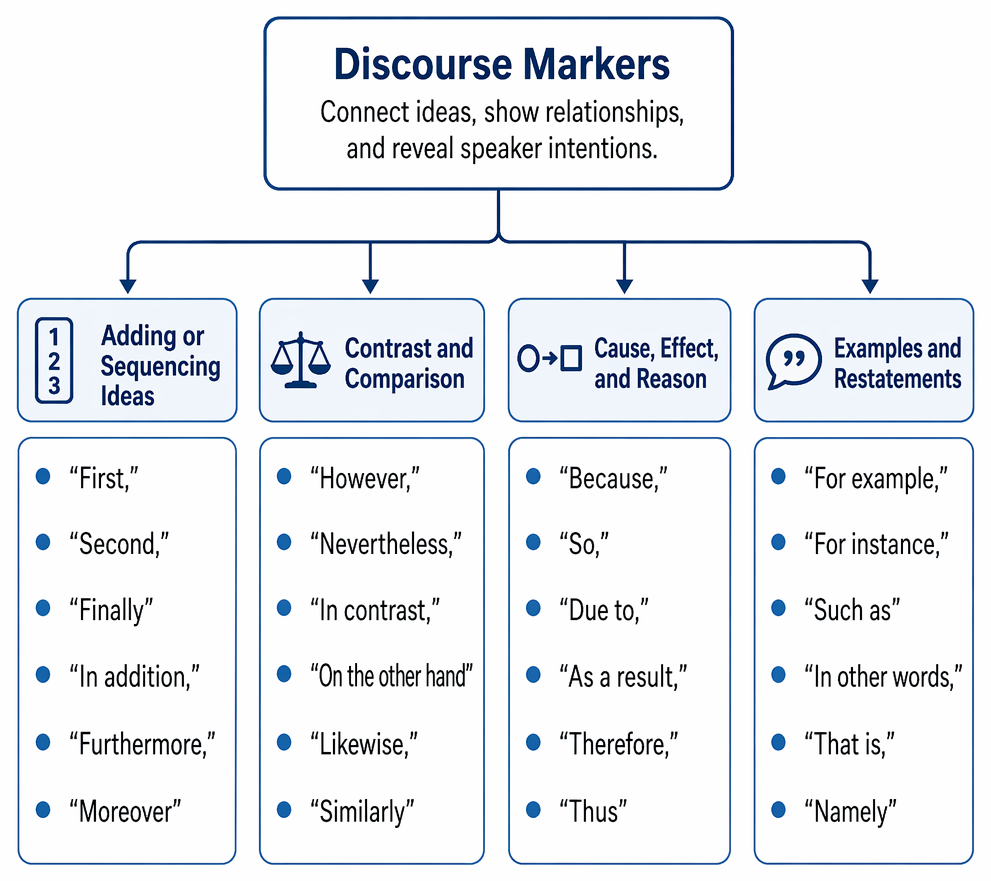
Discourse markers connect ideas, indicate relationships, and help the listener interpret speaker intentions.
Signposting in lectures is grouped into introductory, sectional, emphatic, and concluding functions, each paired with representative expressions.
Key Term: Restatement
A repeated idea expressed in different words to make the meaning clearer for the listener.
Adding or Sequencing Ideas
- "First," "Second," "Finally" signal sequences.
- "In addition," "Furthermore," "Moreover" show more information will follow.
Contrast and Comparison
- "However," "Nevertheless," "In contrast," "On the other hand" signal contrast.
- "Likewise," "Similarly" indicate comparison or similarity.
Cause, Effect, and Reason
- "Because," "So," "Due to," "As a result," "Therefore," "Thus" indicate cause or consequence.
Examples and Restatements
- "For example," "For instance," "Such as" introduce examples.
- "In other words," "That is," "Namely" signal a rephrasing or clarification.
Test Tip: When you hear phrases such as "for example" or "in other words," expect supporting detail or clarification. These parts are often useful for answering detail questions.
Applying Markers for Note-Taking and Comprehension
Identifying signposting and discourse markers boosts listening accuracy and note-taking quality. Recognizing "Now, let's consider..." tells you to expect a new subtopic. Hearing "Consequently," means the speaker will explain a result. Noting these oral cues helps organize your notes and answer detail and inference questions more efficiently.
Worked Example 1.1
Lecture excerpt:
Transcript
"Good morning, everyone. Today, we're going to examine renewable energy sources. I'll start by outlining the limitations of fossil fuels. Then, we'll look at three alternatives: solar, wind, and geothermal. First, fossil fuels are nonrenewable. Moreover, they contribute to pollution. However, alternatives exist which address these issues. For instance, solar panels can be installed on rooftops to provide clean energy..."
Question: According to the lecture, which discourse markers introduce a new argument or example?
Answer:
Phrases like "However," signal new arguments, while "For instance," introduces an example.
Worked Example 1.2
TOEFL-style Listening Question:
You will now listen to part of a lecture in a biology class.
Transcript
Professor: "So, we've discussed endothermic animals. Now, let's turn our attention to ectotherms. Unlike mammals, reptiles rely on external heat sources. For example, snakes warm themselves by lying in the sun. In other words, their body temperature mirrors their environment."
Question: What does the phrase "In other words" signal in this context?
Answer:
It signals a restatement—the professor is rephrasing the previous concept for clarity.Exam Warning: Do not ignore transition words at the beginning or end of sentences in listening passages; they often indicate critical shifts in the speaker's logic or topic that are tested directly or indirectly on the TOEFL.
Exam Warning: Do not try to write down every word. Use signposting and discourse markers to organize your notes around main points, examples, and contrasts.
When practicing listening, intentionally write down transition phrases and signposting cues as you take notes. Review these cues after each practice lecture to strengthen their meaning and use.
Summary
Becoming proficient with signposting and discourse markers allows you to efficiently follow lecture structure, take organized notes, and spot question-relevant information in TOEFL Listening. Recognize introductory cues, transitions, and signals for examples, comparisons, and conclusions to perform at a high level.
Key Point Checklist
This article has covered the following key knowledge points:
- Define and distinguish signposting and discourse markers in academic listening.
- Recognize common spoken cues used to introduce, transition, summarize, or contrast points in lectures and discussions.
- Understand how to use these cues to follow academic talk structure accurately.
- Apply these concepts to TOEFL Listening questions requiring comprehension of lecture organization and relationships.
Key Terms and Concepts
- Signposting
- Discourse Marker
- Restatement