Learning Outcomes
After studying this article, you will be able to accurately recognize and work with the audio contexts of TOEFL academic lectures, including those with and without class discussion. You will understand how lectures are structured, how interaction may occur, and how to efficiently listen for main points and supporting evidence. You will also be able to apply TOEFL listening strategies for academic contexts and improve your note-taking for this type of audio.
TOEFL iBT Syllabus
For TOEFL, you are required to identify and understand a variety of academic lecture audio sources and contexts. For revision, focus on these syllabus points:
- Distinguish between pure academic lectures and those that include class discussion.
- Recognize lecture structure and the speaker’s purpose in university settings.
- Identify main ideas, supporting details, and organizational cues in academic audio.
- Interpret classroom interactions, including student questions and teacher responses.
- Apply note-taking skills to academic lecture audio sources.
- Answer questions accurately for both lecture-only and lecture-with-discussion contexts.
Test Your Knowledge
Attempt these questions before reading this article. If you find some difficult or cannot remember the answers, look more closely at that area during your revision.
- What are the key differences between a lecture-only audio recording and a lecture with class discussion on TOEFL?
- Why is it important to recognize when a student asks a question during a TOEFL listening lecture?
- List two strategies for effective note-taking when listening to an academic lecture (with or without class discussion).
Introduction
Academic lecture audio sources on TOEFL simulate university classes. These may involve a single professor speaking (lecture-only), or may include classroom discussion where students ask questions or comment. Being able to distinguish these contexts is essential for understanding main ideas, following the speaker’s argument, and answering TOEFL questions correctly.
Key Term: Academic Lecture
A spoken presentation delivered by a university teacher on a specific subject, often structured and focused on sharing content knowledge. Key Term: Class Discussion
A segment during or following a lecture in which students participate by asking questions, responding, or providing examples related to the topic. Key Term: Speaker Function
The specific purpose or role each speaker (professor or student) takes within the conversation, such as presenting, questioning, giving examples, or clarifying. Key Term: Note-taking
The process of writing down important information from spoken language to help remember main ideas and supporting details.
Recognizing Academic Lecture Contexts
TOEFL listening lectures closely reflect real-life university classes. These may present as:
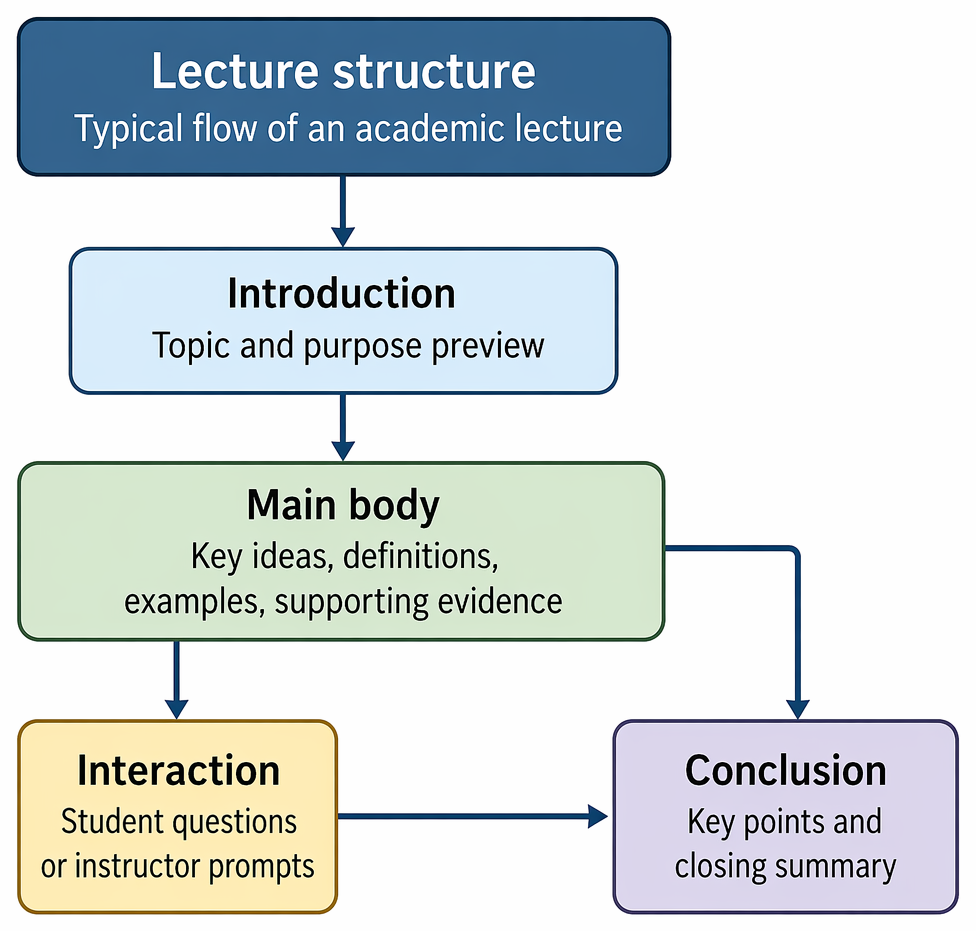
Lecture organization is presented as a sequence from topic introduction to explanatory body, possible class discussion, and closing summary.
-
Lecture-Only: The professor talks for most of the passage. There may be brief introductions or overviews, but student voices are minimal or absent.
-
Lecture with Class Discussion: The professor remains the main speaker, but students may ask questions, make comments, or answer the professor’s queries. These parts are signaled by changes in voice and can include clarifications, challenges, or examples.
Identifying Structure in Lectures
A typical academic lecture on TOEFL follows a clear structure:
- Introduction: The professor announces the topic, often using cue words (e.g., “Today we’ll discuss…”).
- Main Body: The professor explains concepts, gives definitions, and provides supporting evidence or examples.
- Interaction (if present): Students may interject with questions or the professor may prompt the class for input.
- Conclusion: A summary or closing remark.
Students should listen for signal phrases and understand who is speaking and their speaker function.
Key Term: Lecture Cues
Words or phrases that signal transitions, examples, or important points in a lecture (e.g., “For instance,” “To sum up,” “Let’s move on to…”).
Dealing with Class Discussion
Lectures with student participation require a slightly different approach. Student questions can clarify complex points, raise common misunderstandings, or introduce alternative viewpoints.
When a class discussion appears:
- Listen for changes in voice pitch or style.
- Focus on the student’s question: is it about a definition, process, or application?
- Pay attention to the professor's response—often, this part clarifies or repeats a main idea, which may be tested.
- Do not ignore side comments from students. These can help identify the main point or a frequently tested detail.
Worked Example 1.1
Passage:
Transcript
Professor: "Today, we're looking at the greenhouse effect. As you know, the greenhouse effect is responsible for maintaining Earth's temperature. Without it, the planet would be too cold for life."
Student: "Isn't the greenhouse effect the same as global warming?"
Professor: "Good question. They are related but not identical. The greenhouse effect is a natural and necessary phenomenon, while global warming refers to an increase in greenhouse gases due to human activities, causing Earth's average temperature to rise."
Question: According to the professor, what is the difference between the greenhouse effect and global warming?
Answer:
The greenhouse effect is a natural process that keeps Earth’s temperature livable; global warming is an unnatural increase in temperature caused by extra greenhouse gases from human activities.
Worked Example 1.2
Passage:
Transcript
Professor: "Let's turn to supply-side economics. It assumes that tax cuts will lead to economic growth, as business owners invest their savings and create jobs."
Student: "Did this theory always work in practice?"
Professor: "Not always. While some countries saw growth, others did not. Results depend on various external factors, not just tax cuts themselves."
Question: Why does the professor mention other countries' experiences with supply-side economics?
Answer:
To show that supply-side policies do not always produce the same results everywhere because success depends on several factors, not just on the policy.
Applying Listening Strategies
When working with academic lecture audio, especially those involving discussion, apply these strategies:
- Note-taking: Write down the topic, key definitions, main points, and supporting details. In discussions, note student questions and the professor’s responses.
- Identify Speaker Function: Recognize when the professor introduces, explains, or concludes, and when students question or clarify.
- Listen for Structure: Track how the lecture is organized—beginning, middle, and end.
Key Term: Main Point
The most important idea or argument presented in a section of the lecture.Exam Warning: A common error is to ignore student questions or teacher responses to student input. Often, TOEFL questions focus on these moments, testing whether you understood the clarification or important detail provided.
Revision Tip: Whenever you hear a student’s voice, underline or mark any answer or clarification given by the professor. These are often tested, especially in detail or function questions.
Key Point Checklist
This article has covered the following key knowledge points:
- Understand the features of lecture-only versus lecture-with-discussion TOEFL audio.
- Identify main topic, structure, and speaker function in academic lectures.
- Listen for and note class discussion elements that may clarify or introduce main ideas.
- Apply effective note-taking and question-answering strategies in both lecture types.
- Avoid missing important points presented in student-teacher interactions.
Key Terms and Concepts
- Academic Lecture
- Class Discussion
- Speaker Function
- Note-taking
- Lecture Cues
- Main Point