Learning Outcomes
After reading this article, you will be able to understand the audio features used in TOEFL Listening, explain what one-time playback means, and describe effective note-taking strategies when audio is only played once. You will recognize how these features influence your test approach and learn how to identify key ideas during listening passages.
TOEFL iBT Syllabus
For TOEFL, you are required to understand how audio sources are presented, the constraints of one-time playback during Listening, and the functions of note-taking. For revision, focus on these syllabus points:
- Identify that Listening audio (lectures and conversations) is played only once.
- Recognize the rules and best practices for taking notes during Listening.
- Distinguish between different Listening question types relying on your notes.
- Apply time management and efficient listening strategies when you cannot repeat audio.
- Understand how your approach to Listening tasks changes compared to Reading tasks.
Test Your Knowledge
Attempt these questions before reading this article. If you find some difficult or cannot remember the answers, look more closely at that area during your revision.
- True or false: On the TOEFL Listening section, you can play the audio passages more than once.
- Why is note-taking important when listening audio is played only a single time on TOEFL?
- Identify two strategies you can use to improve your effectiveness on "one-time playback" Listening passages.
Introduction
In the TOEFL Listening section, all audio—whether it is a classroom lecture, a discussion, or a campus conversation—can be heard only once. You must answer all questions based on your memory and any notes you make while listening.
Key Term: One-time Playback
An audio feature where each Listening passage can be played a single time only. You cannot pause, replay, or rewind during the TOEFL Listening section. Key Term: Note-taking
The process of writing brief information while listening to audio, focusing on main ideas, keywords, and important details, to help answer later questions. Key Term: Audio Source
In TOEFL, this refers to the lecture, conversation, or discussion that is played to test your listening comprehension. Each is played only one time.
One-time playback means you must use different skills from reading, including fast comprehension, concentration, and quick note writing. Careless mistakes or missed details cannot be fixed by replaying audio.
Audio Playback Constraints
Unlike Reading, where you can move back and forth in the text, TOEFL Listening only allows you to hear each passage a single time. This applies to both campus conversations and academic lectures.
If you lose focus, are distracted, or miss a main idea, you have no option to hear it again. This rule applies in all TOEFL Listening tasks.
Key Term: Active Listening
Fully concentrating and making an effort to understand the audio in real time, as you cannot repeat it.
To maximize your score:
- Listen attentively from the start—there is no chance to "catch up" if you miss something.
- Avoid trying to write every word. Instead, focus on main ideas, key details, and signal words.
- Use abbreviations and symbols to speed up note-taking.
Note-taking Strategies
In TOEFL, your notes are not graded, but they are essential for recalling information and selecting correct answers. Most high-scoring candidates take simple, clear notes while listening.
Good note-taking helps you:
- Remember main ideas and supporting details.
- Answer detail, main idea, organization, and inference questions more accurately.
- Stay focused throughout the entire audio passage.
For practical note-taking:
- Write keywords, not full sentences.
- Use indentation or bullet points for organization.
- Only include information that might answer questions later.
Key Term: Signal Words
Words or phrases in audio passages (such as "first," "for example," "however") that indicate key points or changes in topic.
Adapting to One-Time Playback Contexts
Since you cannot replay audio, avoid over-relying on memory alone or skipping note-taking. Practice Listening with podcasts or lectures using "no replay" rules to simulate real exam conditions.
Avoid these common mistakes:
- Daydreaming or letting your attention slip—even briefly.
- Focusing too much on notes and missing the next key point.
- Attempting to write every word. This causes you to fall behind quickly.
Recognizing Listening Question Types
One-time playback is most challenging for:
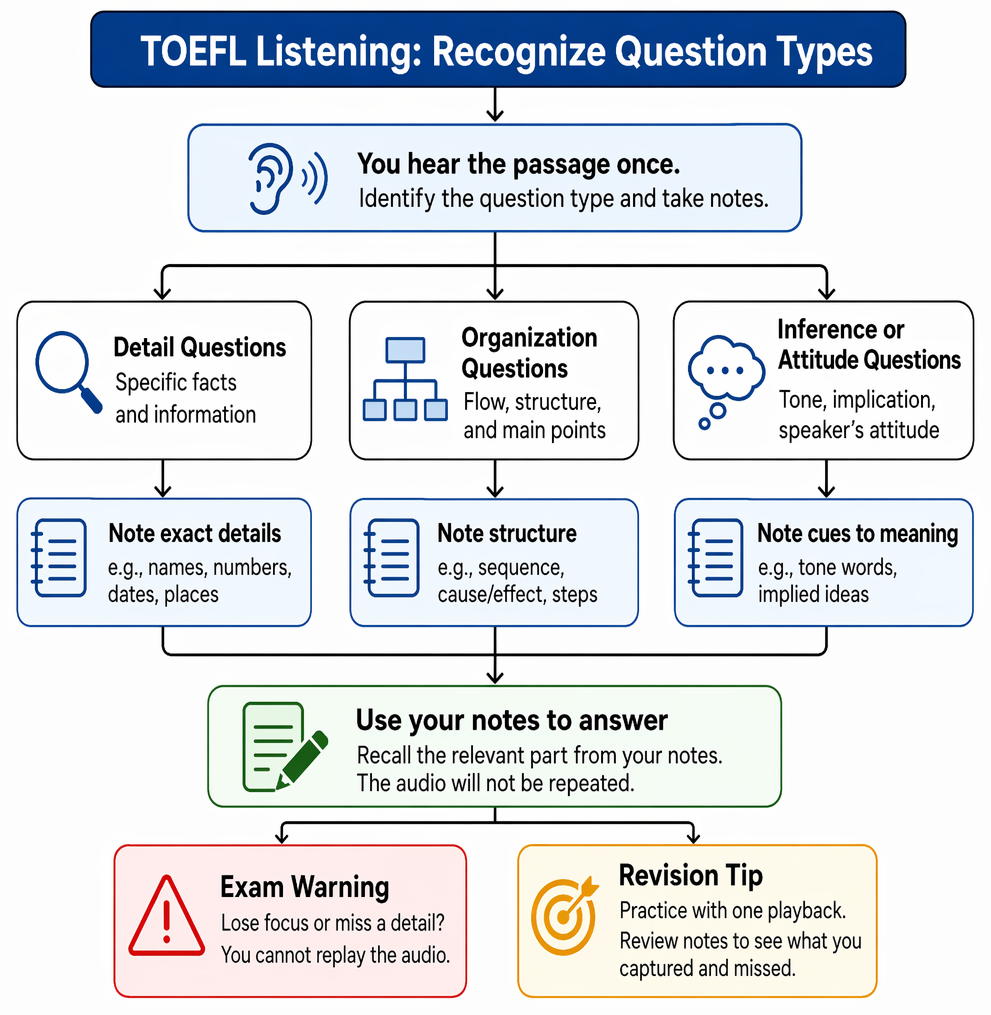
Note-taking focuses by question type include specific facts, discourse structure, speaker purpose, and tonal or inferential cues.
- Detail questions: require accurate notes on specific facts.
- Organization questions: demand you follow the flow and structure.
- Inference or attitude questions: you must listen for tone and implication.
You must rely on your notes because the passage will not be repeated. Train yourself to identify the type of question and recall the relevant part from your notes.
Worked Example 1.1
A TOEFL Listening audio plays a campus conversation between a student and a library clerk about finding a textbook. The audio lasts two minutes and is played only once.
Question: What is the main reason the student visited the library clerk?
Answer:
The student wanted help locating a textbook that was not on the shelf, hoping the clerk could suggest where to find it. Explanation: You should have noted the main topic of the conversation and the student's problem during listening. Since the passage cannot be replayed, your note for this conversation might say: "Student needs help—textbook missing—clerk gives suggestions." Rely on this note (not just memory) to answer.
Worked Example 1.2
A TOEFL Listening audio passage presents a biology lecture about bats' feeding habits. You listen once, make notes, and then see this question:
Question: According to the lecture, how do bats find insects in the dark?
Answer:
Bats use echolocation—emitting sound waves and listening for echoes to locate insects. Explanation: If your note said "bats—find insects—echolocation (sound waves, echoes)" you can answer accurately even if you don't remember the wording or exact explanation from the lecture.Exam Warning: If you lose focus for even a few seconds or miss a key detail in a Listening passage, you cannot replay the audio. All answers must come from the first and only playback.
Revision Tip: Practice listening to short lectures or news reports using only one playback and make notes each time. Review your notes afterward to check which details you captured and what was missed.
Summary
TOEFL Listening uses one-time playback for audio sources. You cannot repeat audio, so you must practice concentrated listening and clear note-taking to follow the passage and answer all types of questions.
Key Point Checklist
This article has covered the following key knowledge points:
- Understand that TOEFL Listening audio is only played once, with no option to replay.
- Recognize why effective, selective note-taking is essential under one-time playback conditions.
- Identify types of Listening questions most affected by the single-play rule.
- Practice active listening and use signal words to focus on main ideas and organization.
- Use simple abbreviations and symbols in your notes to quickly record and remember details.
- Know that attentive, well-organized notes can help answer all Listening question types accurately.
Key Terms and Concepts
- One-time Playback
- Note-taking
- Audio Source
- Active Listening
- Signal Words