Learning Outcomes
After studying this article, you will be able to distinguish expository, argumentative, and historical texts as they appear in TOEFL Reading passages. You will recognize typical organization structures for each, identify main ideas quickly, and predict the likely types of questions for each passage type. You will also learn how organizational clues help you locate information efficiently in different passage types.
TOEFL iBT Syllabus
For TOEFL, you are required to identify and interpret fundamental passage types and their structures. For revision, focus on these syllabus points:
Expository, argumentative, and historical texts are grouped by typical structural components such as process description, counterargument, and chronological sequence.
- Recognize the differences between expository, argumentative, and historical reading passages.
- Identify main idea, supporting detail, and purpose in different passage types.
- Predict common question formats based on passage organization.
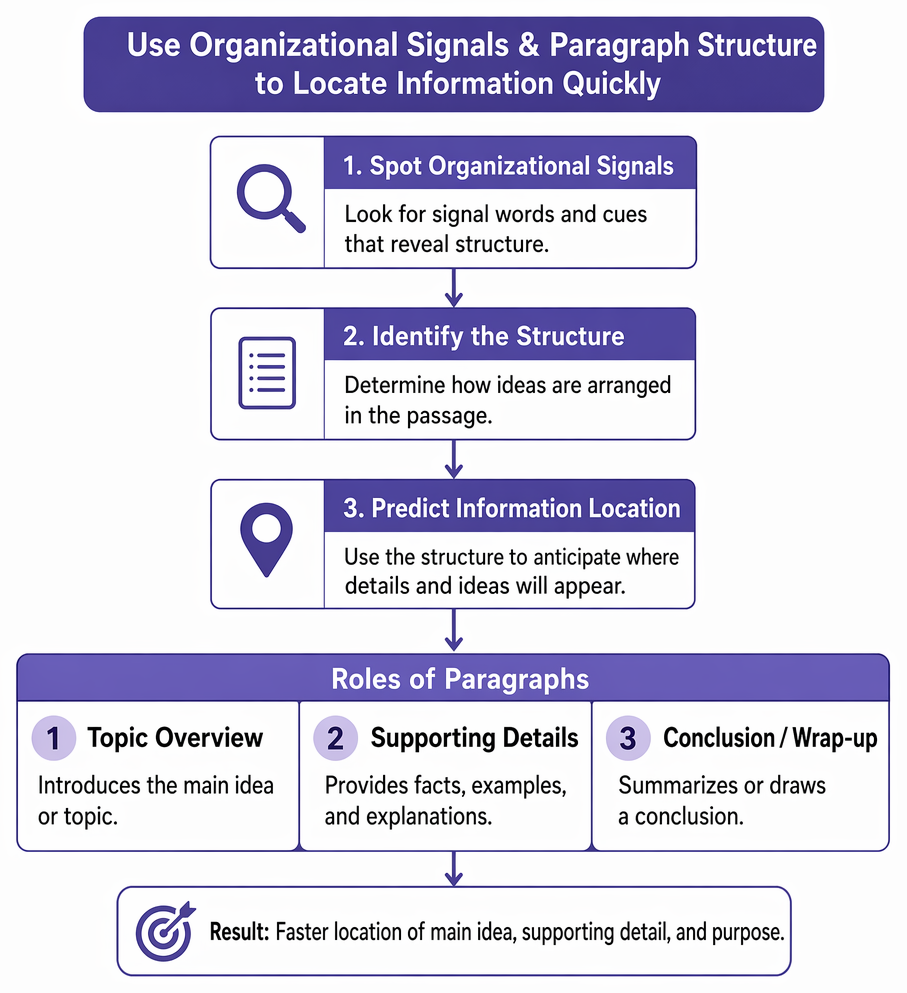
- Use organizational signals and paragraph structure to locate information quickly.
- Distinguish between factual reporting, explanation, and analysis in texts.
Test Your Knowledge
Attempt these questions before reading this article. If you find some difficult or cannot remember the answers, look more closely at that area during your revision.
- Which passage type is most likely to contain a chronological sequence of events?
- What signal might indicate a writer is presenting his or her point of view?
- What is the main organizational pattern of an expository text?
- True or false: Argumentative passages are always based on opinion, never evidence.
Introduction
The TOEFL Reading section contains academic texts that mirror university-level materials—primarily taken from natural sciences, social sciences, arts, and history. Understanding the types of passages presented, and how each is organized, is essential for answering questions efficiently and achieving a high score.
Different passage types follow distinct patterns:
- Expository passages explain or describe concepts, processes, or facts.
- Argumentative texts present a position and support it with evidence and reasoning.
- Historical passages recount or explain past events, often in chronological order.
Recognizing these types and their typical organizations helps you find main ideas, understand details, and predict common TOEFL questions.
Key Term: Expository Text
An academic passage whose main purpose is to explain, describe, or inform about a topic, fact, or process. Key Term: Argumentative Text
A passage that presents a claim or viewpoint, supports it with reasoning and evidence, and sometimes refutes counterarguments. Key Term: Historical Text
A reading passage focused on describing, analyzing, or recounting past events, developments, or periods, usually in temporal order.
Identifying Passage Types
TOEFL passages do not always announce their type directly. However, clues such as organization, language, and the presence of dates or opinions help you determine the type quickly.
- Expository texts: Frequently use headings or topic sentences that present a concept. Most details are factual, definitions, or explanations.
- Argumentative texts: Include thesis statements, words like “claim,” “argue,” or “should.” Look for evidence, examples, and counterarguments.
- Historical texts: Provide dates, periods, names of people or places, and arrange details in time sequence.
Knowing the type guides your reading approach and helps you anticipate question types.
Organization Signals in Each Passage Type
- Expository: Organized by definition, classification, cause/effect, or process. Paragraphs usually begin with topic sentences, followed by supporting explanations or examples.
- Argumentative: Often structured as an introduction (claim), supporting body paragraphs with reasons and evidence, and sometimes a conclusion or counterargument. Signal words include “however,” “therefore,” “on the other hand,” or “in contrast.”
- Historical: Organized chronologically or by major developments. Transitions like “first,” “next,” “during,” “in [year],” and “as a result” are common.
Key Term: Topic Sentence
The sentence—often at the start of a paragraph—that states its main idea. Key Term: Chronological Organization
Arrangement of details or events in the order in which they occurred in time.
Typical Question Styles by Passage Type
- Expository: Main idea, detail, definition, process description, purpose of a paragraph or sentence.
- Argumentative: Author’s claim, supporting evidence, inference about point of view, function of an example, refutation of an opposing view.
- Historical: Chronological order of events, effect of a development, reason for a historical change, identification of primary sources, main achievement.
Recognizing these question types allows faster and more focused answering on test day.
Worked Example 1.1
Read the following excerpt:
“Throughout the late 19th century, several vaccines were developed and tested in Europe and North America. Scientific collaboration and the exchange of medical knowledge led to rapid progress, with new vaccines introduced for previously deadly diseases.”
Question: What is the main purpose of this passage?
Answer:
The passage’s main purpose is to explain (expository) how vaccine development advanced through scientific effort and knowledge exchange in the late 19th century.
Worked Example 1.2
Read the excerpt:
“Some researchers argue that strict recycling laws are not effective because they place undue burden on consumers while doing little to change large-scale manufacturing waste. Proponents suggest alternative solutions, such as regulations for industrial polluters.”
Question: According to the passage, what two positions are presented and what type of passage is this?
Answer:
The passage presents two positions—criticism of strict recycling laws, and support for industrial regulation. This is an argumentative passage because it compares viewpoints and suggests evidence.
Worked Example 1.3
Read the excerpt:
“In 1945, the city’s population doubled as soldiers returned from war. Over the next decade, government investment in infrastructure and industry transformed living standards for most residents.”
Question: What organizational pattern is used in this passage, and what type is it?
Answer:
The passage uses chronological organization, detailing events in time order (1945, then the next decade). It is a historical passage describing post-war changes.Exam Warning: Don't assume every reading passage uses the same question types. Argumentative and historical texts may require you to infer author opinion or identify causes and effects—not just find simple factual details. Always check the passage type before answering.
Revision Tip: When reviewing passages, underline signal words or topic sentences. This will make it easier to recognize how the text is organized and predict upcoming questions.
Summary
- TOEFL Reading passages can be expository (explain), argumentative (present and justify a claim), or historical (recount events).
- Each type has predictable organization and signals—learn to spot them quickly.
- Recognizing passage type helps you find main ideas, details, and understand question expectations.
Key Point Checklist
This article has covered the following key knowledge points:
- Identify the three key TOEFL Reading passage types: expository, argumentative, and historical.
- Understand typical structure and organizational clues for each text type.
- Predict and answer common question styles based on passage organization.
- Use headings, topic sentences, and signal words to find information quickly.
- Apply knowledge of passage organization to select or eliminate answer choices efficiently.
Key Terms and Concepts
- Expository Text
- Argumentative Text
- Historical Text
- Topic Sentence
- Chronological Organization