Learning Outcomes
After studying this article, you will be able to accurately paraphrase academic material for TOEFL Integrated Writing, select and connect evidence from reading and listening sources, and use precise source-linked language to show clear relationships between evidence and its origin. You will also know how to avoid copying, maintain task focus, and create organized, source-connected responses that meet TOEFL expectations.
TOEFL iBT Syllabus
For TOEFL, you are required to demonstrate clear paraphrasing of ideas and accurate linking of information to the source (reading or listening) in Integrated Writing. Review and practice these syllabus points:
- Recognize and avoid direct copying; use your own wording for both reading and listening content.
- Paraphrase complex ideas while retaining their essential meaning.
- Link each piece of evidence to its exact source (e.g., "The reading states...", "The lecturer argues...") using explicit reference.
- Summarize main points without adding opinions, using objective reporting verbs.
- Ensure all key lecture points are connected to relevant reading ideas, showing a clear source relationship.
- Organize your response to match the typical three-point structure (three main arguments or ideas).
- Use concise, direct language to report, explain, and connect ideas from sources.
Test Your Knowledge
Attempt these questions before reading this article. If you find some difficult or cannot remember the answers, look more closely at that area during your revision.
- What is "paraphrasing" in the context of TOEFL Integrated Writing, and why is it important?
- Why must every key idea in your essay be explicitly attributed to its source in Integrated Writing?
- Which reporting verb could you use to show that a point comes from the listening, not the reading?
- True or false: Copying full sentences from the reading into your Integrated essay will result in a high-scoring answer.
Introduction
In the TOEFL Integrated Writing task, you must write an essay that clearly explains how points in a lecture relate to points in a reading. The most important skills for this question are paraphrasing—writing ideas in your own words—and explicitly linking every idea to its source. Answers that copy sentences, or present facts without showing which source they come from, will not meet TOEFL standards.
Key Term: Paraphrasing
Restating an idea from a source in your own words, while preserving the original meaning. On TOEFL, paraphrasing is required; copying is not permitted. Key Term: Source-linked Evidence
Clearly connecting material, facts, or arguments to their origin (reading or listening) with specific reference language in your essay.
Why Paraphrasing and Source-linking Matter
Your Integrated Writing essay must prove you can use academic reading and listening material accurately and objectively. TOEFL raters want to see that you can:
- Avoid copying, even small phrases.
- Express ideas concisely in your own style.
- Show how the lecture supports, contradicts, or explains points in the reading.
An essay that fails to use source-linked language (such as, "According to the lecture, ...") risks confusing the reader and losing essential points.
Key Term: Reporting Verb
A verb such as "states," "claims," or "maintains" that introduces information from a specific source and signals its origin.
How to Paraphrase Effectively
Paraphrasing means restating all content from the passage and the talk in different language. You should:
- Change sentence structure and vocabulary.
- Keep technical terms only if there is no substitute.
- Do not repeat phrases or sentences from either source.
Paraphrase entire main ideas as well as supporting details. The paraphrased version should be shorter, clearer, and match your writing style.
Key Term: Objective Summarizing
Reporting information without adding your opinion or judgment, focusing on the author’s or speaker’s meaning.
Making Source-linkage Clear
Every major point, detail, or example must state its source. Do this by:
- Beginning with a clear reference: "The reading explains that..."; "The lecturer argues that..."; "According to the lecture, ..."
- Using reporting verbs to attribute points.
- Referring back to the correct source as the essay develops.
If you switch from reading to listening, or vice versa, signal it immediately.
Explicit Source-connected Language
Use standard TOEFL objective reporting stems, such as:
- The reading states / explains / points out that...
- The lecturer responds / disputes / notes that...
- According to the lecture ...
- The reading claims...
- The lecturer maintains...
Variety is good, but clarity is more important than stylistic variety for exam success.
Example Structure: Paragraph Organization
Most Integrated Writing tasks expect three lecture points. Each body paragraph should typically:
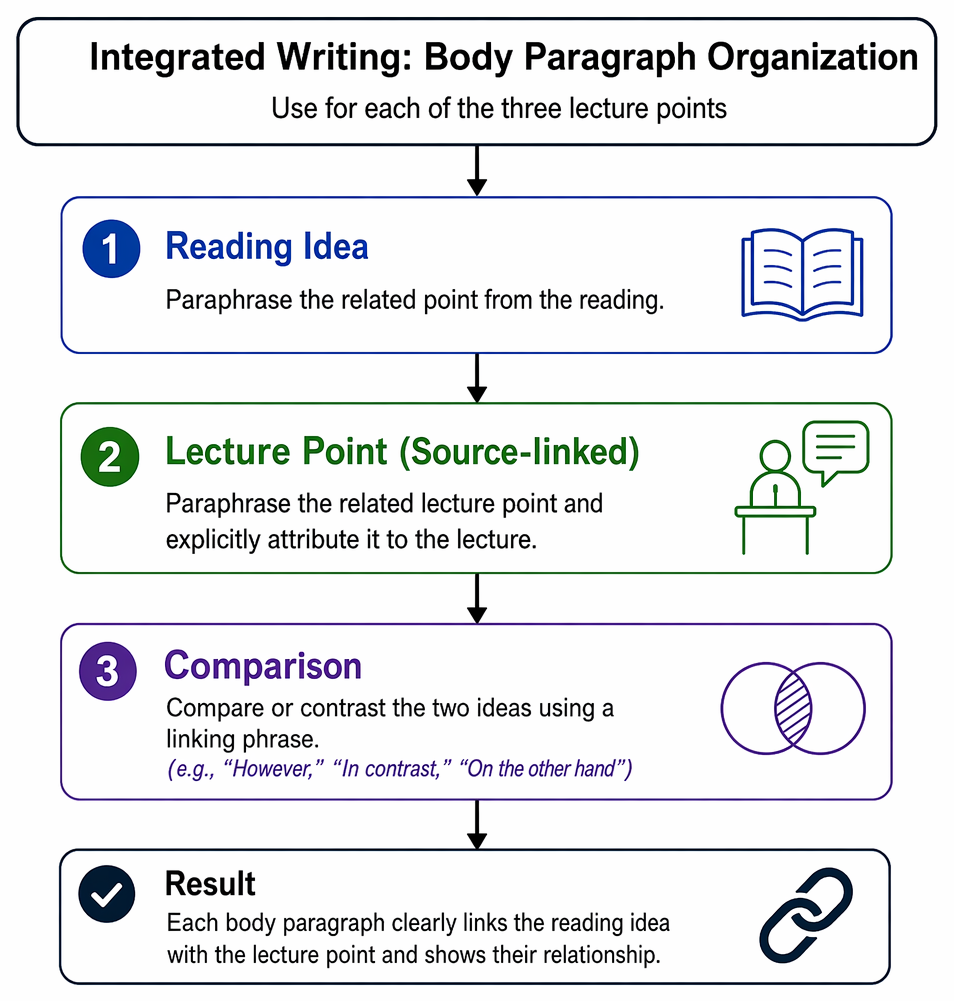
Paraphrase revision stages include syntactic reformulation, synonym replacement, selective retention of technical terminology, and checking for copied multiword sequences.
- Summarize a reading idea.
- Attribute a related lecture point to the lecture, using a clear reference and paraphrase.
- Compare or contrast the two ideas with a linking sentence (e.g., "However," "In contrast," or "On the other hand").
Do not write opinions or conclusions based on your own beliefs. Stay focused on accurate, source-linked summary.
Worked Example 1.1
Reading Summary (Paraphrased):
Researchers have argued that small online classes lead to higher student satisfaction because they allow more personal interaction. They also claim that students receive more frequent feedback and individualized support.
Listening Summary (Paraphrased with Explicit Source-linking):
The lecturer contradicts the reading’s points. According to the lecture, small class size is not the main factor in student satisfaction. The lecturer notes that some students in large online classes are satisfied if instructors design activities for group support, proving that feedback and support can be achieved without a small class size.
Model TOEFL-style Paragraph:
The reading claims that students are more satisfied in small online classes due to personal interaction and individualized feedback. In contrast, the lecture explains that class size is less important than the teaching methods used. The lecturer states that even in large online sections, frequent feedback and support are possible if the instructor sets up effective group activities.
Answer:
This paragraph demonstrates clear paraphrasing and explicit, source-linked reference using reporting verbs for both reading and lecture ideas.
Worked Example 1.2
Short TOEFL-style Passage:
The reading passage asserts that hybrid cars are better for the environment because they use less gasoline. It also suggests that government subsidies encourage more drivers to buy them.
Lecture Point (Listening):
The lecturer argues that, although hybrids reduce fuel use, some environmental damage still results from electricity generation for charging the cars. He also points out that giving subsidies only to hybrid buyers is unfair to people who cannot afford these cars.
Sample Essay Paragraph:
The reading states that hybrid cars benefit the environment due to their fuel efficiency and that subsidies increase adoption rates. However, the lecturer counters that hybrid cars still contribute to pollution indirectly, since electricity for charging often comes from fossil fuels. Additionally, the lecturer claims that government subsidies are not truly helpful for lower-income individuals, as they may not be able to purchase hybrids at all.
Answer:
This paragraph uses paraphrased content and links every major idea to its precise source, both for reading and lecture.Exam Warning: Many students lose points by copying two or more consecutive words from the reading or listening. TOEFL scorers can see direct copying immediately. Another common mistake is making general statements that do not specify the source ("Some believe...") instead of using explicit attributions ("The lecturer asserts..."). Always use paraphrase and direct source linkage.
Revision Tip: After writing each major point, quickly check: Does this idea clearly state whether it comes from the reading or the lecture? Is it expressed in words and structure that sound natural for me?
Key Point Checklist
This article has covered the following key knowledge points:
- Paraphrasing means expressing an idea in completely different language while preserving the meaning.
- Direct copying from reading or listening is not accepted on TOEFL.
- You must attribute every major idea to its exact source: reading or lecture.
- Use clear reporting verbs (e.g., states, argues, explains) and explicit attribution.
- Organize Integrated Writing essays so each paragraph links lecture ideas to related reading points.
- Never add your own opinions, nor summarize without clear source reference.
Key Terms and Concepts
- Paraphrasing
- Source-linked Evidence
- Reporting Verb
- Objective Summarizing