Learning Outcomes
After reading this article, you will be able to describe the structure and goals of the TOEFL Integrated Writing task. You will identify how the reading and listening sources are combined, understand what effective synthesis means, and explain how responses are scored. You will also recognize typical question wording, spot common mistakes, and apply key strategies for exam success.
TOEFL iBT Syllabus
For TOEFL, you are required to demonstrate written academic English using information from both reading and listening sources. For revision, focus on these syllabus points:
- Explain the Integrated Writing task’s step-by-step format (read, listen, write).
- Describe the purpose of integrating ideas from two sources.
- Identify how the task measures your ability to combine information, paraphrase, and organize a summary linking the lecture and reading.
- Practice responding to typical question phrasings and meeting the time and word requirements.
Test Your Knowledge
Attempt these questions before reading this article. If you find some difficult or cannot remember the answers, look more closely at that area during your revision.
- What are the three main steps in the TOEFL Integrated Writing task, and how much time is given for each?
- What does the term "integrating" mean in the context of the Integrated Writing task?
- True or false: TOEFL Integrated Writing responses should include your personal opinion if you disagree with the reading or lecture.
- Describe at least one common error test takers make in this section.
Introduction
The Integrated Writing task in TOEFL iBT tests how well you combine information from two academic sources: a reading passage and a lecture. Your task is to write a summary that clearly explains how the key points from the lecture relate to the reading. This section is not about your personal views, but about accurate reporting and summarizing.
Key Term: Integrated Writing task
A writing section on the TOEFL iBT where you combine (integrate) information from a reading and a listening source into a summary essay.
The Read–Listen–Write Format
You begin the Integrated Writing section by reading a short academic passage. Immediately after, you listen to a short lecture on the same topic. Finally, you have 20 minutes to write a structured essay explaining how the main points from the lecture support or challenge those from the reading.
Key Term: Synthesis
The skill of logically combining ideas or evidence from two different sources to create a clear, accurate summary or explanation.
Task Purpose
The aim of this task is to see if you can write clearly with academic English while using information only from the sources provided. This means you must:
- Paraphrase key ideas from both the lecture and the reading.
- Compare, contrast, or connect information where required.
- Avoid adding your personal views or outside information.
- Write in a structured, concise, and well-organized manner.
Key Term: Paraphrase
Restating information from a source in your own words while keeping the meaning the same.
Structure and Timing
The Integrated Writing task has three precise steps:
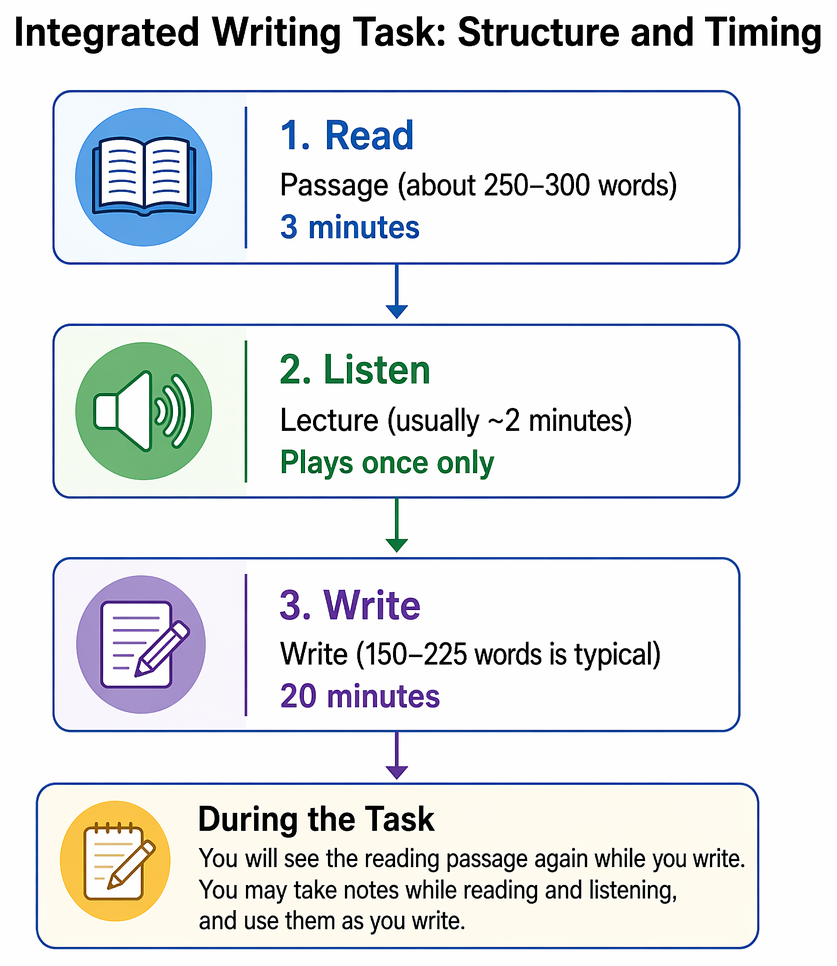
Lecture and reading synthesis involves identifying whether the lecture supports or challenges the text, matching corresponding points, and paraphrasing source content.
- Read: A passage (about 250–300 words) is presented for 3 minutes.
- Listen: A lecture (usually ~2 minutes) plays once only.
- Write: You have 20 minutes to write (150–225 words is typical).
You will see the reading passage again while you write. You may take notes while reading and listening, and use them as you write.
Key Term: Integrated Essay
A short academic response linking information from two sources, required in TOEFL Integrated Writing.
Common Question Wording
Questions in this section often say:
- "Summarize the main points in the lecture and explain how they cast doubt on the points in the reading passage."
- "Explain how the points in the lecture support the statements in the reading passage."
You must address every main point in the lecture and clearly connect each one to a point from the reading.
Worked Example 1.1
Read the following reading passage:
"Online courses offer students flexibility, wider access, and convenience. Many educators believe online courses are just as effective as traditional in-person classes because students have access to the materials at any time and can replay lectures."
After reading, you hear this lecture:
"Despite the growth of online courses, many students struggle to stay motivated. Technical issues and lack of personal interaction can make it harder for students to learn effectively. Several studies show that students in traditional classrooms complete more assignments and receive higher grades than those online."
Question: Summarize the main points in the lecture and explain how they challenge the claims made in the reading.
Answer:
The lecture disputes the claims in the reading by citing studies that show students in regular classrooms do better than those learning online. While the reading says online courses provide flexibility and wide access, the lecture points out that technical problems and less face-to-face contact often lead to lower motivation and less effective learning. Thus, the speaker argues that traditional in-person classes are more successful than online courses.
What Makes a Good Response?
A high-scoring answer always:
- Clearly summarizes the main points from both sources.
- Explains the connection (usually disagreement) between each point in the reading and the lecture.
- Uses your own words.
- Is well organized, with a brief introduction, body paragraphs covering each related point, and a short conclusion or summary if time allows.
Key Term: Scoring Rubric
The official TOEFL marking guide that assigns levels based on task fulfillment, organization, vocabulary, connection of ideas, and grammatical accuracy.
Common Errors and Exam Tips
Exam Warning: Many students lose marks for including their opinion or outside knowledge. Remember, your response must only include what the sources say. Copying whole sentences from the reading or lecture also results in a lower score—always use your own words.
Revision Tip: Practice by outlining which points in the lecture support or contradict each point in the reading. This planning step speeds up writing and increases clarity.
Key Point Checklist
This article has covered the following key knowledge points:
- Explain the TOEFL Integrated Writing (read–listen–write) task and its format.
- Identify the purpose: integrating information, summarizing, and connecting both sources.
- Structure responses by comparing/contrasting lecture and reading points.
- Avoid personal opinions and copying; use paraphrase.
- Time management: 3 minutes reading, ~2 minutes listening, 20 minutes writing.
- Understand what the scoring rubric requires.
Key Terms and Concepts
- Integrated Writing task
- Synthesis
- Paraphrase
- Integrated Essay
- Scoring Rubric