Learning Outcomes
After studying this article, you will be able to identify and use referencing devices and transition signals to improve clarity and logical flow in TOEFL writing and speaking responses. You will learn how to avoid ambiguity, construct coherent paragraphs, and apply common transition words and pronouns to connect ideas smoothly in both integrated and independent TOEFL tasks.
TOEFL iBT Syllabus
For TOEFL, you are required to demonstrate control of coherence in written and spoken responses. For revision, focus on the following syllabus points:
- Identify references used to replace or refer to earlier information, such as pronouns, demonstratives, and synonyms.
- Recognize and use transition signals to indicate relationships between sentences and paragraphs (addition, contrast, cause, etc.).
- Construct responses where referencing and transition use lead to logical, connected paragraphs and complete essays.
- Avoid ambiguity in referencing and incorrect or missing transitions.
- Appropriately connect ideas in both integrated and independent questions.
Test Your Knowledge
Attempt these questions before reading this article. If you find some difficult or cannot remember the answers, look more closely at that area during your revision.
- What is the main purpose of using pronouns such as "it" or "this" in TOEFL essays and responses?
- Give two examples of common transition words and explain what kind of relationship each indicates.
- What is a common mistake when using referencing devices that can lead to confusion in your writing?
- True or false: In TOEFL writing, every paragraph should start with "Additionally" or "However." Why/why not?
Introduction
Producing a connected and successful TOEFL response depends on how ideas are linked within and across sentences and paragraphs. This skill is tested explicitly throughout the TOEFL iBT, particularly in the Writing and Speaking sections. You must demonstrate clear organization by using referencing words and transition signals accurately. This article explains the principles of referencing and transitions, provides worked examples, and offers revision advice specific to TOEFL assessment.
Key Term: Referencing (Reference)
The use of words, such as pronouns and demonstratives, to refer back to or replace earlier content in a passage. This prevents unnecessary repetition and helps maintain clarity and flow. Key Term: Transition Signal
A word or phrase that shows the relationship between ideas, sentences, or paragraphs, such as addition, contrast, or cause. Transition signals guide the reader or listener through your argument or explanation.Test Tip: When practising Cohesion: referencing and transitions, connect each technique or language choice to the exact task demand, audience, or text purpose.
Coherence by Referencing: Avoiding Repetition and Ambiguity
Referencing prevents repetition by using pronouns ("it", "they", "this", "these"), demonstratives ("this idea", "such results"), or synonyms to refer back to earlier words or phrases. However, referencing only helps if it is clear what each reference means.
When referencing is unclear, the reader may not know what "it", "they", or "this" refers to. If two different items are referenced by the same pronoun, ambiguity will occur. Ambiguous referencing is penalized in TOEFL essays and spoken responses.
Key Term: Ambiguity (in referencing)
When a pronoun or referencing word could refer to more than one possible noun or idea, confusing the reader about what is meant.
Common Types of Referencing in TOEFL
- Personal pronouns: it, they, he, she, him, her, them, etc.
- Demonstrative pronouns: this, that, these, those.
- Synonyms or paraphrases: replacing a word with a similar one in the following sentence.
- Grammatical substitution: such + noun, the former/latter.
Poor referencing usually happens when you use "it" or "this" too soon after two or more noun phrases, or when you use "these", "those", or "which" without a clear antecedent.
Worked Example 1.1
Passage:
Most cities are suffering from increased traffic congestion. Traffic jams are common during peak hours, and public transport is often overcrowded. These conditions make commuting stressful for many residents.
Question: In the passage above, what does the word "These" refer to? Why is this referencing effective?
Answer:
"These" refers back to the set of earlier conditions: increased traffic congestion, frequent traffic jams, and overcrowded public transport. This referencing is effective because it clearly collects all the negative conditions just described, allowing for a concise sentence without repeating all the terms.
Worked Example 1.2
Example of ambiguity:
The professor discussed the results of the experiment with her teaching assistant before she published them.
Question: What does "them" refer to: the results or the assistant? What problem does this cause?
Answer:
"Them" could refer to either "the results" or "her teaching assistant". This is ambiguous and may confuse the reader. For clarity, refer specifically: "...before she published the results," or "...before she published the results with her teaching assistant.”
Exam Warning – Referencing
Failing to use specific nouns after transition words, or using pronouns with unclear referents, will lower your TOEFL score. Always check that each reference clearly matches a previously stated noun or idea.
Transitions: Signaling the Relationships Between Ideas
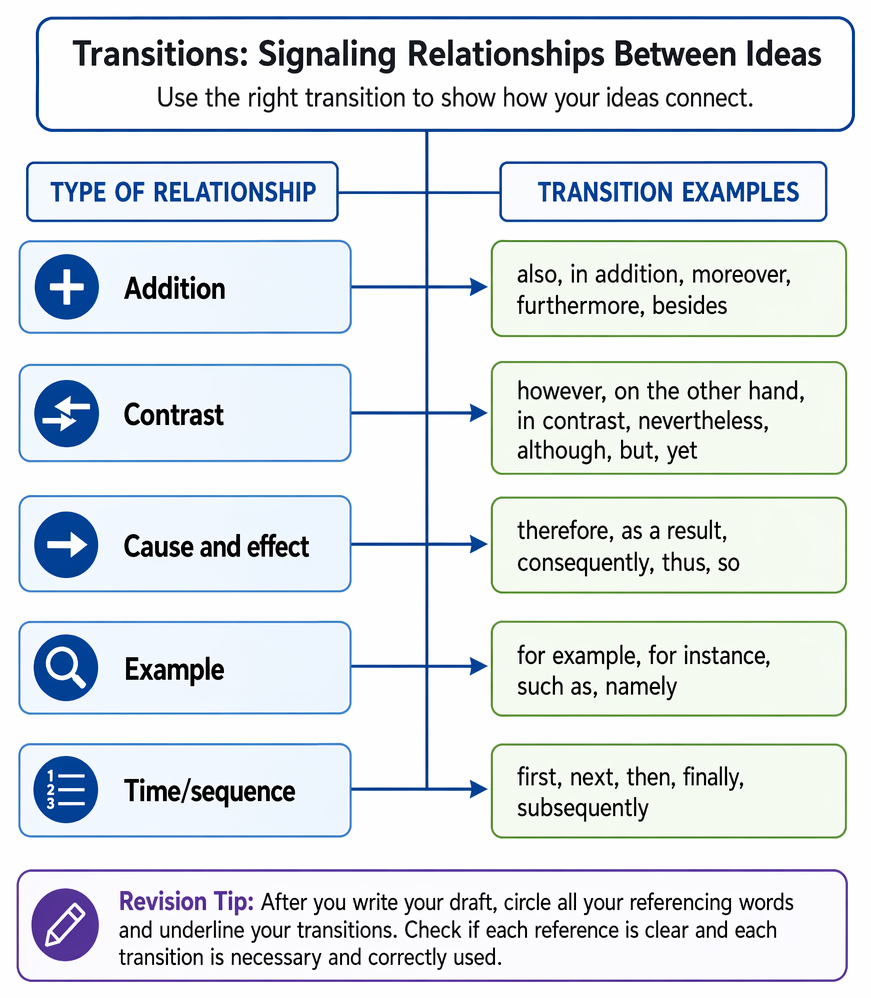
Transitions are essential to guide the reader through your response. They make your argument or explanation easier to follow. Each type of transition has a specific use:
Transition signals are presented from assessing necessity to selecting relation type and checking position, grammar, punctuation, and flow.
- Addition: also, in addition, moreover, furthermore, besides
- Contrast: however, on the other hand, in contrast, nevertheless, although, but, yet
- Cause and effect: therefore, as a result, consequently, thus, so
- Example: for example, for instance, such as, namely
- Time/sequence: first, next, then, finally, subsequently
Incorrect use of transitions, or using a transition repeatedly out of habit, makes your writing sound mechanical and damages organization.
Key Term: Logical Connector
A transition word or phrase that shows a logical relationship between two clauses, sentences, or paragraphs (e.g. cause, addition, sequence).
Worked Example 1.3
Passage: Online education is becoming more popular among working adults. For example, a recent survey found that 46% of those enrolled in online courses have full-time jobs.
Question: What type of transition is "For example"? Why is it appropriate here?
Answer:
"For example" is a transition that introduces an illustration or evidence. It is appropriate here because the sentence provides specific data to support the preceding general statement.Revision Tip: After you write your draft, circle all your referencing words and underlining your transitions. Check if each reference is clear and each transition is necessary and correctly used.
Building Paragraphs and Essays with Referencing and Transitions
A well-organized TOEFL response connects ideas at three levels:
- Within sentences — referencing avoids repetition.
- Between sentences — referencing and transitions connect statements.
- Between paragraphs — transitions and explicit references link discussion sections.
Ensure each paragraph’s first sentence links clearly to what came before, usually with a transition or summarizing reference ("This trend...", "Another factor...").
Worked Example 1.4
Opening sentences of two paragraphs:
Paragraph 1: Modern diets often contain large amounts of processed sugar. Paragraph 2: As a result, rates of obesity have increased worldwide.
Question: What is the function of "As a result" at the beginning of Paragraph 2?
Answer:
"As a result" expresses a cause-effect relationship, linking the increase in obesity to the prevalence of processed sugar in diets introduced in the first paragraph.
Common TOEFL Errors with Coherence
- Using "this", "that", "these", "those", or personal pronouns without a clear noun referent.
- Overusing transition signals or using them where logical connection is unclear ("On the other hand" without a real contrast).
- Beginning every body paragraph with "Additionally" or "Furthermore".
- Failing to connect paragraphs, causing abrupt topic shifts.
- Using transition words as sentence fragments.
Exam Warning (Transitions)
Transition words do not replace complete sentences. Never use a transition (e.g., "Therefore, because...") as a stand-alone sentence.
Key Point Checklist
This article has covered the following key knowledge points:
- Explain referencing as a method for avoiding repetition and connecting ideas.
- Identify and correct ambiguity in referencing words.
- Use transition signals appropriately to show relationships (addition, contrast, cause, example).
- Connect paragraphs and answers logically in TOEFL speaking and writing.
- Spot and avoid common errors with referencing and transitions.
Key Terms and Concepts
- Referencing (Reference)
- Transition Signal
- Ambiguity (in referencing)
- Logical Connector