Learning Outcomes
After studying this article, you will be able to write and speak using accurate English grammar with effective organization and an appropriate academic register. You will understand common TOEFL requirements for sentence structure, error correction, and academic style, and apply these skills to strengthen both your speaking and writing responses in test situations.
TOEFL iBT Syllabus
For TOEFL, you are required to demonstrate control of grammar and organization as well as suitable academic register. For revision, focus on these syllabus areas:
- Identify and avoid frequent grammar mistakes such as subject-verb disagreement, incorrect verb tense, and faulty sentence structure.
- Apply correct sentence punctuation and prevent sentence fragments or run-ons.
- Use formal, accurate vocabulary and structures to meet academic register standards.
- Organize sentences and paragraphs in coherent, logical order.
- Edit your speaking and writing for grammar, organization, and formality.
Test Your Knowledge
Attempt these questions before reading this article. If you find some difficult or cannot remember the answers, look more closely at that area during your revision.
- What is the difference between a sentence fragment and a run-on sentence?
- Which word choice best demonstrates academic register for the TOEFL: "kids," "children," or "youngsters"?
- True or false: Contractions (like "it's" or "can't") should always be used in your TOEFL essays.
- Identify the error in this sentence: "The results indicates a significant improvement."
Introduction
Accurate grammar and academic register are essential for success in TOEFL Speaking and Writing tasks. The examiner checks not only your ideas but also how clearly, correctly, and formally you express them. Effective organization—both within sentences and across paragraphs—shows the reader that your ideas are logically connected and easy to follow. In this article, you will review main principles for grammar accuracy, formal register, and organizing your language to meet TOEFL standards.
Key Term: Grammar Accuracy
The correct and consistent use of the rules of English grammar, including verb forms, agreement, punctuation, and sentence structure. Key Term: Academic Register
A formal style of English language used in academic and professional contexts, avoiding slang, contractions, and overly casual vocabulary. Key Term: Organization
The clear and logical arrangement of sentences and ideas in both spoken and written language.
Grammar Accuracy and Error Avoidance
Common Grammar Errors
Many TOEFL candidates lose points because of repeated simple errors. These include:
-
Subject-Verb Agreement: The subject and verb must match in number (singular or plural):
- Incorrect: The data shows…
- Correct: The data show… (data = plural noun)
-
Verb Tenses: Use the correct verb tense for time reference and sequence.
- Incorrect: Yesterday, she write the essay.
- Correct: Yesterday, she wrote the essay.
-
Sentence Fragments: A complete sentence must have a subject and a verb and express a complete idea.
- Fragment: Because the experiment failed.
- Correct: The experiment failed.
-
Run-on Sentences: Two complete sentences joined without proper punctuation or conjunction.
- Run-on: The results were surprising the researchers reported new findings.
- Correct: The results were surprising. The researchers reported new findings.
-
Pronoun Reference: Make sure each pronoun (it, they, this) clearly refers to a specific noun.
Punctuation for Clarity
Punctuation helps separate ideas, clarify meaning, and create professional tone.
- Commas separate items in a list or join clauses with conjunctions.
- Periods end full sentences.
- Semicolons can connect two related independent clauses.
Building Correct Sentences
Every TOEFL sentence should have a clear subject and verb, use correct word order, and vary sentence length for readability. Combine short related ideas into complex or compound sentences when appropriate.
Using Academic Register
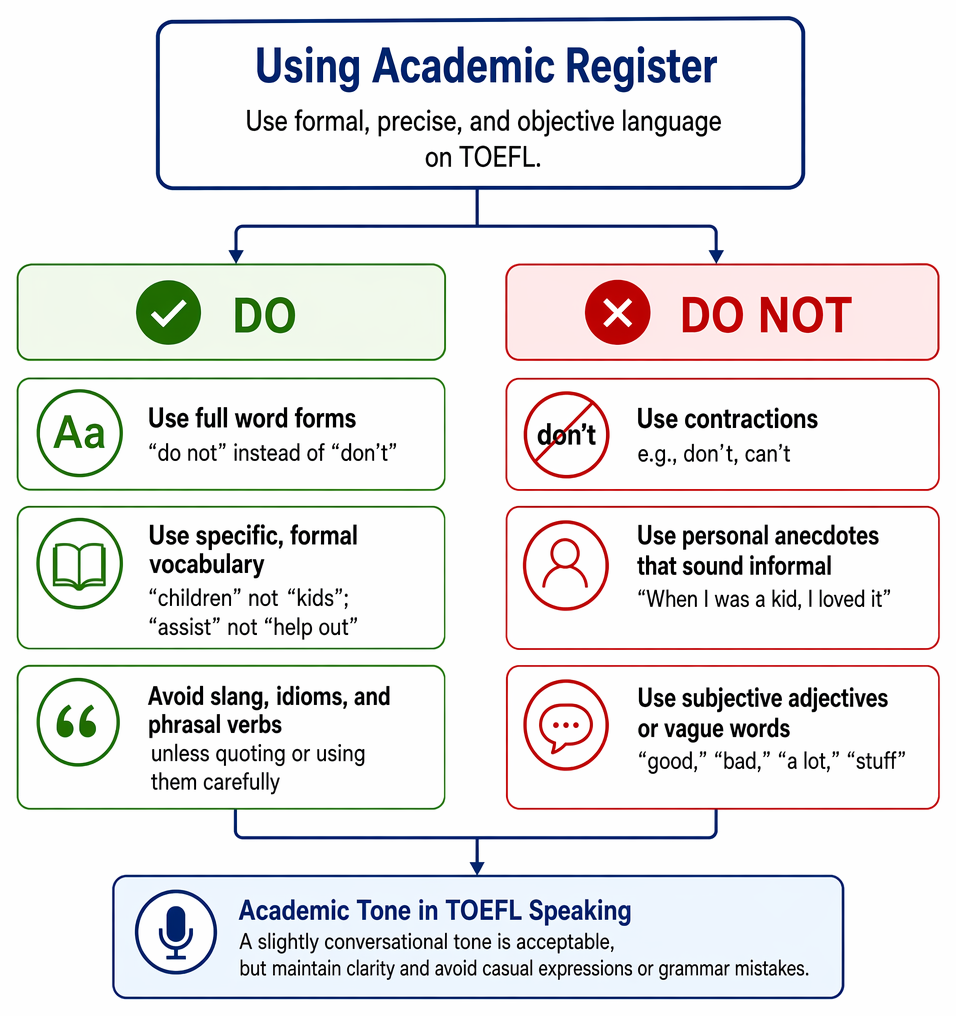
Academic English on TOEFL is different from everyday conversation. Language should be formal, precise, and objective.
Sentence analysis proceeds from subject-verb completeness to independent-clause connection, identifying fragments, run-ons, or acceptable punctuation and revision paths.
Do:
- Use full word forms ("do not" instead of "don't").
- Prefer specific, formal vocabulary ("children" instead of "kids"; "assist" instead of "help out").
- Avoid slang, idioms, and phrasal verbs unless quoting or using them carefully.
Do not:
- Use contractions.
- Use personal anecdotes that sound informal ("When I was a kid, I loved it").
- Use subjective adjectives or vague words ("good," "bad," "a lot," "stuff").
Academic Tone in TOEFL Speaking
While a slightly conversational tone is acceptable in the Speaking section, maintain clarity and avoid casual expressions or grammar mistakes.
Organization: Coherent Structure
Your TOEFL responses must have a clear, logical structure. In Writing tasks, each paragraph should have a topic sentence followed by supporting details and examples. Ideas should connect with transition words ("however," "therefore," "in addition," "for instance").
Key Term: Transition Word
A word or phrase that connects ideas and helps the reader follow your logic, such as "however," "in contrast," and "as a result."
Editing for Grammar and Register
Always leave time to check your writing or spoken notes for common mistakes. Focus on:
- Verb endings ("he studies," not "he study")
- Plural forms ("children," not "childrens")
- Correct punctuation
- Consistent use of formal, accurate vocabulary
Use available grammar checklists or editing guides to systematically review your answers.
Worked Example 1.1
Read the following sentence: In todays society, scientists is working hard to solve big problems in climate change, like weather and stuff.
Identify and correct the grammar and register errors.
Answer:
"In today's society, scientists are working hard to solve major problems concerning climate change, such as extreme weather."
- Apostrophe added for possessive ("today's")
- Plural verb ("are") to agree with subject ("scientists")
- "Is working" → "are working"
- "Big problems" → "major problems" (academic vocabulary)
- "Stuff" → "such as extreme weather" (precise academic expression)
Worked Example 1.2
Paraphrase for academic register: "People shouldn't use their phones in class because teachers get mad."
Answer:
"Mobile phones should not be used in class, as this distracts instructors and disrupts the learning environment."
- No contractions ("should not" not "shouldn't")
- Replaces "get mad" with "distracts instructors and disrupts the learning environment" (formal, precise vocabulary)
- Passive construction acceptable in academic writing
Worked Example 1.3
Spot the run-on sentence and correct it: The study examined the outcomes the results were unexpected it prompted further research.
Answer:
"The study examined the outcomes. The results were unexpected, and this prompted further research."
- Split into two sentences
- Added "and this" to clarify connection
Exam Warning: Examiners frequently reduce scores for repeated grammar mistakes or informal expressions, even if your ideas are strong. Always check language form and style.
Revision Tip: As you edit, read each sentence aloud (for Writing) or review your notes (for Speaking). Ask if it is complete, clear, and formal.
Key Point Checklist
This article has covered the following key knowledge points:
- Define grammar accuracy and academic register for TOEFL purposes.
- Identify and avoid frequent grammar errors in test responses.
- Apply formal, precise vocabulary for academic register.
- Organize sentences and paragraphs with topic sentences and transition words.
- Use systematic editing to correct grammar and register before submission.
Key Terms and Concepts
- Grammar Accuracy
- Academic Register
- Organization
- Transition Word