Learning Outcomes
After reading this article, you will be able to explain and distinguish maximax, maximin, minimax regret, and expected value as decision criteria under uncertainty. You will understand the risk attitudes associated with each, interpret payoff tables, construct regret tables, and apply these rules in practical scenarios. You will also be able to select appropriate criteria based on risk preferences and exam scenarios.
ACCA Advanced Performance Management (APM) Syllabus
For ACCA Advanced Performance Management (APM), you are required to understand how uncertainty affects decision-making and which tools help analyse possible outcomes. For this topic, focus your revision on:
- Explaining how risk and uncertainty affect strategic and operational decisions.
- Identifying and describing key decision criteria under uncertainty.
- Evaluating when to use maximax, maximin, minimax regret, or expected value approaches.
- Applying each decision rule to payoff tables and interpreting results.
- Relating decision rules to organisational or managerial risk appetite.
- Commenting on the appropriateness of different rules in given scenarios.
Test Your Knowledge
Attempt these questions before reading this article. If you find some difficult or cannot remember the answers, look more closely at that area during your revision.
-
Which decision rule is most suitable for a risk-seeking manager?
- a) Maximin
- b) Maximax
- c) Minimax regret
- d) Expected value
-
True or false? The minimax regret rule always produces the same result as the maximin rule.
-
Briefly explain the difference between uncertainty and risk as used in decision making.
-
A company faces three possible demand scenarios (low, medium, high). It can launch product X or product Y, and their associated profits are shown in a payoff table. Describe the process for determining which product to choose under the maximin rule.
-
Given probabilities for outcomes, which decision rule uses them in its calculation?
Introduction
Managers often face decisions where future outcomes depend on uncertain events. In these situations, different decision criteria help choose the best course of action, each reflecting a different view of risk. It is important for ACCA candidates to accurately apply, interpret, and justify the use of maximax, maximin, minimax regret, and expected value rules. This article explains each criterion, their associated risk attitudes, and how to apply them using payoff and regret tables.
Key Term: uncertainty
A situation in which the future outcome is unknown and probabilities of different results are not available. Key Term: risk
A situation where several outcomes may occur, but the probability of each can be estimated.
DECISION RULES UNDER UNCERTAINTY
Selecting between options when outcomes depend on uncertain events demands a systematic approach. Four major decision rules are commonly examined in the ACCA syllabus: maximax, maximin, minimax regret, and expected value. Each rule suits particular risk attitudes and situations.
Maximax (Optimistic)
The maximax rule (maximum of the maxima) considers the best possible outcome for each alternative and selects the alternative with the highest maximum payoff. This rule is for decision-makers who are risk-seeking and focus on achieving the most favourable result.
Key Term: maximax
A decision rule that chooses the alternative with the highest possible payoff, assuming the best-case scenario.
Maximin (Pessimistic)
The maximin rule (maximum of the minima) examines the worst outcome for each alternative, then selects the alternative with the best (largest) minimum payoff. This rule is appropriate for risk-averse managers who wish to avoid the worst-case scenario.
Key Term: maximin
A decision rule that chooses the alternative with the highest minimum payoff, focusing on the worst-case outcome.
Minimax Regret
The minimax regret rule involves first constructing a regret (opportunity loss) table, then identifying, for each alternative, the largest regret across possible outcomes. The chosen action is the one with the smallest of these maximum regrets. This rule fits individuals who wish to minimise the risk of missing the best possible outcome.
Key Term: minimax regret
A decision rule that selects the alternative with the smallest possible 'worst regret', aiming to limit possible lost opportunity.
Expected Value (Probabilities Known)
The expected value rule requires knowledge of the probability of each possible outcome. The decision-maker multiplies each payoff by its probability and sums the results for each alternative. The option with the highest expected value is chosen. This rule is suitable for risk-neutral managers who repeatedly face similar decisions.
Key Term: expected value
The probability-weighted average payoff for an alternative over all possible outcomes.
Constructing Payoff and Regret Tables
When using these rules, a payoff table summarises the possible results (profits, costs, etc.) of each alternative under different states of nature (e.g., high/low demand). For minimax regret, a separate regret table is constructed showing the opportunity loss in each scenario.
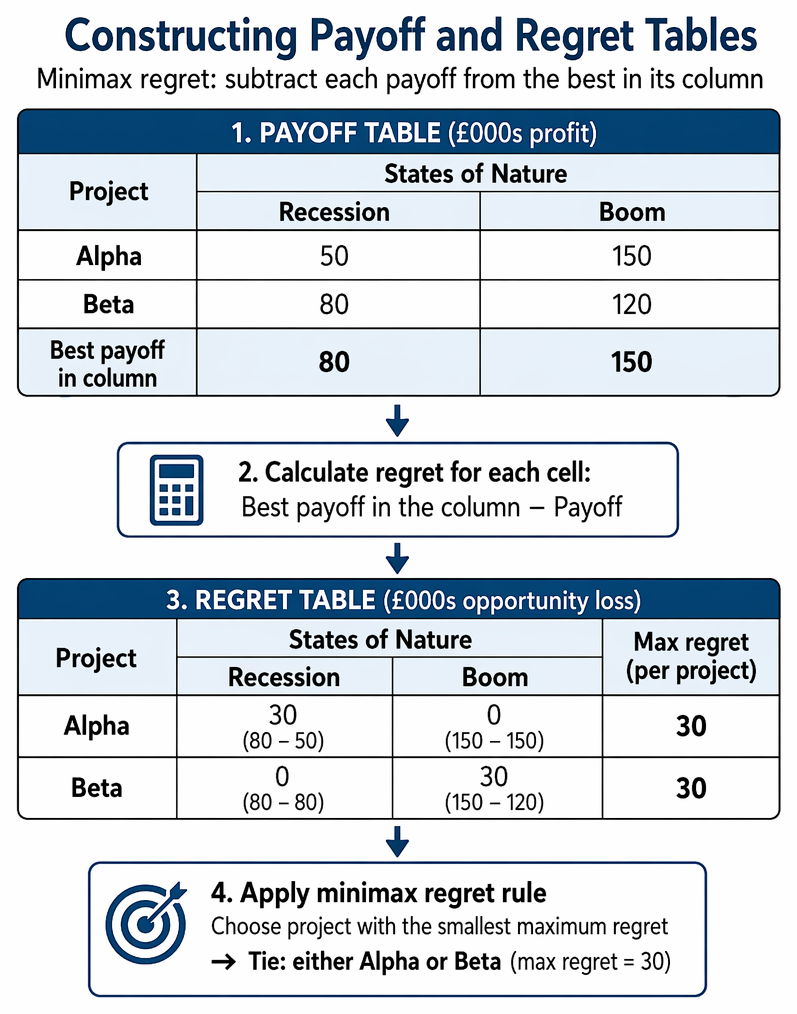
Minimax regret analysis identifies state-by-state opportunity loss, derives each alternative's worst regret, and selects the option with the lowest maximum regret.
Worked Example 1.1
An investment manager can select between Project Alpha and Project Beta. The possible economic conditions (Recession or Boom) and payoffs (£000s profit) are shown below:
| Recession | Boom | |
|---|---|---|
| Alpha | 50 | 150 |
| Beta | 80 | 120 |
Apply maximax, maximin, and minimax regret rules to choose a project.
Answer:
- Maximax: Alpha's maximum = 150, Beta's maximum = 120. Choose Alpha.
- Maximin: Alpha's minimum = 50, Beta's minimum = 80. Choose Beta.
- Minimax regret:
- Regret table (subtract each payoff from best in column):
- Recession: best = 80; Alpha's regret = 80 - 50 = 30, Beta's regret = 0
- Boom: best = 150; Alpha's regret = 0, Beta's regret = 150 - 120 = 30
- Alpha's max regret = 30, Beta's max regret = 30. Either project can be chosen as both have the same maximum regret.
Worked Example 1.2
A new product can be produced in a quantity of 100, 200, or 300 units. Demand is uncertain, but management estimates probabilities as follows:
| Production | 100 units | 200 units | 300 units |
|---|---|---|---|
| Probability | 0.3 | 0.5 | 0.2 |
Profit per strategy (£):
- Produce 100: £1,800, £1,200, £600 for low, medium, high demand.
- Produce 200: £1,400, £2,100, £800.
- Produce 300: £900, £1,700, £2,100.
Which quantity should be produced using the expected value rule?
Answer:
- Calculate expected values:
- For 100 units: (0.3 × £1,800) + (0.5 × £1,200) + (0.2 × £600) = £540 + £600 + £120 = £1,260
- For 200 units: (0.3 × £1,400) + (0.5 × £2,100) + (0.2 × £800) = £420 + £1,050 + £160 = £1,630
- For 300 units: (0.3 × £900) + (0.5 × £1,700) + (0.2 × £2,100) = £270 + £850 + £420 = £1,540
- Highest expected value is £1,630 (200 units). Produce 200 units.
Worked Example 1.3
A retail manager faces the following profit table (£):
| Order Size | Low Demand | High Demand |
|---|---|---|
| Small | 1,000 | 1,000 |
| Large | 0 | 1,700 |
Which order size does a risk-seeking manager choose?
Answer:
- Maximax: Small: max = 1,000; Large: max = 1,700. Risk-seeking manager (maximax) chooses Large (potential of highest profit).
Exam Warning: In exam questions, always check if probabilities are provided. If not, ignore the expected value rule—only maximax, maximin, and minimax regret are valid. If probabilities exist, be able to show expected value workings. Choose decision rules supported by scenario context and justify your answer.
Revision Tip: Learn to set up both payoff and regret tables swiftly. Practise explaining, in one sentence, the risk attitude that matches each decision rule.
Summary
| Rule | Suitable For | Calculation Method | When Appropriate |
|---|---|---|---|
| Maximax | Risk-seeking | Choose highest possible payoff | Seeking best-case results |
| Maximin | Risk-averse | Choose highest minimum payoff | Avoiding worst-case outcomes |
| Minimax Regret | Cautious/Regret-averse | Minimise maximum regret | Concerned with lost opportunity |
| Expected Value | Risk-neutral | Probability-weighted average payoff | Where probabilities are known |
Key Point Checklist
This article has covered the following key knowledge points:
- Explain uncertainty and risk and their impact on decisions
- Describe maximax, maximin, minimax regret, and expected value rules
- Link each rule to risk attitude (risk-seeking, risk-averse, neutral)
- Prepare and interpret payoff and regret tables
- Apply each decision rule correctly to select among alternatives
- Select and justify appropriate decision rules in scenario-based exam questions
Key Terms and Concepts
- uncertainty
- risk
- maximax
- maximin
- minimax regret
- expected value