Learning Outcomes
This article provides key techniques for decision making under uncertainty as expected in the ACCA Advanced Performance Management (APM) exam. After reading, you should be able to construct and interpret payoff tables, identify dominated choices, and use dominance rules to eliminate sub-optimal options. You will be able to apply these tools in practical scenarios, enhancing decision quality where risks and outcomes are not fully known.
ACCA Advanced Performance Management (APM) Syllabus
For ACCA Advanced Performance Management (APM), you are required to understand how to support decision making when outcomes are uncertain. This article focuses your revision on:
- Constructing and interpreting payoff tables for uncertain business scenarios
- Applying dominance rules to eliminate inferior options systematically
- Recognizing situations where some choices can be disregarded for strategic or operational efficiency
Test Your Knowledge
Attempt these questions before reading this article. If you find some difficult or cannot remember the answers, look more closely at that area during your revision.
- What is the main purpose of a payoff table in decision making under uncertainty?
- When is a decision option said to be "dominated" by another in a payoff table?
- In a table with several alternatives and outcomes, how would you use dominance to simplify analysis?
- True or false? If an option is dominated, it should always be considered in the final recommendation.
Introduction
Business decisions often involve uncertainty—future events may have several possible outcomes, and management may lack information about which will occur. Payoff tables and dominance analysis are simple but robust techniques to assist in choosing between alternatives with unknown consequences. This article explains how to construct and work with payoff tables and introduces the principle of dominance to narrow choices rationally.
Key Term: payoff table
A matrix showing the possible payoffs from different courses of action under each uncertain future state. Key Term: dominance
A rule stating that if one option yields results at least as good as another in all circumstances, and better in at least one, it is considered to "dominate" the other.
Payoff Tables—Structure and Use
A payoff table sets out the possible financial outcomes (or payoffs) associated with each decision choice, given different possible states of the future. It supports clear comparison of the consequences of each action when future events are not controllable.
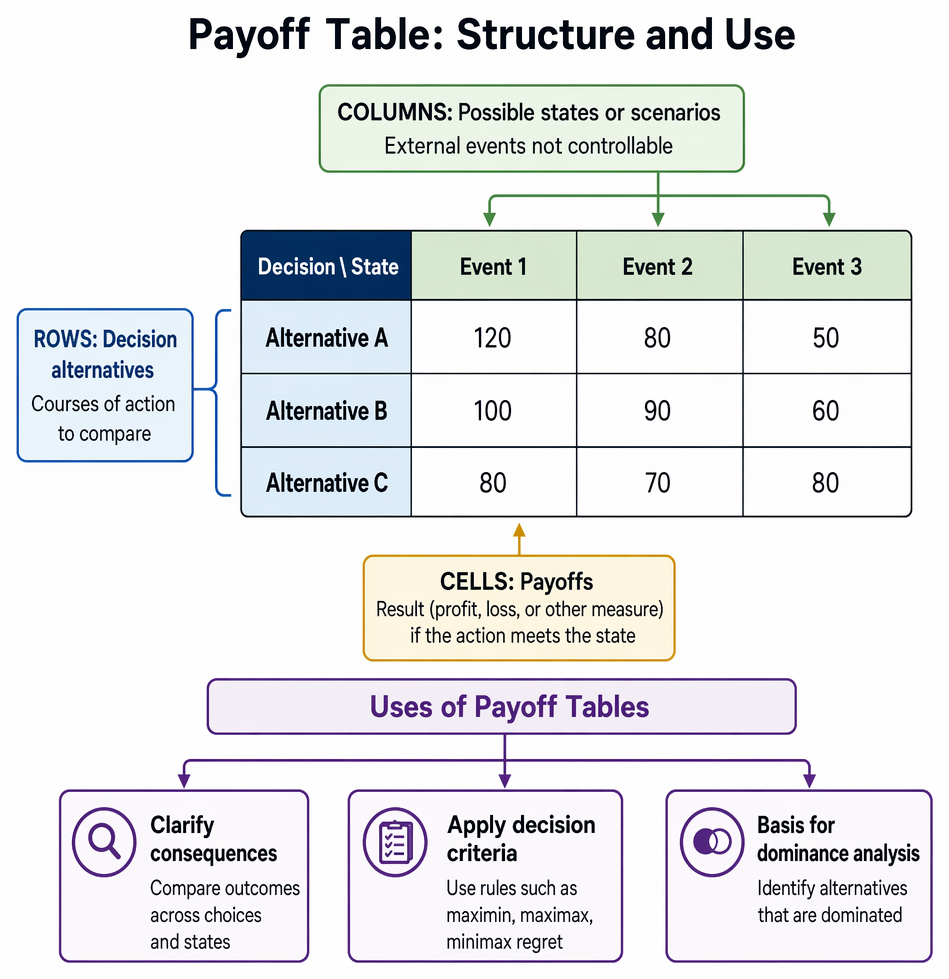
Pairwise comparison of payoffs across states determines whether one alternative strictly dominates another or both remain under consideration.
A typical table has:
- Rows: Each decision alternative (e.g., launch, defer, reject project).
- Columns: Each possible external state or scenario (e.g., high demand, low demand).
Each cell contains the payoff (profit, loss, or other measure) that would occur if the chosen action meets the given state.
Payoff tables are used to:
- Clarify the consequences of different courses of action
- Enable systematic application of decision criteria (such as maximin, maximax, minimax regret—a detailed treatment is in separate articles)
- Serve as the basis for dominance analysis
Example Payoff Table
| Decision \ State | Event 1 | Event 2 | Event 3 |
|---|---|---|---|
| Alternative A | 120 | 80 | 50 |
| Alternative B | 100 | 90 | 60 |
| Alternative C | 80 | 70 | 80 |
Interpretation: Each row shows what the result will be for a given option if a given future event occurs. Decision criteria can now be applied systematically.
Key Term: decision criteria
Rules, such as maximax or maximin, used to select between alternatives when outcomes are uncertain.
Principle of Dominance
Not all alternatives in a payoff table need detailed analysis—some can be disregarded if they are "dominated".
Dominance occurs when, for all states of nature, one alternative produces a result that is at least as good as another, and is strictly better for at least one scenario.
Rules for dominance:
- If an option is dominated by another (i.e., always worse/equal and sometimes worse), it can be removed from further consideration.
- Applying dominance can simplify complex payoff tables, making further analysis faster and more reliable.
Worked Example 1.1
A manufacturer is considering three new product designs (X, Y, Z). Market conditions could be "Favourable" or "Unfavourable". Payoffs are as follows:
| Product | Favourable (£000) | Unfavourable (£000) |
|---|---|---|
| X | 90 | 50 |
| Y | 80 | 60 |
| Z | 90 | 55 |
Question: Identify any dominated product and justify your answer.
Answer:
Comparing X and Z: For both states, Z’s payoff is equal or better than X (Favourable: 90 vs 90, Unfavourable: 55 vs 50). Z is strictly better in the "Unfavourable" state. Y is not strictly dominated by Z or X as it is higher than Z only in "Unfavourable" (60), but lower in Favourable. Therefore, X is dominated by Z and can be eliminated—Z is always as good or better.
Worked Example 1.2
A coffee chain considers options for a new store: A (city centre), B (suburbs), C (online delivery focus). Outcomes (profit in £000) depend on market trend:
| Option | High Street Recovery | Suburban Boom | Online Growth |
|---|---|---|---|
| A | 60 | 20 | 10 |
| B | 40 | 50 | 15 |
| C | 30 | 25 | 40 |
Question: Does any option dominate another?
Answer:
There is no single option with payoffs equal or superior to another in every scenario, so no option strictly dominates another. All options must remain for further analysis.
Applying Dominance in Practice
- Arrange the payoff table for clarity.
- Compare each pair of alternatives, column by column.
- Remove options that are always inferior.
- If complex, repeat stepwise: every time you remove an alternative, recheck for new dominance.
Dominance reduces the workload for more advanced criteria.
Exam Warning: In APM questions, failure to use dominance may waste time by forcing you to compare unnecessary alternatives. Always scan for dominance first—it speeds up later calculations (especially for more complex tables).
Revision Tip: For tables with many options, quickly check for rows (or columns) that are strictly lower than another in all states—these can usually be eliminated immediately using dominance.
Summary
Payoff tables are a primary tool for comparing decisions under uncertainty. The dominance rule helps eliminate inferior choices before applying more advanced rules (such as maximax or minimax regret), streamlining decision making. Proficiency in this process is essential for ACCA APM scenario analysis.
Key Point Checklist
This article has covered the following key knowledge points:
- Construct the structure and content of a payoff table for uncertain decisions
- Define and identify dominance between alternatives in a payoff table
- Apply the dominance rule to remove sub-optimal options before further analysis
- Recognize when and why dominance can be used in ACCA APM exam scenarios
Key Terms and Concepts
- payoff table
- dominance
- decision criteria