Learning Outcomes
This article explains how to identify and manage limiting factors in resource planning, a key skill for the ACCA Advanced Performance Management exam. It covers recognition of constraints, key terms, and the use of linear programming to determine optimal resource allocation. After studying this, you will be able to apply quantitative and qualitative techniques to exam scenarios involving limited resources.
ACCA Advanced Performance Management (APM) Syllabus
For ACCA Advanced Performance Management (APM), you are required to understand the management of scarce resources and how to optimise their use through analytical tools. Special focus is given to:
- Identification of limiting factors in resource planning and their implications for performance management
- Application of quantitative methods—such as linear programming—for optimal resource allocation when facing constraints
- Evaluation of the impact of resource constraints on organisational objectives and strategy
- Interpretation of linear programming results for decision-making under resource limitations
- Explanation of qualitative factors and real-world complexities in resource-planning decisions
Test Your Knowledge
Attempt these questions before reading this article. If you find some difficult or cannot remember the answers, look more closely at that area during your revision.
- If a company is restricted by a maximum number of machine hours, what is this resource called and how should management respond?
- Which of the following resource allocation approaches guarantees the highest total contribution when processing a single limiting factor?
- a) Allocate equally to all products
- b) Prioritise highest selling price per unit
- c) Prioritise highest contribution per unit of limiting factor
- d) Allocate to the lowest variable cost per unit
- A factory produces two products and faces limited labour hours and material availability. Briefly outline the steps required to determine how many units of each product to make for maximum profit.
- True or false? Linear programming can be used when a business faces more than one resource constraint.
Introduction
Resource planning ensures that critical company resources—such as labour, materials, and machine time—are allocated efficiently to support organisational objectives. In the real world, these resources are rarely unlimited. A key challenge for management accountants is handling situations where scarce resources restrict the level of activity, known as limiting factors. Decision-makers must then identify the optimal use of limited resources, often using quantitative techniques such as linear programming.
Key Term: Limiting factor
A resource or input in short supply that constrains an organisation's ability to meet demand or achieve objectives. Key Term: Linear programming
A mathematical method used to determine the optimal allocation of scarce resources to achieve a specific objective, subject to constraints.
Limiting Factors in Resource Planning
Many organisations encounter situations where one resource is insufficient to satisfy all desired levels of activity. Common limiting factors include labour hours, machine time, components, or even market demand. The presence of such constraints means management must decide how best to allocate these resources to maximise profit or achieve another objective.
Step 1: Identifying the Limiting Factor
To determine which resource is limiting, compare the expected resource requirement for the plan with the actual resource available. The resource for which demand outstrips supply is the limiting factor. There may be just one, or multiple, simultaneously.
Step 2: Calculating Contribution per Unit of Limiting Factor
Once the constraint is identified, profit maximisation requires prioritising those products or activities that yield the highest contribution per unit of the scarce resource.
Key Term: Contribution per unit of limiting factor
The contribution earned from one unit of output divided by the number of units of the limiting resource required to make that unit.
Step 3: Allocating the Limiting Resource
Allocate the constrained resource in order of highest to lowest contribution per unit of limiting factor until the constraint is exhausted. Remaining resources, if any, are allocated to the next best option.
Worked Example 1.1
A company makes Products X and Y using the same machine. Product X generates £8 contribution and needs 4 machine hours per unit. Product Y generates £10 contribution and needs 5 machine hours per unit. Machine time is limited to 80 hours per week.
Which product should be prioritised?
Answer:
Calculate contribution per machine hour: For X: £8 / 4 hours = £2 For Y: £10 / 5 hours = £2 Both offer identical contribution per machine hour. Management can choose either or mix production, considering other factors like market demand.
Multiple Limiting Factors: The Need for Linear Programming
If the organisation only faces a single limiting factor, ranking by contribution per limiting resource solves the problem. However, with two or more constraints (e.g., labour and material), a more robust method—linear programming (LP)—is required.
Limiting-factor analysis routes single-constraint problems to contribution-per-limiting-unit ranking and multi-constraint cases to linear programming, solved graphically or by simplex.
Key Term: Feasible region
The set of all possible combinations of decision variables that satisfy all resource constraints in a linear programming problem.
Steps in Linear Programming for Resource Allocation
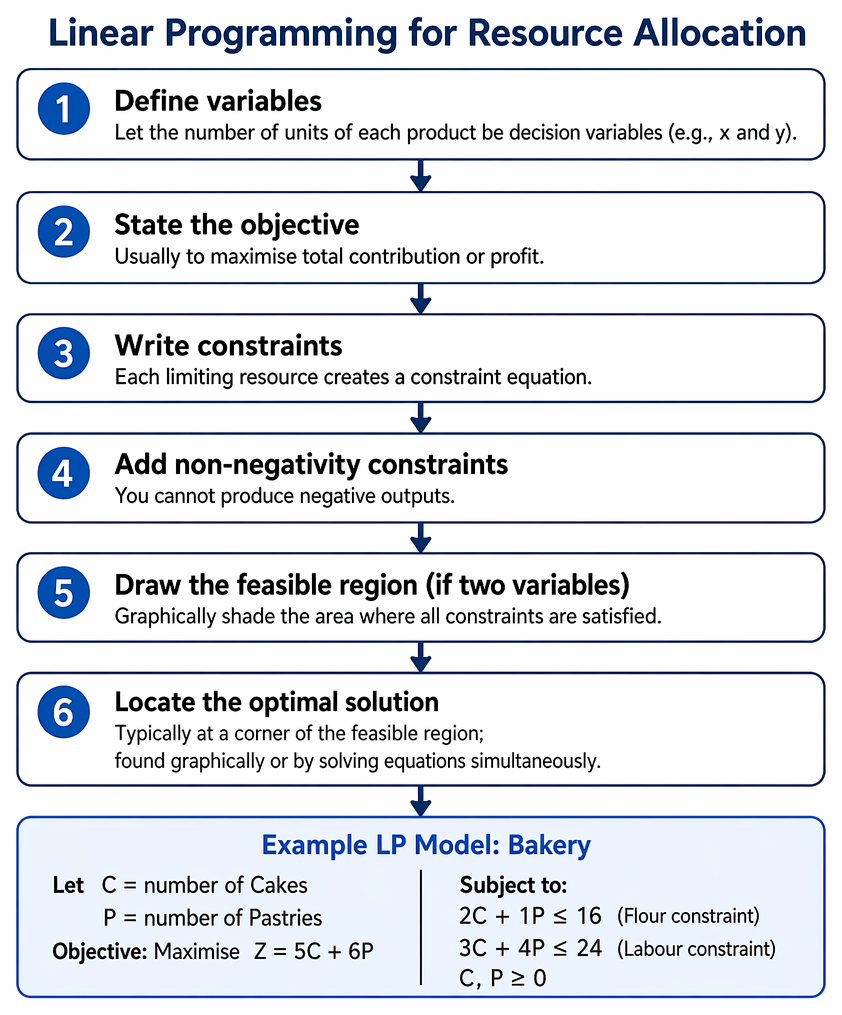
- Define variables: Let the number of units produced of each product be decision variables (e.g., x and y).
- State the objective: Usually to maximise total contribution or profit.
- Write constraints: Each limiting resource creates a constraint equation.
- Add non-negativity constraints: You cannot produce negative outputs.
- Draw the feasible region (if two variables): Graphically shade the area where all constraints are satisfied.
- Locate the optimal solution: This is typically at a corner of the feasible region, which can be found graphically or by solving equations simultaneously.
Worked Example 1.2
A bakery makes Cakes (C) and Pastries (P). Each Cake requires 2kg flour and 3 hours of labour. Each Pastry needs 1kg flour and 4 hours of labour. Maximum flour available is 16kg and maximum labour is 24 hours. Each Cake earns £5 contribution, each Pastry £6.
Set up the LP model.
Answer:
Let C = number of Cakes P = number of Pastries Objective: Maximise Z = 5C + 6P Subject to: 2C + 1P ≤ 16 (Flour constraint) 3C + 4P ≤ 24 (Labour constraint) C, P ≥ 0
Other Considerations in Resource Planning
- Qualitative factors: Not all decision variables can be quantified. Market trends, customer satisfaction, supplier reliability, and ethical issues should also be considered.
- Divisional or multi-product businesses: When resource constraints exist across products or departments, linear programming can be extended to include more variables and constraints, but graphical approaches become impractical and the simplex method is used instead.
- Shadow price: In LP, the shadow price of a resource indicates how much the objective (e.g., profit) would improve per extra unit of that resource.
Key Term: Shadow price
The increase in total contribution that would result from having one additional unit of the limiting resource, as determined by linear programming.
Application and Limitations
Linear programming provides an objective solution to allocation problems under multiple constraints, but results are sensitive to the accuracy of the model's assumptions and data.
Worked Example 1.3
A manufacturer uses linear programming to maximise profit. If the LP solution gives a shadow price for labour of £3 per hour, what does this mean?
Answer:
An extra hour of labour, if made available, would increase maximum achievable profit by £3, until another constraint becomes limiting.Exam Warning: In exam scenarios, always check for demand restrictions. If demand is limited, include this as an additional constraint in your linear programming model.
Revision Tip: Write out all limits and the objective function before trying to solve. Many errors come from misreading the constraint equations.
Summary
Limiting factors restrict the ability to meet production or sales plans. When one constraint exists, prioritise activities by highest contribution per unit of the limiting factor. When two or more restraints exist, linear programming is the required technique for optimal allocation. Always interpret LP results with context in mind, considering qualitative as well as quantitative data.
Key Point Checklist
This article has covered the following key knowledge points:
- Explain the concept and impact of limiting factors on resource planning
- Calculate contribution per unit of limiting resource for ranking production priorities
- Set up a basic linear programming model including constraints and objective function
- Identify when to use linear programming (multiple constraints or complex scenarios)
- Interpret linear programming results including the role of shadow price
- Recognise the importance of qualitative factors in constrained resource planning
Key Terms and Concepts
- Limiting factor
- Linear programming
- Contribution per unit of limiting factor
- Feasible region
- Shadow price