Learning Outcomes
After reading this article, you will be able to plan and document an inventory count, explain the main count controls, and reconcile physical quantities to inventory records. You will be able to calculate shortages and surpluses, separate timing differences from real discrepancies, and decide what corrections are needed. You will also be able to post the required entries to update inventory in the accounting system and explain the effect on the trial balance.
ACCA Recording Financial Transactions (FA1) Syllabus
For ACCA Recording Financial Transactions (FA1), you must understand...
- why reconciliations are used as a checking device to identify errors and omissions
- how inventory movements are supported by business documents (eg delivery notes and goods received notes)
- how to compare physical inventory counts with system records and investigate differences
- how to correct errors using journals and update ledger balances
- why discrepancies should be dealt with quickly and recorded with clear supporting evidence
Test Your Knowledge
Attempt these questions before reading this article. If you find some difficult or cannot remember the answers, look more closely at that area during your revision.
-
When reconciling a physical inventory count to records, which situation is most likely a timing difference?
- A. Damaged goods written off but still on the shelf count
- B. Goods received and put away, but the purchase invoice has not been entered yet
- C. Theft of goods during the year
- D. A counting error where one location was counted twice
-
True or false? If the physical count is lower than the inventory record, you should always post a journal immediately without investigating.
-
A stores record shows 800 units at a unit cost of £6. The physical count shows 790 units. Calculate the inventory shortage value.
-
Which journal entry records a genuine inventory shortage in a perpetual inventory system?
- A. Dr Inventory, Cr Inventory write-off
- B. Dr Inventory write-off, Cr Inventory
- C. Dr Payables, Cr Inventory
- D. Dr Inventory, Cr Cost of sales
-
State two controls that help make an inventory count reliable.
Introduction
Inventory is often one of the largest current assets in a business. If inventory is overstated or understated, profit and the trial balance values used to prepare reports may be wrong.
An inventory count (stocktake) is a practical control: you compare what is physically there to what the system says should be there. For FA1, you need to understand how differences happen, how to investigate them using documents, and how to record any necessary corrections in the accounting system.
Why inventory counts are performed
Inventory counts help you confirm that inventory records are complete and accurate. They also help management spot issues such as damaged items, slow-moving lines, and possible losses.
Counts are often done at the year end, but many businesses also do cycle counts throughout the year (counting a selection of items each week or month). Whichever approach is used, you still reconcile physical quantities to the records and deal with differences.
Key Term: inventory count
A physical count of inventory quantities at a specific date, recorded so the business can compare the results to its inventory records. Key Term: inventory record
A record (often in a stores system or stock module) showing quantities on hand after receipts, issues and returns have been entered.
Planning the count (what you must control)
A good reconciliation depends on a well-run count. In exam questions, weaknesses in the count process often explain the discrepancy.
Stock count sheets and count teams
Count results must be written down in a controlled way. Pre-numbered sheets (or controlled handheld entries) reduce the risk of missing items or adding false lines.
Key Term: stock count sheet
A document (paper or electronic) used to record the quantities counted for each inventory item during an inventory count.
Typical controls include:
- clear count instructions (how to count, where to record, how to label completed areas)
- two-person count teams or independent checks
- separation of duties (people who maintain stock records should not be the only people counting)
- review of unusual results (large differences, negative stock, unexpected surpluses)
Cut-off: stopping timing errors at the count date
Cut-off is about making sure purchases and sales are recorded in the correct period and that the count includes only goods owned at the count date.
Key Term: cut-off
Procedures used to ensure inventory receipts and despatches are recorded in the correct accounting period and treated consistently in the count.
To apply cut-off, you usually:
- identify the last goods received note (GRN) number included in the count
- identify the last delivery note number for goods despatched before the count
- keep evidence so later you can check whether receipts and despatches around the count date were recorded correctly
Key Term: goods received note (GRN)
An internal document raised when goods are received, used to confirm items and quantities received from a supplier. Key Term: delivery note
A document that lists goods delivered or despatched and the quantities, used as evidence of movement of goods.
Reconciling physical quantities to records
Reconciliation means you compare the physical count to the “book” quantities and explain all differences.
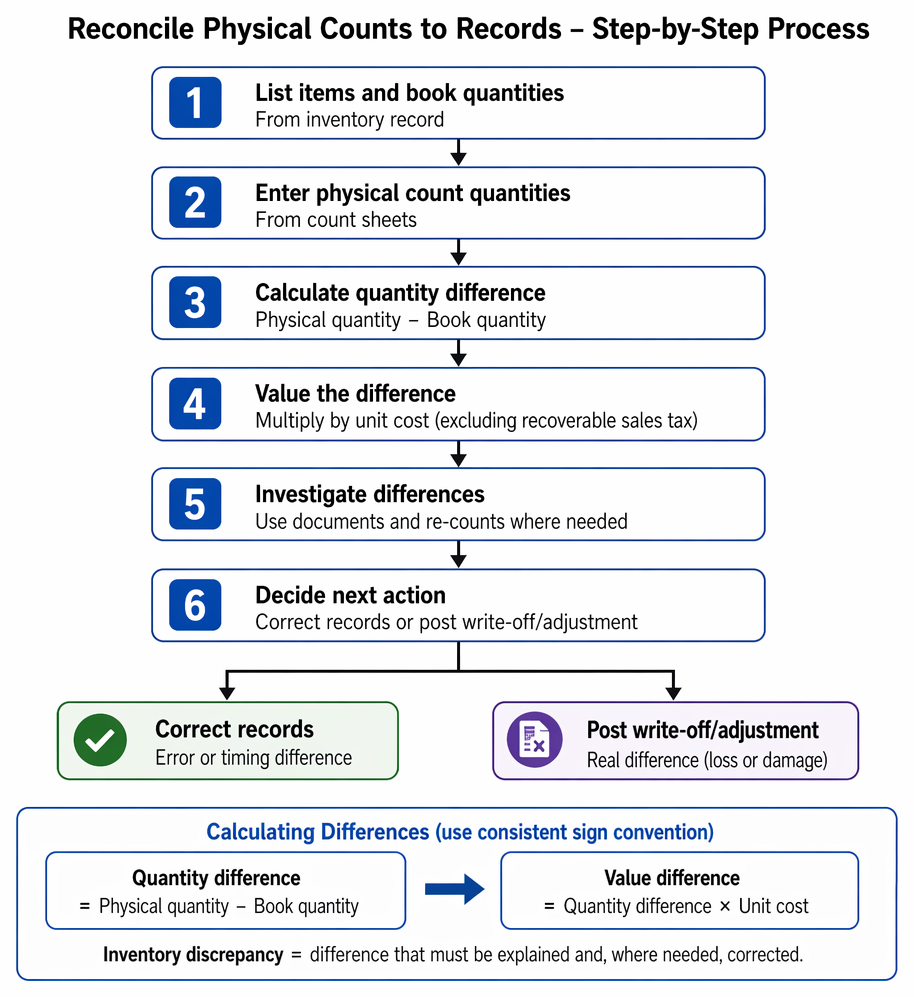
Physical inventory results are compared with ledger quantities to identify shortages, surpluses, timing differences, and required accounting adjustments.
Step-by-step approach you can use in the exam
- List each inventory item with its book quantity (from the inventory record).
- Enter the physical count quantity from the count sheets.
- Calculate the quantity difference for each item.
- Value the difference using the correct unit cost (normally excluding any recoverable sales tax).
- Investigate differences, using documents and re-counts where needed.
- Decide whether to correct records (error/timing) or post a write-off/adjustment (real difference).
Calculating differences
Use a consistent sign convention so you do not reverse entries.
Key Term: inventory discrepancy
A difference between the physical inventory count and the inventory record that must be explained and, where needed, corrected.
Common causes of differences (and what to do)
- Counting errors
Miscounts, wrong unit of measure, missed locations, or counting the same area twice. Action: re-count and check descriptions and units.
- Recording errors
Invoices, credit notes, returns, or adjustments entered with the wrong quantity, wrong item code, or duplicated. Action: correct the entry (often via a journal or reversal and repost).
- Timing differences
Goods received/despatched around the count date but not yet entered into the system, or entered but not physically moved into the counted area. Action: apply cut-off rules and update records so they match what actually happened.
- Genuine losses or damage
Theft, breakages, deterioration, and wastage. Action: authorise and record a write-off, and report it for management follow-up.
Recording adjustments in the accounting system
You should only post an inventory “gain” or “loss” after you have checked for errors and timing issues. Many “shortages” are caused by missing paperwork or incorrect postings.
Correcting the records first (no write-off yet)
If the reconciliation finds that a purchase invoice was never entered, or quantities were entered incorrectly, you correct the accounting records for that transaction. This updates payables, purchases/inventory, and any tax accounts where relevant.
Posting a genuine shortage or surplus
In a perpetual inventory system, the general ledger includes an Inventory account. If the final agreed physical inventory value is different, you adjust the Inventory account and record the other side in an expense or income account.
Key Term: inventory write-off
An accounting entry that reduces inventory for goods that are missing, damaged, obsolete, or otherwise not saleable.
Shortage (physical less than book)
- Credit Inventory (reduce the asset)
- Debit an expense (eg Inventory write-off or Cost of sales)
Surplus (physical more than book)
Treat this carefully: it may indicate earlier errors or unrecorded receipts. If it is a real surplus after investigation:
- Debit Inventory (increase the asset)
- Credit an income account (eg Inventory adjustment gain) or reduce Cost of sales (depending on how the business records it)
Worked Example 1.1
A business has Item A in its Inventory account at £4,000, based on 500 units at £8 each. The physical count shows 480 units. After re-counting and checking documents, the shortage is confirmed as genuine.
Answer:
Shortage units =
Shortage value =
Journal (to record the shortage): Dr Inventory write-off (expense) £160 Cr Inventory £160
Worked Example 1.2
Item B shows 600 units in the inventory record at a unit cost of £4. The physical count shows 630 units. Investigation finds a GRN for 30 units received and put away, but the supplier invoice has not yet been entered into the accounting system.
Answer:
Quantity difference =
Value difference =
This is an unrecorded purchase, not a “gain”. Record the missing purchase: Dr Inventory £120 Cr Payables £120 After posting, the book quantity/value matches the physical count.
Exam Warning: Do not assume every difference is a write-off. If documents show that goods were received or despatched but not recorded, you correct the purchase/sale entry rather than posting an “inventory loss”.
Revision Tip: Practise the direction of entries: a shortage reduces the asset (Inventory is credited), while the other side is usually an expense.
Key Point Checklist
This article has covered the following key knowledge points:
- inventory counts check physical inventory against system records and support reliable reporting
- stock count sheets and controlled procedures reduce missing lines and counting errors
- cut-off controls reduce timing differences around the count date
- reconciliation compares physical quantity to book quantity and values differences at the correct unit cost
- differences can be caused by counting errors, posting errors, timing differences, or real losses/damage
- you correct errors and missing entries first, then post write-offs only for genuine discrepancies
- a confirmed shortage is recorded as Dr expense, Cr Inventory in a perpetual inventory system
Key Terms and Concepts
- inventory count
- inventory record
- stock count sheet
- cut-off
- goods received note (GRN)
- delivery note
- inventory discrepancy
- inventory write-off