Learning Outcomes
After reading this article, you will be able to explain why inventory counts are needed and how they affect profit and assets. You will be able to describe good stocktake procedures, including cut-off controls and documentation. You will be able to calculate and explain stock variances and typical causes. You will also be able to record the double-entry adjustments for stocktake differences and inventory write-downs.
ACCA Recording Financial Transactions (FA1) Syllabus
For ACCA Recording Financial Transactions (FA1), you must understand:
- how inventory is measured and reported as a current asset
- how a stocktake supports the year-end inventory figure used in financial statements
- how to calculate cost of sales using opening inventory, purchases and closing inventory
- how to process period-end adjustments using journal entries (double entry)
- how to identify and correct inventory differences (variances) between records and physical counts
Test Your Knowledge
Attempt these questions before reading this article. If you find some difficult or cannot remember the answers, look more closely at that area during your revision.
-
Which procedure best reduces the risk of missing lines during a stocktake?
- A. Use unnumbered blank paper for counting
- B. Use pre-numbered count sheets and account for all sheets issued
- C. Let warehouse staff adjust the inventory records during the count
- D. Price the inventory at selling price during the count
-
True or false? Goods received into the warehouse before the year end should be included in closing inventory even if the supplier invoice has not yet been received.
-
The inventory control account shows $50,000 (debit). The stocktake shows inventory at cost of $48,700. What is the variance, and what journal entry would you record?
-
Inventory includes damaged goods with cost $900 and net realisable value $500. What adjustment is required?
- A. No adjustment (inventory is always at cost)
- B. Increase inventory by $400
- C. Reduce inventory by $400 and record an expense
- D. Reduce inventory by $500 and record an expense
-
State two likely causes of a stock shortage shown by the stocktake.
Introduction
Inventory is often one of the largest figures in the statement of financial position for a trading business. It also affects profit, because closing inventory is used to calculate cost of sales and gross profit.
A stocktake (inventory count) is the main way a business checks that the inventory figure in the accounting records is realistic. Any differences between the count and the records must be investigated and, where necessary, adjusted using double entry.
Inventory counts: purpose and key risks
Key Term: Stocktake
A stocktake is a physical count of inventory held by a business at a particular date, often at the financial year end. Key Term: Count sheet
A count sheet is the document (paper or electronic) used to record quantities counted during a stocktake, usually with item codes and locations.
Why inventory counts matter in FA1
Inventory affects:
- Assets: closing inventory is a current asset.
- Profit: closing inventory reduces cost of sales and increases gross profit (and vice versa).
The basic trading calculation is:
If closing inventory is wrong, both the statement of financial position and the statement of profit or loss will be wrong.
Common stocktake risks
Most stocktake problems fall into one of these categories:
- Quantity errors (miscounts, double counting, wrong unit of measure).
- Cut-off errors (goods recorded in the wrong period).
- Valuation errors (wrong cost, or failure to write down damaged/obsolete items).
- Losses (theft, breakages, deterioration).
Stocktake procedures (what good looks like)
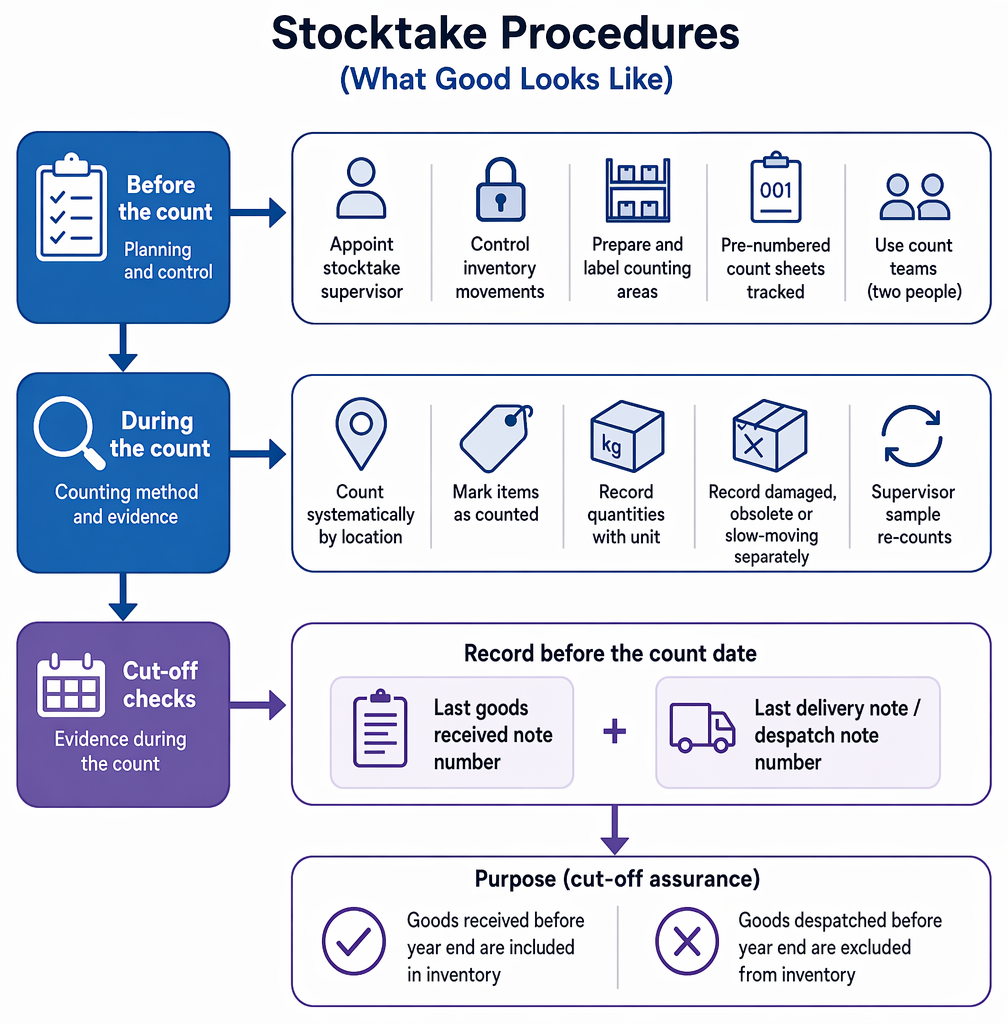
Inventory counting controls and subsequent journal adjustments for shortages, surpluses, and lower-of-cost-and-NRV valuation are summarised.
Key Term: Cut-off
Cut-off is the process of ensuring that transactions (such as goods received and goods despatched) are recorded in the correct accounting period.
Before the count: planning and control
Good preparation reduces errors and makes the results easier to reconcile.
Typical steps include:
- Appoint a stocktake supervisor and issue written instructions.
- Decide how to control inventory movements (for example, stop movements during the count, or record movements separately).
- Prepare the counting areas so that inventory is clearly stored and labelled.
- Issue pre-numbered count sheets and track all sheets issued and returned.
- Use count teams (often two people) to reduce recording mistakes.
During the count: counting method and evidence
Common controls during the count:
- Count systematically by location (aisle/bin/shelf) to avoid missing areas.
- Mark items as counted (tags, stickers, chalk marks) to reduce double counting.
- Record quantities clearly, including the unit (each/box/kg).
- Record damaged, obsolete, or slow-moving items separately for later review.
- Supervisor performs sample re-counts of selected lines (especially high-value items).
Cut-off checks during the count
To support cut-off, businesses often record:
- The last goods received note number before the count date, and
- The last delivery note/despatch note number before the count date.
This helps you check that:
- goods received before the year end are included in inventory, and
- goods despatched before the year end are excluded from inventory.
Valuation at the stocktake date
Key Term: Net realisable value (NRV)
Net realisable value is the estimated selling price of inventory less any costs needed to complete and sell it. Key Term: Inventory write-down
An inventory write-down is a reduction in the recorded inventory value when NRV is lower than cost.
Cost and NRV (what you need for FA1)
For exam questions, inventory is generally valued at lower of cost and NRV:
- Use cost for normal inventory items.
- Use NRV where goods are damaged, obsolete, or selling prices have fallen.
If NRV is lower than cost, you reduce the inventory value and record an expense (often within cost of sales).
Worked Example 1.1
A business has:
- Opening inventory: $12,500
- Purchases (during the year): $88,400
- Stocktake closing inventory at cost: $15,200
- Included in the $15,200 are damaged goods with cost $1,000 and NRV $600.
Calculate:
- the closing inventory value to use in the accounts, and
- cost of sales for the year.
Answer:
Damaged goods must be valued at lower of cost and NRV, so write down by \1,000 - 600 = 400$15,200 - 400 = 14,800$12,500 + 88,400 - 14,800 = 86,100$.
Stock variances: identifying, explaining and correcting
Key Term: Inventory variance
An inventory variance is the difference between inventory per the accounting records and inventory per the physical stocktake. Key Term: Shrinkage
Shrinkage is a stock shortage caused by losses such as theft, damage, deterioration, or unrecorded usage.
How to calculate a variance
A simple approach is:
- A negative variance suggests a shortage (physical is less than book).
- A positive variance suggests a surplus (physical is more than book).
Common causes of variances (what exam questions test)
Typical reasons include:
- Counting mistakes (wrong quantity, wrong unit, wrong location).
- Recording mistakes (unposted receipts/issues, wrong item code, duplicate entries).
- Cut-off errors (goods received/despatched around the year end recorded in the wrong period).
- Losses (theft, breakages, wastage).
- Pricing errors (wrong cost used when valuing lines).
What you do before adjusting the ledger
A stocktake variance should not be posted automatically without checks.
Usual checks:
- Re-count the affected items (especially high value).
- Check recent goods received notes and delivery notes around the count date.
- Check whether any purchase invoices, returns, or internal issues have not been processed.
- Confirm whether any items are held for someone else (and should not be included).
Recording stocktake adjustments (double entry)
Key Term: Inventory control account
An inventory control account is the general ledger account that records the total value of inventory for double-entry purposes.
Posting the stocktake result (general approach)
When the stocktake shows that inventory should be lower, you must reduce the asset and increase an expense:
- Shortage: Dr expense (often cost of sales) / Cr inventory
When the stocktake shows that inventory should be higher, you must increase the asset and reduce an expense:
- Surplus: Dr inventory / Cr expense (often cost of sales)
Period-end journals (periodic approach)
Many exam questions use a periodic approach where purchases are recorded during the year, and inventory is adjusted at the end.
Two common journals are:
- To transfer opening inventory into cost of sales: Dr Cost of sales / Cr Inventory
- To record closing inventory: Dr Inventory / Cr Cost of sales
This produces the cost of sales calculation shown earlier.
Worked Example 1.2
The inventory control account shows $50,000 (debit). The year-end stocktake values inventory at cost as $48,700. The business decides the difference is a genuine shortage.
Required: prepare the journal entry to update the general ledger.
Answer:
Variance (shortage) is \50,000 - 48,700 = 1,300. Inventory is overstated by \1,300, so reduce the asset and record the loss in profit. Journal: Dr Cost of sales (or Inventory shrinkage) $1,300; Cr Inventory control $1,300.Exam Warning:
- Do not value inventory at selling price unless the question tells you to; use cost and NRV rules.
- Do not post a variance until you have considered cut-off and simple errors (a “shortage” can be an unrecorded goods received note).
- For a shortage, the inventory asset must go down (credit inventory). For a surplus, the inventory asset must go up (debit inventory).
Revision Tip: If you are unsure which way round the journal goes, ask: “Is inventory too high or too low?” Then post the entry needed to move it to the physical stocktake value.
Key Point Checklist
This article has covered the following key knowledge points:
- inventory affects both profit (cost of sales) and assets (closing inventory)
- a stocktake is a physical count used to support the inventory figure in the accounts
- good stocktake control uses planning, pre-numbered count sheets, supervision and clear marking of counted items
- cut-off checks ensure goods received and goods despatched are recorded in the correct period
- closing inventory must be valued at lower of cost and NRV, with write-downs recorded as expenses
- inventory variances arise from errors, cut-off problems, and stock losses such as shrinkage
- stocktake variances are adjusted using double entry to align book inventory to physical inventory
Key Terms and Concepts
- Stocktake
- Count sheet
- Cut-off
- Net realisable value (NRV)
- Inventory write-down
- Inventory variance
- Shrinkage
- Inventory control account