Learning Outcomes
After reading this article, you will be able to record VAT on sales, purchases, returns and cash expenses using double entry. You will be able to maintain and balance the VAT control account, interpret whether the balance is a liability or an asset, and link the account to the VAT return. You will also be able to post the payment to the tax authority (or receipt of a refund) so that the VAT control account is cleared for the period.
ACCA Recording Financial Transactions (FA1) Syllabus
For ACCA Recording Financial Transactions (FA1), you must understand...
- How sales tax (VAT) is calculated from VAT exclusive and VAT inclusive amounts
- How VAT affects entries for credit sales and credit purchases (including the VAT ledger/control account)
- How VAT is recorded for sales returns and purchase returns using credit notes
- How VAT is recorded for cash purchases and petty cash payments
- How the VAT return figures are obtained and how VAT payments/refunds are recorded
Test Your Knowledge
Attempt these questions before reading this article. If you find some difficult or cannot remember the answers, look more closely at that area during your revision.
-
A business issues a sales invoice for £2,000 + VAT at 20% on credit. Which entry records the VAT?
- A. Debit VAT control account £400
- B. Credit VAT control account £400
- C. Debit Sales £400
- D. Credit Trade receivables £400
-
True or false? Input VAT is normally recorded as a debit in the VAT control account.
-
A receipt for fuel is £72 VAT inclusive at 20%. Calculate (i) the VAT and (ii) the net expense.
-
Which entry records a VAT payment to the tax authority when the VAT control account shows a credit balance?
- A. Dr Bank, Cr VAT control account
- B. Dr VAT control account, Cr Bank
- C. Dr VAT control account, Cr Sales
- D. Dr Purchases, Cr VAT control account
-
State two types of source document that you would use to support input VAT recorded in the VAT control account.
Introduction
VAT is a sales tax collected by VAT-registered businesses on behalf of the tax authority. When you sell goods or services, you charge VAT to customers; when you buy goods or services, suppliers charge VAT to you. Most businesses pay (or reclaim) only the difference.
In bookkeeping, VAT is recorded in a VAT control account (a general ledger account). Maintaining this account correctly matters because it affects your current liability (or asset) and it provides the figures used in the VAT return. In FA1, you are often tested on the correct double entries and the correct VAT calculation from VAT inclusive amounts.
VAT control account: what it shows
Key Term: VAT control account
A general ledger account that collects input VAT and output VAT and shows the net VAT payable to, or receivable from, the tax authority. Key Term: output VAT
VAT charged to customers on sales. It is a liability because the business collects it for the tax authority. Key Term: input VAT
VAT charged by suppliers on purchases and expenses. It is usually recoverable from the tax authority.
Debit and credit rules (how to keep it consistent)
In the VAT control account:
- Input VAT is recorded on the debit side (it reduces what you owe overall).
- Output VAT is recorded on the credit side (it increases what you owe overall).
The balance at the end of the VAT period is usually:
- Credit balance = VAT payable (liability)
- Debit balance = VAT refundable (asset)
Calculating VAT correctly (exclusive vs inclusive)
Key Term: VAT exclusive amount
A price before VAT is added. VAT is calculated on this net amount. Key Term: VAT inclusive amount
A price that already includes VAT. You must extract the VAT element before posting to the VAT control account.
If VAT rate is (for example, 20% means ):
-
From VAT exclusive net amount :
- VAT
- Gross
-
From VAT inclusive gross amount :
- VAT
- Net
For 20% VAT, extracting VAT from a VAT inclusive figure commonly uses:
Posting VAT from common documents
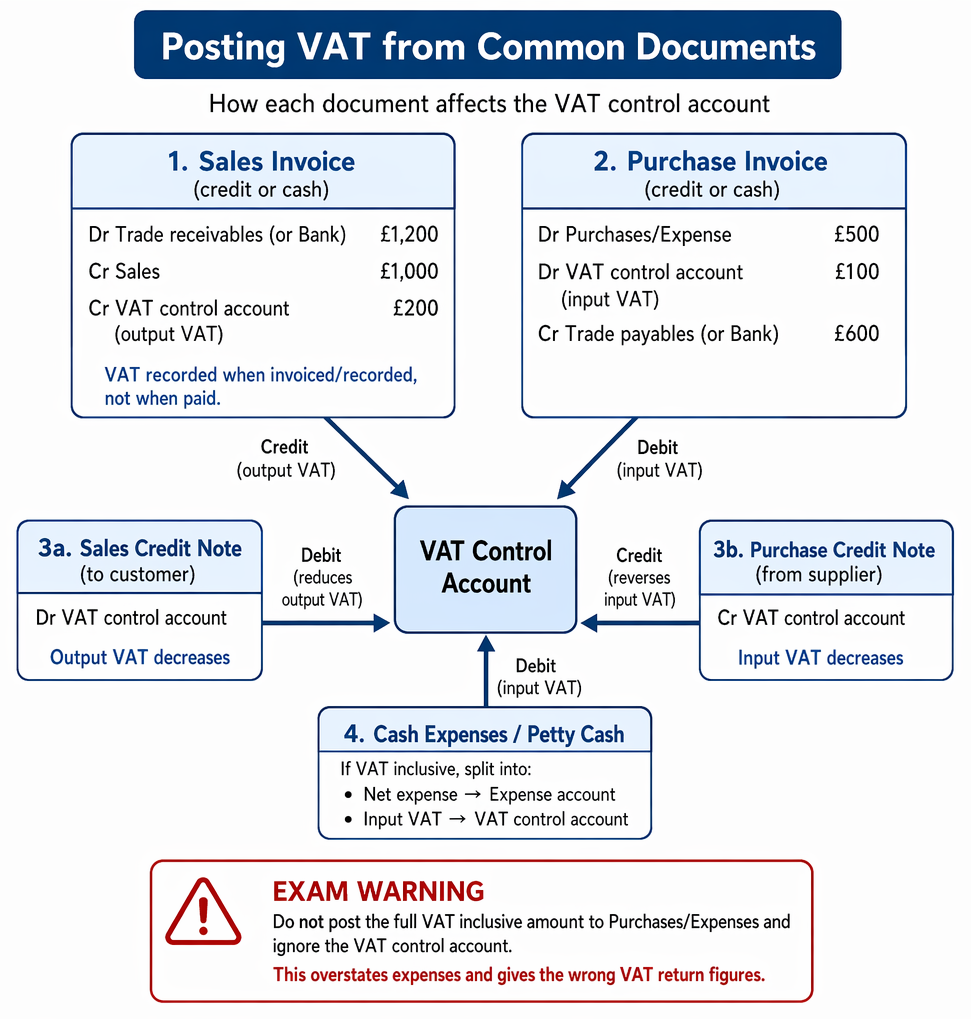
VAT control account movements distinguish input and output tax and show the balance payable to, or recoverable from, the tax authority.
Sales invoices (credit or cash)
For a sale of net £1,000 plus VAT £200 (gross £1,200):
- Debit Trade receivables (or Bank) £1,200
- Credit Sales £1,000
- Credit VAT control account (output VAT) £200
VAT is recorded when the sale is invoiced/recorded, not when the customer pays.
Purchase invoices (credit or cash)
For a purchase/expense of net £500 plus VAT £100 (gross £600):
- Debit Purchases/Expense £500
- Debit VAT control account (input VAT) £100
- Credit Trade payables (or Bank) £600
Credit notes (returns and corrections)
Credit notes reverse part (or all) of an earlier invoice. They also reverse the related VAT.
-
Sales return (credit note issued to a customer): output VAT decreases
- Debit VAT control account (reduces output VAT previously credited)
-
Purchase return (credit note received from a supplier): input VAT decreases
- Credit VAT control account (reverses input VAT previously debited)
Cash expenses and petty cash
If a cash receipt is VAT inclusive, you must split it into:
- Net expense (posted to the expense account)
- Input VAT (posted to the VAT control account)
This is a common FA1 test area because the VAT must be extracted correctly.
Exam Warning: A frequent error is to post the full VAT inclusive amount to Purchases/Expenses and ignore the VAT control account. This overstates expenses and gives the wrong VAT return figures.
Balancing the VAT control account at the VAT return date
When the VAT period ends, you total each side of the VAT control account and bring down the balance:
- A credit balance brought down shows VAT owed to the tax authority.
- A debit balance brought down shows VAT due back (refund) from the tax authority.
You then use the totals (not the balance) to prepare the VAT return.
VAT returns and clearing the VAT control account
Key Term: VAT return
A periodic report submitted to the tax authority showing total output VAT, total input VAT and the net VAT payable (or refundable) for the period.
The net VAT for the period is:
Posting the payment (or refund)
Once the VAT return is submitted:
-
If VAT is payable (VAT control account has a credit balance):
- Dr VAT control account
- Cr Bank
-
If VAT is refundable (VAT control account has a debit balance):
- Dr Bank
- Cr VAT control account
This entry clears the VAT control account for the period (so it returns to nil, assuming no timing differences or later corrections).
Worked Example 1.1
A business is VAT registered (20%). During June:
- Credit sale: £3,000 + VAT
- Credit purchase: £1,200 + VAT
- Petty cash taxi receipt (VAT inclusive): £36
- Customer returns goods: £500 + VAT (credit note issued)
Answer:
- Credit sale (£3,000 + £600 VAT): Dr Trade receivables £3,600 Cr Sales £3,000 Cr VAT control £600
- Credit purchase (£1,200 + £240 VAT): Dr Purchases £1,200 Dr VAT control £240 Cr Trade payables £1,440
- Petty cash taxi receipt £36 VAT inclusive:
Dr Travel expense £30 Dr VAT control £6 Cr Petty cash £36
- Sales return credit note (£500 + £100 VAT): Dr Sales returns £500 Dr VAT control £100 Cr Trade receivables £600
VAT control account movement: Credits (output VAT): £600 Debits (input VAT and output VAT reversed): £240 + £6 + £100 = £346 Balance: £600 − £346 = £254 credit (VAT payable)
Worked Example 1.2
Using the figures from Worked Example 1.1, prepare the net VAT due and show the payment entry.
Answer:
Output VAT = £600 Input VAT = £346
Payment to tax authority: Dr VAT control account £254 Cr Bank £254 After posting, the VAT control account balance for the period is cleared.
Revision Tip: When you see VAT in an exam question, write “Net / VAT / Gross” next to each transaction before you post anything. This reduces calculation and posting errors, especially with VAT inclusive receipts.
Key Point Checklist
This article has covered the following key knowledge points:
- The VAT control account is a general ledger account that summarises VAT payable or refundable.
- Output VAT is credited to the VAT control account; input VAT is debited.
- VAT must be extracted from VAT inclusive amounts using .
- Sales and purchase credit notes reverse the original VAT entries.
- The VAT control account balance indicates whether VAT is owed (credit) or due back (debit).
- Net VAT for the return is output VAT minus input VAT.
- Paying VAT clears a credit balance (Dr VAT control, Cr Bank); a refund clears a debit balance (Dr Bank, Cr VAT control).
Key Terms and Concepts
- VAT control account
- output VAT
- input VAT
- VAT exclusive amount
- VAT inclusive amount
- VAT return