Learning Outcomes
After reading this article, you will be able to calculate VAT from net and gross figures, and record VAT correctly on sales and purchases (including returns). You will be able to post input VAT and output VAT into a VAT control account and interpret its balance. You will also be able to prepare the main VAT return figures for a period and record the VAT payment (or refund) in the ledger.
ACCA Recording Financial Transactions (FA1) Syllabus
For ACCA Recording Financial Transactions (FA1), you must understand...
- how to calculate sales tax (VAT) from net or gross amounts
- how to record sales invoices and sales credit notes including VAT
- how to record purchase invoices and purchase credit notes including VAT
- how the VAT control account operates and what its balance means
- how to prepare output VAT, input VAT and net VAT figures for a VAT return
- how to record the settlement of the VAT balance (payment or refund)
Test Your Knowledge
Attempt these questions before reading this article. If you find some difficult or cannot remember the answers, look more closely at that area during your revision.
-
In a VAT control account, input VAT on purchases is normally recorded:
- A. On the credit side
- B. On the debit side
- C. On both sides
- D. It is not recorded in the double-entry system
-
True or false? Output VAT should be included as part of sales revenue.
-
A sales invoice shows goods £1,500 net, VAT at 20%. State the double entry (account names and amounts).
-
A purchase invoice totals £960 including VAT at 20%. What is the input VAT?
- A. £160
- B. £192
- C. £800
- D. £960
-
State how you calculate net VAT payable for a period, and what a credit balance on the VAT control account usually represents.
Introduction
VAT (value added tax) affects many day-to-day bookkeeping entries because invoices often show both a net amount and a VAT amount. If you mix up net and gross figures, your sales, purchases, receivables, payables and VAT liability can all be wrong.
In FA1, you are often asked to post VAT transactions and then prepare figures for a VAT return. The VAT control account is the key ledger account that collects input VAT and output VAT so that the net amount due to (or from) the tax authority can be identified.
VAT on invoices: net, VAT and gross
Key Term: Value added tax (VAT)
A sales tax charged on certain sales and usually recoverable on certain purchases by a VAT-registered business. Key Term: Net amount
The value of goods or services before VAT is added. Key Term: Gross amount
The total amount including VAT, equal to the net amount plus VAT.
Most VAT invoices show all three figures: net, VAT and gross. In bookkeeping, income and expense accounts record the net amount; the VAT element goes to the VAT control account.
Use these relationships (VAT rate shown as a decimal, for example 20% is 0.20):
If a question gives you the gross total and the VAT rate, calculate the net first using the fraction above, then calculate VAT as .
Recording VAT on sales and sales returns
Key Term: Output VAT
VAT charged on sales to customers; it is owed to the tax authority.
When you issue a sales invoice, the customer owes the gross amount. Sales revenue is recorded net of VAT, and the output VAT is credited to the VAT control account (because it is a liability).
Sales invoice (credit sale)
- Dr Trade receivables (customer) = gross
- Cr Sales = net
- Cr VAT control account = output VAT
Sales credit note (sales return)
A sales credit note reduces what the customer owes and reduces output VAT.
- Dr Sales returns = net
- Dr VAT control account = output VAT
- Cr Trade receivables (customer) = gross
Recording VAT on purchases and purchase returns
Key Term: Input VAT
VAT charged by suppliers on purchases; it is usually recoverable from the tax authority.
A purchase invoice creates a payable for the gross amount. Purchases (or the relevant expense) is recorded net of VAT, and the input VAT is debited to the VAT control account (because it reduces what you owe overall).
Purchase invoice (credit purchase)
- Dr Purchases/expense = net
- Dr VAT control account = input VAT
- Cr Trade payables (supplier) = gross
Purchase credit note (purchase return)
A supplier credit note reduces what you owe and reduces input VAT previously claimed.
- Dr Trade payables (supplier) = gross
- Cr Purchase returns = net
- Cr VAT control account = input VAT
The VAT control account
Key Term: VAT control account
A ledger account that collects output VAT (credits) and input VAT (debits) to show the net VAT payable or receivable for a period.
In T-account terms:
- Debit side: input VAT (VAT on purchases)
- Credit side: output VAT (VAT on sales)
The balance shows the net position:
- Credit balance = VAT payable to the tax authority (output VAT > input VAT)
- Debit balance = VAT recoverable from the tax authority (input VAT > output VAT)
Preparing figures for the VAT return
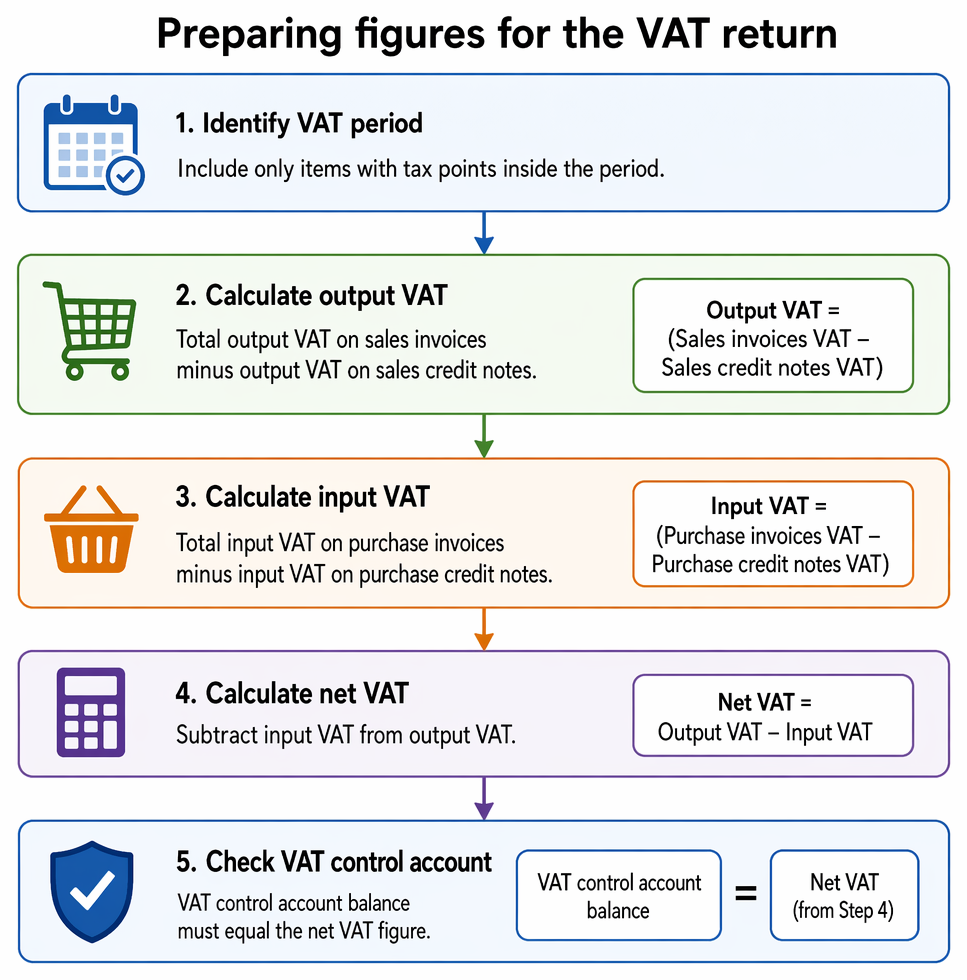
VAT return figures are derived from period output VAT and input VAT totals, reconciled to the net VAT payable or recoverable.
Key Term: VAT return
A periodic submission showing output VAT, input VAT and the net VAT payable to (or reclaimable from) the tax authority. Key Term: Tax point
The date that decides when a sale or purchase is included for VAT (often the invoice date in exam questions).
To prepare VAT return figures, you normally follow these steps:
- Identify the VAT period and include only invoices and credit notes with tax points inside that period.
- Total output VAT on sales invoices, then subtract output VAT on sales credit notes.
- Total input VAT on purchase invoices, then subtract input VAT on purchase credit notes.
- Calculate net VAT: .
- Check that the VAT control account balance matches the net VAT figure.
Worked Example 1.1
A business is VAT registered. VAT is 20%. For the quarter, standard-rated transactions are:
- Sales invoices: £48,000 net
- Sales credit notes: £3,000 net
- Purchase invoices: £27,500 net
- Purchase credit notes: £1,500 net
Calculate (i) output VAT, (ii) input VAT and (iii) net VAT payable. State the VAT control account balance.
Answer:
Output VAT:
Input VAT:
Net VAT payable:
VAT control account balance: £3,800 credit (VAT payable).
Worked Example 1.2
VAT is 20%. A supplier invoice totals £2,400 (including VAT). Later, the supplier issues a credit note for £480 (including VAT) for returned goods. Calculate the net and VAT for both documents and state the double entries.
Answer:
Invoice net:
Input VAT:
Credit note net:
Input VAT:
Invoice entry: Dr Purchases 2,000; Dr VAT control 400; Cr Trade payables 2,400 Credit note entry: Dr Trade payables 480; Cr Purchase returns 400; Cr VAT control 80.
Paying (or receiving) the VAT amount
If the VAT control account has a credit balance, you will usually pay that amount to the tax authority:
- Dr VAT control account
- Cr Bank
If the VAT control account has a debit balance and the tax authority refunds it:
- Dr Bank
- Cr VAT control account
Exam Warning: Common errors in VAT questions include:
- posting sales and purchases at gross instead of net
- putting output VAT on the debit side (or input VAT on the credit side)
- forgetting that credit notes reverse VAT as well as the net amount
- extracting VAT from a gross figure using $0.20 instead of dividing by
Revision Tip: When you start any VAT question, sketch the VAT control account headings: “Input VAT (Dr)” and “Output VAT (Cr)”. It helps you keep the direction of entries correct and makes the final VAT return totals easier to check.
Key Point Checklist
This article has covered the following key knowledge points:
- VAT is recorded separately from income and expenses; sales and purchases are posted net of VAT.
- Output VAT arises on sales and is credited to the VAT control account.
- Input VAT arises on purchases and is debited to the VAT control account.
- Credit notes reduce the original net amount and reverse the related VAT.
- Net VAT for a period is calculated as output VAT minus input VAT.
- A credit balance on the VAT control account usually means VAT payable; a debit balance usually means VAT recoverable.
- Paying VAT clears the VAT control account balance by a bank entry.
Key Terms and Concepts
- Value added tax (VAT)
- Net amount
- Gross amount
- Output VAT
- Input VAT
- VAT control account
- VAT return
- Tax point