Learning Outcomes
After reading this article, you will be able to calculate and explain the present value of ordinary annuities, perpetuities, and growing perpetuities. You will understand the formulas, apply annuity and perpetuity tables, and adjust calculations for advanced and delayed payments—skills essential for ACCA Financial Management exam scenarios.
ACCA Financial Management (FM) Syllabus
For ACCA Financial Management (FM), you are required to understand how the time value of money affects financial decisions. In particular, ensure you are confident with:
- Explaining the concepts of annuities and perpetuities in project appraisal
- Calculating the present value (PV) of ordinary annuities and perpetuities using formulae and tables
- Applying appropriate factors for advanced or delayed annuities and perpetuities
- Understanding and calculating growing perpetuities
- Incorporating these calculations into investment appraisal techniques such as NPV
Test Your Knowledge
Attempt these questions before reading this article. If you find some difficult or cannot remember the answers, look more closely at that area during your revision.
- In the context of the time value of money, how is the present value of an ordinary annuity calculated?
- A project generates $12,000 per year in perpetuity. If the required return is 8%, what is its present value?
- Explain how the present value of a perpetuity is affected if the cash flow is expected to grow each period.
- True or false? An annuity table shows the present value of a series of identical payments, each received at the end of the period.
Introduction
In ACCA Financial Management (FM), understanding the time value of money is indispensable. Annuities and perpetuities are central to this concept, forming the backbone of most investment appraisal calculations. Whether forecasting future inflows or evaluating financing options, you must be comfortable applying present value techniques for both limited and unlimited cash flows.
Key Term: annuity
A series of equal payments made at regular intervals over a specified, finite period, typically with each payment at the end of each period. Key Term: perpetuity
A stream of equal cash flows occurring at regular intervals, continuing forever with no end. Key Term: present value (PV)
The current worth of a future sum or a series of future cash flows discounted back at a specified rate.
Calculating Present Value of Annuities
An ordinary annuity consists of fixed payments received at consistent intervals for a set number of periods, starting one period from the present.
Formula for Present Value of an Ordinary Annuity
The present value (PV) of an ordinary annuity is calculated using the following formula:
Where:
- = amount of each payment
- = discount rate per period (decimal form)
- = total number of periods
Alternatively, you can use a pre-calculated annuity factor from annuity tables.
Worked Example 1.1
A company expects to receive $5,000 annually for the next 6 years. The discount rate is 7%. What is the present value of the annuity?
Answer:
Find the annuity factor for 6 years at 7%: From the annuity table, 6 years at 7% gives a factor of approximately 4.767.
Revision Tip: In exam conditions, look up the correct factor in the table for the given rate and period. Double-check that you are not confusing the single payment (PV) table with the annuity table.
Using Annuity Tables
Annuity tables condense calculations by listing annuity factors for various rates and periods. This allows you to multiply the periodic payment by the relevant factor for immediate results.
Key Term: annuity factor
The present value of an ordinary annuity of $1 per period. It encapsulates the entire series of discounted payments into a single multiplier.
Present Value of Perpetuities
A perpetuity is a cash flow that repeats forever. Unlike an annuity, perpetuities have no fixed end date.
Formula for Perpetuity
Where:
- = annual cash flow
- = discount rate per period (decimal)
Worked Example 1.2
A trust fund is set up to provide an annual scholarship of $4,000 forever. If the required return is 5%, how much is needed in the fund today?
Answer:
The trust fund must invest $80,000 to provide $4,000 per year indefinitely at 5%. Exam Warning: Do not use the perpetuity formula when the cash flow series has an end date. Use annuity formulas for fixed periods and perpetuity formulas only for genuinely infinite series.
Growing Perpetuities
If the cash flow increases by a fixed rate each period, the formula becomes:
Where . This is commonly used for valuing shares and businesses with steadily increasing dividends.
Advanced and Delayed Annuities and Perpetuities
Standard annuities and perpetuities assume the first payment occurs in one period. Adjustments are needed for immediate (advanced) or delayed cash flows.
Annuity valuation routes are organised by first-payment date, with ordinary, annuity-due, and deferred cash flows discounted appropriately.
Immediate (Advanced) Annuities
If the first payment is at time 0 (now), add 1 to the annuity or perpetuity factor:
Delayed Annuities and Perpetuities
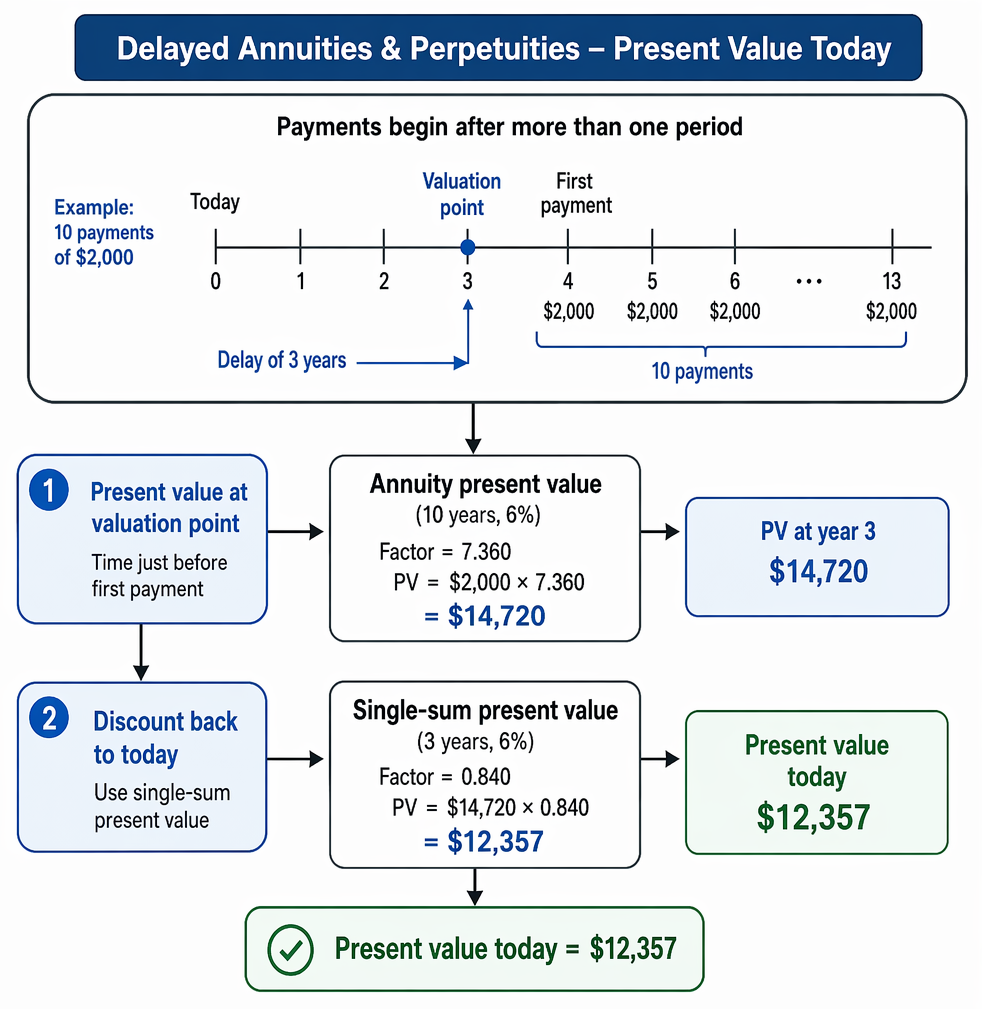
If payments start after more than one period, calculate the present value as of the period before payments begin, then discount that amount back to today.
Steps:
- Compute the annuity or perpetuity present value for the time just before the first payment.
- Discount that present value back to today using the single-sum present value formula.
Worked Example 1.3
A pension pays $2,000 per year for 10 years, but payments begin in 4 years' time. The discount rate is 6%. What is the present value today?
Answer:
Step 1: Present value at year 3 of a 10-year annuity: Annuity factor (10 years, 6%) = 7.360
Step 2: Discount $14,720 back 3 years: Present value factor (3 years, 6%) = 0.840
Applying Annuities and Perpetuities in Investment Appraisal
In practice, annuities and perpetuities are used within discounted cash flow (DCF) techniques, particularly NPV calculations. They allow for rapid valuation of regular, constant cash streams without repetitive discounting.
Key Term: discounted cash flow (DCF)
An approach that values future cash flows by discounting them to their present value using an appropriate discount rate.
Summary
Annuities and perpetuities are essential time value of money tools. The annuity formula gives the present value of a fixed series of payments. The perpetuity formula values never-ending, equal cash flows. Adjustments are needed for immediate or delayed payment patterns. Command of these calculations is essential for ACCA investment appraisal and financial decision questions.
Key Point Checklist
This article has covered the following key knowledge points:
- Explaining ordinary annuities and perpetuities
- Calculating annuity present values using tables and formulas
- Calculating perpetuity and growing perpetuity present values
- Adjusting calculations for immediate (advanced) and delayed payments
- Using these tools for NPV and DCF investment appraisal techniques
Key Terms and Concepts
- annuity
- perpetuity
- present value (PV)
- annuity factor
- discounted cash flow (DCF)