Learning Outcomes
After reading this article, you will be able to explain the concept of the time value of money and apply discounting and compounding methods to compare and calculate present and future values of cash flows. You will also recognise the key formulas used in ACCA FM exam questions and understand why time value principles are critical for assessing investments and finance decisions.
ACCA Financial Management (FM) Syllabus
For ACCA Financial Management (FM), you are required to understand how the time value of money affects financial management decisions. In particular, you should focus your revision on:
- Explaining the concept of the time value of money and its practical significance
- Calculating future values using compounding
- Calculating present values using discounting
- Applying formulae to compute PVs and FVs of single sums and streams of cash flows
- Using present value and annuity tables in financial management scenarios
- Selecting appropriate discount rates (cost of capital) for discounting cash flows
- Relating time value of money principles to investment appraisal techniques
Test Your Knowledge
Attempt these questions before reading this article. If you find some difficult or cannot remember the answers, look more closely at that area during your revision.
- Why is $1 received today generally worth more than $1 received in one year's time?
- Which formula is used to calculate the present value of $10,000 receivable in three years if the annual discount rate is 8%?
- True or false? Compounding refers to calculating the value of an investment at a future date, given a starting sum and a rate of return.
- If a bank offers 6% annual interest, what amount will $5,000 grow to in four years?
- Briefly explain the difference between a discount rate and a compounding rate.
Introduction
Many financial management decisions cannot be made by just comparing the size of cash flows: when money is received or paid matters as much as how much is involved. This core idea—the time value of money—underpins practically all investment appraisal and finance techniques in the ACCA FM syllabus.
It is therefore essential that you can both explain and apply time value concepts. This article introduces the logic behind the time value of money, sets out the formulas for discounting and compounding, and explains how to apply them in exam scenarios.
Key Term: time value of money
The principle that money available now is worth more than the same amount in the future because of its potential to earn returns and the effects of inflation and risk.
TIME VALUE OF MONEY: CONCEPT AND REASONS
The time value of money reflects three main factors:
- Opportunity to earn returns: Money received now can be invested to generate further income.
- Inflation: Over time, rising prices reduce the purchasing power of money.
- Risk and uncertainty: The longer you wait for money, the less certain you are to actually receive it.
For these reasons, financial managers compare sums of money received or paid at different times using compounding and discounting methods.
COMPOUNDING: CALCULATING FUTURE VALUE
Compounding calculates what a sum of money today will be worth in the future given a rate of return.
The compounding formula is:
where:
- = Future value after periods
- = Present value (amount invested now)
- = Interest (or return) rate per period
- = Number of periods
Worked Example 1.1
How much will $2,500 invested today at 7% annual interest be worth after 5 years?
Answer:
Calculate using F = 2,500 \times (1.07)^5 = 2,500 \times 1.4026 = \3,506.50$. Key Term: compounding
The process of calculating the value of a present sum at a future date by applying an interest or growth rate over time.
DISCOUNTING: CALCULATING PRESENT VALUE
Discounting finds out what a future sum is worth in present terms, using a discount rate (cost of capital).
The present value (PV) of a future sum is:
where:
- = Future amount to be received
- = Discount rate per period
- = Number of periods until receipt
Key Term: discounting
The process of calculating the current value of a future cash flow by reducing it using a discount rate.
Worked Example 1.2
What is the present value of $12,000 receivable in 4 years if the relevant discount rate is 10% per year?
Answer:
PV = \frac{12,000}{(1.10)^4} = 12,000 \div 1.4641 = \8,196.24$.
PRESENT VALUE TABLES AND ANNUITY CALCULATIONS
In the exam, you may use provided present value (PV) and annuity tables to speed up calculations.
Cash flow classification determines whether to apply future value compounding, present value discounting, annuity factors, or separate discounting of each receipt.
- Single sum: Use the correct PV factor for the discount rate and period.
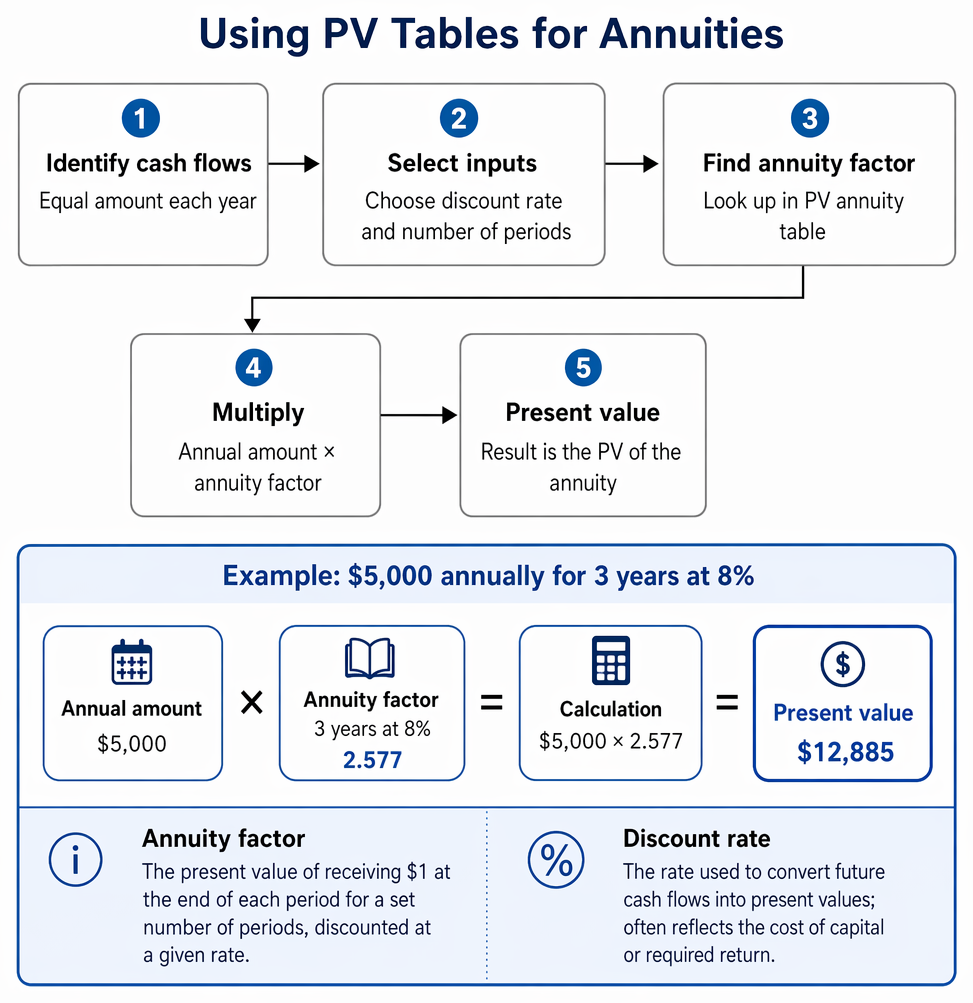
- Annuity: For equal cash flows each year, multiply the annual amount by the annuity factor from the tables.
Worked Example 1.3
A company will receive $5,000 annually for 3 years, starting in one year. If the discount rate is 8%, what is the present value?
Answer:
From tables, annuity factor = 2.577. $5,000 \times 2.577 = $12,885. Key Term: annuity factor
The present value of receiving $1 at the end of each period for a set number of periods, discounted at a given rate. Key Term: discount rate
The rate used to convert future cash flows into present values; often reflects the cost of capital or required return.
CHOOSING THE DISCOUNT RATE
The discount rate should reflect the cost of capital relevant to the transaction. This could be a company's weighted average cost of capital (WACC), a project-specific required return, or a market rate.
Always use the rate specified in the exam scenario (unless told to assume otherwise).
IMPORTANCE IN FINANCIAL MANAGEMENT
Time value of money principles apply to:
- Investment appraisal (NPV, IRR)
- Asset valuation
- Loan calculations
- Cost of finance
- Working capital management
Misunderstanding time value principles can directly lead to incorrect investment decisions and exam errors.
Exam Warning: In exam questions, carefully check cash flow timings. Discount only those flows that occur later than the present. Always match the time period and discount rate precisely.
Revision Tip: Practise both "single sum" and "series of cash flows" (annuity) discounting questions using tables and the full formula. Confirm you know when to use each method.
Summary
Time value of money is a fundamental principle for comparing money at different times. Compounding is used to calculate how values grow with interest; discounting is used to find the present value of future receipts or payments. ACCA FM questions require accuracy in both formulas and application.
Key Point Checklist
This article has covered the following key knowledge points:
- Define and explain the concept of time value of money
- Calculate future value using compounding
- Calculate present value using discounting formulas and tables
- Apply annuity factors to streams of equal payments
- Select and apply the appropriate discount rate in scenarios
- Identify the importance of time value principles in financial decisions
Key Terms and Concepts
- time value of money
- compounding
- discounting
- annuity factor
- discount rate