Learning Outcomes
After reading this article, you will be able to explain the role of sensitivity and ‘what-if’ analysis in asset budgeting and investment appraisal. You will understand how managers use these tools to assess investment risks, test project assumptions, and make better decisions. You will be able to apply sensitivity and scenario analysis to budget forecasts and capital project appraisals, and identify key variables influencing success. You will also recognise the advantages and limitations of these analytical techniques in planning and control.
ACCA Management Accounting (MA) Syllabus
For ACCA Management Accounting (MA), you are required to understand the significance of sensitivity and ‘what-if’ analysis techniques as part of the asset budgeting and investment appraisal process. Focus your revision on the following syllabus areas:
- The definition and role of asset budgeting within capital expenditure planning
- Identification and evaluation of relevant cash flows for investment decision-making
- Understanding and application of sensitivity analysis to investment appraisal projects
- Implementation and interpretation of ‘what-if’ and scenario analysis in budgeting
- Recognition of risk, uncertainty, and methods for risk assessment in investment decisions
- Evaluation of limitations and benefits of sensitivity and scenario analysis in practice
Test Your Knowledge
Attempt these questions before reading this article. If you find some difficult or cannot remember the answers, look more closely at that area during your revision.
- What is the main purpose of sensitivity analysis in investment appraisal?
- When performing a ‘what-if’ analysis on a project’s cash flows, which type of uncertainty is primarily being addressed?
- True or false? Scenario planning in budgeting always considers one variable change at a time.
- A project’s net present value (NPV) is most sensitive to which of the following: a) Initial investment, b) Discount rate, c) Project lifespan, d) All equally? Briefly explain.
- List two advantages and two limitations of using sensitivity analysis for capital investment decisions.
Introduction
Asset budgeting and investment appraisal are central to organisational planning and control. Organisations frequently commit substantial funds to long-term assets, so it is essential that managers appraise these projects carefully, not just on the most likely outcomes but also by considering risk and uncertainty.
Sensitivities and ‘what-if’ techniques allow managers to test how changes in key assumptions—such as costs, sales volumes, or discount rates—affect a project’s outcome. By systematically varying input values, management can identify the factors that have the greatest impact on viability and can plan appropriate responses to risk.
Key Term: sensitivity analysis
A technique that assesses how the result of a decision—such as NPV or profit—changes when one input variable is varied while all other variables are held constant. Key Term: what-if analysis
The process of recalculating financial projections or investment appraisal results after changing one or more input assumptions to see the effect on the outcome. Key Term: scenario analysis
A method that evaluates the effects of simultaneous changes in multiple variables, usually by creating alternative sets of assumptions—such as best-case, worst-case, and most-likely scenarios.
ASSET BUDGETING AND INVESTMENT APPRAISAL IN CONTEXT
Asset budgeting, also referred to as capital budgeting, is the process of planning and controlling capital expenditure on long-term projects or major assets. Investment appraisal techniques—like NPV, IRR, and payback—compare expected costs with expected cash inflows, discounted for the time value of money.
However, all forecasts rely on estimates. Even a small change in a key estimate can sometimes turn a profitable project into a loss. Sensitivity and ‘what-if’ analysis help managers test investment proposals by examining how outcomes react to changes in assumptions, aiding in risk assessment.
Why consider risk and uncertainty?
All investment decisions involve some degree of uncertainty. Actual outcomes—such as costs, revenues, or economic factors—may differ from estimates. Understanding how changes in each variable impact the overall outcome allows managers to:
- Focus attention on the most critical assumptions
- Prepare strategies for adverse situations
- Avoid investing in projects excessively exposed to uncontrollable risk
Sources of uncertainty in budgeting and appraisal
Common sources of risk in asset budgeting include:
- Sales volumes achieved
- Selling price and demand
- Cost overruns or savings
- Economic and regulatory changes
- Project delays or technological obsolescence
- Changes in cost of capital or discount rates
SENSITIVITY ANALYSIS: EXPLORING IMPACT OF VARIABLES
Sensitivity analysis is used to determine how sensitive a decision—such as the accept/reject outcome for an investment—is to changes in a single variable at a time.
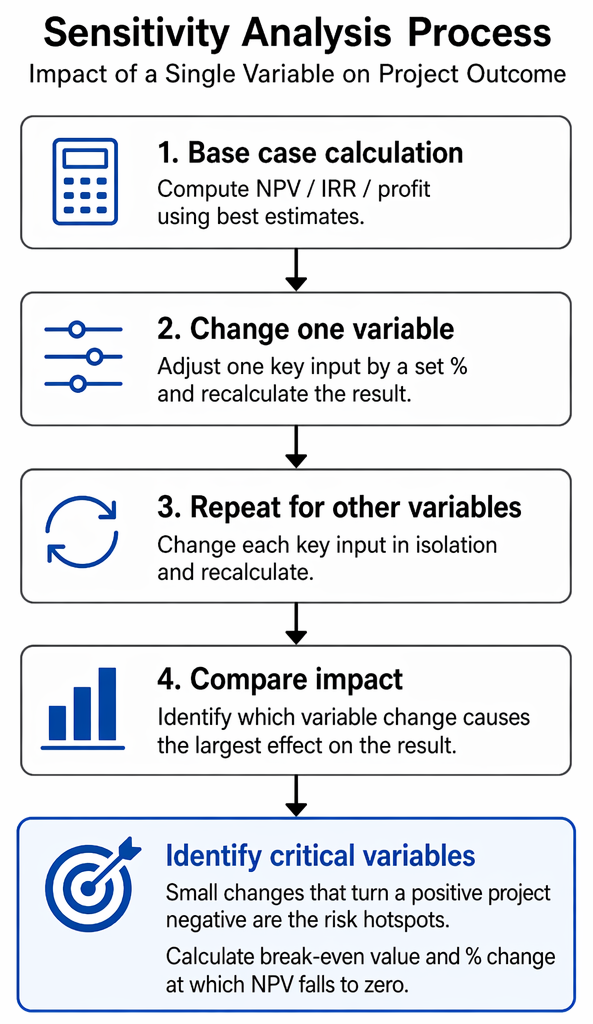
Investment appraisal what-if analysis follows one-variable changes to recalculate NPV, determine break-even percentages, and prioritise critical assumptions.
The typical process is:
- Calculate the project’s NPV, IRR, or profit using the best estimates for all variables.
- Adjust one key input (e.g., sales price) by a specific percentage. Recalculate the result.
- Repeat the adjustment for other variables in isolation.
- Compare which variable’s change causes the most significant effect on the result.
This allows management to answer, for example: “If sales are 10% lower than forecast, does the project still deliver a positive NPV?”
Key Term: critical variable
An input factor (such as sales volume, sales price, cost, or discount rate) to which the outcome of an appraisal is highly sensitive. Small changes in critical variables can change the decision outcome.
Typical sensitivity analysis approach
For each input:
- Calculate the point at which the project NPV falls to zero (“break-even value”).
- Express this as a change from the base case (e.g., “sales volume can fall by 22% before NPV becomes negative”).
Worked Example 1.1
A company is appraising a project with the following initial estimates:
- Investment: $200,000 (today)
- Expected annual net cash inflow: $60,000 for 5 years
- Discount rate: 8%
Question: By what percentage could annual cash inflows fall before the project’s NPV falls to zero? (Assume annuity factor for 5 years at 8% is 3.993.)
Answer:
NPV = ($60,000 × 3.993) – $200,000 = $39,580 Break-even inflow: $200,000 / 3.993 = $50,100 (rounded) Max % fall: ($60,000 – $50,100) / $60,000 = 16.5% Annual cash inflows could fall by up to 16.5% before the project is unviable.
Interpreting results
The most critical variables are those where only a small change turns a positive project negative. These are the risk “hotspots” and require careful management or mitigation.
Benefits of sensitivity analysis
- Clarifies key assumptions
- Focuses management on risk areas
- Aids communication—stakeholders can visualise risk exposure
Limitations of sensitivity analysis
- Only analyses one change at a time—real life often involves multiple variables moving simultaneously
- Does not provide probability of variables changing
- Results may fail to capture true risk if variables are interdependent
WHAT-IF AND SCENARIO ANALYSIS
While sensitivity analysis changes one variable at a time, ‘what-if’ and scenario analysis explore the combined effect of changing many variables together.
‘What-if’ analysis in budgeting refers to adjusting estimates—such as sales, costs, or exchange rates—to see how the outcome alters. This is commonly performed in spreadsheets, allowing quick changes and visualisation of results.
Scenario analysis expands on this by developing coherent alternative “stories” for the future; for example:
- Best-case scenario: high sales growth, low costs, stable interest rates
- Worst-case scenario: sluggish demand, increasing costs, adverse regulation
- Most likely scenario: moderate forecasts for all variables
The analyst recalculates profit, cash, or NPV for each scenario, then prepares risk mitigation strategies.
Key Term: scenario planning
The process of developing alternative coherent sets of assumptions about the future to test the impact on business plans and investment appraisals.
Worked Example 1.2
A budget shows an annual profit of $160,000 if direct costs are $1.2m, but costs may rise as high as $1.35m. Using what-if analysis, estimate the impact if costs rise by $150,000 and sales remain the same.
Answer:
Adjusted profit: $160,000 – $150,000 = $10,000 Scenario analysis reveals that profits would nearly disappear if costs rose to this extent, indicating vulnerability to cost overruns.
Application to capital budgeting
Scenario analysis is especially useful for capital budgeting decisions subject to external shocks or combined uncertainties, allowing management to prepare for adverse combinations.
Exam Warning: Sensitivity analysis alone does not provide probability estimates. ACCA may test your understanding of the difference between “possible” and “probable” outcomes. Always recognise what each technique can and cannot tell you.
PRACTICAL USE OF SENSITIVITY AND 'WHAT-IF' ANALYSIS
Financial models—often set up in spreadsheets—allow quick adjustment of input variables:
- Test the effect of higher/lower sales, costs, or investment
- Experiment with interest rates and exchange rates
- Assess results under different levels of inflation
This approach helps prepare flexible budgets and robust investment appraisals, ready for uncertain business environments.
Key Term: risk assessment
The systematic evaluation of the uncertainties affecting an investment or budget, including the potential impact and likelihood of adverse outcomes.
LIMITATIONS AND BEST PRACTICES
Although highly informative, these analyses do not replace judgement. Key limitations include:
- Limited by the range and realism of input changes tested
- Cannot eliminate uncertainty—only clarify where to focus attention
- May give a false sense of security if ranges or scenarios are chosen arbitrarily
Revision Tip: Always state your assumptions when conducting sensitivity or what-if analysis in the exam. Quantify the impact and briefly interpret results—this demonstrates effective risk assessment skills.
Summary
Sensitivity and ‘what-if’ analyses are essential tools in asset budgeting and investment appraisal to assess the impact of uncertainty and risk. By varying key assumptions, managers can identify critical variables and prepare for adverse scenarios. Scenario analysis extends this further by testing the impact of multiple simultaneous changes. Recognise that these techniques guide attention and planning but must be combined with professional judgement and sound risk management.
Key Point Checklist
This article has covered the following key knowledge points:
- The role of asset budgeting and capital expenditure planning
- The use of sensitivity analysis to identify and assess critical variables in project appraisal
- Application of ‘what-if’ and scenario analysis to budgeting and investment decisions
- The distinction between sensitivity and scenario analysis
- The advantages and limitations of these analytical methods in risk assessment
- Best practices for interpreting results and supporting managerial decisions
Key Terms and Concepts
- sensitivity analysis
- what-if analysis
- scenario analysis
- critical variable
- risk assessment
- scenario planning